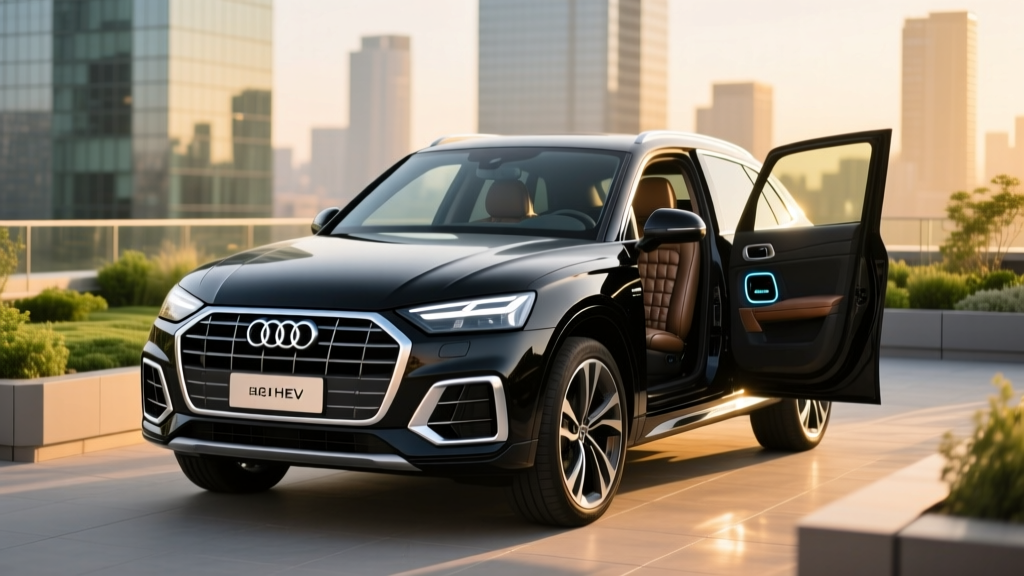
If you're shopping for an Audi crossover hybrid, the 2026 Audi Q5 55 TFSI e is the model you need to evaluate. It's Audi's best-selling vehicle globally, and the plug-in hybrid variant bridges the gap between a traditional gasoline SUV and a full battery-electric vehicle. With 362 combined horsepower, a usable electric-only range for daily commutes, and the cabin refinement Audi is known for, the Q5 PHEV targets buyers who want electrification without fully committing to a charging-dependent lifestyle.
This guide breaks down the Q5 55 TFSI e's powertrain, real-world efficiency, charging logistics, pricing, and how it stacks up against both full EVs and conventional hybrids — so you can decide whether it's the right crossover for your garage.
HEV vs PHEV: What the Audi Q5 Hybrid Actually Is
Before examining specs, it's essential to distinguish between the two hybrid architectures, because Audi only sells the Q5 as a plug-in hybrid (PHEV) in the U.S. market for 2026. There is no conventional hybrid (HEV) Q5 available stateside.
| Feature | Conventional Hybrid (HEV) | Plug-In Hybrid (PHEV) |
|---|---|---|
| Plug in to charge? | No — regenerates internally | Yes — has a charge port |
| Electric-only range | ~0.5–1 mile at low speed | 15–40+ miles at highway speed |
| Battery size | 1–2 kWh | 12–30+ kWh |
| Federal tax credit | No | Potentially up to $3,750–$7,500 |
| Home charging needed | No | Recommended for full benefit |
The Q5 55 TFSI e is firmly in the PHEV column. It carries a 17.9 kWh (gross) lithium-ion battery pack, a charge port on the driver's side rear quarter panel, and a meaningful electric-only driving range. If you never plug it in, it still operates as a hybrid — but you'd be leaving most of its efficiency and performance potential on the table.
Powertrain and Performance Specs
Audi pairs a 2.0-liter turbocharged inline-four with a permanently excited synchronous electric motor integrated into the 7-speed S tronic dual-clutch transmission. The combined output is substantial.
| Specification | Value |
|---|---|
| Engine | 2.0L Turbo I4 (261 hp / 273 lb-ft) |
| Electric Motor | 141 hp / 258 lb-ft (integrated) |
| Combined System Output | 362 hp / 369 lb-ft |
| Transmission | 7-speed S tronic dual-clutch |
| Drivetrain | quattro AWD |
| Battery (Gross / Usable) | 17.9 kWh / ~14.6 kWh |
| 0–60 mph | 5.0 seconds |
| Top Speed | 130 mph (electronically limited) |
| Towing Capacity | 4,400 lbs |
| Cargo Volume | 24.7 cu ft (rear seats up) / 53.1 cu ft (folded) |
The 0–60 mph time of 5.0 seconds puts the Q5 PHEV in sports-sedan territory from a decade ago. The electric motor fills in the torque gap before the turbo spools, resulting in immediate, linear acceleration from a stop. In EV mode, the Q5 is whisper-quiet; when the engine engages, the transition is one of the smoother PHEV handoffs in the luxury segment.
EPA Fuel Economy and Electric Range
Fuel economy is where PHEV ratings get complicated, because you're measuring two different operating modes. Here's the full breakdown per fueleconomy.gov:
| Mode | City | Highway | Combined |
|---|---|---|---|
| Charge-Sustaining (Hybrid) | 25 MPG | 28 MPG | 26 MPG |
| Charge-Depleting (EV + Gas) | — | — | 61 MPGe |
| Electric-Only Range | 23 miles (EPA) | ||
| Total Range (EV + Gas) | ~400 miles | ||
| Electric Consumption | 46 kWh/100 mi | ||
How many MPG does this hybrid get? In charge-sustaining mode (battery depleted, operating as a conventional hybrid), the Q5 returns 26 MPG combined. That's a meaningful improvement over the gas-only Q5 45 TFSI, which achieves 25 MPG combined. But the real efficiency payoff comes from plugging in regularly — if your commute is under 23 miles round-trip, you could burn almost zero gasoline on weekdays.
Real-World MPG vs EPA
Owner reports and independent testing suggest the Q5 PHEV's hybrid-mode fuel economy tracks closely with EPA estimates on the highway, but can exceed them in city driving when regenerative braking is maximized. Drivers who use the "Battery Hold" mode strategically on highway segments and switch to EV mode in urban areas consistently report 28–30 MPG combined in hybrid operation — roughly 10–15% above the EPA city figure. This is typical of PHEVs, which benefit from low-speed electric assist in traffic.
Charging: What You Need to Know
The Q5 55 TFSI e uses a J1772 connector for AC charging. Here's the charging picture:
| Level | Power | Time (0–100%) | Notes |
|---|---|---|---|
| Level 1 (120V household) | 1.4 kW | ~11 hours | Emergency/trickle only |
| Level 2 (240V home/public) | 7.2 kW | ~2.5 hours | Recommended daily charging |
| DC Fast Charge | Not supported | N/A | No CCS/CHAdeMO port |
Critical detail: The Q5 PHEV does not support DC fast charging. This is standard for most PHEVs — the battery is small enough that Level 2 fully replenishes it in about 2.5 hours, which covers overnight or workplace charging scenarios. If you're considering public DC fast chargers as part of your routine, a full BEV is the better choice.
The onboard charger is rated at 7.2 kW, which is competitive for the PHEV segment. A Level 2 home charger (240V, 32A circuit) is the practical sweet spot. Expect a home Level 2 installation to cost between $800–$2,000 depending on electrical panel proximity and local permit requirements — a licensed electrician should evaluate your panel capacity before installation.
Pricing, Trims, and Tax Credit Eligibility
The 2026 Audi Q5 55 TFSI e is offered in three trims. Pricing reflects MSRP before destination charges:
| Trim | MSRP | Key Additions |
|---|---|---|
| Premium | $58,200 | Leather, panoramic roof, 12.3" Virtual Cockpit, power liftgate |
| Premium Plus | $62,800 | Navigation, Bang & Olufsen audio, adaptive cruise, 360° camera |
| Prestige | $68,400 | Matrix LED headlights, heads-up display, Nappa leather, air suspension available |
Does It Qualify for a Federal Tax Credit?
Under current IRS §30D rules, the Q5 55 TFSI e may qualify for a partial federal tax credit — but eligibility is complex and hinges on several factors:
- MSRP cap: SUVs must be under $80,000 — all Q5 PHEV trims qualify.
- Buyer income cap: Modified AGI must not exceed $150,000 (single), $225,000 (head of household), or $300,000 (joint).
- Battery sourcing: The credit is split into two $3,750 halves — one for critical minerals sourcing, one for battery component manufacturing. PHEVs with smaller batteries often qualify for only one half ($3,750) depending on supply-chain compliance for the model year.
- Point-of-sale transfer: As of 2024+, eligible credits can be transferred to the dealer at purchase, reducing your out-of-pocket cost directly.
For 2026, the Q5 55 TFSI e is expected to qualify for $3,750 (one half of the credit), though final sourcing determinations are made per model year. Consult a tax professional and verify current eligibility on the IRS website before purchase.
Reliability, Battery Warranty, and Replacement Cost
Hybrid and PHEV battery longevity is consistently a top buyer concern. Here's what Audi provides:
Audi Q5 PHEV Battery & Powertrain Warranty
- High-voltage battery: 8 years / 100,000 miles (whichever comes first)
- Capacity retention guarantee: Battery warranted against defects and abnormal degradation below 70% of original capacity during the warranty period
- Powertrain: 4 years / 50,000 miles (engine, transmission, electric motor)
- Bumper-to-bumper: 4 years / 50,000 miles
Is this hybrid reliable and what is battery replacement cost? Audi's PHEV system is built on the proven MLB Evo platform shared with the Porsche Macan and other VW Group vehicles. The 2.0L TFSI engine is one of Volkswagen Group's most widely deployed powerplants globally. Independent reliability data from owner surveys places Audi in the middle of the luxury pack — not class-leading like Lexus, but improved significantly over the brand's 2015–2019 era.
If the high-voltage battery requires out-of-warranty replacement, expect a cost between $8,000 and $12,000 including parts and labor. However, PHEV batteries are smaller and less stressed than full EV packs, and real-world data from earlier-generation Audi PHEVs (2019–2022 Q5 TFSI e models) shows minimal degradation at the 60,000–80,000 mile mark when charged properly — typically retaining 88–93% of original capacity.
Best practices for longevity: avoid leaving the battery at 100% SoC for extended periods in hot weather, use scheduled charging to time completion near departure, and avoid repeated full-discharge cycles.
Who Should Buy the Audi Q5 PHEV — And Who Shouldn't
Pros
- 23-mile EV range covers most daily commutes gasoline-free
- 362 hp with seamless electric torque fill — genuinely quick
- Premium cabin with excellent NVH in electric mode
- 4,400-lb towing capacity (unusual for PHEVs)
- No range anxiety — gas engine for long trips
- quattro AWD standard
Cons
- No DC fast charging — not ideal for frequent long-distance EV driving
- Cargo space reduced vs gas Q5 (battery packaging)
- $58K+ starting price before options
- Only partial federal tax credit ($3,750 estimated)
- EV range drops significantly in cold weather
- Requires home Level 2 charger to realize full efficiency benefit
Hybrid vs PHEV vs EV — Which Fits You?
Choose the Q5 PHEV if:
- Your daily commute is under 25 miles and you can charge at home
- You take road trips 4+ times per year and don't want to plan around charging
- You want a luxury crossover with towing capability
- Your household has one garage spot and needs one vehicle to do everything
Choose a full EV (e.g., Audi Q4 e-tron) if:
- You have reliable home and/or workplace charging
- Your daily driving is under 200 miles
- You want to eliminate gasoline purchases and oil changes entirely
- You qualify for the full $7,500 federal credit on eligible BEVs
Choose a conventional hybrid (HEV) if:
- You cannot install a home charger (apartment, street parking)
- You want zero behavior change — just better MPG
- Your budget is lower and you don't need PHEV electric range
Frequently Asked Questions
How many MPG does the Audi Q5 hybrid get?
The 2026 Q5 55 TFSI e achieves 26 MPG combined (25 city / 28 highway) in hybrid mode after the battery is depleted. When regularly charged, it achieves 61 MPGe combined using both electric and gasoline power. Real-world hybrid-mode driving often yields 28–30 MPG in city conditions with regenerative braking.
How far can the Audi Q5 PHEV go on electric only?
The EPA rates the Q5 55 TFSI e at 23 miles of electric-only range. In real-world conditions, expect 18–20 miles at highway speeds and 15–17 miles in cold weather. City driving with regenerative braking can push this to 24–25 miles in ideal conditions.
Does the Audi Q5 hybrid need to be plugged in?
Yes — the Q5 55 TFSI e is a plug-in hybrid. While it will operate as a conventional hybrid if you never plug it in, you'll miss the 23-mile electric range and the majority of its efficiency advantage. A Level 2 home charger is strongly recommended.
Is the Audi Q5 PHEV reliable?
Audi's PHEV powertrain uses proven components from the VW Group's MLB Evo platform. The high-voltage battery is warrantied for 8 years / 100,000 miles. Earlier Q5 PHEV models (2019–2022) have shown solid battery longevity with 88–93% capacity retention at 60,000–80,000 miles. Overall reliability is mid-pack for the luxury segment.
What is the battery replacement cost for the Q5 PHEV?
Out-of-warranty high-voltage battery replacement is estimated at $8,000–$12,000 including labor. However, the battery is warrantied for 8 years / 100,000 miles against defects and abnormal degradation below 70% capacity, and most owners will never need a replacement within normal ownership periods.
Does the Audi Q5 PHEV qualify for a tax credit?
Under current IRS §30D rules, the Q5 55 TFSI e is expected to qualify for a partial federal tax credit of $3,750, subject to buyer income limits ($150K single / $300K joint) and battery-sourcing requirements. The credit can be transferred to the dealer at point of sale. Always verify current eligibility at irs.gov and consult a tax professional.
Can the Audi Q5 PHEV tow?
Yes — the Q5 55 TFSI e has a maximum towing capacity of 4,400 lbs when properly equipped, which is competitive with the gas-only Q5 and significantly higher than most PHEV crossovers in this class.