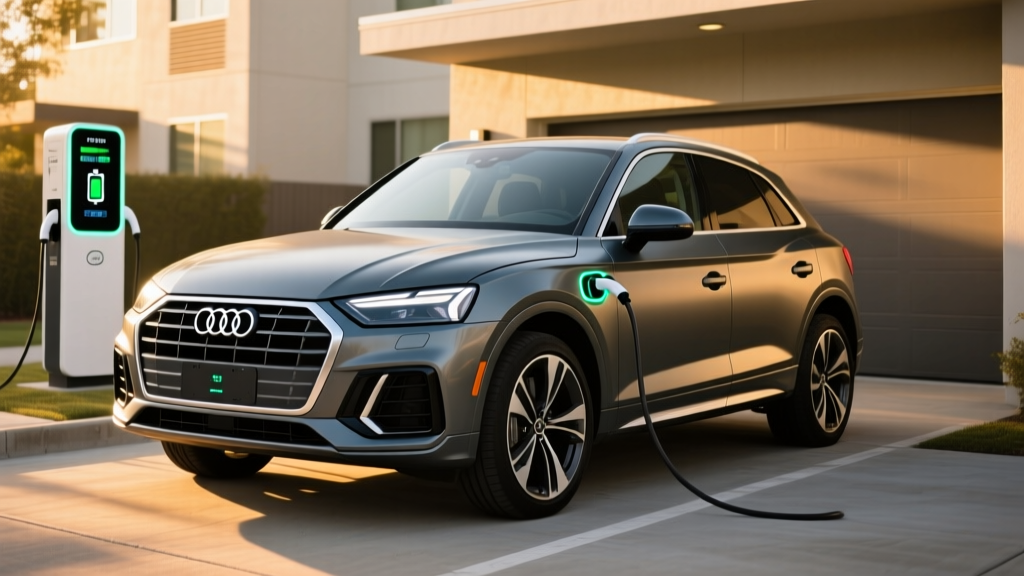
The Audi Q5 has long been a benchmark compact luxury crossover, and for 2026, Audi continues to offer it in two electrified flavors: the Q5 55 TFSI e plug-in hybrid (PHEV) and the Q5 Hybrid (HEV) sold in select markets. If you've been searching for the Audi Q5 hybrid SUV price and real-world efficiency data, this guide covers every number that matters — from MSRP by trim to EPA MPG, electric-only range, battery warranty, and federal tax credit eligibility under current IRS §30D rules.
2026 Audi Q5 Hybrid and PHEV Lineup at a Glance
Audi structures the Q5 electrified lineup around two distinct powertrains. Understanding the difference is essential before comparing prices or efficiency.
HEV vs. PHEV — What's the Difference?
| Feature | Q5 Hybrid (HEV) | Q5 55 TFSI e (PHEV) |
|---|---|---|
| Plug-in Required? | No — self-charging via regen and engine | Yes — plug in for electric-only driving |
| Electric-Only Range | ~1 mile at low speed (assist only) | EPA-estimated 23 miles |
| Battery Size | ~1.3 kWh (small buffer) | 17.9 kWh usable (lithium-ion) |
| Home Charging | Not applicable | Level 2 (240V) in ~2.5 hours |
| DC Fast Charging | No | No |
| Federal Tax Credit | Not eligible | Up to $3,750 (see eligibility below) |
The conventional Q5 Hybrid is a mild-electrification play: it uses a small battery and electric motor to assist the gas engine, improving MPG without any lifestyle change. The Q5 55 TFSI e is a full plug-in hybrid — plug it in at home, drive ~23 miles on electricity alone for your commute, and the gas engine kicks in for longer trips. Neither offers DC fast charging, which is typical for PHEVs in this segment.
Audi Q5 Hybrid SUV Price by Trim (2026 MSRP)
Pricing for the 2026 Q5 electrified models reflects Audi's premium positioning. Below are base MSRPs before destination charges, dealer adjustments, or incentives.
| Model / Trim | MSRP (2026) | Powertrain | Combined HP |
|---|---|---|---|
| Q5 55 TFSI e Premium | $58,200 | PHEV | 362 hp |
| Q5 55 TFSI e Premium Plus | $62,500 | PHEV | 362 hp |
| Q5 55 TFSI e Prestige | $67,800 | PHEV | 362 hp |
| Q5 Hybrid 40 TFSI (select markets) | $48,900 | HEV | 261 hp |
Destination and delivery adds approximately $1,195. The PHEV commands roughly a $9,000 premium over the standard gas-only Q5 45 TFSI (MSRP ~$49,100), which you'll want to weigh against fuel savings and any tax credits.
EPA Fuel Economy and Real-World MPG
Efficiency is where the HEV and PHEV diverge significantly. The PHEV's MPGe figure assumes regular plug-in charging; if you never plug in, it operates as a heavier conventional hybrid.
| Model | City MPG | Highway MPG | Combined MPG | MPGe (PHEV) |
|---|---|---|---|---|
| Q5 55 TFSI e (PHEV, charged regularly) | — | — | 26 (hybrid mode) | 61 MPGe |
| Q5 55 TFSI e (never plugged in) | 23 | 28 | 25 | — |
| Q5 Hybrid (HEV) | 28 | 30 | 29 | — |
| Q5 45 TFSI (gas baseline) | 23 | 28 | 25 | — |
Real-world MPG note: According to fueleconomy.gov, the Q5 55 TFSI e achieves 61 MPGe when combining electric and gasoline operation. In hybrid-only mode (battery depleted), expect 24-27 MPG combined depending on driving style and terrain. The HEV variant, like most conventional hybrids, tends to exceed its EPA city estimate in stop-and-go traffic, where regenerative braking contributes the most energy recapture. Owners on aggregated fuel-tracking platforms report 29-32 MPG city in the HEV under moderate conditions.
PHEV Electric-Only Range: Sticker vs. Reality
EPA estimate: 23 miles electric-only
Real-world expectation: 18-21 miles in mixed driving; 15-17 miles at sustained highway speeds (70+ mph) or in cold weather (below 40°F). Cabin heating draws significantly from the 17.9 kWh battery.
Powertrain Specs: Engine, Motor, and Performance
The Q5 55 TFSI e pairs a 2.0-liter turbocharged four-cylinder engine with an electric motor integrated into the seven-speed S tronic dual-clutch transmission. Combined output is 362 horsepower and 369 lb-ft of torque, with Audi's quattro all-wheel drive standard.
- Engine: 2.0L turbo I4, 261 hp / 273 lb-ft
- Electric motor: 141 hp / 258 lb-ft (integrated)
- Combined system output: 362 hp / 369 lb-ft
- 0-60 mph: 5.0 seconds (PHEV); 6.7 seconds (HEV)
- Transmission: 7-speed S tronic dual-clutch automatic
- Drivetrain: quattro AWD (standard all trims)
The PHEV's 5.0-second sprint to 60 mph makes it the quickest Q5 variant short of the SQ5. The electric motor's instant torque fills in the low-end gap that turbo lag creates, giving the 55 TFSI e a notably responsive feel around town. The HEV, with 261 combined horsepower, prioritizes smoothness and efficiency over performance.
Charging the Q5 55 TFSI e: Times and Setup
The PHEV's 17.9 kWh (usable) lithium-ion battery charges exclusively via AC — there is no DC fast-charging capability, which is standard for PHEVs in this class. Here's what to expect:
| Charging Method | Power Level | 0-100% Time | Infrastructure Needed |
|---|---|---|---|
| Level 1 (120V household outlet) | ~1.4 kW | ~12-13 hours | Standard outlet; included cord |
| Level 2 (240V home charger) | 7.2 kW (onboard charger max) | ~2.5 hours | 240V outlet or hardwired station |
| DC Fast Charge | N/A | N/A | Not supported |
A Level 2 home charger is strongly recommended for PHEV ownership. The 7.2 kW onboard charger means even a 32-amp Level 2 station (7.7 kW) will max out at 7.2 kW — no need to overspend on a 48-amp unit for this vehicle. Installation of a 240V/40-amp circuit typically costs $500-$1,500 depending on panel proximity and local permit fees. Have a licensed electrician assess your panel capacity before installation.
Federal Tax Credit Eligibility (2026 IRS §30D Rules)
Under current IRS §30D guidelines, the Q5 55 TFSI e may qualify for a partial federal tax credit of up to $3,750. The full $7,500 credit requires meeting both critical-mineral and battery-component sourcing thresholds, and Audi's supply chain currently satisfies one of the two requirements for this model year.
§30D Credit Requirements — Does the Q5 PHEV Qualify?
- Vehicle MSRP cap: SUVs must be under $80,000 — all Q5 55 TFSI e trims qualify ✓
- Buyer income cap (MAGI): $150,000 single / $225,000 head of household / $300,000 joint filers
- Battery sourcing: Partial credit ($3,750) — meets one of two sourcing thresholds
- Point-of-sale transfer: Available — you can apply the credit at the dealership to reduce your purchase price directly
- Assembly: Final assembly must be in North America — verify VIN on the DOE qualification tool
The conventional Q5 Hybrid (HEV) does not qualify for any federal tax credit — the §30D credit applies only to plug-in vehicles with at least 7 kWh of battery capacity. Some states offer additional PHEV rebates (California's CVRP, Colorado's state credit, etc.), but amounts and eligibility vary by jurisdiction. Check your state energy office for current programs.
Battery Warranty, Reliability, and Replacement Cost
Hybrid and PHEV battery longevity is a top concern for buyers. Audi backs the Q5's electrified components with competitive warranty coverage.
Warranty Coverage
- Hybrid/PHEV battery: 8 years / 100,000 miles (whichever comes first), covering defects and capacity loss below 70% of original capacity
- Powertrain (engine + motor + transmission): 4 years / 50,000 miles
- New vehicle limited warranty: 4 years / 50,000 miles
- Roadside assistance: 4 years, unlimited miles
Reliability: Audi's 2.0L TFSI engine has been in production for over a decade and is well-understood by dealerships. The PHEV system adds complexity (high-voltage battery, electric motor, power electronics), but PHEVs generally experience fewer drivetrain issues than full EVs because the battery is smaller and undergoes shallower charge cycles. The HEV variant, with its tiny 1.3 kWh buffer battery, is essentially a conventional Q5 with mild assist — reliability mirrors the standard model.
Battery replacement cost: Out of warranty, a Q5 55 TFSI e high-voltage battery replacement runs approximately $8,000-$12,000 including labor, based on current dealer parts pricing. The HEV's small buffer battery is significantly cheaper ($1,500-$3,000) but also far less likely to need replacement given its shallow cycling. PHEV battery degradation data from European fleets (where the Q5 TFSI e has been sold since 2021) suggests 8-12% capacity loss over 5 years / 75,000 miles under normal use — well within the warranty threshold.
Who Should Buy the Q5 Hybrid vs. PHEV vs. Full EV?
Choosing between the Q5 HEV, the Q5 55 TFSI e PHEV, and a full battery-electric vehicle (like the Audi Q4 e-tron or Q8 e-tron) depends on your daily driving pattern, charging access, and trip habits.
Decision Framework
Choose the Q5 Hybrid (HEV) if:
- You have no access to home or workplace charging
- You want better MPG than a gas Q5 without changing any habits
- Your budget is closer to $50,000 and you don't need electric-only driving
Choose the Q5 55 TFSI e (PHEV) if:
- You can install a Level 2 charger at home
- Your daily commute is under 25 miles round-trip (you'll rarely burn gas on weekdays)
- You take regular road trips and don't want to plan around charging stations
- You want 362 hp and a 5.0-second 0-60 without going full EV
Choose a full EV (Q4 e-tron / Q8 e-tron) if:
- Your daily driving is under 200 miles and you have reliable home charging
- You want zero tailpipe emissions and the lowest per-mile fuel cost
- You qualify for the full $7,500 federal credit on an eligible EV
Pros — Q5 55 TFSI e (PHEV)
- 23-mile electric range covers most commutes gas-free
- 362 hp with instant electric torque; 5.0s 0-60
- No range anxiety — gas engine for long trips
- Eligible for up to $3,750 federal credit + state incentives
- quattro AWD standard; premium interior
Cons — Q5 55 TFSI e (PHEV)
- $9,000+ premium over gas Q5; payback takes years at current fuel prices
- No DC fast charging; Level 2 only
- Electric range drops to ~15 miles in cold weather or highway driving
- Cargo space reduced slightly vs. gas Q5 (battery under floor)
- Partial ($3,750) federal credit, not full $7,500
Frequently Asked Questions
How many MPG does the Audi Q5 hybrid get?
The conventional Q5 Hybrid (HEV) achieves an EPA-estimated 28 city / 30 highway / 29 combined MPG. The Q5 55 TFSI e PHEV delivers 61 MPGe when combining electric and gasoline operation, or about 25 MPG combined in hybrid-only mode with a depleted battery. Real-world city MPG for the HEV often exceeds 30 in stop-and-go traffic thanks to regenerative braking.
How far can the Q5 PHEV go on electric only?
The EPA rates the Q5 55 TFSI e at 23 miles of electric-only range. In real-world conditions, expect 18-21 miles in mixed driving and as low as 15-17 miles at sustained highway speeds or in temperatures below 40°F. This covers most daily commutes if you charge at home nightly.
Does the Audi Q5 hybrid qualify for a tax credit?
The Q5 55 TFSI e PHEV qualifies for up to $3,750 under the federal §30D clean vehicle credit, subject to buyer income caps ($150K single / $300K joint) and North American final assembly. The conventional Q5 Hybrid (HEV) does not qualify for any federal credit. Check IRS.gov for current rules and the DOE's VIN lookup tool for vehicle eligibility.
Is the Audi Q5 hybrid reliable, and what does a battery replacement cost?
The Q5's 2.0L TFSI powertrain is well-proven, and PHEV batteries undergo shallower cycles than full EV batteries, reducing degradation risk. Audi's hybrid battery warranty covers 8 years / 100,000 miles. Out-of-warranty PHEV battery replacement costs approximately $8,000-$12,000. European fleet data suggests 8-12% capacity loss over 5 years — within the warranty's 70% retention threshold.
Should I buy the Q5 PHEV or a full EV like the Q4 e-tron?
If you have home charging and your daily driving stays under 200 miles, a full EV like the Q4 e-tron (EPA 265 miles, up to $7,500 credit) offers lower running costs and zero tailpipe emissions. Choose the Q5 PHEV if you regularly exceed 200 miles, take road trips through areas with sparse charging infrastructure, or simply want the flexibility of a gas engine as backup.
Can the Q5 PHEV DC fast charge?
No. The Q5 55 TFSI e charges exclusively via AC (Level 1 or Level 2). The onboard charger maxes out at 7.2 kW, meaning a full charge on a 240V Level 2 station takes approximately 2.5 hours. This is standard for PHEVs — the smaller battery doesn't justify the cost and weight of DC fast-charging hardware.