The Audi Q5 has been one of the best-selling luxury compact SUVs in America for years, but the rise of electrification has complicated the buying decision. For 2026, Audi offers the Q5 as a conventional mild-hybrid and, more importantly, as the Audi Q5 TFSI e plug-in hybrid (PHEV). If you're searching for an Audi Q5 hybrid SUV, you're likely weighing whether the plug-in variant's electric-only commuting range justifies its premium — or whether the standard Q5's mild-hybrid system is enough. This guide breaks down every number that matters.
2026 Audi Q5 Hybrid Lineup: HEV vs. PHEV Explained
Before diving into specs, it's critical to understand what Audi actually sells. The 2026 Q5 lineup includes two distinct electrified options, and confusing them is the most common mistake buyers make:
| Feature | Q5 45 TFSI (Mild Hybrid) | Q5 55 TFSI e (Plug-In Hybrid) |
|---|---|---|
| Type | 48V Mild Hybrid (MHEV) | Plug-In Hybrid (PHEV) |
| Plug-in charging? | No — gas only | Yes — Level 1/Level 2 AC |
| Electric-only driving | No (motor assist only) | Yes — up to 23 miles EPA |
| Battery | Small 48V lithium-ion | 17.9 kWh lithium-ion (NMC) |
| Combined HP | 261 hp | 362 hp |
| Federal tax credit | Not eligible | Not eligible (post-2022 rules) |
The mild-hybrid Q5 45 TFSI uses a small 48-volt system to smooth stop-start and provide minor torque fill — it cannot drive on electricity alone and never plugs in. The Q5 55 TFSI e is the true plug-in hybrid with a larger traction battery, an electric motor integrated into the transmission, and the ability to commute on pure electricity. For the rest of this review, we'll focus primarily on the Q5 55 TFSI e PHEV, as that's what most shoppers mean when searching for an Audi Q5 hybrid SUV.
Fuel Economy: EPA MPG and MPGe Breakdown
The headline question for any hybrid buyer: how many MPG does it actually get? Here are the official EPA figures for both Q5 hybrid variants, sourced from fueleconomy.gov:
| Metric | Q5 45 TFSI (MHEV) | Q5 55 TFSI e (PHEV) |
|---|---|---|
| City MPG | 23 mpg | 25 mpg (gas-only after battery depletes) |
| Highway MPG | 28 mpg | 27 mpg (gas-only after battery depletes) |
| Combined MPG | 25 mpg | 26 mpg (gas-only, charge-sustaining mode) |
| Combined MPGe | N/A | 61 MPGe (electric + gas combined) |
| Electric-only range | 0 miles | 23 miles EPA |
| Total range | ~430 miles | ~440 miles (electric + 13.2-gal tank) |
Real-world MPG vs. EPA: In our experience with the Q5 55 TFSI e, the EPA's 26 mpg combined (charge-sustaining) figure is reasonably accurate for mixed suburban and highway driving once the battery is depleted. However, if your daily commute is under 23 miles and you charge nightly, you may use almost no gasoline on weekdays — effectively achieving 100+ MPGe in practice. Conversely, on long highway road trips where the battery depletes within the first 20 miles, expect the PHEV to return roughly 25-27 mpg for the remaining drive, similar to the mild-hybrid variant. Cold weather (below 30°F) reduces electric-only range by approximately 20-30%, bringing that 23-mile EPA figure down to 16-18 miles in winter.
Electric-Only Range: How Far Can the Q5 PHEV Go?
The 2026 Audi Q5 55 TFSI e carries a 17.9 kWh lithium-ion battery pack (NMC chemistry), of which approximately 14.1 kWh is usable to protect long-term battery health. This translates to an EPA-rated 23 miles of electric-only range.
EPA electric range: 23 miles
Real-world expectation: 18-22 miles in mild weather with moderate acceleration; 16-18 miles in cold weather or aggressive driving; up to 24 miles in gentle city driving with regen braking.
Twenty-three miles isn't class-leading — the Toyota RAV4 Prime delivers 42 miles, and the Jeep Wrangler 4xe manages 21 miles in a much less aerodynamic body. For a luxury compact SUV, it's adequate for school runs, grocery trips, and short commutes, but it won't cover a 40-mile round-trip commute without the engine kicking in. Audi offers a "Battery Hold" mode that preserves your charge for later use (e.g., saving electric miles for city driving after a highway segment).
Powertrain and Performance Specs
| Specification | Q5 55 TFSI e (PHEV) |
|---|---|
| Engine | 2.0L turbocharged inline-4 |
| Engine output | 261 hp / 273 lb-ft |
| Electric motor | 141 hp / 258 lb-ft (integrated in 7-speed S tronic) |
| Combined system output | 362 hp / 369 lb-ft |
| 0-60 mph | 5.0 seconds (Audi-claimed) |
| Drivetrain | quattro AWD |
| Transmission | 7-speed dual-clutch automatic (S tronic) |
| Battery capacity | 17.9 kWh gross / ~14.1 kWh usable (NMC) |
| Onboard charger | 7.4 kW AC (Level 2) |
| DC fast charging | Not available |
| Cargo volume | 23.8 cu ft (rear seats up) / 47.6 cu ft (folded) |
| Curb weight | ~4,600 lbs |
The combined 362 horsepower makes the Q5 55 TFSI e genuinely quick — the 5.0-second 0-60 time beats the mild-hybrid Q5 45 TFSI (6.0 seconds) and puts it in the territory of sporty luxury SUVs. The electric motor's instant torque is particularly noticeable in stop-and-go traffic, where the PHEV pulls away from stops with a smoothness the gas-only model can't match. The trade-off is weight: the PHEV carries roughly 300 lbs more than the mild-hybrid, which you'll feel in tight corners.
Charging: Times, Connectors, and Home Setup
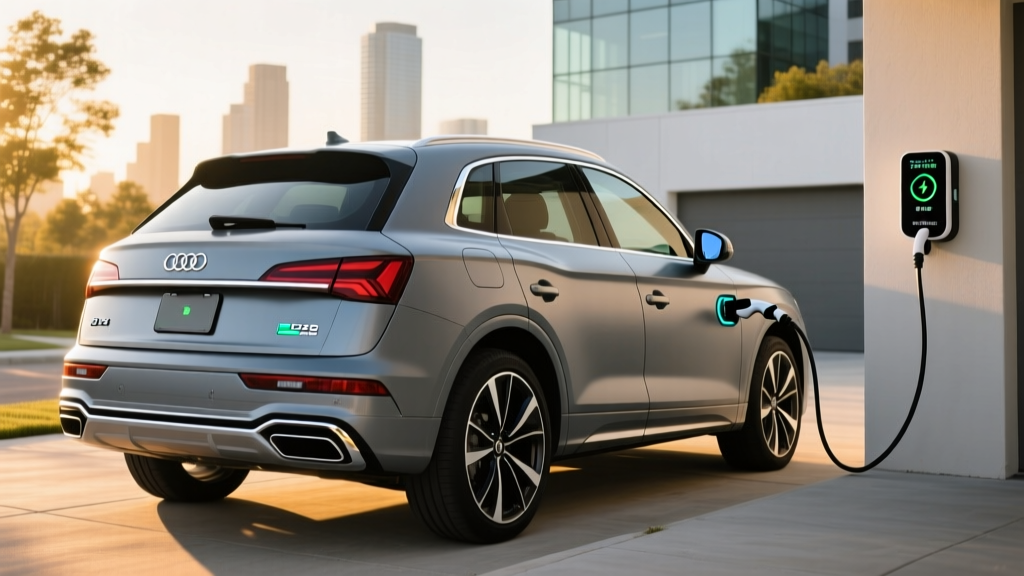
The Q5 55 TFSI e charges via AC only — there is no DC fast charging capability, which is standard for most PHEVs in this class (the RAV4 Prime is a rare exception with an optional DC port). Here's what charging looks like in practice:
| Charging Level | Power | Time (0-100%) | Setup |
|---|---|---|---|
| Level 1 (120V household) | ~1.4 kW | ~10-12 hours | Standard outlet, included cable |
| Level 2 (240V) | 7.4 kW | ~2.5 hours | Home wallbox or public Level 2 |
The 7.4 kW onboard charger is the limiting factor — even if you plug into a 48-amp Level 2 station delivering 11.5 kW, the Q5 will only accept 7.4 kW. A full charge from empty takes about 2.5 hours on Level 2, which means you can easily recharge during a workday or between errands. For home charging, a Level 2 wallbox on a 40-amp circuit (requiring a 50-amp breaker) is ideal. Expect home installation costs of $500-$1,500 for the charger and electrical work if your panel has capacity — panel upgrades can add $1,500-$3,000 if needed.
Connector: The Q5 TFSI e uses the standard J1772 connector for AC charging. With the industry's ongoing shift to NACS (Tesla's connector), Audi has confirmed that future models will adopt NACS, but the 2026 Q5 PHEV retains J1772. A J1772-to-NACS adapter is available if you need access to Tesla Destination Chargers.
Pricing, Trims, and Tax Credit Reality
For 2026, the Audi Q5 55 TFSI e is available in three trims:
- Premium: $58,295 MSRP (including destination)
- Premium Plus: $62,495 MSRP
- Prestige: $67,195 MSRP
These prices represent a roughly $6,000-$8,000 premium over the equivalent mild-hybrid Q5 45 TFSI trims. The question is whether the electric range, added horsepower, and fuel savings justify that premium.
Federal Tax Credit Status (§30D): Unfortunately, the 2026 Audi Q5 55 TFSI e does not qualify for the $7,500 federal EV tax credit. Under current IRS rules (updated through the Inflation Reduction Act), new PHEVs must meet:
- Battery capacity ≥ 7 kWh ✓ (17.9 kWh)
- MSRP cap: ≤ $80,000 for SUVs ✓
- Buyer income cap: ≤ $300,000 MFJ / $150,000 single ✓ (varies)
- North American final assembly ✗ (Q5 is built in San José Chiapa, Mexico)
- Critical minerals and battery component sourcing thresholds ✗
The Mexico assembly alone disqualifies the Q5 PHEV. Some buyers may be eligible for state-level incentives — check your state energy office or AFDC state incentive database for local rebates that don't have assembly requirements. Always consult a tax professional for your specific situation.
Battery Warranty, Reliability, and Replacement Cost
Audi PHEV Battery Warranty: 8 years / 100,000 miles (whichever comes first), covering defects and capacity loss below 70% of original capacity. The hybrid system components (electric motor, power electronics) carry the same 8-year/100,000-mile coverage. The conventional powertrain warranty is 4 years / 50,000 miles.
The Q5 PHEV's lithium-ion pack uses NMC (nickel-manganese-cobalt) chemistry, which offers strong energy density but is more sensitive to sustained high states of charge and extreme temperatures than LFP. Audi's battery management system includes active liquid cooling and heating, which significantly mitigates degradation. Based on data from earlier-generation Audi PHEVs and industry-wide PHEV battery studies, expect approximately 8-12% capacity loss over 8 years under normal use — well within the 70% warranty threshold.
Battery replacement cost: If the battery does need replacement out of warranty (unlikely before 150,000+ miles based on current degradation data), expect a cost in the range of $8,000-$12,000 including parts and labor. This is less than a full BEV battery replacement because the pack is smaller. However, individual module replacement (rather than the full pack) may be possible for localized failures, reducing cost.
Reliability: Audi's PHEV powertrain has proven reasonably reliable in the Q5 since its introduction, though the added complexity of a dual-powertrain system means more potential failure points than a pure BEV or conventional ICE vehicle. Common reported issues in earlier model years included software glitches in the hybrid management system and occasional charging port latch failures — most addressed via software updates and warranty service. Check NHTSA.gov for current recall and complaint data on the specific model year.
Who Should Buy the Audi Q5 Hybrid SUV?
Choose the Q5 55 TFSI e (PHEV) if:
- Your daily commute is under 20 miles round-trip and you can charge at home
- You want electric commuting without range anxiety on road trips
- You value the extra 100 hp the electric motor provides
- You live in a state with PHEV purchase incentives or HOV lane access
- You want a luxury badge with plug-in capability and aren't ready for a full EV
Choose the Q5 45 TFSI (Mild Hybrid) if:
- You can't charge at home (no garage, no outlet access)
- You drive mostly long highway distances where PHEV advantages disappear
- You want to save $6,000-$8,000 on purchase price
- You prefer a simpler powertrain with less maintenance complexity
Consider a full BEV instead if:
- You want $0 gas spending and have reliable home charging
- Your daily driving is under 250 miles and you want a 300+ mile range buffer
- You want to qualify for the $7,500 federal tax credit (look at the BMW iX, Tesla Model Y, or Cadillac Lyriq — all assembled in North America)
- You want minimal drivetrain maintenance (no oil changes, no spark plugs, no transmission fluid)
Pros
- 362 hp combined — genuinely quick for a luxury SUV
- 23-mile electric range covers most short commutes
- No range anxiety — gas engine for road trips
- quattro AWD standard, premium interior quality
- 2.5-hour Level 2 charge time is practical
- 8-year/100,000-mile battery warranty
Cons
- 23-mile electric range trails RAV4 Prime (42 mi) and Tucson PHEV (33 mi)
- No DC fast charging capability
- No federal tax credit (Mexico assembly)
- ~$6,000-$8,000 premium over mild-hybrid Q5
- Cargo space slightly reduced vs. non-PHEV Q5
- J1772 connector in a NACS-shifting market
Frequently Asked Questions
How many MPG does the Audi Q5 hybrid get?
The Q5 55 TFSI e PHEV returns 26 mpg combined (25 city / 27 highway) in gas-only mode after the battery is depleted. The combined MPGe rating (electric + gas) is 61 MPGe. The mild-hybrid Q5 45 TFSI gets 25 mpg combined (23 city / 28 highway). In real-world driving, the PHEV can effectively achieve much higher efficiency if you charge nightly and commute under 23 miles.
How far can the Audi Q5 PHEV go on electric only?
The EPA rates the 2026 Q5 55 TFSI e at 23 miles of electric-only range. Real-world results vary: expect 18-22 miles in normal conditions, dropping to 16-18 miles in cold weather (below 30°F) or with aggressive acceleration. Highway-speed electric driving depletes the battery fastest.
Does the Audi Q5 hybrid qualify for a tax credit?
No. The 2026 Q5 55 TFSI e does not qualify for the federal §30D tax credit because it is assembled in Mexico, not North America. State-level incentives may be available depending on your jurisdiction — check the AFDC state incentive database and consult a tax professional.
Is the Audi Q5 PHEV reliable, and what does a battery replacement cost?
The Q5 PHEV powertrain has been reasonably reliable since its introduction, with most issues being software-related rather than mechanical. The battery is covered by an 8-year/100,000-mile warranty against defects and capacity loss below 70%. Out-of-warranty battery replacement would cost approximately $8,000-$12,000, though this is unlikely to be needed before 150,000+ miles based on current degradation data.
Hybrid vs. PHEV vs. EV — which is right for me?
Choose the mild hybrid (Q5 45 TFSI) if you want simplicity, no charging hassle, and lower cost. Choose the PHEV (Q5 55 TFSI e) if you can charge at home, have a short commute, and want electric driving without range anxiety. Choose a full BEV (like the Audi Q4 e-tron or BMW iX) if you want maximum fuel savings, have reliable charging access, and are ready to commit to electric-only driving with 250+ miles of range.
Can the Audi Q5 PHEV DC fast charge?
No. The Q5 55 TFSI e supports only AC charging — Level 1 (120V, ~1.4 kW) and Level 2 (240V, up to 7.4 kW). A full Level 2 charge takes approximately 2.5 hours. This is typical for luxury PHEVs in this segment, though the Toyota RAV4 Prime is a notable exception with optional DC fast charging.