Quick Verdict: The 2026 Audi Q5 PHEV in 30 Seconds
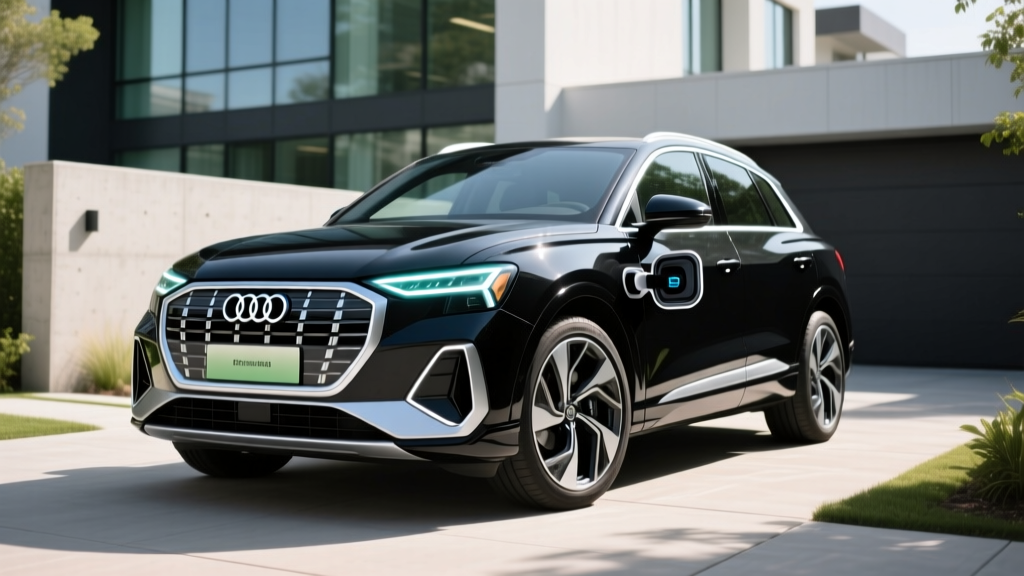
The 2026 Audi Q5 55 TFSI e quattro is a luxury compact SUV that splits the difference between a conventional gas-powered Q5 and the fully electric Q4 e-tron. With 23 miles of EPA-rated electric-only range, a combined 362 horsepower, and standard quattro all-wheel drive, it targets drivers who want daily electric commuting without sacrificing road-trip flexibility. Starting at $58,295, it occupies a narrow but compelling niche — if your commute fits within its battery envelope and you can charge at home.
| Spec | Value |
|---|---|
| Powertrain | 2.0L turbo I4 + electric motor (PHEV) |
| Combined Output | 362 hp / 369 lb-ft torque |
| Battery (gross / usable) | 17.9 kWh / ~14.7 kWh |
| Battery Chemistry | NMC (Nickel Manganese Cobalt) |
| EPA Electric-Only Range | 23 miles |
| EPA MPGe (charge-depleting) | 62 MPGe |
| EPA MPG (charge-sustaining, gas) | 26 city / 28 hwy / 27 combined |
| Total Combined Range | ~430 miles (electric + gas) |
| Level 2 Charging (7.2 kW) | ~2.5 hours (0–100%) |
| DC Fast Charging | Not available |
| 0–60 mph | 5.0 seconds |
| Drivetrain | quattro AWD |
| Base MSRP | $58,295 (Premium trim) |
| Federal Tax Credit (§30D) | Up to $3,750 (partial; see eligibility section) |
| Hybrid Battery Warranty | 8 years / 100,000 miles |
HEV vs PHEV: What the Audi Q5 Plug-In Hybrid Actually Is
Before diving deeper, it's worth clarifying what you're buying — because the terminology trips up many shoppers.
| Feature | HEV (e.g., Toyota RAV4 Hybrid) | PHEV (e.g., Audi Q5 55 TFSI e) |
|---|---|---|
| Plugs in? | No — charges via regen & engine | Yes — plug in to charge battery |
| Electric-only range | 0–1 mile at low speed | 23 miles (EPA) |
| Battery size | 1–2 kWh | 17.9 kWh gross |
| Tax credit eligible? | No | Potentially (partial credit) |
| Best for | No home charging; want better MPG | Home charging + short commute |
The Audi Q5 55 TFSI e is a PHEV. That means it has a substantially larger battery than a conventional hybrid and can drive on electricity alone for a meaningful distance — but it also has a gas engine that kicks in once the battery depletes, so you're never stranded. Audi does not currently sell a conventional (non-plug-in) HEV version of the Q5 in the US market, so if you're shopping an "Audi Q5 hybrid," you're looking at this plug-in model.
Electric Range, MPG, and Real-World Efficiency
| Mode | City | Highway | Combined |
|---|---|---|---|
| Electric-only (MPGe) | 64 MPGe | 60 MPGe | 62 MPGe |
| Gas-only (charge-sustaining) | 26 MPG | 28 MPG | 27 MPG |
How Far Can It Go on Electric Only?
The EPA rates the Q5 PHEV at 23 miles of electric-only range. In real-world conditions, expect 18–21 miles in mixed driving and closer to 16–18 miles on the highway at sustained speeds above 65 mph. In cold weather (below 35°F), plan on 14–17 miles as the battery's usable capacity shrinks and cabin heating draws additional power.
Real-World Gas MPG
Once the battery depletes, the 2.0L turbo four-cylinder takes over. The EPA rates it at 27 MPG combined in charge-sustaining mode. PHEVs tend to match or slightly underperform their EPA gas-mode rating on the highway (the added battery weight doesn't help), but city driving can surprise you — regenerative braking recaptures energy in stop-and-go traffic, and some owners report 28–30 MPG in urban use. On a long highway trip at 75 mph, expect 25–26 MPG.
Total Combined Range
With a full charge and a full 18.5-gallon tank, the Q5 PHEV delivers roughly 430 miles of total range — more than enough for any road trip without range anxiety.
Battery, Charging, and Powertrain Details
Battery Pack
The Q5 55 TFSI e uses a 17.9 kWh gross / ~14.7 kWh usable lithium-ion battery pack with NMC (Nickel Manganese Cobalt) chemistry. Audi reserves a buffer at the top and bottom of the pack to protect long-term health — you'll never see a true 0% or 100% on the dash. The pack is mounted beneath the rear cargo floor, which does reduce cargo space slightly compared to the gas-only Q5 (25.1 cu ft vs 27.2 cu ft behind the rear seats, per Audi specifications).
Charging Speeds
| Level | Power | Time (0–100%) | Notes |
|---|---|---|---|
| Level 1 (120V household) | 1.2 kW | ~12–14 hours | Emergency/top-up only |
| Level 2 (240V, 32A) | 7.2 kW | ~2.5 hours | Recommended home charging |
| DC Fast Charge | N/A | N/A | Not supported |
The onboard charger maxes out at 7.2 kW. That's typical for luxury PHEVs and means a full recharge on a Level 2 home charger takes about two and a half hours. There is no DC fast charging — a common PHEV limitation due to the smaller battery size and cost engineering. For a 23-mile electric range, overnight Level 2 charging is more than adequate; you'll wake up to a full battery every morning.
Powertrain Output
The 2.0L turbocharged inline-four produces 261 hp on its own, while the integrated electric motor adds 141 hp. Combined system output is 362 hp and 369 lb-ft of torque, routed through a 7-speed S tronic dual-clutch automatic to all four wheels via quattro AWD. The 0–60 mph sprint takes 5.0 seconds — meaningfully quicker than the gas-only Q5 45 TFSI (328 hp, 5.5 seconds). The electric motor provides instant torque fill at low RPMs, which makes the PHEV feel more responsive in city driving than the EPA numbers suggest.
Pricing, Tax Credits, and Ownership Costs
MSRP by Trim
| Trim | 2026 MSRP |
|---|---|
| Premium (55 TFSI e) | $58,295 |
| Premium Plus (55 TFSI e) | $62,595 |
| Prestige (55 TFSI e) | $67,295 |
All prices include destination charge. The Q5 PHEV commands roughly a $5,000–$6,000 premium over the equivalently trimmed gas-only Q5 45 TFSI.
Federal Tax Credit Eligibility (§30D)
Under current IRS §30D rules, the 2026 Audi Q5 55 TFSI e qualifies for a partial federal tax credit of up to $3,750. Here's why it's not the full $7,500:
- MSRP cap: SUVs capped at $80,000 — Q5 PHEV passes ✓
- Buyer income cap: $150K single / $300K joint MAGI — varies by buyer
- Battery capacity: Minimum 7 kWh — Q5's 17.9 kWh passes ✓
- Critical minerals requirement ($3,750): Audi's sourcing partially meets 2026 thresholds — likely qualifies ✓
- Battery components requirement ($3,750): Some components sourced from FEOC entities — likely does NOT qualify ✗
- Point-of-sale transfer: Available — credit can reduce purchase price at the dealer
Source: IRS.gov. Eligibility depends on your individual tax situation. Consult a tax professional before relying on credit amounts. Rules subject to change.
5-Year Cost of Ownership Estimate
Assuming 12,000 miles/year, 70% of driving within electric range, and $0.14/kWh home electricity vs $3.50/gallon gas:
| Cost Category | Q5 PHEV (5 yr) | Q5 45 TFSI Gas (5 yr) |
|---|---|---|
| Fuel / Electricity | ~$5,800 | ~$9,400 |
| Maintenance | ~$3,200 | ~$3,800 |
| Insurance (est.) | ~$11,500 | ~$10,200 |
| Depreciation (est.) | ~$22,000 | ~$20,500 |
| Total (approx.) | ~$42,500 | ~$43,900 |
The PHEV edges out the gas model on operating costs, but higher insurance premiums and a steeper purchase price eat into the savings. The math improves significantly if you qualify for the $3,750 tax credit and have access to cheap overnight electricity.
Reliability, Battery Warranty, and Longevity
Is the Q5 PHEV Reliable?
Audi's PHEV powertrain is now in its second generation (the first-gen Q5 PHEV launched for the 2020 model year). The 2.0L EA888 engine is one of Volkswagen Group's most proven mills, and the electric motor adds fewer moving parts than a traditional transmission. That said, PHEVs are inherently more complex than either pure EVs or gas cars — you have two complete powertrains sharing one chassis. Audi's reliability ratings have historically trailed Japanese competitors; J.D. Power's 2025 Vehicle Dependability Study placed Audi near the industry average.
Battery Degradation and Replacement Cost
NMC batteries in PHEVs typically lose 8–12% capacity over the first 5 years under normal use. Because the Q5 PHEV's battery is relatively small and cycles daily (unlike a large EV battery that might only cycle to 50%), degradation is a legitimate consideration. Audi's 70% capacity-retention warranty threshold provides a safety net. Out-of-warranty replacement for the Q5 PHEV battery pack is estimated at $8,000–$12,000 including labor — a figure to weigh if you plan to keep the vehicle past 100,000 miles.
Who Should Buy the Audi Q5 PHEV (and Who Shouldn't)
- 23-mile electric range covers most daily commutes gas-free
- 362 hp makes it the quickest Q5 variant
- Standard quattro AWD for all-weather confidence
- No range anxiety — gas engine for road trips
- Premium interior, quiet cabin, strong build quality
- Partial federal tax credit ($3,750) reduces effective price
- Only 23 miles electric — falls short of rivals like the BMW X5 xDrive50e (38 mi)
- No DC fast charging
- Cargo space reduced vs gas Q5 (battery packaging)
- ~$5,500 premium over gas Q5 with modest fuel savings
- Complex dual powertrain = higher long-term maintenance risk
- Partial ($3,750) rather than full ($7,500) tax credit
- Choose the Q5 PHEV if: Your round-trip commute is under 20 miles, you can install a Level 2 charger at home, you want luxury and AWD, and you take road trips too often for a pure EV to feel practical.
- Choose the gas Q5 45 TFSI if: You can't charge at home, your commute exceeds 30 miles one way, or you want to minimize upfront cost and powertrain complexity.
- Choose the Audi Q4 e-tron (full EV) if: You have reliable home charging, your daily driving is under 200 miles, and you want zero gas stops, lower maintenance, and a full $7,500 tax credit (if eligible).
Frequently Asked Questions
How many MPG does the Audi Q5 plug-in hybrid get?
In charge-sustaining (gas-only) mode, the 2026 Q5 55 TFSI e achieves an EPA-rated 26 MPG city, 28 MPG highway, and 27 MPG combined. In electric mode, it earns 62 MPGe combined. Real-world gas MPG in city driving can reach 28–30 thanks to regenerative braking, while highway cruising at 75 mph yields around 25–26 MPG.
How far can the Audi Q5 PHEV go on electric only?
The EPA rates it at 23 miles of electric-only range. In real-world mixed driving, expect 18–21 miles. Highway driving at sustained speeds or cold-weather operation (below 35°F) reduces this to 14–18 miles. For commutes under 20 miles round-trip with home charging, many owners use zero gasoline on weekdays.
Does the Audi Q5 hybrid plug-in qualify for a tax credit?
Yes, partially. Under current IRS §30D rules, the 2026 Q5 PHEV is expected to qualify for up to $3,750 (the critical-minerals half of the credit). It likely does not qualify for the additional $3,750 battery-components half due to FEOC sourcing restrictions. The credit can be transferred to the dealer at point of sale, reducing your purchase price directly. Eligibility depends on your income (≤$150K single / ≤$300K joint) and the vehicle's MSRP (must be ≤$80,000 for SUVs). Always verify with a tax professional and the latest IRS guidance.
Is the Audi Q5 PHEV reliable, and what does battery replacement cost?
The Q5 PHEV uses Audi's second-generation plug-in system, which has proven more robust than the first. The hybrid battery is warranted for 8 years / 100,000 miles against defects and capacity loss below 70%. Out-of-warranty battery replacement is estimated at $8,000–$12,000. Overall vehicle reliability is near the industry average — not class-leading, but acceptable for a luxury PHEV with this level of performance and technology.
Can the Audi Q5 PHEV DC fast charge?
No. The Q5 55 TFSI e supports Level 1 (120V) and Level 2 (240V, up to 7.2 kW) charging only. DC fast charging is not available, which is typical for PHEVs with smaller battery packs. A full Level 2 charge takes approximately 2.5 hours — sufficient for overnight replenishment.
Hybrid vs PHEV vs EV — which is right for me?
A conventional hybrid (HEV) is best if you can't charge at home and simply want better MPG without changing your habits. A plug-in hybrid (PHEV) like the Q5 55 TFSI e fits drivers who can charge at home, have short commutes, but still need gas-engine range for longer trips. A full EV (BEV) is ideal if you have home charging, drive under 250 miles daily, and want the lowest operating costs and minimal maintenance. The PHEV is a bridge solution — it rewards home charging with daily electric driving while eliminating range anxiety entirely.