Quick Verdict: The Audi Q5 Hybrid at a Glance
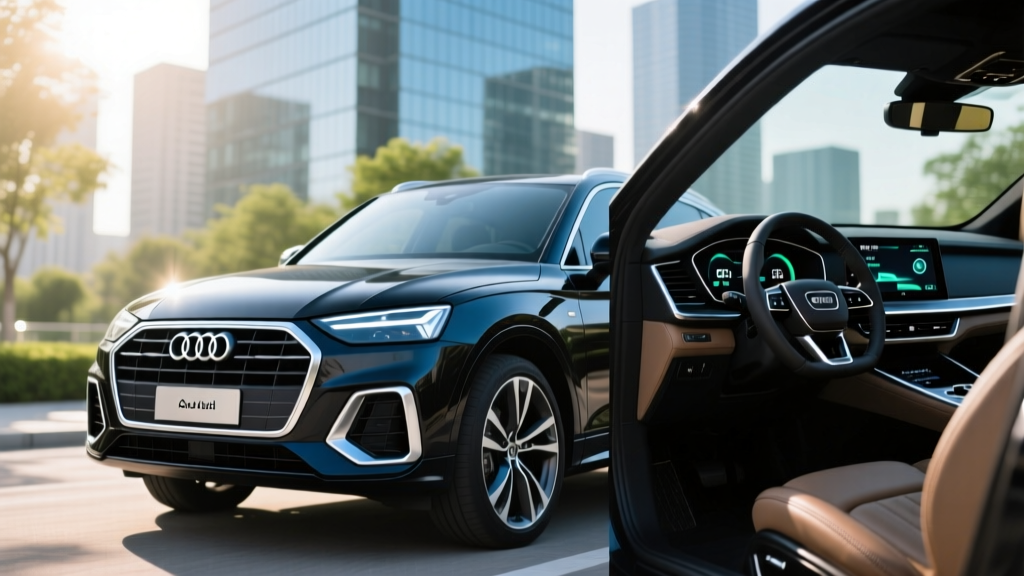
The Audi Q5 plug-in hybrid (officially the Q5 55 TFSI e) occupies a narrow but appealing lane: it's a luxury compact SUV that can handle a short electric commute, then seamlessly switch to its turbocharged gasoline engine for longer trips. For 2026, Audi continues the Q5 PHEV with a 17.9 kWh battery pack, an EPA-rated 23 miles of electric-only driving, and a combined system output of 362 horsepower. It does not offer a conventional hybrid (HEV) variant in the U.S. — if you want an Audi Q5 that sips fuel without plugging in, you'll need to look at the mild-hybrid (MHEV) Q5 45 TFSI, which is a different powertrain entirely.
This guide covers the Q5 PHEV in depth: real-world efficiency, charging logistics, tax credit eligibility under current IRS §30D rules, battery longevity, and whether this plug-in hybrid makes sense versus a full battery-electric vehicle (BEV) or a standard gasoline SUV.
HEV vs PHEV vs MHEV: What Audi Actually Sells
Audi's terminology can confuse buyers. Here's the breakdown for the 2026 Q5 lineup in the United States:
| Type | Powertrain | Plug In? | Electric-Only Range | Q5 Availability |
|---|---|---|---|---|
| MHEV (Mild Hybrid) | 48V system assists gas engine; cannot drive on electricity alone | No | 0 miles | Q5 45 TFSI (standard) |
| PHEV (Plug-In Hybrid) | Larger battery + electric motor; can drive on electricity alone | Yes | ~23 miles EPA | Q5 55 TFSI e |
| HEV (Conventional Hybrid) | Self-charging hybrid; no plug | No | ~1-2 miles at low speed | Not offered in U.S. |
| BEV (Battery Electric) | Electric only; no gas engine | Yes (required) | Full range (200+ mi typical) | Q6 e-tron / Q8 e-tron (separate models) |
The Q5 55 TFSI e is the only electrified Q5 with meaningful electric-only capability. The MHEV system in the Q5 45 TFSI provides marginal efficiency gains (roughly 1-2 MPG improvement over a non-hybrid) through regenerative braking and smoother stop-start — but you never drive on electric power alone. This distinction matters for tax credits, fuel savings, and daily driving experience.
Fuel Economy and Electric-Only Range
The 2026 Q5 55 TFSI e carries EPA ratings that reflect its dual personality. When the battery is charged, it operates as an electric vehicle for short distances. Once the battery depletes, it functions as a conventional hybrid using its 2.0-liter turbocharged four-cylinder engine.
| Metric | EPA Rating | Real-World Expectation |
|---|---|---|
| Combined MPGe (electric + gas) | 61 MPGe | 55-65 MPGe with regular charging |
| Electric-only range | 23 miles | 18-21 mi (highway/cold); 22-25 mi (city/mild weather) |
| Gas-only combined MPG | 26 MPG combined | 24-27 MPG mixed driving |
| City MPG (gas-only) | 25 MPG | 26-28 MPG (hybrid regen helps in stop-and-go) |
| Highway MPG (gas-only) | 27 MPG | 24-26 MPG at 70+ mph |
| Total combined range | ~410 miles | ~370-400 mi real-world |
Real-world note: The 23-mile EPA electric range assumes moderate temperatures and mixed driving. In winter conditions (below 35°F), expect 16-19 miles of electric range due to battery chemistry limitations and cabin heating demands. In warm weather city driving with frequent regenerative braking, some owners report squeezing out 25 miles. Once the battery depletes, the gas engine engages automatically — there's no range anxiety, just a transition to 26 MPG combined hybrid operation.
For context, the non-hybrid Q5 45 TFSI with its mild-hybrid system achieves 25 MPG combined (23 city / 28 highway) per fueleconomy.gov. The PHEV's advantage is most pronounced on short commutes under 20 miles where you can operate entirely on electricity.
Powertrain, Performance, and Battery Specs
| Specification | 2026 Audi Q5 55 TFSI e |
|---|---|
| Engine | 2.0L turbocharged inline-4 |
| Engine output | 261 hp / 273 lb-ft torque |
| Electric motor | 141 hp / 258 lb-ft (integrated in transmission) |
| Combined system output | 362 hp / 369 lb-ft torque |
| Transmission | 7-speed S tronic dual-clutch automatic |
| Drivetrain | quattro all-wheel drive |
| 0-60 mph | 5.0 seconds |
| Battery capacity (gross) | 17.9 kWh |
| Battery capacity (usable) | ~14.5 kWh |
| Battery chemistry | NMC (nickel manganese cobalt) |
| Max AC charge rate (Level 2) | 7.4 kW |
| DC fast charging | Not supported |
| Level 2 charge time (0-100%) | ~2.5 hours at 7.4 kW |
| Level 1 charge time (120V) | ~8-9 hours |
| Charge connector | J1772 (CCS1 for AC) |
The Q5 PHEV's 362 combined horsepower makes it the quickest standard Q5 variant, hitting 60 mph in 5.0 seconds — over a second faster than the Q5 45 TFSI. The electric motor fills in torque at low RPM before the turbo spools, delivering responsive acceleration from a stop.
Charging reality check: The Q5 PHEV charges exclusively via AC — there is no DC fast charging capability. This is standard for most PHEVs (the Toyota RAV4 Prime being a notable exception with optional DCFC). At 7.4 kW on a Level 2 home charger, a full charge takes roughly 2.5 hours. On a standard 120V household outlet (Level 1 at ~1.4 kW), expect 8-9 hours — which works fine for overnight charging if your daily electric use is under 20 miles.
Pricing, Trims, and Tax Credit Eligibility
The 2026 Audi Q5 55 TFSI e starts at approximately $58,995 (including destination) in Premium trim. The Premium Plus trim adds roughly $4,400, and the Prestige trim sits around $67,000 before options.
Federal Tax Credit Status (§30D)
- Current eligibility: The Audi Q5 55 TFSI e does NOT currently qualify for the $7,500 federal §30D new clean vehicle credit. The vehicle's battery components and critical minerals do not meet the domestic sourcing thresholds required under the Inflation Reduction Act as of 2026.
- MSRP cap: Even if it qualified, the Q5 PHEV's MSRP falls under the $80,000 SUV cap — so pricing is not the barrier.
- Buyer income cap: §30D limits apply ($150K single / $300K joint modified AGI) — irrelevant here since the vehicle itself doesn't qualify.
- State incentives: Some states (California, Colorado, New York, others) offer separate PHEV rebates ranging from $1,000-$4,000. Check your state energy office or DMV for current programs.
- Point-of-sale transfer: Not applicable since the vehicle doesn't qualify for the federal credit.
Source: IRS §30D guidance. Tax credit rules change frequently — verify current eligibility with a tax professional before purchasing.
The lack of federal credit eligibility is a meaningful disadvantage against competitors like the Toyota RAV4 Prime (which does qualify) and the Chrysler Pacifica PHEV. However, luxury PHEV buyers in states with their own incentive programs can still offset some cost.
Charging at Home: What You Need
Since the Q5 PHEV doesn't support DC fast charging, your home charging setup determines how practical electric-only driving is day-to-day.
| Charging Level | Power | Time to Full Charge | Equipment Needed | Estimated Cost |
|---|---|---|---|---|
| Level 1 (120V outlet) | ~1.4 kW | 8-9 hours | Included portable cord | $0 (if outlet exists) |
| Level 2 (240V, 32A) | 7.4 kW (vehicle max) | ~2.5 hours | Hardwired or NEMA 14-50 charger | $500-$1,200 (equipment + install) |
Practical recommendation: A Level 2 home charger is strongly recommended for the Q5 PHEV. While Level 1 overnight charging technically works, a 240V setup lets you top up in 2-3 hours — meaning you could recharge during an evening at home and start each morning with a full battery. The vehicle's 7.4 kW onboard charger is the bottleneck, so a 40A or 48A Level 2 station (like a ChargePoint Home Flex or Wallbox Pulsar Plus) will fully utilize the car's capability without overspending on higher-amperage equipment you can't use.
Installation costs vary widely. A straightforward install near your electrical panel with a NEMA 14-50 outlet might run $500-$800. A longer wire run, panel upgrade (200A service), or hardwired installation can push costs to $1,500-$2,500. Always get a quote from a licensed electrician — the Q5 PHEV's modest 7.4 kW draw rarely requires a panel upgrade, which is one advantage over full EVs that charge at 11-19 kW at home.
Battery Longevity, Warranty, and Replacement Cost
Audi Q5 PHEV Battery Warranty
Coverage: 8 years / 100,000 miles (whichever comes first)
Capacity retention threshold: Audi warrants the high-voltage battery against defects and excessive capacity loss. Industry standard defines "excessive" as dropping below 70% of original capacity during the warranty period.
What's covered: Battery cell defects, module failures, battery management system (BMS) faults, and capacity degradation beyond the threshold.
What's not covered: Normal gradual degradation within acceptable limits, damage from accidents or modifications, or failure caused by improper charging equipment.
Long-term degradation expectations: The Q5 PHEV's 17.9 kWh NMC battery is relatively small, meaning it cycles more frequently than a full EV's pack. Based on industry data from similar PHEV platforms, expect 8-12% capacity loss over the first 5 years / 60,000 miles of regular use. Because the usable capacity is only ~14.5 kWh (Audi buffers the top and bottom of the pack to reduce stress), you may notice electric range dropping from 23 miles to roughly 20-21 miles after several years — still adequate for most short commutes.
Out-of-warranty replacement cost: If the battery fails after the 8-year/100,000-mile warranty expires, replacement costs for the Q5 PHEV battery pack are estimated at $8,000-$12,000 (parts and labor) based on current Audi parts pricing for similar PHEV platforms. This is significantly less than a full EV battery replacement ($15,000-$25,000+) because the pack is smaller. However, it's a cost to factor into long-term ownership plans if you intend to keep the vehicle past 10 years.
For reliability data, the Q5 platform has historically scored well in J.D. Power and Consumer Reports assessments, though PHEV-specific powertrain data is more limited. The 2.0L TFSI engine is a proven Audi/VW Group unit with a long production history.
Who Should Buy the Q5 PHEV (And Who Shouldn't)
Pros
- 362 hp makes it the quickest Q5 variant; 5.0s 0-60
- 23-mile electric range covers many daily commutes gas-free
- No range anxiety — gas engine provides 410+ total miles
- Luxury interior, quattro AWD, premium tech standard
- Level 2 home charging is affordable (7.4 kW max, no panel upgrade usually needed)
- Smooth EV-to-gas transition; no behavior change required
Cons
- No federal $7,500 tax credit eligibility
- 23-mile electric range is modest vs. RAV4 Prime (42 mi) or Tucson PHEV (33 mi)
- No DC fast charging — public charging impractical
- $59K+ starting price is steep for a compact luxury SUV
- Cargo space reduced vs. gas Q5 due to battery placement
- 26 MPG gas-only is only marginally better than non-hybrid Q5
Choose the Audi Q5 55 TFSI e (PHEV) if:
- Your daily round-trip commute is under 20 miles and you can charge at home
- You want a luxury SUV with strong acceleration and the option to drive electric locally
- You take regular road trips and don't want to plan around charging stations
- You value the Audi brand, interior quality, and quattro AWD
Choose a full EV (like the Audi Q6 e-tron) if:
- You want 250+ miles of electric range and DC fast charging for road trips
- You want to eliminate gasoline entirely and reduce maintenance (no oil changes, fewer moving parts)
- Your state offers strong EV incentives that offset higher purchase price
Choose the gas Q5 45 TFSI (MHEV) if:
- You can't charge at home (no garage, no outlet access, apartment living)
- Your commute exceeds 30 miles — the PHEV advantage disappears once the battery depletes
- You want a lower purchase price ($47K vs. $59K starting) and don't care about electric driving
Frequently Asked Questions
How many MPG does the Audi Q5 hybrid get?
The 2026 Q5 55 TFSI e achieves 61 MPGe combined when operating in electric-gas hybrid mode, and 26 MPG combined (25 city / 27 highway) when running on gasoline alone after the battery depletes. Real-world gas-only MPG typically falls between 24-27 depending on driving style and conditions. For comparison, the non-hybrid Q5 45 TFSI gets 25 MPG combined.
How far can the Q5 PHEV go on electric only?
The EPA rates the Q5 55 TFSI e at 23 miles of electric-only range. Real-world results vary: expect 18-21 miles in cold weather or highway driving, and 22-25 miles in mild weather with city driving and regenerative braking. The vehicle automatically switches to the gas engine when the battery depletes — there's no manual intervention required.
Does the Audi Q5 hybrid qualify for a tax credit?
As of 2026, the Audi Q5 55 TFSI e does not qualify for the $7,500 federal §30D new clean vehicle credit due to battery sourcing requirements. Some state-level incentives may apply (California, Colorado, and others offer PHEV rebates of $1,000-$4,000). Always check IRS.gov and your state energy office for the most current eligibility before purchasing.
Is the Q5 PHEV reliable, and what does a battery replacement cost?
The Q5 platform has a solid reliability track record, and the 2.0L TFSI engine is a well-established powertrain across the VW Group. The high-voltage battery is warranted for 8 years / 100,000 miles against defects and excessive degradation (below 70% capacity). Out-of-warranty battery replacement is estimated at $8,000-$12,000. Most PHEV owners report minimal degradation in the first 5 years, and the battery buffer system helps preserve long-term health.
Can I charge the Q5 PHEV at a public fast charger?
No. The Audi Q5 55 TFSI e does not support DC fast charging. It can only charge via AC power — Level 1 (120V) or Level 2 (240V). This means public charging is limited to Level 2 destination chargers (hotels, shopping centers, workplaces), which take 2.5+ hours for a full charge. For daily use, home charging is the practical solution.
Hybrid vs PHEV vs EV — which is right for me?
A conventional hybrid (HEV) like the Toyota RAV4 Hybrid requires no plug and improves MPG by 30-40% — ideal if you can't charge at home. A plug-in hybrid (PHEV) like the Q5 55 TFSI e offers 20-40 miles of electric range for short commutes plus a gas engine for longer trips — best if you can charge at home but still take road trips. A full EV (BEV) like the Audi Q6 e-tron eliminates gas entirely with 250+ mile range and fast charging — best if you want zero tailpipe emissions, lower running costs, and can install a home charger. Your charging access and daily mileage are the two biggest decision factors.
What's the difference between the Q5 55 TFSI e and the Q5 45 TFSI?
The Q5 45 TFSI is a mild hybrid (MHEV) with a 48-volt system that assists the gas engine but cannot drive on electricity alone. It gets 25 MPG combined and starts around $47,000. The Q5 55 TFSI e is a plug-in hybrid (PHEV) with a 17.9 kWh battery and 23 miles of electric-only range, 362 combined horsepower, and a starting price around $59,000. The PHEV is significantly more powerful and efficient on short trips, but costs $12,000 more and requires home charging access to realize its benefits.