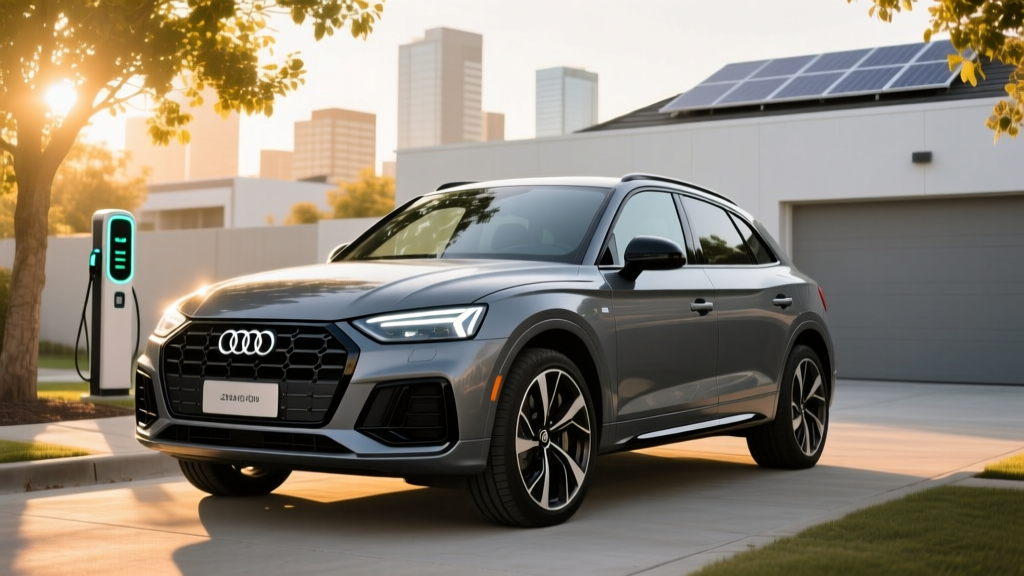
Quick Verdict: The Audi Q5 55 TFSI e PHEV at a Glance
The 2026 Audi Q5 55 TFSI e is a plug-in hybrid (PHEV) — not a conventional hybrid. That distinction matters enormously for your fuel economy, your wallet, and your daily routine. With an EPA-estimated 25 miles of electric-only range and a combined rating of 65 MPGe, the Q5 PHEV can eliminate most short commutes from your gas bill entirely. But once that battery depletes, you're driving a heavy luxury SUV that returns a more modest 26 MPG combined on gasoline alone.
If you're searching for Audi Q5 hybrid MPG, the honest answer is: it depends almost entirely on whether you plug it in every night. Charge daily and keep trips under 25 miles, and you might visit a gas station once a month. Forget to plug in, and you're paying a premium for a 4,800-pound SUV that sips fuel no better than many non-hybrid competitors.
Audi Q5 PHEV MPG: EPA Numbers vs. Real-World Results
Let's get the official numbers on the table first. The EPA rates the 2026 Audi Q5 55 TFSI e as follows:
| Metric | City | Highway | Combined |
|---|---|---|---|
| Electric + Gas (MPGe) | 67 MPGe | 64 MPGe | 65 MPGe |
| Gas Only (MPG) | 25 MPG | 27 MPG | 26 MPG |
| Electric-Only Range | 25 miles (EPA) | ||
| Total Range (Electric + Gas) | ~380 miles | ||
Real-World MPG: What to Actually Expect
The EPA's 65 MPGe combined figure assumes you're blending electric and gasoline driving over its test cycle. In practice, your mileage varies dramatically based on behavior:
- Daily commuter with home charging (under 25 miles round trip): You'll use almost zero gasoline on weekdays. Weekend road trips burn gas normally. Expect an effective annual average of 50–80 MPGe equivalent.
- Longer commutes (30–50 miles one way): The battery depletes within the first 20–25 miles, then you're in gas-only mode at roughly 26 MPG. Blended average: 35–45 MPGe.
- Rarely plugging in: Without regular charging, you're driving a heavy SUV at 24–26 MPG combined — barely better than the non-hybrid Q5 45 TFSI, which returns about 25 MPG combined.
Powertrain: Engine, Motor, and Combined Output
The Q5 55 TFSI e pairs a turbocharged 2.0-liter four-cylinder engine with an electric motor integrated into the seven-speed S tronic dual-clutch transmission. The combined system output is substantial:
| Component | Specification |
|---|---|
| Gas Engine | 2.0L turbo I4, 261 hp / 273 lb-ft |
| Electric Motor | 141 hp / 258 lb-ft (integrated in transmission) |
| Combined System Output | 362 hp / 369 lb-ft |
| Drivetrain | quattro AWD (standard) |
| Transmission | 7-speed S tronic dual-clutch |
| 0–60 mph | 5.0 seconds |
| Towing Capacity | 4,400 lbs |
That 362 combined horsepower makes the PHEV the quickest Q5 variant — 0.7 seconds faster to 60 mph than the gas-only Q5 45 TFSI. The electric motor also provides instant torque fill at low RPMs, which makes city driving and merging feel noticeably more responsive than the gas model.
Battery, Charging, and Electric-Only Range
The Q5 55 TFSI e uses a 17.9 kWh lithium-ion battery pack (gross capacity; usable capacity is approximately 14.1 kWh). This battery is mounted beneath the cargo floor, which does reduce trunk space slightly compared to the gas Q5 — cargo volume drops from 25.8 to approximately 23.7 cubic feet behind the rear seats.
Charging Specifications
| Charging Method | Power | 0–100% Time |
|---|---|---|
| Level 1 (120V household outlet) | ~1.4 kW | ~12–14 hours |
| Level 2 (240V, home or public) | 7.2 kW | ~2.5 hours |
| DC Fast Charging | Not supported — no DC fast-charge port |
The lack of DC fast charging is a notable limitation. On road trips, you cannot top up the battery at Electrify America or other DC fast-charging stations. The battery recharges only via the plug (Level 1 or Level 2) or through regenerative braking and the gasoline engine while driving.
For most PHEV owners, Level 2 home charging is the practical solution. A 240-volt outlet or dedicated Level 2 charger in your garage will fully replenish the battery overnight — and 2.5 hours means even a midday top-up at work can give you a full electric commute home. The onboard charger maxes out at 7.2 kW, so there's no benefit to installing a 48-amp (11.5 kW) charger specifically for the Q5; a 32-amp (7.7 kW) Level 2 unit is the sweet spot.
PHEV vs. Conventional Hybrid vs. Full EV: Which Q5 Fits Your Life?
A common search is "Audi Q5 hybrid" — but that term covers different powertrain realities. Here's how the options actually compare:
Conventional Hybrid (HEV)
How it works: Small battery charges via regenerative braking and the engine. No plug. The car manages electric assist automatically.
Does Audi offer this? Not on the U.S.-spec Q5. The Q5 45 TFSI has a mild-hybrid (MHEV) 12V system that assists with stop-start and minor efficiency gains (~1 MPG improvement), but it is not a full hybrid.
Best for: Drivers who want better MPG without changing any habits.
Plug-In Hybrid (PHEV)
How it works: Larger battery with a charge port. Plug in at home to get 20–30 miles of electric-only range. Once depleted, operates like a conventional hybrid.
Audi's offering: Q5 55 TFSI e — 25 mi electric, 26 MPG gas-only, 362 hp.
Best for: Drivers with home/work charging who commute under 25 miles but need gas range for road trips.
Full EV (BEV) Alternative
If you're considering the Q5 PHEV, also look at the Audi Q4 e-tron (265 miles EPA range, ~$49,800 starting) or the Audi Q8 e-tron (285 miles EPA range, ~$74,400 starting). Full EVs eliminate oil changes, have fewer moving parts, and qualify for the full §30D federal tax credit (up to $7,500, subject to income and sourcing requirements). However, they require reliable charging access and involve range planning on long trips.
Decision Framework
- Choose the Q5 55 TFSI e PHEV if: You have Level 2 charging at home or work, your daily commute is under 30 miles, you take regular road trips where EV range anxiety is a concern, and you want Audi's luxury interior with quattro AWD.
- Choose a full EV (Q4 e-tron / Q8 e-tron) if: You have reliable home charging, rarely drive more than 250 miles in a day, want maximum fuel savings and lowest maintenance costs, and can benefit from the full federal EV tax credit.
- Choose the gas Q5 45 TFSI if: You cannot install a charger at home, your commute is long and highway-heavy (where PHEV electric range adds little), or you want the lowest purchase price.
Pricing, Trims, and Tax Credit Eligibility
The 2026 Audi Q5 55 TFSI e is available in three trims. Pricing includes destination charge:
| Trim | MSRP | Key Features |
|---|---|---|
| Premium | $58,995 | Leather, 10.1" MMI touchscreen, power liftgate, Audi virtual cockpit |
| Premium Plus | $63,495 | Adds panoramic roof, Bang & Olufsen audio, 360° camera, adaptive cruise |
| Prestige | $68,995 | Adds head-up display, matrix LED headlights, ventilated front seats |
Federal Tax Credit: Does the Q5 PHEV Qualify?
Under current IRS §30D rules, the Audi Q5 55 TFSI e may qualify for a partial federal tax credit, but eligibility depends on several factors that change frequently:
- Battery capacity: The 17.9 kWh battery exceeds the 7 kWh minimum threshold for PHEVs. ✓
- MSRP cap: SUVs must be under $80,000 MSRP. All Q5 PHEV trims qualify. ✓
- Buyer income cap: Modified AGI must not exceed $150,000 (single), $225,000 (head of household), or $300,000 (joint). Varies by buyer. ⚠️
- Critical minerals & battery component sourcing: These requirements tighten annually. As of 2026, vehicles must meet increasing percentages of U.S.-sourced critical minerals and battery components to qualify for the full $7,500. The Q5 PHEV's eligibility for the full amount, partial amount ($3,750), or no credit depends on current-year sourcing compliance — check the EPA's qualified vehicles list before purchasing.
- Point-of-sale transfer: If eligible, you can transfer the credit to the dealer at purchase, reducing your out-of-pocket cost immediately rather than waiting for tax filing.
Battery Warranty, Reliability, and Long-Term Costs
Hybrid and PHEV battery longevity is the number-one concern for buyers. Here's what Audi covers:
Battery & Powertrain Warranty Coverage
- High-voltage battery: 8 years / 100,000 miles (whichever comes first). Covers defects and capacity loss below a specified threshold (typically 70% of original capacity).
- Powertrain (engine + transmission + motor): 5 years / 60,000 miles
- Limited vehicle warranty: 4 years / 50,000 miles
- Roadside assistance: 4 years, unlimited miles
Battery Replacement Cost
If the high-voltage battery fails outside warranty, replacement is expensive. Based on current dealer estimates, a Q5 PHEV battery replacement runs $8,000–$12,000 including parts and labor. However, PHEV batteries are smaller and less stressed than full EV batteries, and real-world data from similar VW Group PHEV systems (the Q5 shares its powertrain architecture with the Porsche Cayenne E-Hybrid and VW Tiguan eHybrid) shows strong longevity. Most PHEV batteries retain 85–90% of original capacity at 100,000 miles when properly maintained.
Reliability Track Record
Audi's reliability ratings have historically trailed Japanese competitors. The Q5 PHEV's powertrain adds complexity — a turbocharged engine, an electric motor, a dual-clutch transmission, and high-voltage electronics all in one vehicle. That said, the 2.0L TFSI engine is well-proven across the VW Group, and the electric motor has far fewer wear components than a traditional drivetrain.
Key reliability considerations:
- The S tronic dual-clutch transmission requires periodic fluid service (every 40,000 miles) — don't skip it.
- The high-voltage system is sealed and largely maintenance-free.
- Regenerative braking reduces wear on friction brake pads — expect 60,000+ miles on original pads.
- IIHS has not yet rated the 2026 Q5 PHEV specifically; the previous-generation Q5 earned a Top Safety Pick+ rating.
Who Should Buy the Audi Q5 PHEV — And Who Shouldn't
✓ Ideal Q5 PHEV Buyer
- Has a garage or dedicated parking spot with 240V access
- Daily commute under 25 miles (round trip)
- Takes 3–5 road trips per year (100+ miles)
- Wants luxury SUV with strong acceleration and quattro AWD
- Values the ability to drive electric daily without range anxiety on long trips
✗ Look Elsewhere If
- No access to home or workplace charging — you'll never realize the efficiency benefits
- Commute exceeds 40 miles one way — the small battery depletes quickly, and gas-only MPG is mediocre
- Budget is tight — the PHEV premium over the gas Q5 45 TFSI is ~$7,000–$10,000
- Maximum cargo space is critical — the battery intrudes on trunk volume
- You want the lowest total cost of ownership — a full EV or a Toyota RAV4 Prime may be more economical
Frequently Asked Questions
How many MPG does the Audi Q5 hybrid get?
The 2026 Audi Q5 55 TFSI e (PHEV) gets 65 MPGe combined when blending electric and gas driving, or 26 MPG combined on gasoline alone after the battery depletes. Real-world results vary dramatically: daily plug-in chargers with short commutes see 50–80 MPGe effective averages, while those who rarely charge see 24–26 MPG.
How far can the Audi Q5 PHEV go on electric only?
The EPA rates the Q5 55 TFSI e at 25 miles of electric-only range. In real-world conditions, expect 18–22 miles at highway speeds and 15–18 miles in freezing weather. This is enough for most short commutes but insufficient for longer daily drives.
Does the Audi Q5 hybrid qualify for a tax credit?
The Q5 55 TFSI e may qualify for a partial or full federal tax credit under §30D, depending on current-year battery sourcing rules, your income, and MSRP limits. The MSRP is under the $80,000 SUV cap. Always verify current eligibility on fueleconomy.gov and consult a tax professional before relying on a specific credit amount.
Is the Audi Q5 PHEV reliable, and what does battery replacement cost?
The Q5 PHEV carries Audi's standard 8-year/100,000-mile high-voltage battery warranty. Out-of-warranty battery replacement is estimated at $8,000–$12,000. Real-world data from similar VW Group PHEV powertrains suggests good battery longevity, with most retaining 85–90% capacity at 100,000 miles.
Can the Audi Q5 PHEV fast charge?
No. The Q5 55 TFSI e does not support DC fast charging. It charges at up to 7.2 kW on Level 2 (240V), taking about 2.5 hours for a full charge. Level 1 (120V) charging takes 12–14 hours.
What's the difference between the Q5 55 TFSI e and the Q5 45 TFSI?
The Q5 45 TFSI is a conventional gasoline model with a mild-hybrid (12V) system — it has no plug, no meaningful electric-only range, and returns about 25 MPG combined. The Q5 55 TFSI e is a plug-in hybrid with a 17.9 kWh battery, 25 miles of electric range, 362 combined hp, and the ability to drive on electricity alone. The PHEV costs roughly $7,000–$10,000 more depending on trim.
Should I get the Q5 PHEV or a full EV like the Q4 e-tron?
If you have home charging and your daily driving is under 250 miles, the Q4 e-tron (265 mi range, starting ~$49,800) offers lower running costs, less maintenance, and potentially a larger federal tax credit. Choose the Q5 PHEV if you regularly exceed 250 miles per day, lack reliable public charging infrastructure for road trips, or prefer the Q5's larger cargo area and more powerful engine options.