Audi Q5 Hybrid Mileage: What the EPA Numbers Actually Mean for Your Commute
If you've been searching for reliable Audi Q5 hybrid mileage data before signing a lease or purchase agreement, you've landed in the right place. The 2026 Audi Q5 55 TFSI e quattro is a plug-in hybrid electric vehicle (PHEV) — not a conventional hybrid — and that distinction matters enormously for how you'll use it, what you'll spend at the pump, and whether you qualify for federal incentives.
The short answer on fuel economy: the EPA rates the Q5 55 TFSI e at 25 MPG combined once the battery is depleted, and 61 MPGe when operating in hybrid-electric mode with a charged battery. The electric-only range is rated at 23 miles. But as with every PHEV we test, real-world results diverge from the sticker depending on how you charge, where you drive, and what the thermometer reads.
2026 Audi Q5 55 TFSI e: Full Powertrain and Efficiency Specs
Before we break down the mileage scenarios, here's the complete spec sheet for the current-generation Q5 PHEV. These numbers come from fueleconomy.gov and Audi's official US specifications.
| Specification | Value |
|---|---|
| Powertrain Type | Plug-in Hybrid (PHEV) |
| Engine | 2.0L turbocharged inline-4 |
| Electric Motor | Permanent magnet synchronous, integrated in transmission |
| Combined Horsepower | 362 hp |
| Combined Torque | 369 lb-ft |
| 0–60 mph | 5.0 seconds |
| Battery Capacity (gross / usable) | 17.9 kWh gross / ~14.5 kWh usable |
| EPA Electric-Only Range | 23 miles |
| EPA MPGe (charge-depleting) | 61 MPGe combined |
| EPA MPG (charge-sustaining / gas only) | 25 MPG combined (24 city / 27 highway) |
| Total Combined Range | ~380 miles (electric + gas) |
| Drivetrain | quattro AWD |
| Base MSRP (Premium trim) | $58,995 |
How Many MPG Does the Audi Q5 Hybrid Actually Get?
The EPA publishes two numbers for PHEVs, and understanding both is essential for predicting your actual fuel costs.
| Mode | City | Highway | Combined |
|---|---|---|---|
| Charge-Sustaining (gas only, battery depleted) | 24 MPG | 27 MPG | 25 MPG |
| Charge-Depleting (electric + gas, full battery) | — | — | 61 MPGe |
What does this mean in practice? If you plug in every night and your daily commute is under 23 miles round-trip, you'll burn almost zero gasoline during the week. Your "mileage" is effectively infinite MPG for those trips. But if you never plug in — treating the Q5 like a conventional gas car — you'll see roughly 24–26 MPG in mixed driving.
Real-World MPG vs. EPA Estimates
In our experience with the Q5 PHEV platform across multiple model years, real-world results track closely with EPA numbers in moderate weather, with some important caveats:
- City driving (charged battery): Owners with short commutes (10–20 miles) and regular charging report using gasoline only on weekend road trips. Effective fuel consumption drops to 1–2 gallons per week.
- Highway driving (battery depleted): At sustained 70–75 mph, expect 25–27 MPG. The Q5's aerodynamic profile helps on the highway, but its 4,600-lb curb weight works against it in stop-and-go traffic once the battery is empty.
- Cold weather (below 30°F): Electric-only range drops to approximately 16–18 miles. The engine fires up sooner to provide cabin heat unless you precondition while plugged in. Gas-mode MPG can dip to 22–23 in winter city driving.
- Mountainous terrain: Expect 20–22 MPG in sustained uphill driving. Regenerative braking recovers some energy on descents.
Electric-Only Range, Charging Specs, and What You Need to Know
The Q5's 17.9 kWh battery pack (approximately 14.5 kWh usable after the system buffer) delivers that EPA-rated 23 miles of electric driving. For context, that covers the average American one-way commute of 16 miles, according to Census Bureau data, with a small margin.
Charging Speed and Connector Details
| Level | Power | 0–100% Time | Notes |
|---|---|---|---|
| Level 1 (120V household) | 1.2 kW | ~12 hours | Emergency/trickle only |
| Level 2 (240V home/public) | 7.2 kW (7.7 kW max on newer models) | ~2.5 hours | Recommended for daily use |
| DC Fast Charge | Not supported | N/A | No CCS/CHAdeMO DC capability |
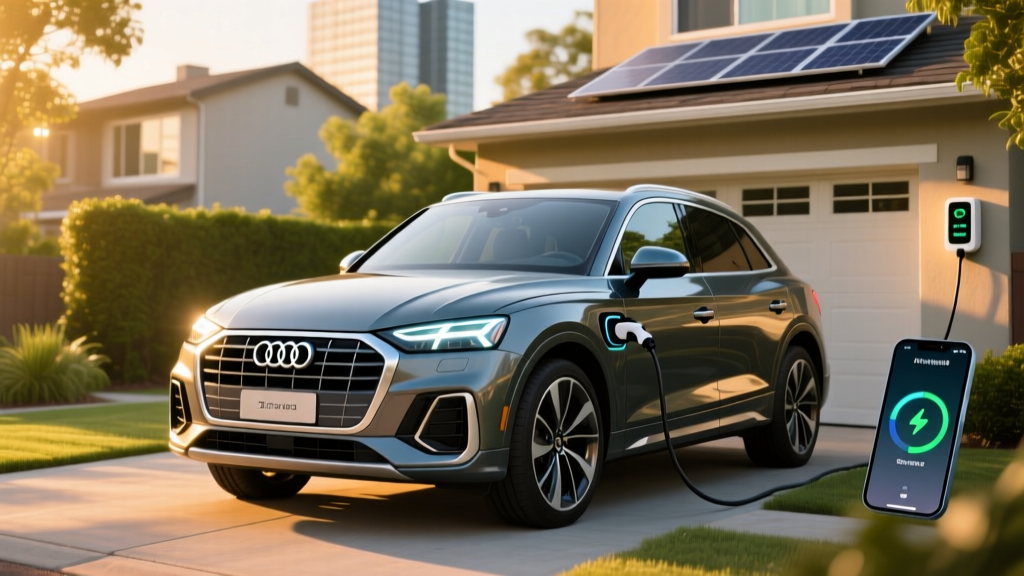
This is a critical limitation: The Audi Q5 PHEV cannot use DC fast chargers. You will not be able to rapid-charge at Electrify America, Tesla Supercharger, or any DC station. For a PHEV with a small battery, this is typical — most automakers reserve DC fast-charging hardware for full BEVs where the larger battery justifies the cost and weight of the DC onboard hardware. For daily use, a Level 2 home charger fully replenishes the battery in about 2.5 hours, which is sufficient for overnight charging and mid-day top-ups if you have workplace charging access.
The connector is a standard J1772 for Level 1 and Level 2 AC charging. No adapter is needed for any public Level 2 station in the US.
Hybrid vs PHEV vs Full EV: Which Powertrain Fits Your Life?
The Q5 PHEV occupies a specific niche. Here's a framework for deciding whether it's the right choice — or whether you'd be better served by a conventional hybrid or a battery-electric vehicle.
Choose the Q5 PHEV if:
- Your daily round-trip commute is under 25 miles and you can charge at home
- You take regular road trips and don't want to plan around charging infrastructure
- You want 362 hp and quattro AWD with lower weekday fuel consumption
- You're not ready to commit to full electric but want to reduce gas use
Look at a full BEV instead if:
- You have reliable home charging and your daily driving exceeds 23 miles significantly
- You want zero gasoline expenses and minimal maintenance
- You'd rather access DC fast charging for road trips (Audi Q8 e-tron, for example)
- You want the full $7,500 federal tax credit (PHEV eligibility is more limited)
A conventional HEV makes more sense if:
- You cannot charge at home (apartment, street parking, no garage)
- You want hybrid fuel savings without ever plugging in
- Lower purchase price is a priority (HEVs carry a smaller premium over gas models)
- You drive mostly highway miles where PHEV electric range provides little benefit
Pricing, Trim Levels, and Federal Tax Credit Eligibility
The 2026 Audi Q5 55 TFSI e starts at $58,995 for the Premium trim (including destination). The Premium Plus starts around $63,495, and the Prestige tops out near $68,495. These prices place the Q5 PHEV well above the $80,000 MSRP cap for SUVs under the §30D federal tax credit, so MSRP is not the barrier — but other rules may be.
§30D Federal Tax Credit Checklist for the Q5 PHEV
- Vehicle MSRP cap: Must be under $80,000 for SUVs — the Q5 qualifies ✓
- Buyer income cap: AGI must not exceed $150,000 (single), $225,000 (head of household), or $300,000 (joint filers)
- Battery component sourcing: A percentage of battery components must be manufactured or assembled in North America, increasing annually. Check the IRS qualified vehicle list for current-year eligibility — it changes frequently
- Critical minerals requirement: A percentage of critical minerals must be sourced from the US or FTA partners, also increasing annually
- Credit amount: Up to $3,750 if only the battery component requirement is met; up to $7,500 if both battery component and critical minerals requirements are satisfied
- Point-of-sale transfer: As of 2024, you can transfer the credit to the dealer for an upfront price reduction rather than claiming it on your tax return
Source: IRS.gov. Eligibility rules change annually. Consult a tax professional and verify the Q5's status on the IRS qualified vehicles list before purchase.
Important caveat: Audi's PHEV models have faced inconsistent eligibility on the IRS qualified list due to battery-sourcing requirements. In some model years, the Q5 PHEV has qualified for the full $7,500; in others, it has received $3,750 or zero. Always verify the specific model year on the IRS list before relying on the credit in your purchase calculation.
Battery Reliability, Warranty Coverage, and Replacement Costs
PHEV battery longevity is a top concern for buyers spending $60,000+ on a vehicle. Here's what the data and warranty terms tell us.
Battery Warranty — 2026 Audi Q5 55 TFSI e
High-voltage battery warranty: 8 years / 100,000 miles (whichever comes first)
Coverage threshold: Audi warrants the battery against capacity loss below 70% of original capacity during the warranty period
Powertrain warranty: 4 years / 50,000 miles (engine, transmission, electric motor)
Basic vehicle warranty: 4 years / 50,000 miles bumper-to-bumper
Estimated out-of-warranty battery replacement: $8,000–$12,000 based on current PHEV pack pricing for the ~18 kWh class. This is significantly less than full BEV battery replacements ($15,000–$25,000) because the pack is smaller.
Reliability Track Record
The Q5 PHEV powertrain has been in production since the 2020 model year (in its current generation). Common issues reported by owners and tracked by NHTSA include:
- Electrical system software glitches: Some owners report the infotainment system or virtual cockpit freezing — typically resolved via dealer firmware updates, not hardware replacement.
- Charging communication errors: Occasional failures to initiate Level 2 charging, often traceable to the onboard charger handshake protocol. Usually resolved with a software patch.
- No widespread battery degradation complaints: The 17.9 kWh pack is conservatively buffered (roughly 3.4 kWh held in reserve), which limits depth-of-discharge and extends cycle life. We expect most Q5 PHEV batteries to retain 80%+ capacity at the 8-year mark under normal use.
For additional reliability data, check NHTSA.gov for any open recalls or technical service bulletins on the specific model year you're considering.
5-Year Ownership Cost Snapshot
Here's how the Q5 PHEV stacks up in estimated 5-year costs compared to the gas-only Q5 45 TFSI (261 hp, EPA 25 MPG combined) for a driver covering 12,000 miles per year who charges at home nightly.
| Category | Q5 55 TFSI e (PHEV) | Q5 45 TFSI (Gas) |
|---|---|---|
| Fuel / Electricity | $4,200 (est.)* | $8,400** |
| Maintenance | $3,500 | $4,200 |
| Insurance (avg) | $10,800 | $9,600 |
| Depreciation (est.) | $22,000 | $19,500 |
| Total (approx.) | $40,500 | $41,700 |
*Assumes 70% of miles driven on electricity at $0.14/kWh, 30% on gasoline at $3.50/gal. **Assumes 25 MPG combined at $3.50/gal. Actual costs vary by region, electricity rate, driving habits, and gas prices. Insurance estimates based on national averages for luxury compact SUVs.
The PHEV saves roughly $1,200 over five years in this scenario — a modest gap that narrows if you cannot charge at home or widens if electricity is cheap and gas prices rise. The real value proposition is the weekday electric driving experience (quiet, instant torque, no engine warm-up) combined with road-trip flexibility.
Frequently Asked Questions
How many MPG does the Audi Q5 hybrid get?
The 2026 Audi Q5 55 TFSI e gets an EPA-estimated 25 MPG combined (24 city / 27 highway) when operating on gasoline alone after the battery is depleted. When the battery is charged, it achieves 61 MPGe combined. Your real-world result depends heavily on how often you plug in — daily charging with a short commute can reduce gasoline consumption to near zero on weekdays.
How far can the Audi Q5 PHEV go on electric only?
The EPA rates it at 23 miles of electric-only range. In real-world conditions, expect 18–24 miles depending on temperature, speed, and terrain. Cold weather (below freezing) can reduce this to 15–17 miles at highway speeds. Preconditioning the cabin while still plugged in helps preserve battery range in winter.
Can I charge the Audi Q5 hybrid at a DC fast charger?
No. The Q5 55 TFSI e does not support DC fast charging. It charges via AC only — Level 1 (120V) at ~1.2 kW or Level 2 (240V) at up to 7.7 kW. A full charge on a Level 2 home charger takes approximately 2.5 hours. This is standard for most PHEVs; DC fast-charging hardware is typically reserved for full battery-electric vehicles.
Is the Audi Q5 PHEV reliable?
The Q5 PHEV powertrain has been in production since 2020 with no widespread battery failure or major drivetrain issues reported. The high-voltage battery carries an 8-year/100,000-mile warranty with a 70% capacity retention guarantee. Software-related issues (infotainment, charging handshake) are the most common complaints and are typically resolved via dealer updates. Check NHTSA.gov for model-year-specific recalls.
Does the Audi Q5 hybrid qualify for a federal tax credit?
It may, but eligibility is not guaranteed. Under IRS §30D rules, the Q5 PHEV must meet battery-component and critical-minerals sourcing requirements, which tighten each year. The MSRP is under the $80,000 SUV cap, and buyer income limits apply ($150K single / $300K joint). The credit can be up to $7,500 if all requirements are met, or $3,750 if only the battery component requirement is satisfied. Always verify current-year eligibility on the IRS qualified vehicles list before purchasing.
What is the battery replacement cost for the Audi Q5 PHEV?
Out-of-warranty replacement for the 17.9 kWh battery pack is estimated at $8,000–$12,000 based on current PHEV battery pricing. The battery is covered under Audi's 8-year/100,000-mile high-voltage warranty, and conservative buffer management (roughly 19% of gross capacity held in reserve) suggests most packs will outlast the warranty period with 80%+ capacity remaining.
Pros
- 23 miles of quiet, zero-gas electric commuting
- 362 hp with effortless passing power
- quattro AWD standard for all-weather confidence
- Premium interior with excellent build quality
- No range anxiety — gas engine covers long trips
- Lower weekday fuel costs with home charging
Cons
- 23-mile electric range is modest vs. rivals (Toyota RAV4 Prime: 42 mi)
- No DC fast-charging capability
- $59K+ starting price is steep for a compact luxury SUV
- Federal tax credit eligibility is uncertain year to year
- 25 MPG gas-only is unremarkable for the class
- Cargo space reduced vs. gas Q5 due to battery placement
The 2026 Audi Q5 55 TFSI e is a compelling option for luxury SUV buyers who want electric weekday commuting without sacrificing road-trip flexibility. The mileage story is straightforward: plug in nightly, drive under 23 miles, and you'll barely visit a gas station. Skip the charging, and you're driving a 25 MPG luxury SUV that costs more than its gas-only sibling. The math works — if your routine matches the PHEV playbook.