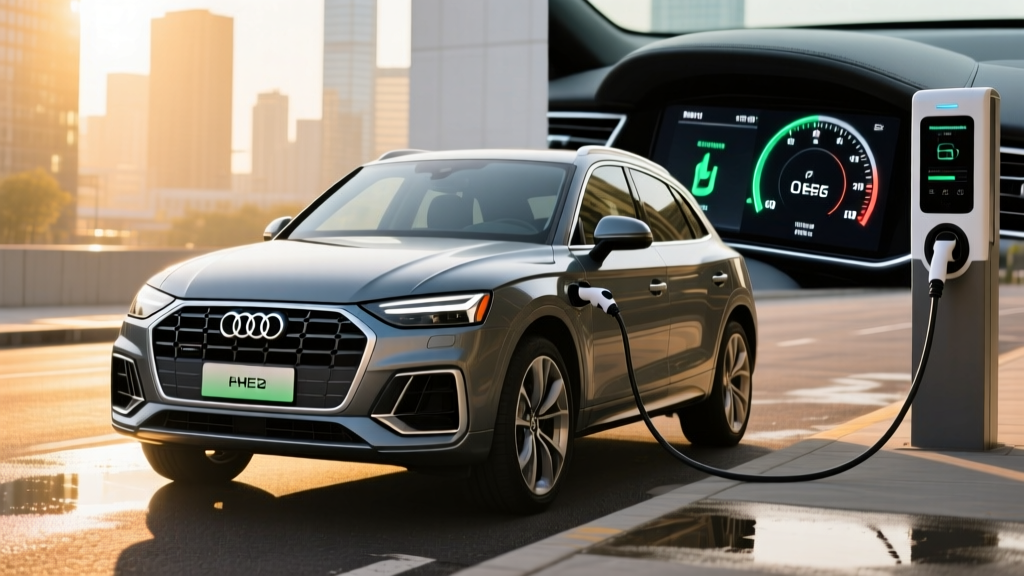
The Audi Q5 55 TFSI e occupies a specific niche in the luxury compact SUV market: a plug-in hybrid (PHEV) that lets you commute on electricity without surrendering the option of a cross-country road trip. For buyers researching Audi Q5 hybrid gas mileage, the numbers tell a nuanced story — one where EPA stickers, real-world driving behavior, and charging habits all shape what you'll actually pay at the pump.
This guide covers the 2026 Audi Q5 PHEV powertrain specs, EPA and real-world fuel economy, electric-only range, charging logistics, tax credit eligibility, and long-term battery reliability — everything you need to decide whether this PHEV, a conventional hybrid, or a full battery-electric vehicle (BEV) fits your garage.
Audi Q5 Hybrid Gas Mileage: EPA Ratings vs. Real-World MPG
The 2026 Audi Q5 55 TFSI e pairs a 2.0-liter turbocharged four-cylinder engine with an electric motor integrated into the seven-speed S tronic dual-clutch transmission. When operating as a hybrid (battery depleted or in hybrid drive mode), here is what the EPA estimates:
| Metric | Value |
|---|---|
| Combined MPG (gasoline, battery depleted) | 25 MPG |
| City MPG | 24 MPG |
| Highway MPG | 27 MPG |
| Combined MPGe (gas + electric) | 58 MPGe |
| Electric-only range | 23 miles |
| Total combined range (gas + electric) | ~380 miles |
Source: EPA Fuel Economy
The EPA's 25 MPG combined figure assumes the battery is depleted and the gasoline engine is doing most of the work. In practice, PHEV owners who charge daily and commute within the 23-mile electric envelope may use little to no gasoline on weekdays, effectively achieving triple-digit MPGe. However, on long highway trips where the battery depletes within the first 23 miles, expect sustained fuel economy closer to 23–26 MPG depending on speed, terrain, and climate control use. PHEVs lose some efficiency advantage on the highway because regenerative braking opportunities are limited at steady speeds, and the added weight of the battery and motor (the Q5 55 TFSI e weighs approximately 4,600 lbs) works against pure gasoline efficiency.
HEV vs. PHEV: Understanding the Q5's Hybrid System
Audi does not currently offer a conventional hybrid (HEV) version of the Q5 in the U.S. market. The Q5 55 TFSI e is strictly a plug-in hybrid electric vehicle (PHEV), meaning it has a larger battery that you can charge from an external power source and a meaningful electric-only driving range. Here is the distinction:
Conventional Hybrid (HEV)
- Battery: 1–2 kWh (small)
- Electric-only range: 0–1 mile
- No plug — charges via regenerative braking and engine
- Example: Toyota RAV4 Hybrid (39 MPG combined)
Plug-In Hybrid (PHEV) — Audi Q5 55 TFSI e
- Battery: 17.9 kWh (usable)
- Electric-only range: 23 miles
- Plugs in via Level 1 or Level 2 charger (no DC fast charge)
- Falls back to 25 MPG hybrid operation when battery depletes
If you're cross-shopping, know that a conventional hybrid like the Toyota RAV4 Hybrid or Honda CR-V Hybrid will deliver higher gasoline-only MPG (35–40 combined) without any plugging in. The PHEV trade-off is that you get zero-emission electric commuting for short distances, but a heavier, more complex vehicle when the battery runs out.
Powertrain Specs: Horsepower, Battery, and Charging
| Specification | Value |
|---|---|
| Engine | 2.0L turbocharged inline-4 |
| Electric motor | Integrated into S tronic transmission |
| Combined system output | 295 hp / 369 lb-ft torque |
| 0–60 mph | 5.8 seconds |
| Battery capacity (gross / usable) | 17.9 kWh usable |
| Battery chemistry | Lithium-ion (NMC) |
| Onboard charger (AC) | 7.4 kW (Level 2) |
| DC fast charging | Not supported |
| Level 1 charge time (120V, 1.4 kW) | ~12–13 hours (0–100%) |
| Level 2 charge time (240V, 7.4 kW) | ~2.5 hours (0–100%) |
| Drivetrain | quattro all-wheel drive |
| Cargo volume | 24.7 cu ft (rear seats up) / 51.2 cu ft (folded) |
| Towing capacity | 4,400 lbs |
Charging Realities for the Q5 PHEV
The Q5 55 TFSI e's 7.4 kW onboard AC charger is adequate for overnight replenishment but means you will not find fast-charging relief on road trips. This PHEV does not support DC fast charging — a deliberate engineering choice common among PHEVs with smaller batteries. At a public Level 2 charger (typically 6.6–7.2 kW), a full charge takes roughly 2.5 hours. On a standard 120V household outlet (Level 1), expect 12–13 hours for a full charge, which works fine if you plug in every evening.
Practical tip: To maximize the value of a PHEV, install a Level 2 home charger. A 240V/32A circuit with a quality Level 2 unit (such as a ChargePoint Home Flex or Emporia Vue) will replenish the Q5's battery in about 2.5 hours, meaning you can easily charge overnight and start every morning with a full 23 miles of electric range.
2026 Pricing and Federal Tax Credit Eligibility
The 2026 Audi Q5 55 TFSI e starts at approximately $58,295 MSRP (including destination charge) for the Premium trim. Higher trims — Premium Plus and Prestige — push the price into the mid-$60,000 range before options.
The Audi Q5 55 TFSI e may qualify for up to $3,750 of the federal §30D clean vehicle credit, subject to these IRS requirements (current as of 2026):
- MSRP cap: SUVs must have an MSRP at or below $80,000 — the Q5 qualifies.
- Buyer income cap: Modified AGI must not exceed $150,000 (single), $225,000 (head of household), or $300,000 (joint filers).
- Battery sourcing: A percentage of critical minerals and battery components must be sourced from the U.S. or free-trade-agreement partners. The Q5 55 TFSI e's battery supply chain determines whether you receive $3,750 (one requirement met) or $7,500 (both met). As of 2026, most Audi PHEVs qualify for $3,750 due to partial critical-mineral compliance.
- Point-of-sale transfer: You can elect to transfer the credit to the dealer at purchase, reducing your out-of-pocket cost immediately.
Always verify current eligibility at IRS.gov and consult a tax professional before purchase.
Battery Reliability, Warranty, and Replacement Cost
- High-voltage battery: 8 years / 100,000 miles (whichever comes first), covering defects and capacity loss below approximately 70% of original capacity.
- Powertrain warranty: 4 years / 50,000 miles (engine, transmission, electric motor).
- Limited vehicle warranty: 4 years / 50,000 miles bumper-to-bumper.
PHEV battery degradation is generally less of a concern than with full EVs because the battery is smaller and the vehicle's thermal management system keeps it within optimal temperature ranges. Audi's NMC (nickel-manganese-cobalt) lithium-ion pack is engineered with a buffer — you will never fully deplete or fully charge the cells at the hardware level, which extends cycle life.
Replacement cost: If the high-voltage battery requires replacement outside of warranty, expect a cost in the range of $8,000–$12,000 including parts and labor. However, PHEV battery failures before 100,000 miles are uncommon based on industry data from similar Volkswagen Group PHEV platforms. Most owners will sell or trade the vehicle long before a battery replacement becomes necessary.
Audi's reliability ratings have historically been mid-pack among luxury brands. The Q5 specifically has scored well in IIHS crash testing, earning top marks, though long-term powertrain reliability data for the 55 TFSI e variant is still maturing given the PHEV's relatively recent introduction.
Who Should Choose the Q5 PHEV vs. a Full EV or Gas Car?
- Your daily commute is under 25 miles round-trip and you can charge at home every night.
- You take regular road trips exceeding 200 miles and don't want to plan around DC fast-charging infrastructure.
- You want a luxury compact SUV with AWD and 4,400-lb towing capability that a BEV like the Audi Q4 e-tron cannot match.
- You live in a region with extreme cold, where BEV range loss of 20–30% is a dealbreaker.
Choose a full EV (e.g., Audi Q4 e-tron or Q8 e-tron) if:
- You have reliable home charging and your daily driving stays under 200 miles.
- You want to eliminate gasoline purchases entirely and minimize maintenance (no oil changes, fewer moving parts).
- You qualify for the full $7,500 federal tax credit on a qualifying BEV.
Choose a conventional hybrid (e.g., Lexus NX 350h) if:
- You cannot install a home charger (apartment, street parking) and cannot rely on plugging in.
- You want higher gasoline-only MPG (35+ combined) without any behavioral change.
- You prefer a simpler ownership experience with one less system to maintain.
Pros and Cons at a Glance
✓ Pros
- 23 miles of electric-only range covers most daily commutes
- 295 hp combined output delivers brisk acceleration (5.8s 0–60)
- quattro AWD standard — confident in snow and rain
- 4,400-lb towing capacity exceeds most BEV competitors
- No range anxiety on road trips — gasoline backup always available
- Premium interior with Audi's latest MMI infotainment
✗ Cons
- 25 MPG gas-only is unimpressive for a hybrid — many 4-cyl gas SUVs match it
- No DC fast charging — road-trip battery replenishment is slow
- $58,295 starting price is steep; a gas Q5 starts ~$14,000 lower
- Electric-only range of 23 miles falls short of PHEV leaders (Toyota RAV4 Prime: 42 mi)
- Cargo space slightly reduced vs. gas Q5 due to battery placement
- Federal tax credit likely capped at $3,750, not the full $7,500
Frequently Asked Questions
How many MPG does the Audi Q5 hybrid get?
The 2026 Audi Q5 55 TFSI e achieves an EPA-estimated 25 MPG combined (24 city / 27 highway) when operating on gasoline with a depleted battery. When factoring in electric-only driving, the combined rating is 58 MPGe. Real-world highway fuel economy with a depleted battery typically falls between 23–26 MPG depending on speed and conditions.
How far can the Audi Q5 PHEV go on electric only?
The EPA rates the Q5 55 TFSI e at 23 miles of electric-only range. In mild weather at city speeds (under 45 mph), some drivers report squeezing out 25–27 miles. In cold weather (below 32°F) or at highway speeds, expect the electric range to drop to approximately 16–19 miles due to cabin heating demands and aerodynamic drag.
Does the Audi Q5 PHEV qualify for a tax credit?
Yes, the Q5 55 TFSI e is eligible for a federal §30D tax credit, though likely $3,750 rather than the full $7,500 due to partial compliance with battery critical-mineral sourcing requirements. Eligibility also depends on your income (AGI caps apply) and the vehicle's MSRP (must be under $80,000 for SUVs). The credit can be transferred to the dealer at point of sale. State incentives vary — check your state's energy office or AFDC for local rebates.
Is the Audi Q5 hybrid reliable?
The Q5 platform has a solid reliability track record, and the PHEV powertrain benefits from Volkswagen Group's extensive experience with similar systems in the Golf GTE and other models. The high-voltage battery carries an 8-year/100,000-mile warranty. PHEV systems add complexity (two powertrains, additional cooling circuits), so long-term maintenance costs may exceed a conventional gas car after the warranty period. Independent reliability data from Consumer Reports and J.D. Power places Audi in the mid-tier among luxury brands.
What is the battery replacement cost for the Q5 PHEV?
Out-of-warranty high-voltage battery replacement is estimated at $8,000–$12,000 including parts and labor. However, PHEV batteries experience less stress than full EV batteries because they operate within a narrower state-of-charge window and are smaller. Most Q5 PHEV owners will not face this expense during typical ownership.
Can the Audi Q5 PHEV charge at DC fast chargers?
No. The Q5 55 TFSI e only supports AC charging — Level 1 (120V) and Level 2 (240V) up to 7.4 kW. It cannot use CCS, NACS, or CHAdeMO DC fast chargers. This is standard for most PHEVs with batteries under 20 kWh.
Hybrid vs. PHEV vs. EV — which is right for me?
If you can charge at home and commute under 25 miles daily, the Q5 PHEV lets you drive electric most days while keeping gasoline flexibility for road trips. If you never want to visit a gas station and have home charging, a full EV like the Audi Q4 e-tron (265-mile range) eliminates gasoline entirely. If you cannot charge at home, a conventional hybrid (HEV) like the Lexus NX 350h delivers 37 MPG combined without any plugging in — a simpler, often more affordable path.