Quick Verdict: A Luxury PHEV That Bridges Two Worlds
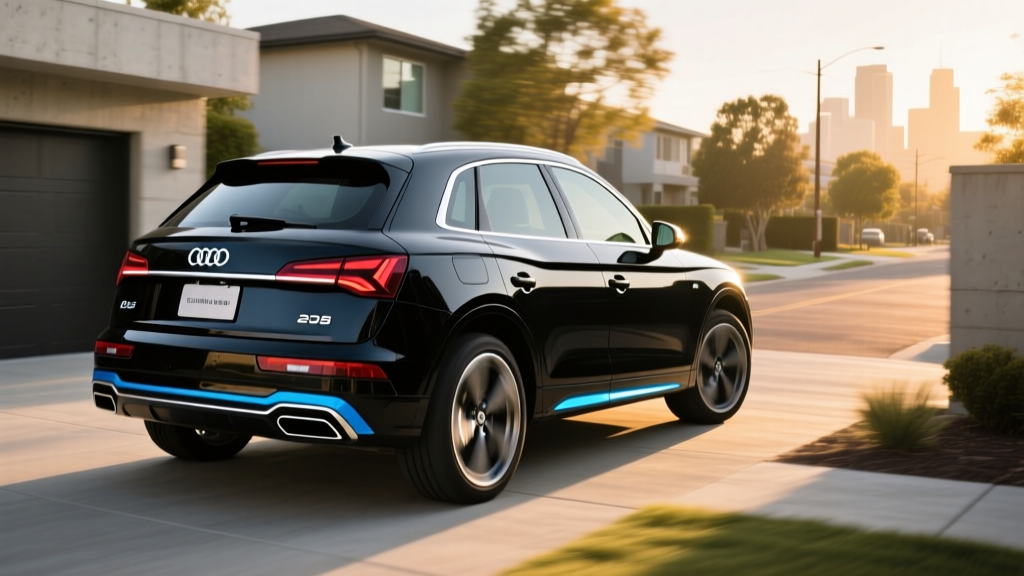
The 2026 Audi Q5 e-Hybrid (officially the Q5 55 TFSI e quattro) occupies a narrow but compelling lane: it's a plug-in hybrid luxury SUV for buyers who want daily electric commuting without surrendering the freedom to road-trip without planning charger stops. With an EPA-rated 23 miles of electric-only range, a combined 362 horsepower, and Audi's quattro all-wheel drive, it targets the executive who has a home charger but isn't ready to commit fully to a battery-electric vehicle.
But at a starting MSRP of approximately $58,295 (Premium trim), and with an electric range that trails some competitors, the Q5 e-Hybrid demands scrutiny. Below, we break down every spec that matters — from real-world MPGe to battery warranty, from §30D tax-credit eligibility to whether a conventional HEV, a PHEV like this one, or a full BEV actually fits your life.
HEV vs. PHEV: Where the Q5 e-Hybrid Fits
Before evaluating the Q5 e-Hybrid, it's essential to distinguish the two hybrid architectures on the market. The Audi Q5 e-Hybrid is a plug-in hybrid electric vehicle (PHEV) — it has a larger battery than a conventional hybrid, can be plugged into a wall or public charger, and delivers meaningful electric-only driving. A conventional hybrid (HEV), like the Toyota RAV4 Hybrid, has a small battery charged solely by regenerative braking and the engine; it cannot be plugged in and typically offers less than one mile of electric-only driving.
| Attribute | HEV (e.g., RAV4 Hybrid) | PHEV (Audi Q5 e-Hybrid) | BEV (e.g., Audi Q8 e-tron) |
|---|---|---|---|
| Plug-in charging | No | Yes | Yes |
| Electric-only range | <1 mile | 23 miles (EPA) | 200-400+ miles |
| Battery size | ~1-2 kWh | 17.9 kWh (gross) | 80-114 kWh |
| Gas engine | Yes | Yes | No |
| DC fast charging | N/A | No | Yes |
| Tailpipe emissions | Low | Zero (EV mode) / Low (hybrid) | Zero |
The Q5 e-Hybrid's PHEV setup is ideal if your daily commute is under 20 miles round-trip and you have access to Level 2 home charging. You'll drive electrically most weekdays and burn gasoline only on longer trips. If you can't charge at home or work, a PHEV's advantage erodes — you're essentially carrying dead battery weight and paying a premium for electrons you never use.
Fuel Economy and Electric-Only Range
The EPA rates the 2026 Audi Q5 55 TFSI e quattro at 64 MPGe combined when operating in electric mode and 26 MPG combined (24 city / 28 highway) when running as a conventional hybrid after the battery is depleted. The electric-only range is 23 miles per a full charge, according to fueleconomy.gov.
| Mode | City | Highway | Combined |
|---|---|---|---|
| Electric (MPGe) | 67 MPGe | 61 MPGe | 64 MPGe |
| Hybrid (MPG, battery depleted) | 24 MPG | 28 MPG | 26 MPG |
| Electric-only range | 23 miles (EPA) | ||
| Total combined range | ~380 miles (est.) | ||
Real-world expectations: In mixed suburban driving with moderate temperatures, owners typically see 20-24 miles of electric range before the engine engages. In cold weather (below 35°F), expect that figure to drop to 16-18 miles due to cabin heating demands and reduced battery efficiency. On the highway at 70+ mph, electric range may fall to 15-17 miles. Once the battery is depleted, real-world hybrid MPG tends to track closely with the EPA's 26 MPG combined — some drivers report 27-28 MPG in gentle city driving, while aggressive highway runs can drop it to 23-24 MPG.
EPA electric range: 23 miles.
Expect ~20-24 miles in mild weather city/suburban driving.
Expect ~16-18 miles in cold weather (below 35°F).
Expect ~15-17 miles at sustained highway speeds (70+ mph).
Compared to the BMW X5 xDrive50e (38 miles electric) or the Lexus TX 550h+ (33 miles), the Q5 e-Hybrid's 23-mile electric range is modest. If your commute exceeds 25 miles one-way, you'll be burning gasoline every day — at which point the value proposition of the PHEV premium narrows.
Powertrain, Performance, and Charging
The Q5 55 TFSI e pairs a 2.0-liter turbocharged four-cylinder engine (261 hp) with an electric motor (141 hp) integrated into the seven-speed S tronic dual-clutch transmission. Combined system output is 362 horsepower and 369 lb-ft of torque, routed through Audi's quattro all-wheel drive system. The 0-60 mph sprint takes approximately 5.0 seconds, making it genuinely quick for a luxury SUV.
| Specification | Value |
|---|---|
| Engine | 2.0L turbocharged I-4 (261 hp) |
| Electric motor | 141 hp (integrated in transmission) |
| Combined output | 362 hp / 369 lb-ft |
| Transmission | 7-speed S tronic dual-clutch |
| Drivetrain | quattro AWD |
| Battery (gross / usable) | 17.9 kWh / ~14.4 kWh |
| Battery chemistry | NMC (nickel manganese cobalt) |
| 0-60 mph | 5.0 seconds |
| EPA electric range | 23 miles |
| EPA combined (hybrid mode) | 26 MPG |
| EPA combined (electric mode) | 64 MPGe |
| Level 2 charge rate | 7.4 kW |
| Level 2 charge time (0-100%) | ~2.5 hours |
| DC fast charging | Not available |
| Towing capacity | 4,400 lbs |
| Cargo volume (behind 2nd row) | 24.7 cu ft |
Charging reality: The Q5 e-Hybrid uses a standard J1772 connector for Level 2 AC charging at up to 7.4 kW. A full charge from empty takes approximately 2.5 hours on a 240-volt Level 2 home charger. There is no DC fast-charging capability — this is common for PHEVs with smaller batteries, since a 17.9 kWh pack doesn't justify the cost and weight of DC hardware. On a standard 120-volt Level 1 outlet (1.4 kW), a full charge takes roughly 12-13 hours, which is workable for overnight replenishment if you can't install a Level 2 unit.
One practical note: because the battery is relatively small, the Q5 e-Hybrid benefits enormously from consistent Level 2 charging. If you plug in every night, you'll start each morning with a full 23-mile electric buffer. Without regular charging, you're paying a PHEV premium for a heavy HEV.
Pricing, Trims, and Tax-Credit Eligibility
The 2026 Audi Q5 55 TFSI e is offered in three trims:
- Premium: ~$58,295 MSRP
- Premium Plus: ~$62,795 MSRP
- Prestige: ~$67,295 MSRP
These prices include destination but exclude dealer-installed options. Fully loaded Prestige models with packages can approach $75,000.
Federal tax credit (§30D): This is where the Q5 e-Hybrid faces a significant hurdle. Under current IRS rules, the new clean vehicle credit offers up to $7,500, but eligibility depends on several criteria — including MSRP caps ($80,000 for SUVs), buyer income limits ($300,000 joint / $150,000 individual modified AGI), and critically, battery-component and critical-mineral sourcing requirements. As of the 2026 model year, many Audi PHEVs do not meet the full battery-sourcing requirements, meaning the Q5 e-Hybrid may qualify for $3,750 (partial credit) or $0, depending on the specific manufacturing lot and sourcing compliance. Always verify eligibility for your specific VIN using the IRS tool at fueleconomy.gov before purchasing. The credit can be transferred to the dealer as a point-of-sale rebate if eligible.
- MSRP must be ≤ $80,000 (SUV cap) — all trims qualify ✓
- Buyer MAGI ≤ $300,000 (joint) or $150,000 (individual) — varies by buyer
- Battery components: must meet North American manufacturing threshold — check VIN
- Critical minerals: must meet sourcing threshold — check VIN
- Vehicle must be assembled in North America — Q5 is assembled in Mexico ✓
- Credit is $3,750 if one requirement met, $7,500 if both — verify per VIN
State incentives vary widely. California, Colorado, New York, and several other states offer additional rebates for PHEVs, but amounts and eligibility change frequently. Check your state energy office or AFDC state incentive database for current programs.
Battery Warranty, Reliability, and Long-Term Costs
Audi provides an 8-year / 100,000-mile warranty on the Q5 e-Hybrid's high-voltage battery, covering defects and capacity loss below a specified threshold (typically 70% of original capacity). The conventional powertrain warranty is 4 years / 50,000 miles. This battery warranty is federally mandated for emissions-related components on PZEV/LEV vehicles and is standard across the luxury PHEV segment.
High-voltage battery: 8 years / 100,000 miles (capacity retention ≥70%)
Powertrain: 4 years / 50,000 miles
Basic vehicle: 4 years / 50,000 miles
Roadside assistance: 4 years / unlimited miles
Reliability: Audi's PHEV powertrain has been in production since the 2019 model year (for the previous-generation Q5 e), and the 2.0T EA888 engine is one of the Volkswagen Group's most widely deployed and well-documented powerplants. The primary reliability concerns are not the battery itself — NMC cells in a thermally managed pack typically degrade only 5-10% over 8-10 years — but rather the complexity of the dual-powertrain system. You have an internal combustion engine, a turbocharger, a dual-clutch transmission, an electric motor, power electronics, and a high-voltage battery all working together. More components mean more potential failure points compared to a pure BEV or a conventional HEV.
Battery replacement cost: If the battery fails outside warranty, replacement is estimated at $8,000-$12,000 including labor. However, out-of-warranty failures in thermally managed NMC packs remain rare within the first 150,000 miles. Most owners will trade the vehicle before facing this cost.
Insurance: Expect premiums 10-20% higher than a gas-only Q5 45 TFSI due to the PHEV's higher MSRP and repair complexity. Get quotes before purchasing.
Who Should Choose the Q5 e-Hybrid vs. a Full EV or Gas Car?
- Your daily commute is under 25 miles round-trip and you can charge at home
- You take road trips of 300+ miles several times per year and don't want to plan around chargers
- You want a luxury compact SUV with quattro AWD and a premium interior
- You live in an apartment or area with limited public DC charging infrastructure
- You have reliable Level 2 home charging and your daily driving is under 250 miles
- You want zero tailpipe emissions and minimal maintenance (no oil changes, no engine)
- You want access to DC fast charging for road trips (20-30 min stops)
- You want to maximize fuel cost savings (electricity is cheaper per mile than gas)
- You cannot charge at home or at work
- Your budget is tighter and the PHEV premium ($5,000-$8,000 over gas Q5) isn't justified
- Your daily commute is mostly highway driving exceeding 40+ miles
The Q5 e-Hybrid's competitive set includes the BMW X5 xDrive50e (38 mi electric, larger, more expensive), the Volvo XC60 Recharge (35 mi electric, similar price), and the Lexus NX 450h+ (37 mi electric, less powerful). The Audi's advantage is its driving dynamics and interior refinement; its disadvantage is the shortest electric range in the segment.
- 362 hp provides genuinely quick acceleration (5.0 sec 0-60)
- quattro AWD standard; excellent all-weather capability
- Quiet, refined electric-only driving for short commutes
- Premium interior materials and build quality
- No range anxiety — gas engine covers long trips seamlessly
- 4,400-lb towing capacity (competitive for class)
- 23-mile electric range trails rivals (BMW X5: 38 mi, Volvo XC60: 35 mi)
- No DC fast charging — Level 2 only
- Federal tax credit may be partial ($3,750) or unavailable — verify VIN
- Cargo space reduced vs. gas Q5 due to battery placement
- Dual-powertrain complexity means higher long-term maintenance risk
- Premium fuel recommended for optimal performance
Frequently Asked Questions
How many MPG does the Audi Q5 e-Hybrid get?
The EPA rates the 2026 Q5 55 TFSI e at 64 MPGe combined in electric mode and 26 MPG combined (24 city / 28 highway) when operating as a hybrid after the battery is depleted. Real-world hybrid MPG typically falls between 24-28 depending on driving style and conditions. In electric mode for short commutes, you'll use zero gasoline.
How far can the Q5 e-Hybrid go on electric only?
The EPA rates it at 23 miles of electric-only range. In real-world mild-weather suburban driving, expect 20-24 miles. In cold weather or at highway speeds, that drops to 15-18 miles. This is shorter than the BMW X5 xDrive50e (38 mi) or Volvo XC60 Recharge (35 mi).
Does the Audi Q5 e-Hybrid qualify for a federal tax credit?
It may qualify for a partial $3,750 credit under §30D, depending on battery-component and critical-mineral sourcing compliance for your specific VIN. The full $7,500 credit is unlikely for this model. Income limits ($300k joint / $150k individual MAGI) and the $80,000 SUV MSRP cap also apply. Verify at fueleconomy.gov before purchase. The credit can be applied as a point-of-sale rebate at the dealer if eligible.
Is the Q5 e-Hybrid reliable, and what does a battery replacement cost?
Audi's PHEV powertrain has been in production since 2019, and the high-voltage battery is warrantied for 8 years / 100,000 miles against capacity loss below ~70%. Out-of-warranty battery replacement is estimated at $8,000-$12,000, though failures within 150,000 miles are uncommon in thermally managed packs. The dual-powertrain system is more complex than a pure BEV or conventional HEV, so long-term maintenance costs may be higher.
Can the Q5 e-Hybrid DC fast charge?
No. The Q5 e-Hybrid charges only via AC — at up to 7.4 kW on a Level 2 (240V) charger, taking about 2.5 hours for a full charge. On a standard 120V outlet (Level 1), a full charge takes roughly 12-13 hours. This is standard for most PHEVs with smaller battery packs.
Do I need to plug in the Q5 e-Hybrid every night?
You don't have to — the car operates perfectly as a conventional hybrid if you never plug it in. However, to capture the fuel-economy benefit and justify the PHEV price premium, consistent charging is essential. If you can't charge regularly, a conventional hybrid or gas-only Q5 may be a smarter financial choice.
How does the Q5 e-Hybrid compare to a full electric SUV like the Audi Q8 e-tron?
The Q8 e-tron offers 285+ miles of EPA range, DC fast charging at up to 170 kW, and zero tailpipe emissions — but at a starting price above $74,000 and with the need to plan longer road trips around charging stops. The Q5 e-Hybrid is less expensive, doesn't require trip planning, but offers only 23 miles of electric driving and still burns gasoline on longer trips. If you can charge at home and rarely drive more than 250 miles in a day, the Q8 e-tron delivers a more transformative EV experience. If you regularly exceed that or lack reliable charging, the PHEV is the safer choice.
Sources: fueleconomy.gov (EPA ratings), Audi USA specifications, IRS §30D Clean Vehicle Credit.