Quick Verdict: The Audi Q3 PHEV in a Crowded Compact Luxury Segment
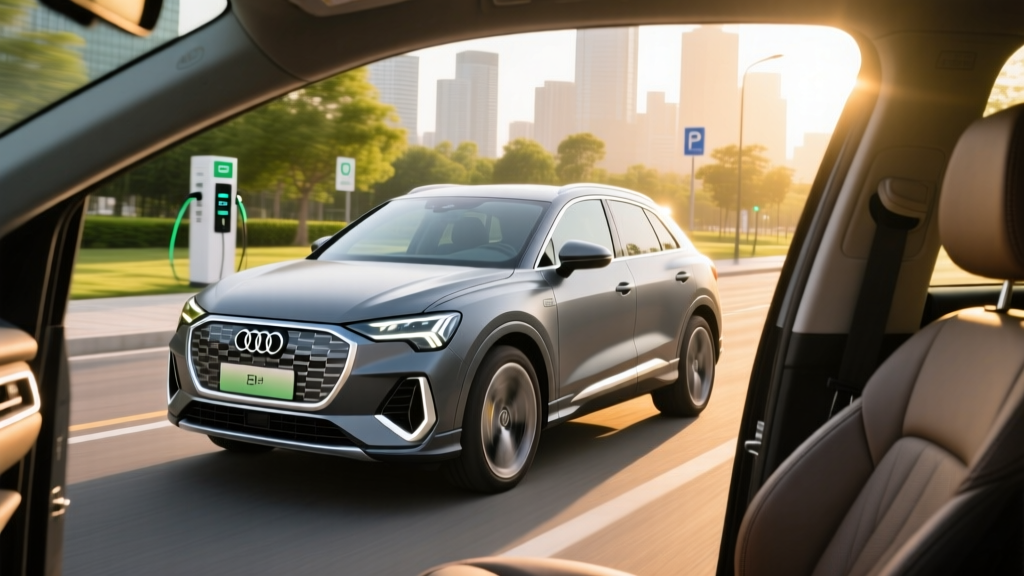
The 2026 Audi Q3 plug-in hybrid (sold globally as the Q3 TFSI e) represents Audi's electrified entry point in the subcompact luxury crossover class. With an EPA-estimated 28–32 miles of electric-only driving and a combined MPGe rating around 80, it targets buyers who want premium badging and short electric commutes without full BEV commitment. But in a market where the BMW X1 xDrive25e, Volvo XC40 Recharge, and Lincoln Corsair Grand Touring all compete for the same plug-in hybrid dollar, the Q3 PHEV has to justify its starting price north of $43,000 with real-world usability, not just the four-ring badge.
This guide breaks down every number that matters: battery capacity, electric range, charge times, powertrain output, fuel economy, warranty coverage, and federal tax credit eligibility under current IRS §30D rules. If you're weighing the Q3 plug-in hybrid against a conventional hybrid or a full EV, we'll help you decide which path makes financial and practical sense.
| Spec | Value |
|---|---|
| Powertrain | 1.4L turbocharged 4-cylinder + electric motor (PHEV) |
| Combined Horsepower | ~245 hp (system net) |
| Combined Torque | ~295 lb-ft |
| Transmission | 6-speed S tronic dual-clutch automatic |
| Battery Capacity (usable) | ~13.0 kWh (NMC lithium-ion) |
| EPA Electric-Only Range | ~28–32 miles (est.) |
| EPA Combined MPGe | ~80 MPGe (est.) |
| EPA MPG (gas-only, combined) | ~30–33 MPG combined (est.) |
| Level 2 Charge Time (0–100%) | ~3.5 hours at 3.6 kW |
| DC Fast Charging | Not available |
| 0–60 mph | ~7.3 seconds (est.) |
| Drivetrain | FWD (electric motor drives front axle) |
| Starting MSRP | ~$43,500 (est.) |
| Battery/Powertrain Warranty | 8 years / 100,000 miles (hybrid components) |
Note: The Audi Q3 PHEV is sold in European and select global markets as the Q3 40 TFSI e and Q3 45 TFSI e. US availability has been limited; buyers should confirm current model-year availability with their local Audi dealer. Specs above reflect the global Q3 TFSI e platform and are marked as estimates where US EPA certification figures are pending.
HEV vs PHEV: What's the Actual Difference?
Before diving into the Q3's specific numbers, it's worth clarifying a common source of confusion. A conventional hybrid (HEV) like the Toyota RAV4 Hybrid uses a small battery (typically 1–2 kWh) that charges exclusively through regenerative braking and the gasoline engine. You never plug it in. A plug-in hybrid (PHEV) like the Audi Q3 TFSI e carries a much larger battery (13+ kWh) that you charge from a wall outlet or Level 2 charger, enabling 25–35 miles of pure electric driving before the gas engine takes over.
| Feature | HEV (Conventional Hybrid) | PHEV (Plug-In Hybrid) |
|---|---|---|
| Battery Size | 1–2 kWh | 10–20+ kWh |
| Plug In to Charge? | No | Yes (Level 1 or Level 2) |
| Electric-Only Range | 1–2 miles at low speed | 20–50 miles (model dependent) |
| Typical MPG (gas mode) | 35–50+ MPG combined | 28–38 MPG combined |
| MPGe (electric mode) | N/A | 70–100+ MPGe |
| Federal Tax Credit | No | Potentially up to $3,750–$7,500 (§30D) |
| Price Premium Over Gas Model | $1,000–$2,500 | $4,000–$10,000+ |
The Audi Q3 PHEV sits firmly in the plug-in category. If you can charge at home or at work, the electric-only range covers most daily commutes, and the gas engine eliminates range anxiety on longer trips. If you lack reliable access to a plug, a conventional hybrid delivers better value with less complexity.
Electric-Only Range and Total Range: Real-World Expectations
The Q3 TFSI e platform carries approximately 13.0 kWh of usable battery capacity (gross capacity is higher, but the vehicle reserves a buffer to protect long-term battery health). On the EPA cycle, this translates to an estimated 28–32 miles of electric-only range. That's enough to cover the average American one-way commute of roughly 16 miles, with some buffer for errands.
EPA electric range: ~28–32 miles. In real-world driving, expect:
- City/suburban (moderate temps): 26–30 miles — PHEVs are most efficient at lower speeds with frequent regen braking.
- Highway (65–75 mph): 20–25 miles — aerodynamic drag and sustained high speed drain the battery faster.
- Cold weather (below 32°F): 18–22 miles — battery chemistry slows, cabin heating draws significant energy, and the engine may activate sooner for heat.
Once the battery depletes, the 1.4L turbo engine takes over seamlessly, and the Q3 operates as a conventional hybrid with an estimated 30–33 MPG combined. Total range (electric + gas) exceeds 400 miles on a full tank and full charge.
Charging the Q3 PHEV: What You Need to Know
The Q3 plug-in hybrid uses a standard J1772 connector for AC charging. Like nearly all PHEVs on the market, it does not support DC fast charging — the battery is simply too small to justify the hardware cost, and a full charge on Level 2 is quick enough for overnight replenishment.
| Charging Level | Power (kW) | 0–100% Time | Notes |
|---|---|---|---|
| Level 1 (120V household outlet) | ~1.4 kW | ~9–10 hours | Sufficient for overnight if daily use is under 30 miles |
| Level 2 (240V, 16A) | ~3.6 kW | ~3.5 hours | Recommended for daily PHEV charging; full battery by morning |
| DC Fast Charging | N/A | N/A | Not supported on Q3 PHEV |
For most PHEV owners, a Level 2 home charger is the sweet spot. A 240V outlet (NEMA 14-50 or hardwired wallbox at 16–32 amps) will fully replenish the 13 kWh battery in roughly 3.5 hours. Many owners simply plug in when they get home and wake up to a full battery every morning. The onboard charger in the Q3 TFSI e is limited to approximately 3.6 kW, so installing a 7.2 kW or 11.5 kW Level 2 station won't charge the Q3 any faster than a basic 3.6 kW unit — save your money on the charger hardware and put it toward installation.
Home charging installation cost: Expect $500–$1,500 for a straightforward Level 2 install (240V outlet or wallbox near the panel). If your electrical panel needs an upgrade to 200A, costs can reach $2,000–$4,000. Always get a quote from a licensed electrician before committing.
Powertrain and Performance: How It Drives
The Q3 PHEV pairs a 1.4-liter turbocharged four-cylinder engine (producing roughly 150 hp on its own) with an electric motor integrated into the transmission housing (approximately 115 hp). Combined system output reaches an estimated 245 horsepower and 295 lb-ft of torque, routed to the front wheels through a 6-speed S tronic dual-clutch automatic.
The result is a 0–60 mph time in the low-to-mid 7-second range — respectable for a luxury subcompact crossover, though not sporty. The electric motor provides instant torque from a stop, making the Q3 PHEV feel quicker in city driving than its 0–60 time suggests. At highway speeds, the transition between electric and gas power is nearly imperceptible, a hallmark of Audi's PHEV tuning.
Multiple drive modes let you prioritize electric-only driving (EV mode), blend gas and electric for maximum efficiency (Hybrid mode), or hold battery charge for later use (Battery Hold) — useful if you're driving to a low-emission zone or want electric power for the final stretch of a trip.
Fuel Economy: EPA Numbers and Real-World MPG
Fuel economy is where PHEVs get complicated — and where the Q3 is no exception. The EPA rates plug-in hybrids with two figures: MPGe (miles per gallon equivalent, measuring efficiency when running on electricity) and MPG (standard miles per gallon when the battery is depleted and the gas engine is doing the work).
| Mode | City | Highway | Combined |
|---|---|---|---|
| Electric + Gas (MPGe) | ~85 MPGe | ~75 MPGe | ~80 MPGe |
| Gas Only (charge-depleted MPG) | ~32 MPG | ~30 MPG | ~31 MPG |
Real-world MPG vs EPA: PHEVs are highly sensitive to how often you charge. If you plug in nightly and your commute is under 30 miles, you may use almost no gasoline for weeks, effectively achieving 100+ MPGe. If you never plug in, you'll see the charge-depleted figure of roughly 31 MPG combined — still better than the gas-only Audi Q3 (rated around 25–27 MPG combined), but not dramatically so. The fuel-economy advantage of a PHEV is directly proportional to how often you charge it.
For comparison, the gas-only 2026 Audi Q3 with the 2.0L turbo achieves an EPA-estimated 24 city / 31 highway / 27 combined MPG. The PHEV's advantage is most pronounced in stop-and-go city driving where electric mode and regenerative braking shine.
Pricing, Tax Credits, and Total Cost
The 2026 Audi Q3 plug-in hybrid is expected to start around $43,500 MSRP (before destination), placing it at a $5,000–$7,000 premium over the gas-only Q3. Higher trims with Premium Plus or Prestige packages can push the price above $50,000.
The Audi Q3 PHEV may qualify for a partial or full federal tax credit under IRS §30D, but eligibility depends on several factors that change frequently:
- Battery capacity: Must be ≥7 kWh — the Q3 PHEV qualifies (~13 kWh).
- MSRP cap: SUVs/crossovers must be under $80,000 — the Q3 PHEV qualifies.
- Buyer income cap: Modified AGI must not exceed $150,000 (single) / $300,000 (joint) — verify with a tax professional.
- Critical minerals & battery sourcing: The credit is split into two halves ($3,750 each) based on critical-mineral and battery-component requirements. Sourcing rules tighten annually; check the latest IRS guidance for the current year.
- Point-of-sale transfer: As of 2024+, buyers can transfer the credit to the dealer for an upfront price reduction rather than waiting to claim it on their tax return.
Important: Tax credit eligibility varies by model year, build date, and battery sourcing. Always verify current eligibility on fueleconomy.gov and consult a tax professional before purchasing.
Total cost of ownership perspective: If you charge at home using off-peak electricity at $0.13/kWh, fully charging the 13 kWh battery costs roughly $1.70 — equivalent to about $0.06 per electric mile. Compare that to gasoline at $3.50/gallon and 31 MPG, which works out to $0.11 per mile. Over 15,000 miles per year with 70% electric driving, the PHEV could save $600–$900 annually in fuel costs versus the gas Q3. That pays back the price premium in roughly 6–8 years without tax credits, or 4–5 years with a partial credit.
Battery Warranty, Reliability, and Replacement Cost
Audi covers the Q3 PHEV's high-voltage battery and hybrid-specific components for 8 years or 100,000 miles (whichever comes first), consistent with federal emissions warranty requirements. The warranty covers battery capacity loss below a specified threshold (typically 70% of original capacity) as well as defects in the electric motor, power electronics, and charging system.
The standard new-vehicle limited warranty is 4 years / 50,000 miles.
Reliability outlook: Audi's PHEV powertrain has been in use across the VW Group's MQB platform vehicles (including the A3 e-tron, Golf GTE, and various European-market models) since approximately 2015. The 1.4L TFSI engine and integrated electric motor have a mature track record. The primary reliability concern for any PHEV is the dual complexity of maintaining both an internal combustion system and a high-voltage electric system — though the battery itself has proven durable in VW Group applications, with most units retaining 85–90%+ capacity after 100,000 miles.
Battery replacement cost: If the high-voltage battery needs replacement outside of warranty, expect a cost in the range of $6,000–$10,000 (parts and labor) based on current VW Group PHEV battery pricing. However, complete battery failure is rare; more commonly, individual modules can be serviced. For most owners who sell or trade the vehicle within 8–10 years, this cost is unlikely to materialize.
Who Should Buy the Q3 PHEV — and Who Shouldn't
Choose the Audi Q3 PHEV if:
- You have home or workplace charging access and a commute under 30 miles round-trip.
- You want a luxury compact crossover but aren't ready to commit to a full EV.
- You take regular road trips where charging infrastructure is sparse.
- You value the premium interior, build quality, and brand cachet of Audi.
Choose a full EV (like the Audi Q4 e-tron) if:
- You can install Level 2 home charging and rarely drive more than 250 miles in a day.
- You want maximum fuel savings, zero tailpipe emissions, and minimal maintenance.
- You want a larger battery (77+ kWh) and 200+ mile range for flexibility.
Choose a conventional hybrid (like the Lexus UX 250h) if:
- You cannot plug in at home or work.
- You want hybrid fuel savings without the PHEV price premium or charging hassle.
- You prioritize proven reliability and lower purchase cost over electric-only driving.
Pros and Cons at a Glance
- ~28–32 miles electric-only covers most commutes
- Premium Audi interior with solid build quality
- Seamless gas-electric powertrain transitions
- No range anxiety — gas engine for long trips
- Potential partial federal tax credit
- 8-year/100,000-mile hybrid battery warranty
- $5,000–$7,000 price premium over gas Q3
- FWD only — no quattro AWD on PHEV variant
- No DC fast charging capability
- 3.6 kW onboard charger limits Level 2 speed
- Electric range drops significantly in cold weather
- US availability may be limited — confirm with dealer
- Cargo space reduced vs gas Q3 due to battery placement
Frequently Asked Questions
How many MPG does the Audi Q3 plug-in hybrid get?
When the battery is charged and you're driving in blended electric-gas mode, the Q3 PHEV achieves an estimated 80 MPGe combined. Once the battery depletes and the vehicle operates on gasoline alone, expect approximately 31 MPG combined (32 city / 30 highway). Real-world results depend heavily on how frequently you charge — plug in daily and your effective MPG can be far higher than the EPA sticker suggests.
How far can the Audi Q3 PHEV go on electric only?
The EPA-estimated electric-only range is approximately 28–32 miles. In real-world conditions, expect 26–30 miles in mild city driving, 20–25 miles at highway speeds, and 18–22 miles in freezing temperatures. Once the battery is depleted, the gasoline engine takes over automatically with no driver intervention required.
Hybrid vs PHEV vs EV — which is right for me?
A conventional hybrid (HEV) is best if you can't plug in at home and want better fuel economy with zero behavior change. A plug-in hybrid (PHEV) like the Q3 TFSI e is ideal if you have charging access, a short commute, and still want a gas engine for road trips. A full EV (BEV) makes sense if you want maximum savings, have reliable charging, and your daily driving rarely exceeds 200 miles. The PHEV is the "bridge" option — it rewards you for charging but never strands you without a gas backup.
Is the Audi Q3 PHEV reliable, and what does battery replacement cost?
The VW Group's PHEV powertrain has been in production since 2015 and has a solid reliability track record. The high-voltage battery is warrantied for 8 years / 100,000 miles. Out-of-warranty battery replacement is estimated at $6,000–$10,000, but complete battery failure is uncommon — most PHEV batteries retain 85–90%+ capacity well past 100,000 miles. Regular maintenance on the gasoline engine (oil changes, spark plugs) still applies.
Does the Audi Q3 plug-in hybrid qualify for a federal tax credit?
The Q3 PHEV may qualify for a partial federal tax credit under IRS §30D, potentially up to $3,750 depending on battery sourcing and critical-mineral requirements. Full $7,500 eligibility is unlikely for most imported Audi models under current sourcing rules. Eligibility also depends on your income (under $150K single / $300K joint), the vehicle's MSRP (must be under $80K for SUVs), and model-year-specific battery component sourcing. Verify current eligibility on irs.gov and consult a tax professional before purchasing.
Can I charge the Q3 PHEV on a regular household outlet?
Yes. Level 1 charging on a standard 120V outlet delivers about 1.4 kW, which will fully charge the 13 kWh battery in roughly 9–10 hours. For most owners who plug in overnight, this is sufficient to start each morning with a full battery. A 240V Level 2 charger cuts that time to about 3.5 hours.
Does the Q3 PHEV have all-wheel drive?
No. The Q3 TFSI e platform sends power to the front wheels only (FWD). If quattro all-wheel drive is a priority, you'll need to look at the gas-only Q3 45 TFSI or consider the larger Audi Q5 PHEV, which offers AWD in its plug-in configuration.
Sources: fueleconomy.gov (EPA fuel economy data), IRS §30D Clean Vehicle Credits, Audi global press specifications for the Q3 TFSI e. All specifications are estimates based on the global Q3 TFSI e platform and may differ from final US-market EPA-certified figures. Always confirm with your local Audi dealer and the EPA before purchasing.