Quick Verdict: Where Audi's PHEVs Stand in 2026
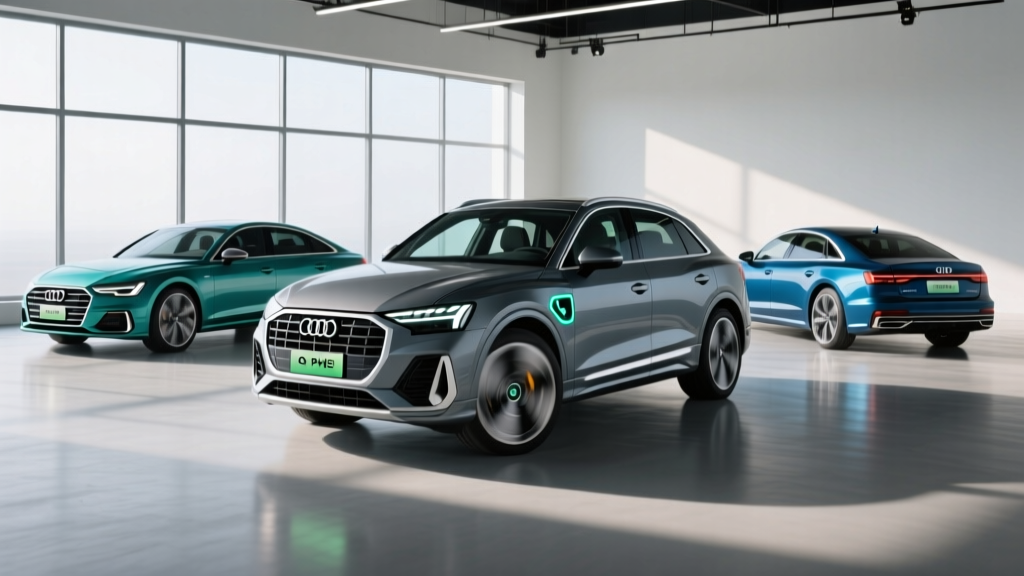
Audi's plugin hybrid strategy in 2026 centers on the TFSI e badge — a 2.0-liter turbocharged four-cylinder paired with an electric motor integrated into the transmission housing. The lineup spans the compact Q5 SUV, the midsize A6 sedan, and the redesigned Q7 three-row. Each targets a buyer who wants electric-only commuting without sacrificing the ability to road-trip without charging stops.
These are not range-extender experiments. They're production vehicles with 20–26 miles of EPA-rated electric-only range, 300+ combined horsepower, and pricing that starts in the mid-$50,000s. For buyers researching an Audi plugin hybrid, the key decision is whether your daily commute fits inside that electric envelope — and whether you have reliable home charging to make it work.
HEV vs PHEV: What Audi Actually Offers
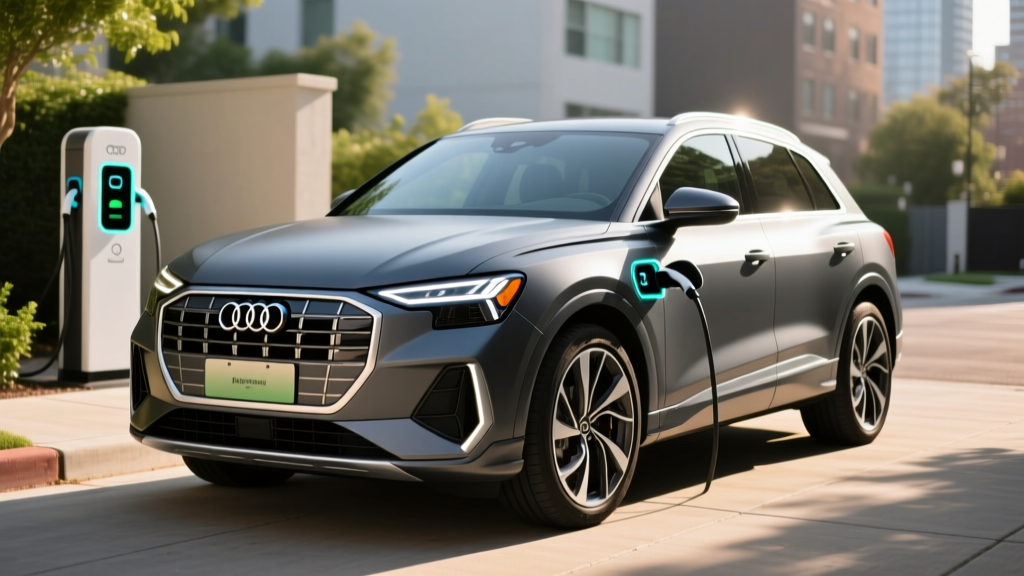
Audi does not sell conventional hybrids (HEVs) in the U.S. market. Every electrified Audi with a gas engine is a plugin hybrid electric vehicle (PHEV), meaning it has a larger battery you charge from an external power source — a wall outlet, Level 2 home charger, or public station.
Key Differences at a Glance
| Feature | Conventional Hybrid (HEV) | Plugin Hybrid (PHEV) — Audi TFSI e |
|---|---|---|
| Plug-in charging | No — self-charging via regen and engine | Yes — Level 1 (120V) and Level 2 (240V) |
| Battery size | 1–2 kWh | 17.9–25.9 kWh (usable) |
| Electric-only range | 0–2 miles at low speed | 20–26 miles EPA |
| Can drive on electric only? | Briefly, at low speeds | Yes, up to ~84 mph |
| DC fast charging | No | No (AC charging only on current models) |
| Federal tax credit eligible | No | Potentially — up to $3,750–$7,500 under §30D |
The distinction matters practically: if you cannot charge at home or work, a PHEV becomes a heavy, less-efficient gas car. The battery adds roughly 300–400 lbs. Without regular charging, you'll see worse fuel economy than a purpose-built HEV like the Toyota RAV4 Hybrid.
The 2026 Audi Plugin Hybrid Lineup: Specs & Pricing
| Spec | Q5 55 TFSI e | A6 55 TFSI e | Q7 55 TFSI e |
|---|---|---|---|
| Body style | Compact SUV | Midsize sedan | Three-row SUV |
| Engine | 2.0L turbo I4 | 2.0L turbo I4 | 2.0L turbo I4 |
| Electric motor | Integrated in transmission | Integrated in transmission | Integrated in transmission |
| Combined HP | 362 hp / 369 lb-ft | 362 hp / 369 lb-ft | 375 hp / 369 lb-ft |
| Battery (usable kWh) | 17.9 kWh (NMC) | 17.9 kWh (NMC) | 25.9 kWh (NMC) |
| EPA electric-only range | 23 miles | 22 miles | 26 miles |
| Total combined range | ~440 miles | ~460 miles | ~480 miles |
| EPA MPGe (electric+gas) | 61 MPGe | 63 MPGe | 58 MPGe |
| EPA MPG (gas only, battery depleted) | 25 city / 27 hwy / 26 combined | 26 city / 30 hwy / 28 combined | 22 city / 25 hwy / 23 combined |
| 0–60 mph | 5.0 sec | 4.9 sec | 5.5 sec |
| Level 2 charge time (0–100%) | ~2.5 hours at 7.2 kW | ~2.5 hours at 7.2 kW | ~3.5 hours at 7.2 kW |
| Level 1 charge time (120V) | ~8 hours | ~8 hours | ~12 hours |
| DC fast charging | No | No | No |
| Drivetrain | quattro AWD | quattro AWD | quattro AWD |
| Starting MSRP | $57,995 | $63,495 | $72,495 |
Source: fueleconomy.gov and Audi USA official specifications, 2026 model year. Pricing excludes destination charge.
Electric-Only Range: Real-World Expectations
Real-World Electric Range vs. EPA Sticker
Q5 55 TFSI e: EPA 23 miles → expect 18–21 miles in mixed driving, 15–17 miles in cold weather (below 40°F) or sustained highway speeds above 70 mph.
A6 55 TFSI e: EPA 22 miles → expect 17–20 miles mixed, 14–16 miles cold/highway.
Q7 55 TFSI e: EPA 26 miles → expect 21–24 miles mixed, 18–20 miles cold/highway. The larger 25.9 kWh battery gives this model a meaningful advantage.
Electric-only range in a PHEV is heavily influenced by three factors:
- Temperature: Lithium-ion batteries lose 20–30% of effective capacity in freezing conditions. The cabin heater also draws from the traction battery unless you precondition while plugged in.
- Speed: Electric efficiency drops sharply above 65 mph. Highway-only commutes will yield the lowest electric range.
- Climate control: Running HVAC on battery power alone can cut electric range by 3–5 miles, especially in extreme heat or cold.
A practical rule: if your one-way commute is 15 miles or less and you can charge at home every night, you'll run on electricity for the vast majority of daily driving. If your commute exceeds 20 miles one way, the gas engine will engage regularly.
Charging: What You Need at Home
All 2026 Audi TFSI e models accept a maximum of 7.2 kW on Level 2 (240V AC). None of them support DC fast charging — a notable limitation compared to competitors like the BMW X5 xDrive50e, which also lacks DC charging, or the Chrysler Pacifica Hybrid, which similarly maxes out at Level 2.
| Charging Level | Power | Q5 / A6 (17.9 kWh) | Q7 (25.9 kWh) | Miles of EV Range per Hour |
|---|---|---|---|---|
| Level 1 (120V household) | ~1.4 kW | ~8 hours (0–100%) | ~12 hours (0–100%) | ~3 miles/hr |
| Level 2 (240V, 32A) | 7.2 kW | ~2.5 hours (0–100%) | ~3.5 hours (0–100%) | ~9–10 miles/hr |
| DC Fast Charge | Not supported | N/A | N/A | N/A |
Home charging setup: A Level 2 wallbox (such as a ChargePoint Home Flex or Emporia Level 2) installed on a 40A or 48A circuit will fully recharge any Audi TFSI e overnight. Expect installation costs of $500–$2,000 depending on your electrical panel's capacity and the distance from panel to charger location. If your home has a 100A panel, a panel upgrade to 200A may be required — budget an additional $1,500–$3,000 for that work.
Level 1 charging from a standard 120V outlet is technically sufficient if you drive less than 15 miles per day and park for 10+ hours, but it's marginal for the Q7's larger battery.
Fuel Economy: EPA Numbers vs. Real-World MPG
| Model | EPA City (gas) | EPA Highway (gas) | EPA Combined (gas) | MPGe (elec+gas) |
|---|---|---|---|---|
| Q5 55 TFSI e | 25 | 27 | 26 | 61 |
| A6 55 TFSI e | 26 | 30 | 28 | 63 |
| Q7 55 TFSI e | 22 | 25 | 23 | 58 |
Gas-only MPG figures apply when the battery is depleted and the vehicle operates as a conventional hybrid. fueleconomy.gov, 2026 model year.
Real-world MPG context: PHEVs behave differently from conventional hybrids once the battery is depleted. Expect the gas-only MPG to vary by 2–4 MPG depending on driving style and terrain. The A6 sedan, being lighter and more aerodynamic, tends to outperform its EPA highway estimate by 1–2 MPG on flat interstates. The Q5 and Q7, with more frontal area and weight, typically match or slightly underperform EPA highway figures.
If you charge daily and commute within the electric range, your effective fuel consumption can drop to near-zero for weekday driving. Owners who never plug in will see 23–28 MPG combined — respectable for the vehicle class, but not exceptional compared to a dedicated hybrid like the Toyota Highlander Hybrid (36 MPG combined).
Tax Credit Eligibility: What §30D Means for Audi PHEVs
2026 Federal Tax Credit (§30D) Requirements for PHEVs
- Battery capacity: Must be ≥7 kWh — all Audi TFSI e models qualify (17.9–25.9 kWh).
- MSRP cap: SUVs (Q5, Q7) capped at $80,000; sedans (A6) capped at $55,000.
- Buyer income cap: AGI ≤ $150,000 (single), ≤ $225,000 (head of household), ≤ $300,000 (joint).
- Battery component sourcing: Percentage of components manufactured/assembled in North America must meet 2026 thresholds.
- Critical minerals: Percentage of critical minerals sourced from the U.S. or FTA partners must meet 2026 thresholds.
- Point-of-sale transfer: Eligible buyers can transfer the credit to the dealer as a down-payment reduction at purchase.
Practical impact for Audi buyers: The A6 55 TFSI e starts at $63,495, which exceeds the $55,000 sedan MSRP cap. This means the A6 sedan is not eligible for the federal §30D credit at any trim level unless Audi adjusts pricing. The Q5 and Q7, classified as SUVs, fall under the $80,000 cap, and base trims should qualify — but higher trims (Prestige, S line packages) may push the MSRP above the limit.
Critical mineral and battery component sourcing rules have tightened significantly since 2024. Audi's battery supply chain may partially or fully meet these requirements, but the exact credit amount (anywhere from $0 to $7,500) depends on current-year sourcing compliance. Always verify eligibility using the IRS's official list at irs.gov before purchasing, and consult a tax professional for your specific situation.
Battery Warranty, Reliability & Replacement Cost
Audi PHEV Battery Warranty
Coverage: 8 years / 100,000 miles (whichever comes first)
Capacity retention guarantee: Battery must retain ≥70% of original capacity during the warranty period. If degradation exceeds 30%, Audi will repair or replace the battery at no cost.
Powertrain warranty: 4 years / 50,000 miles for the engine and transmission.
Reliability considerations: Audi's PHEV powertrain uses a well-proven 2.0L TFSI engine mated to an electric motor in the transmission bell housing. The complexity is higher than a pure EV (two power sources, a clutch system to engage/disengage the engine, and a high-voltage battery), but the components are largely carryover from previous model years with iterative refinements.
Historical data from Audi's earlier TFSI e models (2020–2024) shows battery degradation of approximately 5–8% over the first 100,000 miles under normal use — well within the 70% retention warranty threshold. NMC chemistry, which Audi uses, offers strong energy density but is more sensitive to repeated 100% charges and deep discharges than LFP. Best practice: set your charge limit to 80–90% for daily use and reserve 100% charges for days when you need maximum electric range.
Out-of-warranty battery replacement cost: If the high-voltage battery requires replacement after the warranty expires, expect a cost of $8,000–$14,000 for the battery pack, plus $1,500–$2,500 for labor. Individual module replacement (if only one cell group has failed) may cost $2,000–$4,000 at a specialist shop.
Who Should Buy an Audi PHEV — And Who Should Look Elsewhere
Choose an Audi TFSI e PHEV if:
- Your daily round-trip commute is 25 miles or less and you can charge at home nightly.
- You want a premium badge with strong acceleration (362+ hp) and standard quattro AWD.
- You take road trips of 200+ miles regularly and don't want to plan around DC fast chargers.
- You live in a cold climate where EV range loss is a concern — the gas engine provides backup.
- You value the Audi interior quality, Virtual Cockit, and MMI infotainment system.
Consider a full BEV (like the Audi Q8 e-tron or Tesla Model Y) if:
- Your commute is under 20 miles and you rarely drive more than 250 miles without stopping.
- You want to eliminate oil changes, spark plugs, and engine maintenance entirely.
- You have reliable DC fast charging along your regular routes.
- You want to maximize fuel-cost savings (electricity at $0.14/kWh costs roughly $0.04/mile vs. $0.12–$0.16/mile for gas).
Consider a conventional HEV (Toyota, Honda) if:
- You cannot charge at home or at work.
- You want maximum fuel efficiency without behavioral changes (no plugging in).
- Your budget is under $40,000.
Pros
- 20–26 miles of electric-only range covers most daily commutes
- 362–375 combined HP with smooth electric torque fill
- Standard quattro AWD on all TFSI e models
- No range anxiety — gas engine provides 400+ total miles
- Premium interior, strong build quality, advanced driver assists
- Potential federal tax credit on Q5 and Q7 (up to $7,500)
Cons
- No DC fast charging — Level 2 only
- A6 sedan exceeds $55,000 MSRP cap — ineligible for federal credit
- Electric range drops significantly in cold weather (20–30%)
- Higher starting price than non-premium PHEV competitors
- Complex powertrain means more potential maintenance points long-term
- Gas-only MPG (23–28 combined) is unremarkable if you don't charge regularly
Frequently Asked Questions
How many MPG does an Audi plugin hybrid get?
When the battery is depleted and the car runs on gas alone, the Q5 gets 26 MPG combined, the A6 gets 28 MPG combined, and the Q7 gets 23 MPG combined (EPA estimates). When factoring in electric-only driving, MPGe ratings range from 58 to 63. Real-world results vary by driving style, temperature, and whether you charge regularly.
How far can an Audi PHEV go on electric only?
The EPA rates the Q5 at 23 miles, the A6 at 22 miles, and the Q7 at 26 miles of electric-only range. In real-world driving, expect 18–24 miles depending on temperature and speed. Highway driving and cold weather reduce this to 14–20 miles.
Does the Audi plugin hybrid qualify for a tax credit?
Under current IRS §30D rules, the Q5 and Q7 (SUVs with MSRP under $80,000) may qualify for up to $7,500, depending on battery sourcing requirements and your income. The A6 sedan starts at $63,495, exceeding the $55,000 sedan cap, making it ineligible. Always check the IRS eligible vehicle list and consult a tax professional before relying on credit availability.
Is the Audi PHEV battery reliable and what does replacement cost?
Audi covers the high-voltage battery for 8 years / 100,000 miles with a 70% capacity retention guarantee. Historical degradation data from earlier TFSI e models shows 5–8% loss over 100,000 miles. Out-of-warranty replacement costs $8,000–$14,000 for the full pack, though individual module repairs may be less expensive.
Can I DC fast charge an Audi TFSI e?
No. All 2026 Audi TFSI e models support AC charging only — up to 7.2 kW on Level 2 (240V). A full charge takes 2.5 to 3.5 hours depending on battery size. For faster charging on road trips, you'll rely on the gas engine rather than electric power.
Hybrid vs PHEV vs EV — which is right for me?
If you can charge at home and your daily driving is under 25 miles, a PHEV like the Audi TFSI e gives you electric commuting with gas-engine flexibility. If you can charge at home and rarely exceed 250 miles between stops, a full BEV eliminates engine maintenance and offers lower per-mile fuel costs. If you cannot charge at home, a conventional HEV (non-plugin) is the most practical choice — never plug in, just drive.
What happens if I never plug in my Audi PHEV?
The car will operate as a conventional hybrid, using the engine and regenerative braking to manage a small charge buffer. You'll get 23–28 MPG combined depending on the model — adequate for the class but not exceptional. You'll also miss out on the performance benefit of electric torque assist and the fuel-cost savings that make PHEV ownership worthwhile.