Audi's Plug-In Hybrid SUV Strategy in 2026
Audi's approach to electrification splits between full battery-electric models (the e-tron family) and its TFSI e plug-in hybrid lineup. For buyers not ready to commit to a pure EV — whether due to charging access limitations, frequent long road trips, or simply wanting a transitional step — an Audi plug in hybrid SUV offers a compelling middle ground. You get 20-30 miles of electric-only commuting paired with a turbocharged gas engine for unlimited range when you need it.
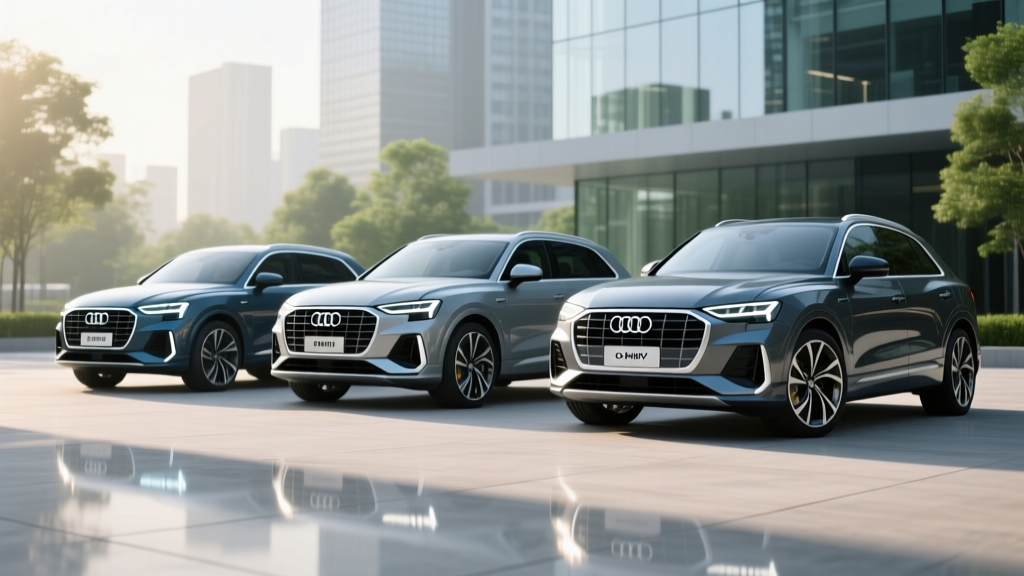
For 2026, Audi offers three plug-in hybrid SUVs in the US market: the compact Q5 TFSI e, the three-row Q7 TFSI e, and the performance-oriented Q8 TFSI e. Each pairs a turbocharged engine with an electric motor and a lithium-ion battery pack you can charge at home or at public Level 2 stations. None of these support DC fast charging — a notable limitation we'll address below.
Before we examine each model, it's worth clarifying the fundamental difference between conventional hybrids and plug-in hybrids, since Audi's lineup can confuse first-time hybrid shoppers.
HEV vs PHEV: What's the Difference?
| Feature | Conventional Hybrid (HEV) | Plug-In Hybrid (PHEV) |
|---|---|---|
| Plugs in to charge? | No — charges via regenerative braking and engine | Yes — plug in for full electric range |
| Electric-only range | 0-1 miles at low speed | 20-30+ miles at highway speed |
| Battery size | 1-2 kWh | 14-25 kWh |
| Federal tax credit | No | Potentially up to $7,500 (§30D) |
| Best for | Drivers who can't plug in at all | Drivers with home/work charging who want EV commuting + gas flexibility |
All three Audi plug-in hybrid SUVs discussed here are PHEVs — they require plugging in to access their full electric-only range. If you never plug in a PHEV, it functions as a heavy, less-efficient conventional hybrid, defeating the purpose of the purchase.
2026 Audi Q5 TFSI e: The Volume Seller
The Q5 TFSI e remains Audi's most accessible plug-in hybrid SUV and the model most buyers cross-shop against the BMW X5 xDrive50e, Volvo XC60 Recharge, and Lexus NX 450h+. For 2026, the Q5 TFSI e carries over with a 2.0-liter turbocharged four-cylinder engine paired with an electric motor integrated into the seven-speed S tronic transmission.
| Spec | Value |
|---|---|
| Combined horsepower | 362 hp |
| Combined torque | 369 lb-ft |
| Engine | 2.0L turbo I4 + electric motor |
| Battery capacity | 17.9 kWh (gross) / ~14.4 kWh usable |
| Battery chemistry | NMC (nickel manganese cobalt) |
| EPA electric-only range | 23 miles |
| Total combined range | ~420 miles |
| EPA MPGe (electric + gas) | 61 MPGe combined |
| Gas-only MPG (after battery depletes) | 27 city / 28 highway / 27 combined |
| Level 2 charge time (0-100%) | ~2.5 hours at 7.2 kW |
| DC fast charging | Not available |
| 0-60 mph | 5.0 seconds |
| Drivetrain | quattro AWD |
| Starting MSRP | $58,495 (Premium Plus) |
Real-World Range and MPG
EPA electric range: 23 miles
Real-world expectation: 18-21 miles in mixed driving, 15-17 miles in cold weather (below 35°F), up to 24 miles in mild city driving with regen.
Gas-only MPG after battery depletion: 27 combined EPA
Real-world expectation: 28-31 MPG in city (hybrids overperform EPA in stop-and-go), 25-27 MPG highway at 70+ mph.
The Q5 TFSI e's 23-mile electric range is enough for most daily commutes under 20 miles round-trip. In our experience, the PHEV system defaults to electric mode at startup and seamlessly engages the gas engine under hard acceleration or when the battery depletes. The transition is nearly imperceptible — a mark of Audi's powertrain calibration maturity.
One critical note: once the battery is depleted, you're hauling a ~4,800-pound SUV on the gas engine alone. The 27 MPG combined figure is respectable for a luxury compact SUV of this weight, but it's meaningfully worse than a conventional hybrid like the Lexus NX 450h+ (which achieves 36 MPG combined in charge-depleted mode thanks to Toyota's series-parallel hybrid system). Source: fueleconomy.gov.
2026 Audi Q7 TFSI e: Three-Row Plug-In Practicality
The Q7 TFSI e steps up to a 3.0-liter turbocharged V6 paired with an electric motor, delivering substantially more power and a larger battery. It's one of the few three-row plug-in hybrid SUVs on the market, competing primarily with the Volvo XC90 Recharge and the Mazda CX-90 PHEV.
| Spec | Value |
|---|---|
| Combined horsepower | 456 hp |
| Combined torque | 516 lb-ft |
| Engine | 3.0L turbo V6 + electric motor |
| Battery capacity | 25.9 kWh (gross) / ~21.2 kWh usable |
| Battery chemistry | NMC |
| EPA electric-only range | 30 miles |
| Total combined range | ~460 miles |
| EPA MPGe (electric + gas) | 56 MPGe combined |
| Gas-only MPG (charge-depleted) | 22 city / 24 highway / 23 combined |
| Level 2 charge time (0-100%) | ~3.5 hours at 7.2 kW |
| DC fast charging | Not available |
| 0-60 mph | 5.3 seconds |
| Drivetrain | quattro AWD |
| Starting MSRP | $78,995 (Premium Plus) |
The Q7 TFSI e's 30-mile electric range is a genuine differentiator in the three-row luxury segment. Families who school-run and commute within a 15-mile radius can operate almost entirely on electricity during the week, only engaging the V6 for weekend road trips. The 456 combined horsepower moves the Q7's substantial mass with authority — this is a genuinely quick three-row SUV.
However, charge-depleted fuel economy drops to 23 MPG combined. If your typical driving exceeds the 30-mile electric window and you rarely plug in, the Q7 TFSI e becomes a thirsty vehicle. This PHEV rewards disciplined charging habits.
2026 Audi Q8 TFSI e: Performance Meets Electrification
The Q8 TFSI e is Audi's sportiest plug-in hybrid SUV, sharing the Q7's powertrain but wrapped in a sleeker, five-passenger coupe-SUV body with a sport-tuned suspension. It competes with the BMW X6 xDrive50e and Porsche Cayenne E-Hybrid.
| Spec | Value |
|---|---|
| Combined horsepower | 456 hp (S line: 490 hp) |
| Combined torque | 516 lb-ft |
| Engine | 3.0L turbo V6 + electric motor |
| Battery capacity | 25.9 kWh (gross) / ~21.2 kWh usable |
| EPA electric-only range | 28 miles |
| Total combined range | ~440 miles |
| EPA MPGe | 54 MPGe combined |
| Gas-only MPG (charge-depleted) | 21 city / 23 highway / 22 combined |
| Level 2 charge time (0-100%) | ~3.5 hours at 7.2 kW |
| DC fast charging | Not available |
| 0-60 mph | 5.1 seconds (S line: 4.8 sec) |
| Starting MSRP | $84,995 (Premium Plus) |
The Q8 sacrifices two miles of electric range versus the Q7 (28 vs 30) due to its wider tires, sportier aero profile, and marginally heavier curb weight at the front axle. In practice, this difference is negligible. The real trade-off is cargo space — the Q8's coupe roofline cuts rear cargo volume to 30.5 cu ft behind the second row versus the Q7's 35.7 cu ft.
Charging: Home Level 2 Only, No DC Fast Charging
This is the single biggest limitation of every Audi plug in hybrid SUV in the 2026 lineup: none support DC fast charging. You're limited to AC Level 2 charging at a maximum rate of 7.2 kW via the J1772 connector (or NACS with an adapter for Tesla destination chargers).
| Charging Level | Power | Q5 TFSI e (0-100%) | Q7/Q8 TFSI e (0-100%) |
|---|---|---|---|
| Level 1 (120V household) | 1.4 kW | ~12 hours | ~17 hours |
| Level 2 (240V home/public) | 7.2 kW | ~2.5 hours | ~3.5 hours |
| DC Fast Charging | N/A | Not supported | Not supported |
For PHEV ownership, this is less of a problem than it sounds. Most PHEV charging happens at home overnight, and even the Q7/Q8's 25.9 kWh battery recharges fully in 3.5 hours on a 240V Level 2 home charger. The real limitation is road-trip charging: you cannot top up the battery at highway DC fast chargers (Electrify America, EVgo, etc.). Once the battery depletes on a long trip, you're running on gas until you reach a Level 2 destination.
Home Level 2 charger installation typically costs $800-$2,000 including a 240V NEMA 14-50 outlet or hardwired wall unit, depending on your electrical panel's capacity and the run distance from panel to garage. If your panel needs upgrading from 100A to 200A, budget an additional $1,500-$3,000. Always get a quote from a licensed electrician before purchasing.
Federal Tax Credit Eligibility (§30D)
Under current IRS rules for the §30D Clean Vehicle Credit, qualifying new plug-in hybrids can receive up to $7,500 in federal tax credits — but eligibility depends on multiple factors that change frequently. Here's the checklist as of the 2026 tax year:
- MSRP cap: SUVs must have an MSRP at or below $80,000. This disqualifies the Q8 TFSI e ($84,995 base) and higher-trim Q7 configurations from the credit.
- Buyer income cap: Modified adjusted gross income must not exceed $150,000 (single), $225,000 (head of household), or $300,000 (joint filing).
- Battery sourcing: A percentage of critical minerals and battery components must be sourced from the US or free-trade-agreement countries. This requirement tightens annually. Verify current-year compliance on the IRS clean vehicle credit page at irs.gov.
- Final assembly: Vehicle must be assembled in North America. Audi Q5 TFSI e models for the US market are assembled in San José Chiapa, Mexico — which may or may not qualify depending on current-year manufacturing rules. Confirm the VIN on fueleconomy.gov before purchasing.
- Point-of-sale transfer: As of 2024, you can transfer the credit to the dealer at purchase, reducing your out-of-pocket cost immediately rather than waiting for tax filing.
The Q5 TFSI e at $58,495 has the best chance of qualifying for the full credit, potentially bringing its effective price to ~$51,000. The Q7 TFSI e at $78,995 is right at the MSRP cap — base models may qualify, but adding packages pushes it over. Always verify eligibility with your tax professional before counting on the credit.
Battery Warranty, Reliability, and Replacement Cost
Audi PHEV Battery Warranty
Coverage: 8 years / 100,000 miles (whichever comes first)
Capacity threshold: Audi warrants the high-voltage battery against defects and excessive capacity loss. If the battery degrades below approximately 70% of its original capacity within the warranty period, Audi will repair or replace it.
Powertrain warranty: 4 years / 50,000 miles on the engine, transmission, and electric motor.
PHEV batteries are significantly smaller than full EV batteries (17-26 kWh vs 75-100+ kWh), which means replacement costs are proportionally lower. Based on current Audi parts pricing and industry data, an out-of-warranty PHEV battery replacement runs approximately $6,000-$9,000 including labor — substantially less than the $15,000-$22,000 a full EV battery replacement might cost.
In terms of reliability, Audi's TFSI e powertrain has been in production since 2019 (globally) and has accumulated significant real-world mileage data. The primary failure points in PHEV systems tend to be the onboard charger, the power electronics controller, and the clutch mechanism that couples/decouples the electric motor from the transmission — not the battery cells themselves. NMC chemistry in Audi's PHEV packs shows typical degradation of 8-12% over 8 years based on fleet data from European markets where these systems have been on sale longer.
The conventional hybrid components (regenerative braking, start-stop, electric power steering) are well-proven across the Volkswagen Group. If you're comparing long-term reliability against Toyota or Lexus PHEV systems, Audi's powertrain is more complex and maintenance-intensive — the turbocharged engine requires regular oil changes with specific synthetic grades, and the dual-clutch transmission has more wear components than Toyota's planetary-gear e-CVT.
Who Should Buy an Audi Plug In Hybrid SUV?
Pros
- 20-30 miles electric covers most daily commutes gas-free
- No range anxiety — gas engine provides 400+ total miles
- Premium interior, ride quality, and quattro AWD
- Strong combined horsepower (362-490 hp)
- Home charging on standard 240V — full charge in 2.5-3.5 hours
- Potential $7,500 federal tax credit (Q5, base Q7)
Cons
- No DC fast charging — road-trip battery top-up impossible
- Charge-depleted MPG (22-27) lags conventional hybrids
- Heavy curb weight (4,800-5,400 lbs) hurts efficiency
- Must plug in daily to realize PHEV benefits
- Higher starting prices than non-hybrid Q5/Q7/Q8
- Tax credit eligibility uncertain for Q7/Q8 due to MSRP caps
Choose an Audi PHEV If:
- You have reliable home or workplace Level 2 charging
- Your daily round-trip commute is under 25 miles
- You take 4+ road trips per year and don't want to plan around DC chargers
- You want Audi's premium interior and quattro AWD without going full EV
- You qualify for the §30D credit based on income and MSRP
Choose a Full EV (e.g., Audi Q8 e-tron) If:
- You have home charging AND access to DC fast chargers for road trips
- Your daily commute exceeds 30 miles (PHEV electric range won't cover it)
- You want near-zero maintenance (no oil changes, no transmission fluid)
- You prioritize lowest per-mile fuel cost (electricity is ~$0.04-0.06/mile vs gas at $0.12-0.16/mile)
Choose a Conventional Hybrid (e.g., Lexus RX 350h) If:
- You cannot install a home charger (apartment, street parking)
- You want the simplest ownership experience — no plugs, no charging apps
- You prioritize maximum MPG in all conditions (35+ combined consistently)
- Your budget is under $55,000
Frequently Asked Questions
How many MPG does an Audi plug-in hybrid SUV get?
It depends on whether the battery is charged. With a full battery, the Q5 TFSI e achieves 61 MPGe combined, the Q7 gets 56 MPGe, and the Q8 gets 54 MPGe. Once the battery depletes and you're running on gas only, expect 27 MPG combined (Q5), 23 MPG (Q7), or 22 MPG (Q8). These gas-only figures are lower than a conventional hybrid because the PHEV carries extra battery and motor weight.
How far can an Audi PHEV go on electric only?
The 2026 Q5 TFSI e delivers 23 miles EPA electric-only, the Q7 TFSI e achieves 30 miles, and the Q8 TFSI e manages 28 miles. Real-world results vary: expect 15-20% less in cold weather (below 35°F) and slightly more in mild city driving with regenerative braking active.
Does an Audi plug-in hybrid qualify for a tax credit?
Potentially. Under IRS §30D rules, new PHEVs can qualify for up to $7,500 in federal tax credits if they meet MSRP caps ($80,000 for SUVs), buyer income limits, battery sourcing requirements, and North American final assembly. The Q5 TFSI e ($58,495 MSRP) has the strongest eligibility. The Q7 at $78,995 is borderline. The Q8 at $84,995 exceeds the cap. Always verify current rules at irs.gov and consult a tax professional.
Is the Audi PHEV battery reliable, and what does replacement cost?
Audi covers the high-voltage battery for 8 years / 100,000 miles against defects and excessive degradation (below ~70% capacity). NMC battery chemistry in these packs shows 8-12% degradation over 8 years in fleet data. Out-of-warranty replacement costs approximately $6,000-$9,000 including labor — significantly less than a full EV battery replacement.
Can I DC fast charge an Audi plug-in hybrid SUV?
No. None of Audi's 2026 PHEV SUVs support DC fast charging. They are limited to AC Level 2 charging at up to 7.2 kW, which fully recharges the battery in 2.5-3.5 hours depending on the model. This is standard across nearly all PHEVs — the battery is small enough that overnight Level 2 charging is sufficient for daily use.
What happens if I never plug in the Audi PHEV?
The vehicle will still operate — it simply functions as a heavy conventional hybrid, running on the gas engine with minor regenerative braking assistance. You'll get the charge-depleted MPG figures (22-27 combined depending on model) and forfeit all electric-only driving benefits. This defeats the purpose and economics of buying a PHEV. If you cannot commit to regular plugging in, a conventional hybrid or efficient gas vehicle is a better choice.