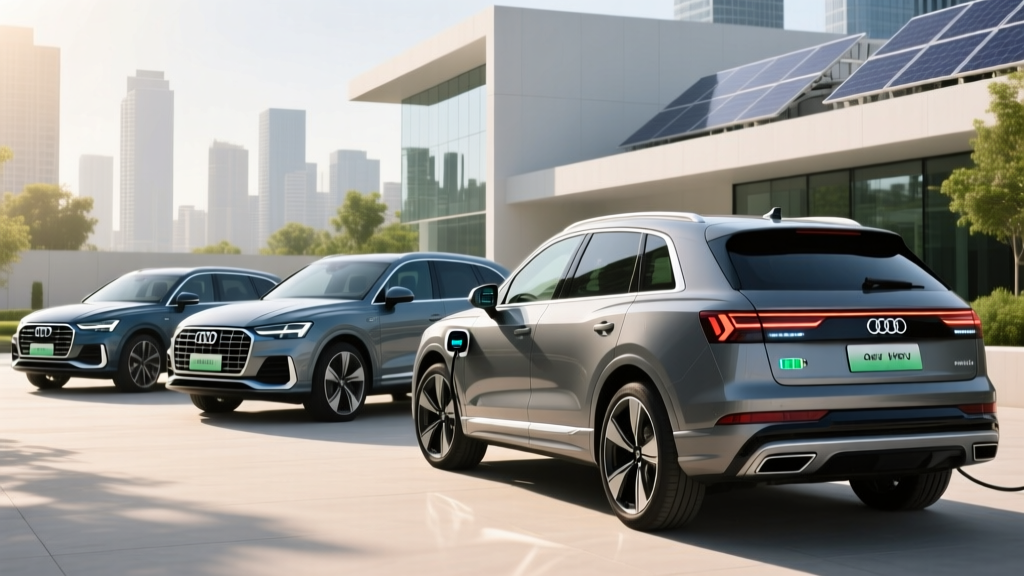
If you want Audi luxury and all-wheel drive but aren't ready to commit to a fully electric vehicle, the brand's plug-in hybrid lineup offers a practical middle ground. For the 2026 model year, Audi sells three PHEV SUVs in the United States: the compact Q5 55 TFSI e, the midsize three-row Q7 55 TFSI e, and the performance-oriented Q8 55 TFSI e. Each pairs a turbocharged gasoline engine with an electric motor and a lithium-ion battery you can recharge from a wall outlet — giving you electric-only commuting during the week and gas-engine range for weekend road trips.
This guide breaks down every 2026 Audi PHEV SUV by the numbers: EPA electric range, combined MPG, battery capacity, charging speed, powertrain output, pricing, and federal tax credit eligibility. We'll also clarify how these plug-in hybrids differ from conventional hybrids and full EVs, so you can pick the right electrified Audi for your driving pattern.
HEV vs PHEV: What Audi Actually Sells
Before diving into specs, it's worth clarifying terminology. A conventional hybrid (HEV), like the Toyota RAV4 Hybrid, uses a small battery that charges only through regenerative braking and the gas engine — you never plug it in. A plug-in hybrid (PHEV) has a larger battery that you can charge from an external power source, enabling a meaningful electric-only driving range before the gas engine kicks in.
| Feature | Conventional Hybrid (HEV) | Plug-In Hybrid (PHEV) | Battery Electric (BEV) |
|---|---|---|---|
| Plug in to charge? | No | Yes | Yes |
| Electric-only range | 0–2 miles (assist only) | 20–40 miles typical | 200–400+ miles |
| Gas engine? | Yes | Yes | No |
| Battery size | 1–2 kWh | 14–26 kWh | 60–120+ kWh |
| Home charging needed? | No | Recommended for full benefit | Essential |
| Federal tax credit (§30D) | No | Potentially up to $7,500 | Potentially up to $7,500 |
Audi does not currently sell a conventional (non-plug-in) hybrid SUV in the US market. Every electrified Audi SUV stateside is a PHEV, meaning you'll want access to a Level 2 home charger or reliable workplace charging to extract maximum value from the electric powertrain.
2026 Audi PHEV SUV Lineup: Side-by-Side Specs
Here's how Audi's three plug-in hybrid SUVs stack up on the metrics that matter most to buyers. All figures reflect the latest available EPA data and Audi's official 2026 model-year specifications.
| Spec | Q5 55 TFSI e | Q7 55 TFSI e | Q8 55 TFSI e |
|---|---|---|---|
| Vehicle class | Compact luxury SUV | Midsize 3-row luxury SUV | Midsize luxury coupe SUV |
| Engine | 2.0L turbo I-4 | 3.0L turbo V-6 | 3.0L turbo V-6 |
| Electric motor | Integrated in transmission | Integrated in transmission | Integrated in transmission |
| Combined system output | 362 hp / 369 lb-ft | 389 hp / 369 lb-ft | 389 hp / 369 lb-ft |
| Battery (gross / usable) | 17.9 kWh / ~14.4 kWh | 17.9 kWh / ~14.4 kWh | 17.9 kWh / ~14.4 kWh |
| EPA electric-only range | 23 miles | 21 miles | 22 miles |
| EPA combined MPG (hybrid mode) | 26 MPG | 22 MPG | 22 MPG |
| EPA MPGe (electric + gas) | 61 MPGe | 54 MPGe | 55 MPGe |
| Total combined range | ~410 miles | ~420 miles | ~400 miles |
| Level 2 charge time (0–100%) | ~2.5 hours (7.2 kW) | ~2.5 hours (7.2 kW) | ~2.5 hours (7.2 kW) |
| DC fast charging | Not available | Not available | Not available |
| 0–60 mph | 5.0 seconds | 5.5 seconds | 5.3 seconds |
| Drivetrain | quattro AWD | quattro AWD | quattro AWD |
| Starting MSRP | $58,395 | $80,195 | $82,595 |
Sources: EPA fueleconomy.gov, Audi USA. MSRP excludes destination charge. Specs reflect base Premium Plus trims where applicable.
Electric-Only Range and Real-World Efficiency
All three Audi PHEV SUVs share the same 17.9 kWh gross battery pack (approximately 14.4 kWh usable), which limits differentiation on electric-only range. The Q5 55 TFSI e, being the lightest of the trio, ekes out the best EPA electric range at 23 miles. The Q7 and Q8, carrying more mass, manage 21 and 22 miles respectively.
Real-World Electric Range Expectations: The EPA's 21–23 mile estimates assume moderate temperatures and mixed driving. In practice:
- Summer city driving: Expect 20–25 miles — regenerative braking in stop-and-go traffic extends range.
- Highway at 70 mph: Range drops to roughly 15–18 miles due to higher energy consumption at speed.
- Cold weather (below 32°F): Expect 12–16 miles. The battery's usable capacity shrinks, and cabin heating draws significant energy.
Once the battery depletes, the gas engine takes over seamlessly. Here's how the EPA MPG breaks down in hybrid mode:
| Model | City MPG | Highway MPG | Combined MPG |
|---|---|---|---|
| Q5 55 TFSI e | 26 | 27 | 26 |
| Q7 55 TFSI e | 21 | 23 | 22 |
| Q8 55 TFSI e | 21 | 23 | 22 |
Real-world MPG note: Plug-in hybrids tend to exceed their EPA city estimates when drivers use electric mode for short trips and the engine only engages for longer drives. If your daily commute falls within the 20-mile electric range and you charge nightly, you may use very little gasoline during the workweek. On long highway road trips with a depleted battery, expect the Q7 and Q8 to deliver closer to 20–21 MPG at sustained speeds above 70 mph, while the Q5 may reach 25–26 MPG.
Powertrain Deep Dive: Engine Meets Electric Motor
Audi's PHEV architecture integrates the electric motor directly into the transmission housing, between the engine and the gearbox. This design preserves the familiar quattro all-wheel-drive feel while adding instant electric torque at low speeds.
The Q5 55 TFSI e pairs a 2.0-liter turbocharged four-cylinder engine (261 hp on its own) with a 141-hp electric motor for a combined 362 hp. The result is a 0–60 mph sprint in 5.0 seconds — quicker than the gas-only Q5 45 TFSI (which manages 6.0 seconds).
The Q7 and Q8 55 TFSI e both use a 3.0-liter turbocharged V-6 (335 hp) supplemented by the same electric motor, yielding 389 hp combined. The Q7 hits 60 mph in 5.5 seconds; the slightly lighter Q8 shaves that to 5.3 seconds.
All three models use a 7-speed S tronic dual-clutch automatic transmission and come standard with Audi's quattro all-wheel drive. The electric motor can power all four wheels independently at low speeds, providing silent electric AWD traction in snow or rain without engaging the gas engine.
Charging: What You Need to Know
A critical limitation of Audi's current PHEV lineup: none of these models support DC fast charging. You're limited to AC charging only, which is typical for most plug-in hybrids in this segment (the BMW X5 xDrive50e and Mercedes GLE 350e also lack DC fast charging).
| Charging Level | Power | Time (0–100%) | Practical Use |
|---|---|---|---|
| Level 1 (120V household) | ~1.4 kW | ~10–12 hours | Overnight top-up; too slow for daily full recharge |
| Level 2 (240V home/public) | 7.2 kW (max) | ~2.5 hours | Ideal daily charging; full battery by morning |
| DC Fast Charge | N/A | N/A | Not supported on Audi PHEVs |
Home charging setup: A Level 2 home charger (240V, 32-amp circuit minimum) is strongly recommended. At 7.2 kW, the onboard charger replenishes the ~14.4 kWh usable battery in roughly 2.5 hours. This means you can fully recharge during a work-from-home lunch break or between an evening commute and a morning departure.
If you're limited to a standard 120V outlet (Level 1), expect about 4–5 miles of range added per hour of charging. That's enough to partially replenish the battery overnight but won't deliver a full charge in a single session. For PHEV owners without Level 2 access, the vehicle still functions as a conventional hybrid — you simply won't maximize the electric-only range benefit.
Pricing, Trims, and Federal Tax Credit Eligibility
Audi's PHEV SUVs command a premium over their gas-only siblings, but the electric powertrain adds meaningful performance and efficiency gains. Here's the pricing breakdown for 2026:
- Q5 55 TFSI e: Starting at $58,395 (Premium Plus trim; Prestige adds ~$4,500)
- Q7 55 TFSI e: Starting at $80,195 (Premium Plus; Prestige ~$85,000)
- Q8 55 TFSI e: Starting at $82,595 (Premium Plus; Prestige ~$88,000)
All prices exclude Audi's $1,195 destination charge.
Federal Tax Credit (§30D) Eligibility — 2026 Rules:
- Q5 55 TFSI e: MSRP is under the $80,000 SUV cap. May qualify for up to $3,750–$7,500 depending on battery mineral sourcing and buyer income limits (AGI ≤ $150K single / $300K joint). Credit eligibility for Audi PHEVs has been inconsistent due to critical-mineral sourcing requirements — verify current status at IRS.gov §30D.
- Q7 55 TFSI e: MSRP exceeds the $80,000 SUV cap for the §30D credit. Not eligible for the federal new clean vehicle credit.
- Q8 55 TFSI e: MSRP exceeds the $80,000 SUV cap. Not eligible for the federal new clean vehicle credit.
State and local incentives may apply separately. Check your state's energy office or AFDC state incentive database for details.
The Q7 and Q8's ineligibility for the federal credit is a significant financial consideration. The MSRP cap under §30D is $80,000 for SUVs, and both models start above that threshold even before options. If the federal credit is important to your purchase decision, the Q5 55 TFSI e is the only Audi PHEV SUV that can potentially qualify — and even then, the exact credit amount depends on where the battery minerals and components are sourced, which shifts periodically.
Battery Warranty, Reliability, and Replacement Costs
Audi PHEV Battery Warranty: All 2026 Audi plug-in hybrids carry a high-voltage battery warranty of 8 years or 100,000 miles (whichever comes first), with a capacity retention threshold of 70%. If the battery degrades below 70% of its original capacity within that window, Audi will repair or replace it at no cost. This aligns with the industry-standard PHEV battery warranty and meets California Air Resources Board (CARB) requirements adopted by many states.
Reliability outlook: Audi's PHEV powertrain has been in production since the 2019 model year (with a battery refresh for 2021), giving it a reasonable track record. The 2.0L and 3.0L turbocharged engines are well-established in Audi's lineup. Common owner complaints tend to center on software integration and infotainment rather than powertrain failures. The PHEV system adds complexity — two power sources, additional cooling circuits, and high-voltage components — which can mean higher repair costs out of warranty compared to a gas-only vehicle.
Battery replacement cost: If your Audi PHEV battery fails outside the 8-year/100,000-mile warranty window, expect a replacement cost in the range of $8,000 to $14,000 (parts and labor), based on current dealer pricing for the 17.9 kWh pack. This is less expensive than a full EV battery replacement (which can exceed $20,000) because the PHEV battery is significantly smaller. However, it's still a meaningful long-term ownership cost to budget for if you plan to keep the vehicle beyond 10 years.
General hybrid battery longevity: Lithium-ion PHEV batteries typically retain 85–90% of their original capacity after 5 years of normal use. Audi's thermal management system actively heats and cools the battery to minimize degradation. Owners who avoid frequent deep discharges (letting the battery drain completely) and extreme heat exposure will see the best long-term battery health.
Who Should Buy an Audi PHEV SUV?
Choose an Audi PHEV SUV if:
- Your daily commute is under 20 miles round-trip and you have home Level 2 charging — you'll drive mostly on electricity during the week.
- You regularly take road trips of 200+ miles where charging infrastructure is sparse or unreliable.
- You want Audi's interior quality, quattro AWD, and brand prestige without committing to a full EV.
- You live in a cold climate where EV range loss is a concern — the gas engine eliminates range anxiety in winter.
- You need a luxury SUV that can tow (Q7: up to 4,400 lbs; Q5: up to 4,400 lbs).
Choose a full EV (like the Audi Q8 e-tron) instead if:
- You have reliable home charging and your daily driving rarely exceeds 200 miles.
- You want to eliminate gasoline costs and engine maintenance entirely.
- You want access to DC fast charging for road trips (the Q8 e-tron charges at up to 170 kW).
- You want the maximum federal tax credit (the Q8 e-tron may qualify depending on current sourcing rules).
Choose a gas-only SUV instead if:
- You don't have access to home or workplace charging — a PHEV driven without charging is just a heavier, less efficient hybrid.
- Your budget is under $50,000 — the PHEV premium is difficult to recoup through fuel savings alone at this price point.
- You drive mostly highway miles exceeding 50+ miles daily — the electric range benefit becomes negligible.
Pros
- Silent, torque-rich electric driving for daily commutes (20+ miles)
- Standard quattro AWD across all three models
- No range anxiety — gas engine provides 400+ total miles
- Q5 55 TFSI e potentially eligible for federal tax credit
- Strong performance: 0–60 in 5.0–5.5 seconds
- Premium Audi interior with Virtual Cockit and MMI
Cons
- Electric-only range (21–23 mi) trails rivals like the BMW X5 xDrive50e (~38 mi)
- No DC fast charging on any model
- Q7 and Q8 exceed $80K MSRP cap — no federal tax credit
- Small 17.9 kWh battery limits electric highway driving
- Higher purchase price vs gas-only equivalents
- Added powertrain complexity may increase long-term maintenance costs
Frequently Asked Questions
How many MPG does the Audi PHEV SUV get?
In hybrid mode (battery depleted), the 2026 Q5 55 TFSI e achieves 26 MPG combined (26 city / 27 highway). The Q7 and Q8 55 TFSI e each deliver 22 MPG combined (21 city / 23 highway). When factoring in electric-only driving, the MPGe ratings are 61 MPGe for the Q5, 54 MPGe for the Q7, and 55 MPGe for the Q8. Real-world results vary significantly based on how often you charge and your driving mix.
How far can the Audi PHEV SUV go on electric only?
The EPA rates the Q5 55 TFSI e at 23 miles of electric-only range, the Q8 at 22 miles, and the Q7 at 21 miles. In real-world conditions, expect 20–25 miles in warm city driving, 15–18 miles at highway speeds, and 12–16 miles in freezing temperatures. This range is adequate for short commutes but trails competitors like the BMW X5 xDrive50e (EPA 38 miles) and the Lincoln Corsair Grand Touring (EPA 27 miles).
Does the Audi PHEV qualify for a federal tax credit?
Only the Q5 55 TFSI e potentially qualifies, since its MSRP falls under the $80,000 SUV cap set by IRS §30D rules. The actual credit amount (up to $7,500) depends on your income (AGI caps: $150K single, $300K joint), battery critical-mineral sourcing compliance, and whether you elect the point-of-sale transfer. The Q7 and Q8 both exceed the MSRP cap and are ineligible for the federal new clean vehicle credit. Always verify current eligibility at IRS.gov before purchasing.
Is the Audi PHEV battery reliable and what does replacement cost?
Audi covers the high-voltage battery for 8 years or 100,000 miles with a 70% capacity retention guarantee. Based on industry data for similar PHEV packs, most owners will see 85–90% capacity retention after 5 years. If replacement is needed out of warranty, expect $8,000–$14,000 for parts and labor. The PHEV system adds mechanical complexity over a gas-only vehicle, so budget-conscious buyers planning to keep the vehicle past the warranty period should factor in potential maintenance costs.
Can I charge the Audi PHEV at a DC fast charger?
No. None of Audi's current PHEV SUVs support DC fast charging. You're limited to Level 1 (120V) or Level 2 (240V) AC charging, with a maximum onboard charger rate of 7.2 kW. A full charge from empty takes about 2.5 hours on Level 2. This is a common limitation among PHEVs — the smaller battery doesn't justify the added cost and weight of DC fast-charging hardware.
Hybrid vs PHEV vs EV — which Audi SUV fits me?
Audi doesn't sell conventional hybrids in the US, so your choice is between a PHEV (Q5/Q7/Q8 55 TFSI e) or a full EV (Q8 e-tron). If you have home charging and a short commute but also take regular road trips, the PHEV gives you the best of both worlds. If your driving is mostly under 200 miles per day and you want zero tailpipe emissions with lower running costs, the Q8 e-tron (EPA range up to 285 miles) is the stronger long-term choice. If you have no charging access at all, consider a gas-only Audi SUV until charging becomes feasible.
All specifications, pricing, and tax credit details reflect the 2026 model year and current IRS guidance as of publication. Rules and eligibility may change. Verify details with your local Audi dealer and a qualified tax professional before purchasing.