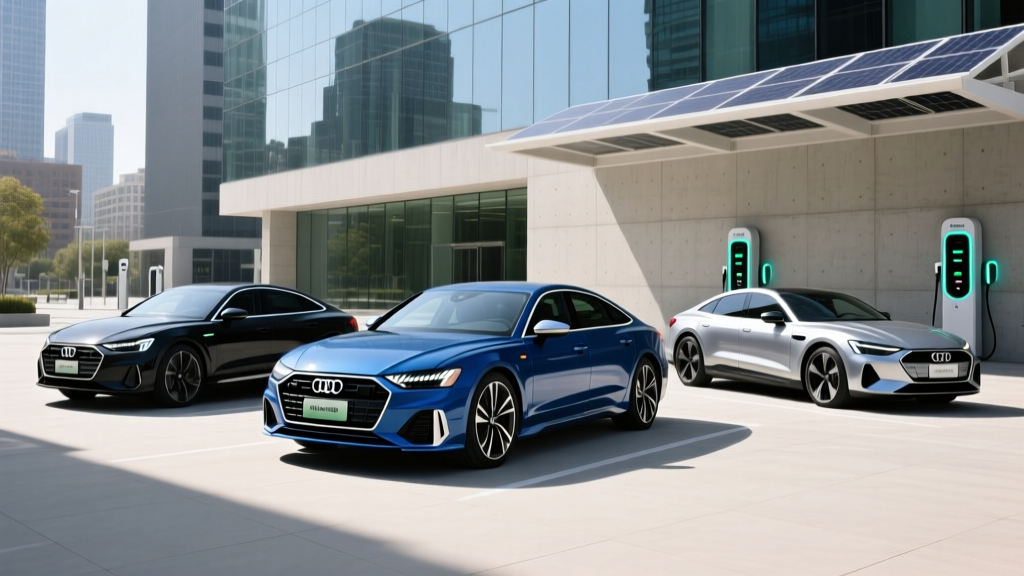
Audi's plug-in hybrid lineup occupies a specific niche: luxury buyers who want electric-only commuting without committing to a full battery-electric vehicle. For 2026, Audi offers several TFSI e models spanning sedans and SUVs, each pairing a turbocharged gasoline engine with an electric motor and a modest battery pack. This guide breaks down every current Audi PHEV model with exact specs, real-world efficiency data, and whether any qualify for federal tax incentives.
What Defines an Audi PHEV (TFSI e)?
Audi brands its plug-in hybrids under the TFSI e badge. These vehicles combine a turbocharged gasoline engine (TFSI) with an electric motor (e) integrated into the transmission housing. Unlike conventional hybrids (HEVs) that generate electricity solely from regenerative braking and the engine, PHEVs carry a larger battery you can charge from an external source — a wall outlet or Level 2 charger — enabling a meaningful electric-only driving range before the gas engine engages.
HEV vs PHEV: Key Differences
| Feature | Conventional Hybrid (HEV) | Plug-in Hybrid (PHEV) |
|---|---|---|
| External charging | No — self-charging only | Yes — plug in to charge battery |
| Electric-only range | ~1-2 miles at very low speed | 20-40+ miles at highway speeds |
| Battery size | 1-2 kWh | 14-26 kWh (usable) |
| Federal tax credit | None | Up to $7,500 (subject to §30D rules) |
| Gas engine | Frequently cycles on/off | Stays off during EV-only driving |
Audi does not currently sell conventional HEVs in the U.S. market — every Audi hybrid is a plug-in. If you see an Audi with hybrid badging, it is a TFSI e PHEV that requires plug-in charging to unlock its full electric range.
2026 Audi PHEV Lineup: Model-by-Model Specs
For the 2026 model year, Audi's U.S. PHEV portfolio centers on three core models. Each uses a variant of VW Group's modular longitudinal platform with a battery positioned under the trunk or rear seat, which does reduce cargo capacity slightly compared to gas-only variants.
| Specification | 2026 Audi Q5 TFSI e | 2026 Audi A7 TFSI e | 2026 Audi Q8 TFSI e |
|---|---|---|---|
| Powertrain | 2.0L turbo I4 + electric motor | 2.0L turbo I4 + electric motor | 3.0L turbo V6 + electric motor |
| Combined HP | 362 hp / 369 lb-ft | 362 hp / 369 lb-ft | 456 hp / 516 lb-ft |
| Battery (usable) | ~14.1 kWh | ~14.1 kWh | ~17.9 kWh |
| EPA Electric Range | 23 miles | 25 miles | 28 miles |
| EPA MPG (gas, combined) | 26 MPG combined | 29 MPG combined | 22 MPG combined |
| MPGe (electric + gas) | 61 MPGe | 65 MPGe | 50 MPGe |
| Total Combined Range | ~410 miles | ~440 miles | ~400 miles |
| 0-60 mph | 5.0 sec | 5.1 sec | 5.2 sec |
| Level 2 Charge Time | ~2.5 hours (7.2 kW) | ~2.5 hours (7.2 kW) | ~3.0 hours (7.2 kW) |
| DC Fast Charge | Not available | Not available | Not available |
| Drivetrain | quattro AWD | quattro AWD | quattro AWD |
| Starting MSRP | $59,200 | $78,500 | $88,400 |
Electric-Only Range: EPA vs Real World
The EPA electric range figures above assume moderate temperatures, mixed driving, and a full charge. In practice, PHEV electric range is highly sensitive to driving style and climate conditions.
Real-World Electric Range Expectations
Q5 TFSI e: EPA 23 mi → expect 18-20 mi on the highway, 22-25 mi in city driving (regen braking extends range at lower speeds). In winter (below 35°F), plan for 14-17 mi.
A7 TFSI e: EPA 25 mi → expect 20-22 mi highway, 24-27 mi city. Cold weather: 16-19 mi.
Q8 TFSI e: EPA 28 mi → expect 23-25 mi highway, 26-29 mi city. Cold weather: 18-21 mi.
Why the variance? PHEV batteries lack the active thermal management systems found in full EVs like the Audi Q8 e-tron, making them more susceptible to temperature-related range loss. Highway speeds above 65 mph also drain the small battery faster due to aerodynamic drag.
For most commuters with a round trip under 20 miles and home charging, these PHEVs can handle daily driving on electricity alone — which is where the real fuel savings materialize. Once the battery depletes, the gas engine takes over seamlessly and you drive it like a conventional vehicle.
Fuel Economy: EPA MPG and Real-World Results
PHEV fuel economy is split into two metrics: MPGe (miles-per-gallon-equivalent when running on electricity) and MPG (miles-per-gallon when the battery is depleted and the gas engine operates). Both matter, but which one applies to you depends entirely on your charging habits.
| Model | EPA City (gas) | EPA Highway (gas) | EPA Combined (gas) | Combined MPGe |
|---|---|---|---|---|
| Q5 TFSI e | 25 MPG | 27 MPG | 26 MPG | 61 MPGe |
| A7 TFSI e | 27 MPG | 31 MPG | 29 MPG | 65 MPGe |
| Q8 TFSI e | 20 MPG | 24 MPG | 22 MPG | 50 MPGe |
Real-world note: Hybrid and PHEV vehicles in gas-only mode often exceed EPA city estimates because regenerative braking recovers energy in stop-and-go traffic. Highway MPG tends to match or fall slightly below EPA estimates. If you rarely charge, expect the Q5 TFSI e to deliver 25-27 MPG combined, the A7 to return 28-31 MPG, and the Q8 to achieve 21-23 MPG. These are respectable for their respective vehicle classes, but not dramatically better than non-hybrid luxury competitors.
The efficiency advantage of a PHEV only fully materializes when you charge regularly. According to fueleconomy.gov, drivers who charge daily and commute within the electric range can reduce gasoline consumption by 50-70% compared to the gas-only variant.
Charging: Level 2 Only, No DC Fast Charging
Every 2026 Audi PHEV charges exclusively via AC power — a standard J1772 connector for Level 1 (120V) and Level 2 (240V) charging. None support DC fast charging (CCS or NACS). This is typical for PHEVs: the small battery simply doesn't warrant the added cost and weight of DC hardware.
| Charging Level | Power | Estimated Time (0-100%) | Miles of EV Range per Hour |
|---|---|---|---|
| Level 1 (120V household) | ~1.4 kW | 10-13 hours | ~3-4 miles |
| Level 2 (240V, 32A) | 7.2 kW | 2.5-3.0 hours | ~10-12 miles |
For PHEV ownership, Level 2 home charging is ideal but not mandatory. Because the battery is small (14-18 kWh), even a standard 120V outlet will fully recharge overnight — roughly 10-13 hours from empty. Most PHEV owners plug in nightly and wake up with a full battery, making a dedicated Level 2 station convenient but not a dealbreaker.
A Level 2 home charger installation typically costs $800-$2,000 including equipment and electrician labor, depending on panel capacity and run length. If your electrical panel needs an upgrade to 200A, add $1,500-$3,000.
Federal Tax Credit Eligibility for Audi PHEVs
Under IRS §30D, plug-in hybrids with a battery capacity of at least 7 kWh may qualify for a federal tax credit of up to $7,500 — but eligibility depends on multiple requirements that change frequently and vary by model year and build date.
§30D Credit Requirements (2026)
- Battery capacity: Minimum 7 kWh (all Audi PHEVs exceed this)
- MSRP cap: Vans/SUVs/pickups ≤ $80,000; sedans ≤ $55,000
- Buyer income cap: MAGI ≤ $150,000 (single) / $300,000 (joint)
- Battery component sourcing: Percentage of battery components must be manufactured or assembled in North America (threshold increases annually)
- Critical minerals: Percentage of critical minerals must be sourced from the U.S. or FTA partners
- Point-of-sale transfer: Eligible buyers can transfer the credit to the dealer for an upfront price reduction
Where Audi PHEVs stand for 2026: The Q5 TFSI e at $59,200 MSRP sits under the $80,000 SUV cap, making it potentially eligible on price. The A7 TFSI e at $78,500 exceeds the $55,000 sedan cap, disqualifying it. The Q8 TFSI e at $88,400 exceeds the $80,000 SUV cap. However, battery sourcing and critical mineral requirements are the most restrictive factor — and many European-built PHEVs fail these thresholds. Always verify current eligibility on fueleconomy.gov and consult a tax professional before relying on the credit. Rules per IRS.gov are subject to change.
Battery Warranty, Reliability, and Replacement Costs
Audi covers the high-voltage battery in its PHEV models with a warranty that exceeds the federal minimum. This is a critical data point for buyers concerned about long-term ownership costs.
Audi PHEV Battery Warranty
Duration: 8 years or 100,000 miles (whichever comes first)
Capacity retention threshold: Battery must retain at least 70% of original capacity during the warranty period
Powertrain warranty: 4 years / 50,000 miles (standard Audi coverage)
Out-of-warranty replacement cost: $8,000-$14,000 depending on model (parts + labor)
PHEV batteries are smaller and experience fewer deep charge cycles than full EV batteries, which generally translates to slower degradation. Most owners report negligible electric-range loss in the first 5-6 years. However, because PHEV batteries lack sophisticated liquid cooling (some Audi PHEVs use air cooling or basic thermal management), extreme climates may accelerate degradation over a 10+ year ownership period.
In terms of general reliability, Audi PHEVs add complexity — two powertrains, power electronics, and high-voltage systems — compared to either a pure gas car or a full EV. Audi's overall reliability ratings from sources like Consumer Reports have historically placed the brand mid-pack among luxury automakers. The hybrid-specific components (electric motor, inverter, battery) have proven durable across VW Group's PHEV fleet, but the gasoline engine still requires standard maintenance: oil changes, spark plugs, and transmission fluid service.
Audi PHEV vs Full EV vs Gas: Which Is Right for You?
The decision between an Audi PHEV, a full battery-electric vehicle (like the Q8 e-tron or Q6 e-tron), and a conventional gas Audi comes down to three factors: your daily mileage, charging access, and willingness to maintain two powertrains.
Choose an Audi PHEV If:
- Your daily round-trip commute is under 25 miles and you can charge at home
- You regularly take road trips exceeding 200 miles and want zero range anxiety
- You want to reduce fuel consumption without committing to full electric
- You live in an area with limited public DC fast-charging infrastructure
Choose a Full EV (Q8 e-tron, Q6 e-tron) If:
- You have reliable home Level 2 charging
- Your daily driving is under 200 miles (well within modern EV range)
- You want the lowest per-mile fuel cost and minimal drivetrain maintenance
- You want to maximize federal tax credit eligibility (many EVs qualify more easily)
Choose a Gas-Only Audi If:
- You cannot charge at home or at work
- You want the lowest purchase price and simplest maintenance
- Your annual mileage is low enough that fuel savings don't offset the PHEV premium
Audi PHEV Advantages
- Electric-only commuting eliminates daily gasoline use for short trips
- No range anxiety — gas engine provides 350+ additional miles
- quattro AWD standard across all PHEV models
- Strong combined horsepower (362-456 hp) with instant electric torque
- 8-year / 100,000-mile battery warranty
Audi PHEV Limitations
- Electric range (23-28 mi) covers only short commutes
- No DC fast charging — impractical to top up on road trips
- Reduced cargo space vs gas-only variants (battery under trunk floor)
- Two powertrains = more maintenance complexity than EV or gas
- Most models exceed §30D MSRP caps or fail sourcing requirements
- Premium pricing: $59K-$88K starting MSRP
Frequently Asked Questions
How many MPG does an Audi PHEV get?
In gas-only mode (battery depleted), the 2026 Q5 TFSI e returns an EPA-estimated 26 MPG combined, the A7 TFSI e returns 29 MPG combined, and the Q8 TFSI e returns 22 MPG combined. When factoring in electric driving, MPGe ratings range from 50-65 MPGe. Real-world city MPG often exceeds EPA estimates due to regenerative braking.
How far can an Audi PHEV go on electric only?
EPA-rated electric-only range spans 23 miles (Q5 TFSI e) to 28 miles (Q8 TFSI e). Real-world range varies: expect 18-25 miles depending on speed, temperature, and terrain. Cold weather (below 35°F) can reduce electric range by 20-30%.
Do Audi PHEVs qualify for the $7,500 federal tax credit?
Eligibility is model- and buyer-specific. The Q5 TFSI e ($59,200 MSRP) falls under the $80,000 SUV cap, but must also pass battery sourcing and critical mineral requirements — which many European-built PHEVs do not meet. The A7 and Q8 exceed their respective MSRP caps. Always check fueleconomy.gov for the latest eligibility list and consult a tax professional.
Is the Audi PHEV battery reliable and what does replacement cost?
Audi covers the PHEV battery for 8 years or 100,000 miles with a 70% capacity retention guarantee. PHEV batteries degrade more slowly than full EV batteries due to smaller size and shallower cycles. Out-of-warranty replacement costs range from $8,000 to $14,000 depending on the model.
Can I charge an Audi PHEV at a Tesla Supercharger or DC fast charger?
No. Audi PHEVs only accept AC charging via J1772 (Level 1 and Level 2). They do not have DC fast-charge capability. Charging is limited to home outlets, Level 2 home stations, and public AC chargers.
What happens if I never plug in my Audi PHEV?
You can drive an Audi PHEV without ever plugging it in — it operates as a conventional hybrid, using the gas engine and regenerative braking. However, you forfeit the electric-only range and most of the fuel savings. You'll get 22-29 MPG combined depending on the model, which is respectable but not dramatically better than a gas-only luxury SUV or sedan.
Should I buy an Audi PHEV or a full EV like the Q8 e-tron?
If you can charge at home and your daily driving is under 200 miles, a full EV like the Q8 e-tron (EPA range ~285 miles) offers lower operating costs, less maintenance, and better tax credit eligibility. Choose the PHEV if you regularly drive 300+ miles between charges, lack reliable public DC charging on your routes, or want the flexibility of gasoline for long trips.
Sources: fueleconomy.gov (EPA estimates), IRS.gov (§30D credit rules), Audi USA official specifications. All pricing and specifications reflect 2026 model year data as published. Tax credit eligibility is subject to change — verify before purchase.