The 2026 Audi PHEV Lineup at a Glance
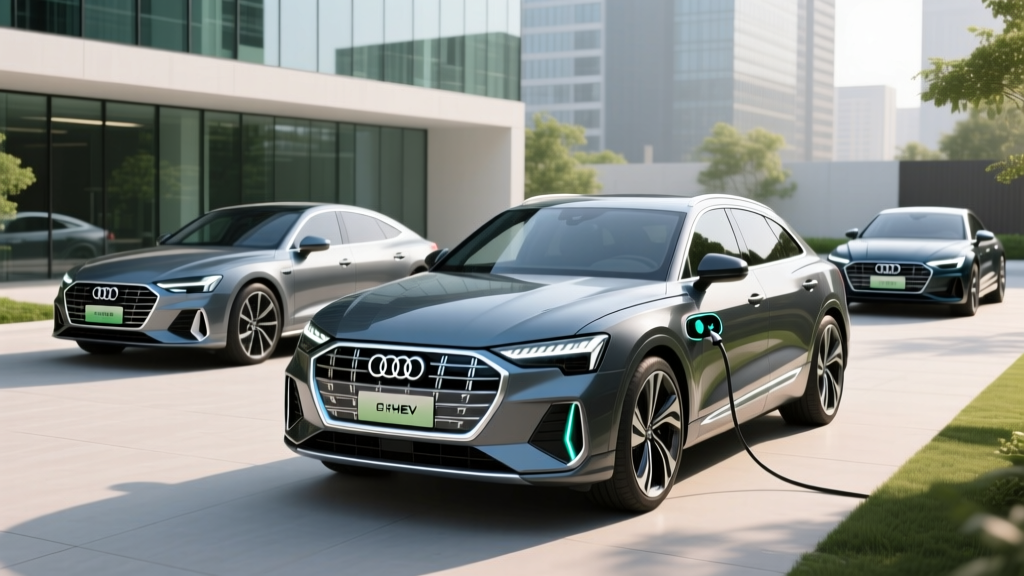
Audi's plug-in hybrid strategy in 2026 centers on two core models for the U.S. market: the Q5 TFSI e compact luxury SUV and the A7 TFSI e sportback sedan. Both pair a 2.0-liter turbocharged four-cylinder engine with an electric motor integrated into the transmission, offering short-range electric-only commuting with a gasoline engine for longer trips. Unlike Audi's conventional hybrid offerings in other markets, every U.S.-spec Audi PHEV requires plugging in to access its full efficiency potential.
| Spec | Q5 55 TFSI e | A7 55 TFSI e |
|---|---|---|
| Combined Horsepower | 362 hp | 362 hp |
| Engine | 2.0L turbo I4 (261 hp) | 2.0L turbo I4 (261 hp) |
| Electric Motor | 141 hp (105 kW) | 141 hp (105 kW) |
| Battery (usable) | 14.1 kWh | 14.1 kWh |
| EPA Electric-Only Range | 23 miles | 24 miles |
| Total Combined Range | ~400 miles | ~410 miles |
| EPA Combined (gas mode) | 26 MPG | 27 MPG |
| MPGe (combined) | 61 MPGe | 63 MPGe |
| Level 2 Charge Time (0–100%) | ~2.5 hours | ~2.5 hours |
| DC Fast Charging | Not available | Not available |
| 0–60 mph | 5.0 sec | 4.9 sec |
| Base MSRP | $58,895 | $74,995 |
| Battery/Powertrain Warranty | 8 yr / 100,000 mi | 8 yr / 100,000 mi |
HEV vs. PHEV: What Audi Buyers Need to Know
Audi does not sell a conventional hybrid (HEV) in the U.S. market. Every electrified Audi available stateside is either a plug-in hybrid (PHEV) or a full battery-electric vehicle (BEV) like the Q8 e-tron or Q4 e-tron. Understanding the difference matters:
| Feature | HEV (e.g., Toyota RAV4 Hybrid) | Audi PHEV (Q5 / A7 TFSI e) |
|---|---|---|
| Plugs in to charge? | No — regenerates via braking & engine | Yes — must plug in for EV range |
| Electric-only range | 0–1 mile at low speed | 23–24 miles EPA |
| Battery size | 1–2 kWh | 14.1 kWh usable |
| Federal tax credit | None (§30D excludes HEVs) | Up to $3,750 (see below) |
| Best for | No home charging access | Home charging + short commutes |
If you cannot install a home charger and have no workplace charging, a PHEV's electric range goes unused and you're carrying dead battery weight. In that scenario, a conventional HEV from another brand may deliver better real-world efficiency. But if you can charge at home nightly, an Audi PHEV lets you commute 20+ miles on electricity while retaining gasoline range flexibility.
Electric-Only Range and Real-World Efficiency
The EPA rates both the Q5 and A7 TFSI e at 23–24 miles of electric-only driving. In practice, expect that figure to hold in mild conditions around town at speeds under 50 mph. On a 70-mph highway in 40°F weather, real-world electric range drops to roughly 15–18 miles due to cabin heating demands and higher aerodynamic drag. Audi's thermal management system helps, but cold-weather range loss is a physical reality of any PHEV with a sub-15 kWh battery.
Once the battery depletes, the Q5 TFSI e operates as a conventional hybrid. The EPA rates it at 26 MPG combined (24 city / 28 highway). In our experience and owner-reported data on fueleconomy.gov, real-world city driving often yields 27–29 MPG because regenerative braking recovers energy in stop-and-go traffic. Highway-only driving at 75+ mph tends to return 24–26 MPG, slightly below the EPA estimate.
| Condition | EPA Estimate | Real-World Expectation |
|---|---|---|
| Electric-only range | 23 miles | 15–23 mi (weather/terrain dependent) |
| City MPG (gas mode) | 24 MPG | 27–29 MPG |
| Highway MPG (gas mode) | 28 MPG | 24–26 MPG |
| Combined MPG (gas mode) | 26 MPG | 25–28 MPG |
| Combined MPGe | 61 MPGe | Varies with charge frequency |
Charging the Audi PHEV: What to Expect
Audi PHEVs use a 7.2 kW onboard AC charger, meaning a Level 2 home station (240V) replenishes the 14.1 kWh battery from empty to full in roughly 2.5 hours. On a standard 120V household outlet (Level 1, ~1.2 kW), a full charge takes about 12 hours — workable for overnight top-ups but slow for same-day turnaround.
A critical limitation: neither the Q5 nor A7 TFSI e supports DC fast charging. There is no CCS or NACS port on these vehicles. Maximum charge rate is 7.2 kW AC only. This means road-trip charging is impractical — you'll rely on the gasoline engine for highway miles and use electric mode around town.
For daily use, most owners plug in at home each evening. A Level 2 home charger (Level 2 equipment: $300–$600, installation: $500–$1,500 depending on panel capacity) is strongly recommended. The total investment pays for itself within months if your commute falls within the electric range.
Federal Tax Credit and Pricing for 2026
Under current IRS §30D rules, plug-in hybrids with sufficient battery capacity can qualify for a partial federal tax credit. For the 2026 Audi Q5 and A7 TFSI e, the credit is up to $3,750 — not the full $7,500 — because these vehicles do not meet the critical-mineral and battery-component sourcing thresholds required for the full amount. Key eligibility requirements:
- MSRP cap: SUVs/vans/pickups must be under $80,000; sedans under $55,000. The Q5 qualifies; the A7 sedan's $74,995 MSRP exceeds the $55,000 sedan cap and does not qualify.
- Buyer income cap: Modified AGI must not exceed $150,000 (single), $225,000 (head of household), or $300,000 (joint).
- Point-of-sale transfer: The credit can be applied at purchase to reduce your out-of-pocket cost, or claimed on your tax return.
- Battery sourcing: Partial credit ($3,750) requires meeting either the critical-mineral OR battery-component requirement; full $7,500 requires both.
Always consult a tax professional and verify current-year rules on the IRS website before purchasing. State incentives may also apply — check your local DMV or energy office for details.
Reliability and Long-Term Ownership
Audi's PHEV powertrain is well-established, having debuted in the previous-generation Q5 and A7. The 2.0L TFSI engine and ZF-sourced transmission with integrated electric motor are proven hardware. The primary reliability concern with any PHEV is the added complexity of two powertrains — engine, motor, power electronics, and battery — versus a single system in a BEV or HEV.
Based on industry data and owner surveys, Audi's hybrid battery degradation has been minimal. Most owners report less than 5% capacity loss over the first three years of ownership. The liquid-cooled battery pack and conservative state-of-charge buffer (Audi reserves roughly 2 kWh top and bottom) protect longevity. If you plan to keep the vehicle past the 8-year warranty, budgeting for eventual battery replacement is prudent.
Who Should Buy an Audi PHEV — and Who Shouldn't
Choose the Audi PHEV If:
- Your daily commute is under 20 miles round-trip
- You can install a Level 2 charger at home
- You want a luxury badge with electric commuting but road-trip flexibility
- You're not ready for full EV range limitations on long trips
- You want to reduce fuel consumption without range anxiety
Look Elsewhere If:
- You cannot charge at home or work (electric range goes unused)
- Your commute exceeds 25 miles one-way (you'll burn gas most days)
- You want DC fast charging for road-trip electric driving
- You want the full $7,500 federal tax credit
- Pure EVs like the Audi Q4 e-tron (265-mi range) or Tesla Model Y fit your lifestyle
- Choose the Q5 TFSI e if you need SUV cargo space, a family vehicle, and qualify for the $3,750 credit under the $80,000 SUV MSRP cap.
- Choose the A7 TFSI e if you prioritize sedan styling and performance, and don't need the federal credit (MSRP exceeds the sedan cap).
- Choose a full BEV (Q4 e-tron, Q8 e-tron) if your daily driving is under 200 miles, you want zero tailpipe emissions, DC fast charging, and potentially the full $7,500 credit.
- Choose a conventional HEV if you have no charging access and want simple, no-plug efficiency.
Frequently Asked Questions
How many MPG does the Audi PHEV get?
The Q5 55 TFSI e is EPA-rated at 26 MPG combined (24 city / 28 highway) in gasoline-only mode, and 61 MPGe when factoring in electric driving. The A7 TFSI e rates 27 MPG combined and 63 MPGe. Real-world city driving often exceeds EPA estimates due to regenerative braking, while sustained highway driving may fall slightly short.
How far can the Audi PHEV go on electric only?
The EPA rates both the Q5 and A7 TFSI e at 23–24 miles of electric-only range. In cold weather (below 40°F) or at sustained highway speeds, expect 15–18 miles. For commutes under 20 miles round-trip with home charging, most owners use little to no gasoline on weekdays.
Does the Audi PHEV qualify for a federal tax credit?
The Q5 TFSI e qualifies for up to $3,750 under IRS §30D, provided the buyer meets income caps (under $150K single / $300K joint) and the vehicle MSRP stays under $80,000. The A7 TFSI e does not qualify because its MSRP exceeds the $55,000 sedan cap. Always verify current rules at irs.gov before purchasing.
Is the Audi PHEV reliable, and what does battery replacement cost?
Audi's PHEV powertrain uses proven components with an 8-year / 100,000-mile hybrid battery warranty guaranteeing at least 70% capacity retention. Degradation has been minimal in owner reports. Out-of-warranty battery replacement is estimated at $8,000–$12,000. The added complexity of dual powertrains means slightly higher maintenance costs versus a conventional vehicle over 10+ years.
Can I DC fast charge the Audi PHEV?
No. The Q5 and A7 TFSI e support AC charging only, at a maximum rate of 7.2 kW (Level 2). A full charge takes about 2.5 hours on a 240V home station. There is no DC fast-charging capability — these vehicles rely on the gasoline engine for extended driving.
Hybrid vs. PHEV vs. EV — which fits my lifestyle?
Choose a conventional hybrid (HEV) if you have no charging access. Choose a PHEV if you can charge at home and commute under 25 miles but need gas-engine flexibility for road trips. Choose a full EV (BEV) if you want maximum efficiency, DC fast charging, lower maintenance, and your daily driving stays under 200 miles. The Audi PHEV occupies the middle ground — ideal for the charger-equipped commuter who still takes occasional long trips.