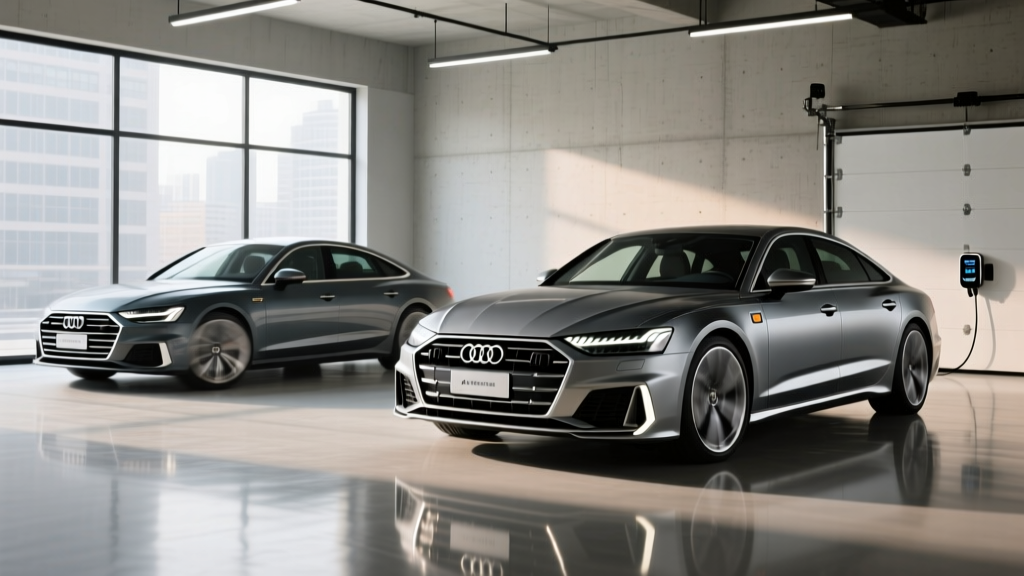
If you want luxury, all-electric commuter capability, and a gas engine for road trips, the Audi hybrid sedan lineup — badged as "TFSI e" — is one of the most compelling options on the market in 2026. But Audi's naming convention can confuse shoppers: the brand currently sells plug-in hybrid (PHEV) sedans, not conventional hybrids (HEV). Understanding that distinction is the first step to deciding whether an Audi PHEV sedan fits your garage.
This guide breaks down every current Audi plug-in hybrid sedan with exact EPA numbers, battery specs, charging times, real-world efficiency, pricing, and federal tax-credit eligibility so you can buy with confidence.
Audi Hybrid Sedans: HEV vs PHEV — What Audi Actually Sells
Let's clear up the biggest misconception immediately. When shoppers search for an "Audi hybrid sedan," they're looking for a vehicle that blends an internal-combustion engine with electric propulsion. There are two fundamentally different architectures that accomplish this:
| Feature | HEV (e.g., Toyota Camry Hybrid) | PHEV (e.g., Audi A6 TFSI e) |
|---|---|---|
| Battery Size | 1–2 kWh (small) | 14–26 kWh (large) |
| Electric-Only Driving | Very short, low-speed only | 20–40+ miles at full highway speed |
| Plug In to Charge? | No — regenerates while driving | Yes — plug in for full electric range |
| Gas Engine Role | Primary propulsion, assisted by motor | Backup & long trips; motor is primary for commutes |
| Federal Tax Credit | No | Up to $7,500 (if eligible under §30D) |
The bottom line: Audi does not currently sell a conventional HEV sedan in the U.S. market. Every Audi hybrid sedan wears the "TFSI e" badge and is a plug-in hybrid. If you don't have access to a plug — whether at home, work, or a dedicated outlet — you will lose the majority of the benefit an Audi PHEV offers, and a conventional hybrid from Lexus or Toyota would serve you better.
2026 Audi PHEV Sedan Lineup: Specs at a Glance
Audi offers three plug-in hybrid sedans for the 2026 model year. Here is the spec-table breakdown by model:
| Spec | A6 Sedan 55 TFSI e | A7 Sportback 55 TFSI e | A8 L 60 TFSI e |
|---|---|---|---|
| Powertrain | 2.0L turbo I-4 + electric motor | 2.0L turbo I-4 + electric motor | 3.0L turbo V6 + electric motor |
| Combined Horsepower | 362 hp | 362 hp | 453 hp |
| Combined Torque | 369 lb-ft | 369 lb-ft | 516 lb-ft |
| 0–60 mph | 4.9 sec | 5.0 sec | 4.6 sec |
| Battery (gross / usable) | 25.9 kWh / ~22 kWh | 25.9 kWh / ~22 kWh | 25.9 kWh / ~22 kWh |
| EPA Electric-Only Range | 39 miles | 38 miles | 33 miles |
| Total Combined Range | ~430 miles | ~420 miles | ~390 miles |
| EPA MPGe (electric+gas) | 57 MPGe | 55 MPGe | 50 MPGe |
| EPA MPG (gas-only, combined) | 28 MPG | 27 MPG | 24 MPG |
| AC Charging (Level 2) | 7.2 kW onboard charger | 7.2 kW onboard charger | 7.2 kW onboard charger |
| DC Fast Charging | Not supported | Not supported | Not supported |
| Charge Time 0–100% (L2) | ~3.5 hours | ~3.5 hours | ~3.5 hours |
| Drivetrain | quattro AWD | quattro AWD | quattro AWD |
| Base MSRP | $72,395 | $79,295 | $104,895 |
Sources: EPA fueleconomy.gov, Audi USA official specifications. Real-world results will vary based on driving style, climate, and terrain.
EPA MPG, Electric Range & Real-World Efficiency
The headline number for any Audi hybrid sedan buyer is efficiency. Here's the EPA breakdown for the volume-seller A6 55 TFSI e:
| Metric | City | Highway | Combined |
|---|---|---|---|
| MPGe (charge-sustaining + electric) | 60 | 55 | 57 |
| MPG (gas only, battery depleted) | 26 | 30 | 28 |
Real-World MPG vs the EPA Sticker
PHEVs behave differently from any other vehicle class because your real-world efficiency depends almost entirely on how often you plug in. Here's what to expect:
- Daily commuter (plugged in nightly, under 35 miles/day): You may use little to no gasoline for weeks at a time. Effective "MPG" is essentially infinite, with electricity cost around 3–5 cents per mile depending on your utility rate.
- Mixed driver (some plug-in, some gas): Expect 40–55 MPGe blended. This is the realistic scenario for most owners who plug in at home but take occasional longer drives.
- Never plugged in: The car operates as a heavy luxury sedan with a ~28 MPG combined ceiling. You're carrying ~350 lbs of battery you never use. A conventional gas A6 would be more economical in this scenario.
In cold weather (below 32°F), expect the electric-only range to drop by 15–25%. The A6's EPA-rated 39-mile electric range may shrink to roughly 29–33 miles on a freezing January morning. This is normal for all PHEVs and BEVs due to battery chemistry and cabin-heating demands.
Charging: What You Need to Know Before You Buy
Every 2026 Audi TFSI e sedan comes with a 7.2 kW onboard AC charger and a J1772 charge port. Here is the critical reality of PHEV charging:
- Level 1 (120V household outlet): Adds roughly 4–5 miles of electric range per hour. A full charge from empty takes approximately 16–18 hours. Fine for overnight top-ups if your daily commute is short.
- Level 2 (240V home or public AC): A full 0–100% charge completes in roughly 3.5 hours. This is the recommended charging method and easily replenishes the battery overnight or during a workday.
- DC Fast Charging: Not available. No Audi TFSI e sedan supports DC fast charging. This is typical for PHEVs — the battery is small enough that Level 2 AC is sufficient, and it keeps cost and weight down.
Home charging setup: A NEMA 14-50 outlet installed by a licensed electrician typically costs $500–$1,500 depending on panel proximity. This is the single best investment for a PHEV owner, transforming your daily routine to near-BEV convenience for commutes under 40 miles.
Battery Warranty, Longevity & Replacement Cost
Audi PHEV High-Voltage Battery Warranty
Audi covers the high-voltage battery in all TFSI e models for 8 years or 100,000 miles, whichever comes first. Under federal emissions warranty requirements, the battery is also covered against capacity loss below 70% of original capacity during that period.
The 12V auxiliary battery (which powers electronics and starts the system) carries a separate warranty and is a maintenance item like any conventional vehicle.
How Long Will the Battery Last?
Modern PHEV batteries use NMC (nickel-manganese-cobalt) lithium-ion chemistry with active liquid cooling. Based on long-term fleet data from BMW, Mercedes, and Audi PHEVs on the road since 2019, degradation is typically modest:
- Years 1–3: 2–5% capacity loss (barely perceptible)
- Years 4–8: 5–12% total capacity loss
- Beyond 10 years: Data is limited, but NMC PHEV batteries with thermal management are generally projected to retain 75–85% of original capacity at 150,000 miles
Battery Replacement Cost
If your high-voltage battery fails outside of warranty, replacement cost for an Audi TFSI e battery pack currently ranges from $12,000 to $18,000 including parts and labor at a dealership. This is a significant expense and the primary long-term ownership risk. However, outright failures are rare — gradual degradation is the more common scenario, and a battery at 75% capacity still provides roughly 29 miles of electric range in the A6.
Pricing, Trims & Federal Tax Credit Eligibility
Here's where the math gets interesting — and complicated. The federal plug-in vehicle tax credit under IRS §30D offers up to $7,500 for qualifying new PHEVs. However, eligibility depends on several factors that change regularly:
- MSRP cap: Sedans must have an MSRP at or below $55,000. All three Audi PHEV sedans exceed this cap, meaning none currently qualify for the new-vehicle §30D credit at purchase.
- Buyer income limits: Modified AGI must not exceed $150,000 (single), $225,000 (head of household), or $300,000 (joint).
- Battery sourcing & critical minerals: The battery components and critical minerals must meet escalating domestic-content thresholds that tighten each year through 2030.
- Point-of-sale transfer: If eligible, the credit can be transferred to the dealer at purchase for an immediate price reduction.
Used-vehicle credit opportunity: The previously owned clean vehicle credit offers up to $4,000 (or 30% of the sale price, whichever is lower) for PHEVs purchased used at $25,000 or less. As 2020–2022 Audi TFSI e models depreciate into this range, this becomes a realistic option for budget-conscious luxury buyers.
State incentives: Several states — including California, Colorado, and New York — offer additional rebates for PHEVs that may apply regardless of MSRP caps. Check your state energy office or department of revenue for current programs.
Who Should Buy an Audi Hybrid Sedan — And Who Shouldn't
Choose an Audi TFSI e PHEV if:
- Your daily round-trip commute is under 35–40 miles and you can plug in at home or work
- You want a luxury sedan with near-silent electric commuting but need a gas engine for 300+ mile road trips without charging-infrastructure planning
- You live in an area with reliable electricity but inconsistent DC fast-charging infrastructure
- You want quattro AWD and Audi's build quality without going full BEV
Choose a full BEV (like the Audi e-tron GT or Tesla Model S) if:
- Your commute is under 250 miles and you want zero gasoline expenses and zero oil changes
- You have reliable Level 2 home charging and access to DC fast chargers for road trips
- You want the lowest per-mile fuel cost and minimal maintenance long-term
Choose a conventional HEV (Lexus ES Hybrid, Toyota Crown) if:
- You cannot plug in at home or work — a PHEV driven only on gas is a waste of its battery weight and cost premium
- You want set-it-and-forget-it efficiency with no behavioral changes
- Your budget is under $50,000
Pros
- 38–39 miles of real electric commuting — covers most daily driving
- 430+ miles total range eliminates road-trip anxiety
- Luxury interior, quattro AWD, and 362+ hp standard
- Lower operating cost than gas-only equivalents when plugged in regularly
- Smooth, silent electric takeoff from stoplights
Cons
- MSRP above $55K disqualifies from federal new-vehicle tax credit
- No DC fast charging — long road trips run exclusively on gas
- $12K–$18K out-of-warranty battery replacement risk
- Trunk space reduced by battery packaging vs gas-only A6/A7/A8
- Premium fuel recommended for optimal performance and efficiency
Frequently Asked Questions
How many MPG does the Audi hybrid sedan get?
The 2026 Audi A6 55 TFSI e achieves an EPA-rated 57 MPGe combined when using both electric and gas power, and 28 MPG combined once the battery is depleted and you're running on gasoline alone. The A7 returns 55 MPGe / 27 MPG, and the A8 returns 50 MPGe / 24 MPG. Your actual results depend heavily on how often you charge.
How far can the Audi PHEV sedan go on electric only?
The A6 55 TFSI e is EPA-rated for 39 miles of electric-only driving, the A7 for 38 miles, and the A8 for 33 miles. In real-world conditions — especially cold weather or sustained highway speeds above 70 mph — expect roughly 29–35 miles from the A6 before the gas engine engages.
Does the Audi hybrid sedan qualify for a tax credit?
Under current IRS §30D rules, new Audi TFSI e sedans do not qualify for the $7,500 federal credit because their MSRP exceeds the $55,000 sedan cap. However, you may qualify for up to $4,000 under the used-vehicle credit if you purchase a qualifying pre-owned TFSI e for $25,000 or less. State-level incentives may also apply — check your state's energy office.
Is the Audi PHEV battery reliable, and what does replacement cost?
Audi's high-voltage battery is covered for 8 years or 100,000 miles. Real-world degradation data from similar NMC PHEV platforms shows 5–12% capacity loss over 8 years with normal use. Out-of-warranty replacement costs $12,000–$18,000. Catastrophic battery failures are rare; gradual range reduction is the typical long-term experience.
Do I need to plug in the Audi hybrid sedan?
Yes — if you want to benefit from the electric range and superior MPGe. The Audi TFSI e is a plug-in hybrid. If you never plug it in, it will still drive as a conventional (albeit heavy) luxury sedan at roughly 24–28 MPG combined, but you'll be paying for battery capacity you never use. If you can't plug in, a conventional HEV from Lexus is a more rational choice.
Can the Audi TFSI e DC fast charge?
No. All 2026 Audi PHEV sedans support only Level 1 (120V) and Level 2 (240V) AC charging via a J1772 connector at up to 7.2 kW. DC fast charging is not available on any current Audi PHEV. A full Level 2 charge takes approximately 3.5 hours.
Hybrid vs PHEV vs EV — which is right for me?
A conventional HEV (no plug) is best if you want efficiency with zero lifestyle change. A PHEV like the Audi TFSI e is ideal if you can plug in daily and commute under 40 miles but still want gas-engine flexibility for road trips. A full BEV is best if you want the lowest operating cost, have home charging, and are comfortable planning road-trip charging stops.