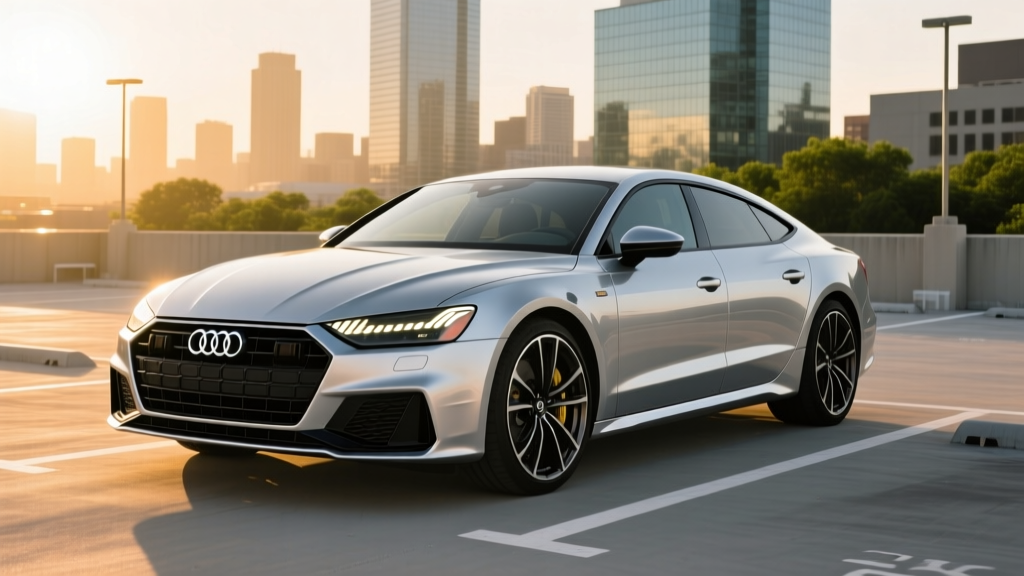
The 2026 Audi A7 Hybrid — badged as the A7 55 TFSI e quattro — is Audi's plug-in hybrid (PHEV) answer in the luxury midsize sportback segment. It pairs a turbocharged 2.0-liter four-cylinder with an electric motor integrated into the transmission, delivering all-wheel-drive performance while offering a meaningful electric-only commute window. For buyers not ready to go fully electric but who want daily electric driving with gas-engine road-trip flexibility, the A7 PHEV occupies a specific and practical niche.
This guide covers everything a prospective buyer needs: EPA fuel economy, real-world MPG, electric-only range, battery and charging specs, powertrain output, pricing, tax credit eligibility, and how the A7 Hybrid stacks up against both full EVs and conventional hybrids.
HEV vs PHEV: Where the Audi A7 Hybrid Fits
Before diving into specs, it is critical to understand the distinction between hybrid types, because it affects how you use the car daily.
| Feature | Conventional Hybrid (HEV) | Plug-In Hybrid (PHEV) — Audi A7 55 TFSI e |
|---|---|---|
| Plugs in? | No — charges via regen and engine | Yes — plug in to charge the battery |
| Battery size | ~1–2 kWh | 17.9 kWh (gross) / ~14.1 kWh usable |
| Electric-only driving | Minimal (under 1 mile at low speed) | EPA-est. ~24 miles |
| Fuel economy (charge depleted) | High MPG continuously | ~29 MPG combined on gas alone |
| Ideal use case | No home charging access | Home charging + short commute |
The Audi A7 is not a conventional hybrid. It is a PHEV, meaning you should plug it in nightly to extract its full value. If you cannot charge at home or at work, the A7 PHEV becomes a heavier, less efficient gas car once the battery depletes — and you would be better served by a dedicated HEV or a mild-hybrid vehicle.
Powertrain: Horsepower, Engine, and Motor Specs
The 2026 A7 55 TFSI e quattro uses a powertrain shared with the Audi A6 PHEV platform:
| Specification | Value |
|---|---|
| Engine | 2.0L turbocharged inline-4 (261 HP / 273 lb-ft) |
| Electric motor | Integrated in 7-speed S tronic (141 HP / 258 lb-ft) |
| Combined system output | 362 HP / 369 lb-ft torque |
| Drivetrain | quattro all-wheel drive |
| Transmission | 7-speed dual-clutch automatic (S tronic) |
| 0–60 mph | 5.1 seconds |
| Battery (gross / usable) | 17.9 kWh / ~14.1 kWh |
| Battery chemistry | NMC (nickel manganese cobalt) |
The combined 362 HP output makes the A7 PHEV genuinely quick — the electric motor fills the torque gap before the turbo spools, resulting in immediate throttle response. In EV mode, the motor alone provides adequate acceleration for city merging and stoplight departures, though highway passing on electric-only power requires planning.
Fuel Economy: EPA MPG, MPGe, and Real-World Numbers
As a PHEV, the A7 carries two fuel economy ratings: MPGe (when operating on combined electric + gas) and standard MPG (when the battery is depleted and the car runs as a hybrid).
| Mode | City | Highway | Combined |
|---|---|---|---|
| Charge-sustaining (gas only, battery depleted) | 27 MPG | 31 MPG | 29 MPG |
| Charge-depleting (EV + gas blended) | 49 MPGe combined | ||
Source: fueleconomy.gov
If your daily commute is under 24 miles and you charge nightly, you may use little to no gasoline on weekdays. On a long road trip with a depleted battery, expect 29 MPG combined — respectable for a 4,600-pound luxury sportback but not class-leading among hybrids.
Electric-Only Range and Total Range
| Range Metric | Value |
|---|---|
| EPA electric-only range | 24 miles |
| Real-world electric range (mild weather, city) | 20–26 miles |
| Real-world electric range (cold weather, highway) | 14–18 miles |
| Gas tank capacity | 13.7 gallons |
| Total combined range (full charge + full tank) | ~420 miles |
The 24-mile EPA electric range is enough to cover the average American one-way commute (roughly 16 miles per the U.S. Census Bureau). However, cold weather and highway speeds reduce this significantly. At 30°F with cabin heating active and 70-mph highway driving, expect the electric range to drop to approximately 14–18 miles. The A7 PHEV does not use a dedicated heat pump for cabin heating — it relies on engine waste heat in hybrid mode and resistive heating in EV mode, which draws heavily from the battery.
Charging: Battery Size, Speed, and Times
Charging the A7 PHEV is straightforward, but it is limited to AC charging only — there is no DC fast charging capability, which is typical for PHEVs in this class.
| Charging Level | Power (kW) | Estimated Time (0–100%) |
|---|---|---|
| Level 1 (120V household outlet) | ~1.4 kW | ~10–12 hours |
| Level 2 (240V, home or public AC) | 7.2 kW (onboard charger max) | ~2.5 hours |
| DC Fast Charging | Not available | |
A 240V Level 2 home charger is strongly recommended. On a standard 120V outlet, a full overnight charge is possible only if the car is plugged in for 10+ hours — tight for evening arrivals and morning departures. A Level 2 wallbox (such as a ChargePoint Home Flex or Audi-branded unit) replenishes the battery fully in about 2.5 hours, meaning you can top up midday if you return home for lunch.
The 7.2 kW onboard charger is competitive for a PHEV. Some rivals (like the BMW 550e xDrive) offer similar rates, while others (Toyota RAV4 Prime) accept up to 6.6 kW. The lack of DC fast charging means you cannot meaningfully top up the battery on a road trip at a public fast charger — but since the battery is only 17.9 kWh, this is a minor practical limitation.
Pricing, Trims, and Tax Credit Eligibility
The 2026 Audi A7 55 TFSI e quattro starts at approximately $78,995 (including destination), with the Prestige trim reaching roughly $86,000. Options such as the S line package, adaptive air suspension, and the Driver Assistance package can push a well-equipped example past $92,000.
- MSRP cap: Sedans must be under $55,000 to qualify. The A7 at ~$79,000 exceeds this cap.
- Buyer income cap: AGI must be under $150,000 (single) or $300,000 (joint).
- Battery sourcing: Critical minerals and battery components must meet phased-in domestic-content thresholds.
- Point-of-sale transfer: Eligible credits can be applied at purchase to reduce the transaction price.
The Audi A7 PHEV does not qualify for the $7,500 federal §30D tax credit because its MSRP exceeds the $55,000 sedan cap. This is a significant factor in total cost of ownership. Some states offer additional PHEV rebates (California's CVRP, for example, has its own income and MSRP rules), so check your state incentive database for local programs. Always consult a tax professional before making purchase decisions based on credits.
Battery Warranty, Reliability, and Replacement Cost
- Coverage: 8 years / 100,000 miles (whichever comes first)
- Capacity retention threshold: Battery must retain at least 70% of original capacity
- Hybrid system components: 8 years / 100,000 miles (power electronics, electric motor)
Audi's PHEV battery warranty matches the industry standard for electrified vehicles, mandated in part by CARB-emissions-state requirements. In practice, NMC batteries in PHEVs tend to degrade slowly because the usable window is limited (the car buffers the top and bottom of the pack to protect longevity). Owners of earlier-generation Audi PHEVs (2019–2023 A7/A6 TFSI e) have reported minimal degradation at 60,000+ miles.
If the battery does require out-of-warranty replacement, expect a cost between $8,000 and $14,000 including parts and labor, based on current dealer pricing for the 17.9 kWh pack. This is a meaningful long-term ownership risk for second or third owners who will be outside the 8-year warranty window.
Overall reliability for the A7 platform is average for the luxury segment. The 2.0L EA888 engine is well-proven across the VW Group lineup, and the S tronic transmission has been refined over multiple generations. The primary reliability concern is the complexity of integrating high-voltage systems with conventional powertrain components — more potential failure points than either a pure EV or a pure gas car.
Who Should Buy the Audi A7 Hybrid?
- Genuine electric-only commuting for trips under 24 miles
- 362 HP with quattro AWD — performance-oriented PHEV
- Sportback design with practical hatchback cargo access
- Premium interior with dual-touchscreen MMI system
- No range anxiety — gas engine for long trips
- Eligible for HOV lane stickers in select states (check local rules)
- No federal tax credit (MSRP exceeds $55K sedan cap)
- 24-mile electric range is modest vs. rivals (BMW 550e: ~35 mi)
- No DC fast charging
- Charge-sustaining MPG (29) is unremarkable for the segment
- Heavier and more complex than a pure EV or conventional HEV
- Premium fuel required
- You have home Level 2 charging and a commute under 24 miles
- You want a luxury sportback with performance credentials and AWD
- You regularly take road trips beyond EV charging infrastructure
- You value Audi's interior quality and design language
- You want zero gas-engine maintenance and lower running costs
- Your daily driving exceeds 24 miles but is under 250 miles
- You want access to the federal tax credit on a luxury vehicle (check MSRP caps for SUVs: $80,000)
- You have no access to home or workplace charging
- You prioritize maximum MPG without behavioral changes
- You want lower purchase price and simpler mechanicals
FAQ: Audi A7 Hybrid Questions Answered
How many MPG does the Audi A7 Hybrid get?
When the battery is depleted and the car operates as a hybrid, the A7 55 TFSI e returns an EPA-estimated 27 city / 31 highway / 29 combined MPG. When operating with a charged battery blending electric and gas, it achieves 49 MPGe combined. Real-world highway driving at 70 mph yields approximately 30 MPG in hybrid mode.
How far can the Audi A7 PHEV go on electric only?
The EPA rates the A7 55 TFSI e at 24 miles of electric-only range. In mild city driving, you may see 26 miles; in cold weather or at highway speeds, expect 14–18 miles. The total combined range (full battery + full 13.7-gallon tank) is approximately 420 miles.
Does the Audi A7 Hybrid qualify for a tax credit?
No. The 2026 A7 55 TFSI e has an MSRP of approximately $79,000, which exceeds the $55,000 federal §30D tax credit cap for sedans. Some state-level incentives may apply — check your state's clean vehicle rebate program and consult a tax professional for eligibility.
Is the Audi A7 Hybrid reliable, and what does a battery replacement cost?
The A7 PHEV uses the proven EA888 2.0L engine and a well-developed S tronic transmission. The high-voltage battery is warrantied for 8 years / 100,000 miles at 70% capacity retention. Out-of-warranty battery replacement is estimated at $8,000–$14,000. Overall reliability is average for a complex European luxury PHEV — not as bulletproof as a Toyota hybrid system, but competitive within its segment.
Should I buy the A7 PHEV or a full EV?
If you can charge at home, your commute is under 24 miles, and you take regular long road trips where charging infrastructure is uncertain, the A7 PHEV is a strong bridge solution. If your daily driving is mostly under 250 miles and you want lower maintenance and running costs, a full EV like the Audi Q8 e-tron or BMW i5 may offer a better long-term ownership experience — and some luxury EVs priced under $80,000 (SUVs) may still qualify for the federal tax credit.
Can the Audi A7 Hybrid charge at a DC fast charger?
No. The A7 55 TFSI e supports only AC charging: Level 1 (120V, ~1.4 kW) and Level 2 (240V, up to 7.2 kW). There is no DC fast charging port. A full Level 2 charge takes approximately 2.5 hours.