Quick Verdict: The Audi A6 TFSI e in 2026
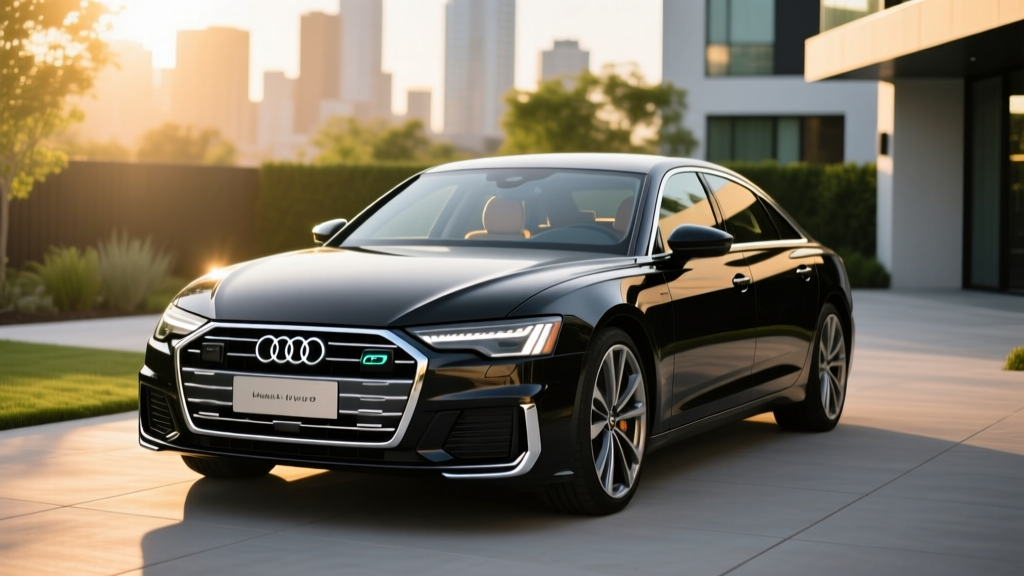
The Audi A6 sedan continues to offer a plug-in hybrid (PHEV) variant badged as the A6 55 TFSI e for the 2026 model year. It pairs a turbocharged 2.0-liter four-cylinder with an electric motor integrated into the transmission, delivering a combined 299 horsepower and roughly 31 miles of electric-only driving. For buyers who want luxury-sedan comfort with the option to commute on electricity without range anxiety, the A6 TFSI e occupies a specific niche — but its high starting price and limited federal tax credit eligibility narrow its appeal considerably.
Note: Audi does not currently sell a conventional hybrid (HEV) version of the A6 in the United States. The only electrified A6 available is the plug-in hybrid. If you see "A6 hybrid" referenced online, it almost certainly means the TFSI e PHEV.
HEV vs. PHEV: What the Audi A6 Actually Offers
| Feature | Conventional Hybrid (HEV) | Plug-In Hybrid (PHEV) — A6 55 TFSI e |
|---|---|---|
| Plugs in? | No — charges via regenerative braking and engine | Yes — has a charge port for Level 1/Level 2 AC charging |
| Electric-only range | 0–2 miles at low speed | ~31 miles (EPA est.) |
| Battery size | ~1–2 kWh | 17.9 kWh (gross) / ~14.4 kWh usable |
| Runs on gas only? | Yes, always | Yes — operates as a hybrid once battery is depleted |
| Federal tax credit | None | Up to ~$4,300–$7,500 (subject to §30D sourcing/income rules) |
The distinction matters. A conventional hybrid like the Toyota Camry Hybrid never needs plugging in — it simply uses a small battery and electric motor to assist the gas engine, improving fuel economy. The A6 55 TFSI e is a plug-in hybrid: it has a much larger battery that you charge from an outlet or charger, enabling genuine electric-only commuting. Once that battery depletes, it seamlessly transitions to hybrid mode, blending engine and motor power.
EPA MPG, Electric Range, and Real-World Efficiency
| Metric | A6 55 TFSI e (PHEV) | A6 Gas (45 TFSI, 2.0T) |
|---|---|---|
| EPA Combined MPGe (charge-sustaining + electric) | 55 MPGe (est.) | 27 MPG |
| EPA Combined MPG (gas-only / charge-depleted) | 29 MPG | 27 MPG |
| EPA City MPG (gas-only) | 28 MPG | 25 MPG |
| EPA Highway MPG (gas-only) | 31 MPG | 30 MPG |
| Electric-only range (EPA est.) | ~31 miles | N/A |
| Total combined range | ~440 miles | ~420 miles |
Real-world MPG note: PHEVs are highly sensitive to your driving habits. If your daily commute is under 31 miles and you charge nightly, you may use almost zero gasoline for months. On long highway road trips where the battery depletes quickly, expect the gas-only fuel economy to hover around 27–29 MPG combined — a modest improvement over the gas-only A6. In city driving with a depleted battery, regenerative braking helps push efficiency slightly above the EPA highway figure, which is typical for hybrids and PHEVs.
Powertrain, Battery, and Charging Specs
| Specification | A6 55 TFSI e (2026) |
|---|---|
| Engine | 2.0L turbocharged inline-4 |
| Electric motor | Single motor, integrated into 7-speed S tronic transmission |
| Combined horsepower | 299 hp |
| Combined torque | 369 lb-ft |
| 0–60 mph | 5.8 seconds (mfr. est.) |
| Battery (gross / usable) | 17.9 kWh / ~14.4 kWh |
| Battery chemistry | NMC (nickel manganese cobalt) |
| Onboard charger (AC) | 7.4 kW (Level 2) |
| Level 1 charge time (120V, 1.4 kW) | ~10–11 hours (0–100%) |
| Level 2 charge time (240V, 7.4 kW) | ~2.5 hours (0–100%) |
| DC fast charging | Not available |
| Drivetrain | quattro all-wheel drive |
| Fuel tank capacity | 13.7 gallons |
Charging reality: The A6 TFSI e does not support DC fast charging — a limitation shared with most PHEVs. Its 17.9 kWh battery is designed for overnight AC charging at home. On a Level 2 home charger (240V, 32A+), a full charge takes roughly 2.5 hours. On a standard 120V household outlet (Level 1), expect an overnight charge to take 10–11 hours, which still works if you plug in when you get home from work.
The 7.4 kW onboard charger is adequate for the battery size. To put this in perspective: kW (kilowatts) measures the rate of charging power, while kWh (kilowatt-hours) measures the battery's energy capacity. At 7.4 kW, you're adding roughly 7.4 kWh of energy per hour — enough to fill the ~14.4 kWh usable battery in under two hours, accounting for charging losses.
Pricing, Trims, and Federal Tax Credit Eligibility
The 2026 Audi A6 55 TFSI e starts at approximately $72,995 (including destination). Audi typically offers it in Premium Plus and Prestige trim levels, with Prestige pushing the MSRP above $78,000 once options are added.
- MSRP cap: Sedans must be under $55,000 MSRP to qualify. The A6 TFSI e starts at ~$72,995 — it exceeds the cap and does NOT qualify for the §30D new-vehicle credit.
- Income caps: Even if it qualified, buyer AGI must be ≤$150K (single) / $300K (joint).
- Battery sourcing: Critical mineral and battery component phase-in requirements apply to eligible vehicles.
- Point-of-sale transfer: Available for eligible vehicles — but irrelevant here since the A6 exceeds the MSRP cap.
Source: IRS §30D Clean Vehicle Credit. Consult a tax professional for your specific situation. State-level incentives (e.g., California, New York, Colorado) may still apply — check your state's energy office.
Bottom line on incentives: The A6 TFSI e's luxury pricing disqualifies it from the federal EV tax credit. Some state and utility-level rebates for PHEVs may still apply depending on your jurisdiction, but most require the vehicle to appear on an approved list. Check fueleconomy.gov and your state's clean-vehicle program for specifics.
Battery Warranty, Reliability, and Replacement Cost
8 years / 100,000 miles (whichever comes first), covering defects and capacity loss below ~70% of original capacity. This is consistent with industry-standard PHEV battery warranties and is mandated at the federal level for emissions-related components.
Reliability outlook: Audi's PHEV powertrain has been in production across multiple model lines (A7, Q5, A6) since 2019, and the 2.0T engine + S tronic combination is well-established. The primary reliability concerns with the A6 platform historically involve electronics and infotainment rather than the hybrid system itself. The high-voltage battery uses proven NMC chemistry, and degradation in PHEVs tends to be slower than in full BEVs because the battery is smaller, cycles less deeply, and the vehicle's thermal management system is less stressed.
Battery replacement cost: If the high-voltage battery requires replacement out of warranty, expect a cost in the range of $8,000–$14,000 including parts and labor, based on current Audi PHEV battery pricing. This is significantly less than a full BEV battery replacement ($15,000–$25,000+) because the PHEV battery pack is much smaller. However, most PHEV batteries last well beyond the warranty period — data from similar platforms suggests 10–15 years of service life before meaningful degradation.
12V battery note: Like all modern Audis, the A6 TFSI e still has a conventional 12V auxiliary battery that powers electronics and starts the system. This battery typically lasts 3–5 years and costs $200–$400 to replace — unrelated to the high-voltage traction battery.
Who Should Buy the Audi A6 Hybrid (and Who Shouldn't)
- Your daily commute is under 30 miles and you can charge at home nightly
- You want a luxury midsize sedan with the flexibility to road-trip on gasoline
- You don't have reliable access to public DC fast chargers for a full EV
- You value quattro AWD and a refined, quiet electric mode around town
- You want zero tailpipe emissions and lower per-mile "fuel" costs
- You have home Level 2 charging and access to DC fast charging for road trips
- You want to eliminate oil changes and engine maintenance entirely
- You can't charge at home or at work
- You want a lower purchase price (gas A6 starts ~$10,000 less)
- Your driving is mostly long-distance highway where PHEV advantages diminish
Pros and Cons
- ~31 miles electric-only covers most daily commutes
- Seamless transition to hybrid mode — no range anxiety
- 299 hp with quattro AWD provides confident acceleration
- Quiet, refined electric driving in EV mode
- Full luxury sedan features, premium interior, advanced ADAS
- ~$73K starting price; does NOT qualify for federal §30D tax credit
- No DC fast charging — home charging only
- Electric range drops significantly in cold weather (~18–22 mi)
- Trunk space reduced vs. gas A6 due to battery placement
- Gas-only fuel economy (29 MPG) is only marginally better than gas A6
Frequently Asked Questions
How many MPG does the Audi A6 hybrid get?
The 2026 Audi A6 55 TFSI e is rated at approximately 29 MPG combined when operating on gasoline alone (charge-depleted mode). When factoring in electric driving, its combined rating is around 55 MPGe. Real-world gas-only MPG varies: expect 27–28 MPG on highway road trips and up to 30–32 MPG in mixed city driving where regenerative braking recovers energy.
How far can the Audi A6 PHEV go on electric only?
The EPA estimates ~31 miles of electric-only range. In real-world conditions, plan for 24–28 miles in moderate temperatures and 18–22 miles in freezing weather. Once the battery is depleted, the car seamlessly switches to hybrid mode and can travel an additional ~410 miles on its 13.7-gallon fuel tank.
Does the Audi A6 hybrid qualify for any tax credit?
The A6 55 TFSI e does not qualify for the federal §30D Clean Vehicle Credit because its MSRP (~$72,995) exceeds the $55,000 sedan cap. Some state-level incentives for PHEVs may still apply — check your state energy office or fueleconomy.gov for state-specific programs. Always consult a tax professional for eligibility guidance.
Is the Audi A6 hybrid reliable, and what does battery replacement cost?
Audi's PHEV powertrain has been in use since 2019 across multiple models and is generally considered reliable. The high-voltage battery is covered by an 8-year/100,000-mile warranty. Out-of-warranty replacement costs are estimated at $8,000–$14,000. Based on data from similar PHEV platforms, most batteries retain usable capacity well beyond the warranty period.
Can I charge the Audi A6 TFSI e at a public fast charger?
No. The A6 TFSI e only supports AC charging (Level 1 at 120V or Level 2 at 240V). It does not have a DC fast-charge port. This is typical for PHEVs — their smaller batteries are designed for overnight home charging, not rapid public charging. A full Level 2 charge takes about 2.5 hours.
Hybrid vs. PHEV vs. full EV — which is right for me?
A conventional hybrid (HEV) is best if you can never plug in and want better MPG with zero behavior change. A PHEV like the A6 TFSI e is ideal if you can charge at home and want electric commuting with gas-engine backup for road trips. A full EV (BEV) suits drivers with home charging and access to DC fast charging who want the lowest operating costs and zero tailpipe emissions. The PHEV is the compromise — but it's a compromise that works well for mixed-use drivers.
What is the difference between kW and kWh on the A6 TFSI e?
kW (kilowatts) measures power — the rate at which energy flows. The A6's onboard charger is rated at 7.4 kW, meaning it can accept energy at that rate. kWh (kilowatt-hours) measures energy capacity — the battery holds 17.9 kWh total (~14.4 kWh usable). Think of kW as how fast water flows through a hose, and kWh as the size of the bucket you're filling.
Sources: EPA fueleconomy.gov, IRS §30D Clean Vehicle Credit rules, Audi USA official specifications. Pricing and specs reflect 2026 model year data and are subject to change. Verify current incentive eligibility with official sources before purchasing.