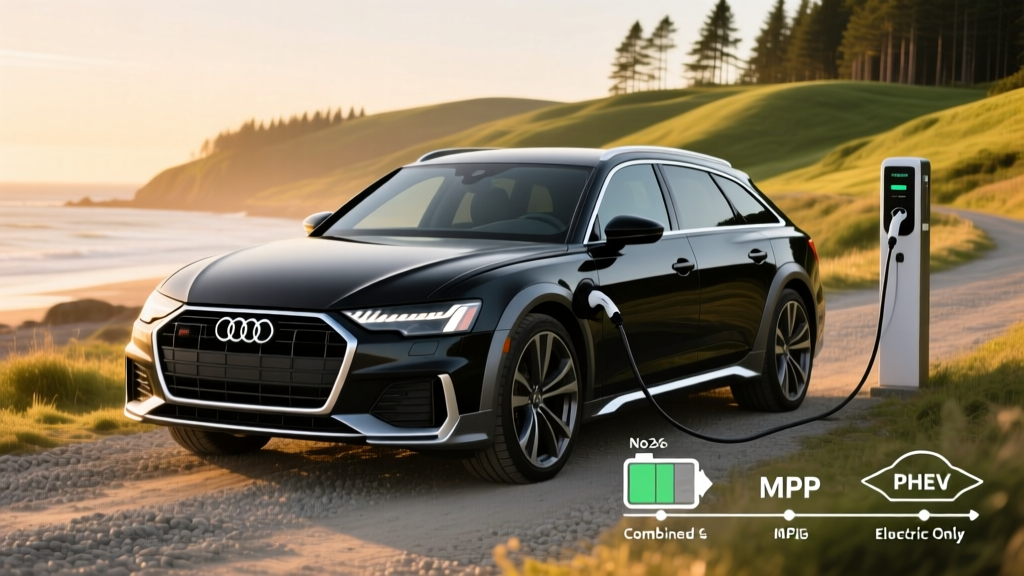
The Audi A6 Allroad has long occupied a niche few wagons dare to claim: raised ride height, Quattro all-wheel drive, and near-SUV utility wrapped in a sleek long-roof body. For 2026, the A6 Allroad lineup continues to offer the 55 TFSI e plug-in hybrid variant, giving buyers a genuine electric-only commute mode without sacrificing the go-anywhere capability the Allroad name promises. If you've been searching for an A6 Allroad hybrid that bridges the gap between a conventional gas wagon and a full battery-electric vehicle, this is the powertrain to understand.
Below, we break down the 2026 A6 Allroad 55 TFSI e's plug-in hybrid system, real-world MPG expectations, electric-only range, charging logistics, battery longevity, and whether this PHEV wagon qualifies for federal tax credits under current IRS §30D rules.
HEV vs PHEV: What the A6 Allroad Hybrid Actually Is
Let's clear up a common point of confusion before diving into specs. The term "hybrid" covers two fundamentally different architectures:
Conventional Hybrid (HEV)
A small battery (typically 1–2 kWh) recharges through regenerative braking and the gas engine. You never plug it in. Examples: Toyota Prius, Honda CR-V Hybrid. Electric-only driving is limited to very low speeds and short distances.
Plug-In Hybrid (PHEV) — This Is What the A6 Allroad 55 TFSI e Is
A larger battery (17.9 kWh usable in this case) that you can plug in to charge, delivering meaningful electric-only range — roughly 30 miles in the A6 Allroad's case. Once the battery depletes, the vehicle operates as a conventional hybrid, seamlessly blending the gas engine and electric motor.
The 2026 Audi A6 Allroad is not available as a conventional HEV in the United States. The only electrified option is the 55 TFSI e plug-in hybrid. If you want an A6 Allroad hybrid, you're getting a PHEV — and that distinction matters for charging habits, tax credit eligibility, and daily driving economics.
Powertrain Specs: Engine, Motor, and Combined Output
The 2026 A6 Allroad 55 TFSI e pairs a turbocharged 2.0-liter inline-four gasoline engine with an electric motor integrated into the seven-speed S tronic dual-clutch transmission. Here's the full breakdown:
| Specification | Value |
|---|---|
| Gas Engine | 2.0L Turbocharged I4 |
| Engine Output | 261 hp / 273 lb-ft torque |
| Electric Motor Output | 141 hp / 258 lb-ft torque |
| Combined System Output | 362 hp / 369 lb-ft torque |
| Transmission | 7-speed S tronic dual-clutch automatic |
| Drivetrain | Quattro AWD (ultra technology) |
| Battery Capacity (Usable) | 17.9 kWh (lithium-ion, NMC chemistry) |
| Battery Location | Under rear cargo floor |
| 0–60 mph | 5.1 seconds |
| Towing Capacity | 4,400 lbs (braked) |
The combined 362 hp makes the A6 Allroad PHEV genuinely quick — the 5.1-second 0–60 time handily beats most six-cylinder competitors in this segment. The electric motor fills in torque at low RPMs before the turbo spools, which gives the car an immediate, responsive feel around town that the gas-only 45 TFSI variant can't match.
Fuel Economy: EPA MPG and MPGe Breakdown
PHEV fuel economy is reported in two ways: MPGe (miles per gallon equivalent) when the battery is charged and you're running on a mix of electric and gas power, and conventional MPG once the battery is depleted. Both numbers matter depending on your driving habits.
| Metric | City | Highway | Combined |
|---|---|---|---|
| MPGe (charge-depleting + sustaining) | — | 64 MPGe | |
| MPG (charge-sustaining / battery depleted) | 27 mpg | 29 mpg | 28 mpg |
Source: EPA Fuel Economy
Real-World MPG Expectations
The 28 mpg combined charge-sustaining figure is what you'll see on long road trips once the battery is empty. In practice, expect 26–27 mpg at sustained 75–80 mph highway speeds — the raised Allroad ride height and standard 20-inch wheels create more aerodynamic drag than the A6 sedan. In city driving with frequent stops and regenerative braking, real-world numbers often climb to 29–31 mpg even after the battery depletes, because the hybrid system recovers energy under braking.
If you charge nightly and your commute is under 30 miles round-trip, you may burn almost no gasoline during the work week.
Electric-Only Range and Total Driving Range
The EPA rates the 2026 A6 Allroad 55 TFSI e at 30 miles of electric-only range on a full charge. That's enough for most daily commutes, school runs, and errand loops — but it's not class-leading. Competitors like the BMW X5 xDrive50e offer closer to 38–40 electric miles.
Once the battery is depleted, the 17.4-gallon fuel tank combined with 28 mpg charge-sustaining efficiency gives a total gas-only range of approximately 487 miles. Add the 30 electric miles, and the maximum combined range from a full charge plus a full tank sits around 517 miles.
| Range Metric | Miles |
|---|---|
| EPA Electric-Only Range | 30 mi |
| Gas-Only Range (battery depleted) | ~487 mi |
| Total Combined Range | ~517 mi |
| Real-World Electric Range (highway, 70°F) | 24–27 mi |
| Real-World Electric Range (winter, 30°F) | 18–22 mi |
Cold weather reduces EV range on all battery-electric and plug-in hybrid vehicles. Expect roughly a 25–35% reduction in electric-only range when temperatures drop below freezing, as the battery's internal resistance increases and cabin heating draws additional energy.
Charging the A6 Allroad PHEV: Speeds, Times, and Logistics
The 2026 A6 Allroad 55 TFSI e uses a standard J1772 connector for AC Level 1 and Level 2 charging. Here's what charging looks like in practice:
| Charging Level | Power (kW) | 0–100% Time | Notes |
|---|---|---|---|
| Level 1 (120V household outlet) | ~1.4 kW | ~13 hours | Overnight top-up only; insufficient for daily full recharge |
| Level 2 (240V home/public charger) | 7.2 kW (onboard charger max) | ~2.5 hours | Ideal for overnight home charging; full charge by morning |
| DC Fast Charging | Not supported | No CCS or NACS DC port | |
This is a critical ownership detail: the A6 Allroad PHEV does not support DC fast charging. There is no CCS or NACS connector on the vehicle. You're limited to AC charging at a maximum rate of 7.2 kW. For most PHEV owners who charge at home overnight, this is perfectly adequate — 2.5 hours on a Level 2 charger easily covers a nightly top-up. But if you were hoping to charge at a highway DC fast charger during road trips, that's not an option with this vehicle.
For home Level 2 charging, you'll want a 240V outlet (NEMA 14-50 or hardwired wall connector) installed by a licensed electrician. Expect installation costs of $500–$1,500 depending on panel proximity and local permit requirements, plus $300–$700 for a quality Level 2 charging unit. If your home's electrical panel is maxed out, a panel upgrade could add $1,500–$3,000.
Pricing, Trim Levels, and Tax Credit Eligibility
The 2026 Audi A6 Allroad 55 TFSI e is offered in two trims:
| Trim | MSRP (incl. destination) |
|---|---|
| Premium Plus | $72,395 |
| Prestige | $78,195 |
Does the A6 Allroad Hybrid Qualify for the Federal EV Tax Credit?
Under current IRS §30D rules, the federal clean vehicle credit of up to $7,500 is available for qualifying PHEVs — but the A6 Allroad 55 TFSI e faces significant hurdles:
- MSRP Cap: The vehicle must have an MSRP at or below $80,000 for SUVs/wagons. The Premium Plus trim at $72,395 clears this cap; the Prestige at $78,195 also qualifies, but options can push it over.
- Battery Sourcing Requirements: Critical minerals and battery components must meet escalating domestic-sourcing thresholds. As of 2026, vehicles with battery components manufactured by a "foreign entity of concern" (FEOC) are disqualified. Audi sources batteries from suppliers that may not meet all current thresholds — verify eligibility at the time of purchase.
- Buyer Income Limits: Modified adjusted gross income must not exceed $150,000 (single) / $300,000 (joint filing).
- Point-of-Sale Transfer: Eligible buyers can transfer the credit to the dealer at purchase, reducing the purchase price directly rather than waiting for a tax refund.
Bottom line: Do not assume the $7,500 credit applies. Verify current eligibility using the IRS's clean vehicle credit lookup tool or consult a tax professional before purchasing. The credit's battery-sourcing rules have tightened significantly since 2024, disqualifying several previously eligible European-built PHEVs.
Battery Longevity, Warranty, and Replacement Cost
Plug-in hybrid battery anxiety is a top concern for buyers transitioning from conventional vehicles. Here's what you need to know about the A6 Allroad 55 TFSI e's high-voltage battery:
Audi Hybrid Battery Warranty
Coverage: 8 years or 100,000 miles (whichever comes first)
Capacity Threshold: Audi warrants the battery against defects and excessive capacity loss below 70% of original capacity during the warranty period, consistent with industry-standard PHEV battery warranties.
Replacement Cost (out of warranty): Estimated $8,000–$12,000 for the high-voltage battery pack, plus labor. This is significantly less than a full EV battery replacement because the PHEV pack is much smaller (17.9 kWh vs. 75–100+ kWh in a BEV).
In practice, PHEV batteries tend to experience less severe degradation than full EV batteries because the vehicle's software maintains a larger buffer — you never truly drain the battery to 0% or charge it to absolute 100% at the cell level. This operating window reduces stress on the NMC cells and extends cycle life. Real-world data from earlier-generation Audi PHEVs (TFSI e models from 2020–2023) suggests 5–8% capacity loss over 5 years / 60,000 miles under normal use, well within the warranty threshold.
The conventional 12V auxiliary battery is a separate component and is covered under the standard 4-year/50,000-mile new vehicle warranty.
Reliability and Ownership Considerations
The A6 Allroad platform is well-established, now in its third generation of the C8 chassis. The 2.0L TFSI engine is one of Volkswagen Group's most widely deployed powerplants, with a mature reliability track record. The PHEV system adds complexity — an electric motor, power electronics, and high-voltage battery — but these components have fewer moving parts than a conventional transmission or all-wheel-drive system.
Areas to watch:
- Cargo space impact: The high-voltage battery sits under the rear cargo floor, reducing under-floor storage. Total cargo volume drops slightly compared to the gas-only A6 Allroad — expect approximately 28 cu ft behind the rear seats (vs. 30 cu ft in the gas model).
- Maintenance: PHEVs still require oil changes, brake fluid service, and coolant maintenance for the gas engine. However, regenerative braking reduces brake pad wear significantly — many PHEV owners report original brake pads lasting 80,000+ miles.
- Insurance: PHEVs typically carry 5–10% higher insurance premiums than their gas-only equivalents due to higher repair costs for the high-voltage system. Get a quote before committing.
Who Should Choose the A6 Allroad Hybrid vs. a Full EV or Gas Car?
Choose the A6 Allroad 55 TFSI e PHEV if:
- Your daily commute is under 30 miles round-trip and you have access to home Level 2 charging — you'll drive electric most weekdays and burn gas only on longer trips.
- You need Quattro AWD and a raised ride height for snow, gravel roads, or light off-pavement use, but don't want an SUV.
- You regularly take road trips exceeding 300 miles and don't want to plan around DC fast-charging stops.
- You want a premium wagon with genuine towing capacity (4,400 lbs) — most BEV wagons can't match this.
Choose a full EV (like the Audi Q8 e-tron or BMW iX) if:
- You have reliable home charging and rarely drive more than 250 miles in a single day.
- You want to eliminate gasoline costs and engine maintenance entirely.
- You prioritize maximum cargo space — BEVs have no engine or transmission tunnel, often offering a front trunk (frunk) in addition to rear cargo.
Choose the gas-only A6 Allroad (or a conventional HEV wagon) if:
- You cannot install a Level 2 charger at home and have no workplace charging access — a PHEV you never plug in is just a heavier, more expensive gas car.
- Your budget is tighter and you want to avoid the PHEV price premium (~$5,000–$7,000 over the gas-only 45 TFSI Allroad).
Pros
- 362 combined hp with seamless electric torque fill — genuinely quick
- 30-mile EV range covers most daily commutes without gas
- Quattro AWD + raised ride height for all-weather confidence
- 4,400-lb towing capacity exceeds most BEV wagons
- No range anxiety on long road trips — gas engine takes over seamlessly
- Premium interior with Audi's latest MMI infotainment
Cons
- No DC fast charging — AC only at 7.2 kW max
- 30-mile EV range is modest vs. PHEV SUV competitors (38–40+ mi)
- Federal tax credit eligibility is uncertain due to battery-sourcing rules
- Battery placement slightly reduces under-floor cargo storage
- MSRP starts above $72,000 — premium pricing for a wagon
- Real-world highway MPG drops to ~26 mpg when battery is depleted
Frequently Asked Questions
How many MPG does the 2026 Audi A6 Allroad hybrid get?
The EPA rates the A6 Allroad 55 TFSI e at 64 MPGe combined when operating with a charged battery (blending electric and gas). Once the battery depletes, it achieves 28 mpg combined (27 city / 29 highway) as a conventional hybrid. Real-world highway driving at 75–80 mph with a depleted battery yields approximately 26–27 mpg.
How far can the A6 Allroad PHEV go on electric only?
The EPA rates it at 30 miles of electric-only range. In real-world conditions at moderate temperatures and mixed driving, expect 24–27 miles. In cold weather (below 30°F), that drops to approximately 18–22 miles due to reduced battery efficiency and cabin heating demands.
Hybrid vs PHEV vs EV — which should I choose?
If you have home charging and a short commute but also take long road trips, the A6 Allroad PHEV is ideal — electric for daily driving, gas for distance. If you can always charge at home and rarely exceed 250 miles per day, a full EV eliminates gas entirely and reduces maintenance. If you have no charging access at all, a conventional HEV (self-charging hybrid, no plug) is the better choice — but Audi doesn't offer an HEV version of the A6 Allroad in the US market.
Is the A6 Allroad hybrid reliable, and what does a battery replacement cost?
The 2.0L TFSI engine and PHEV drivetrain are well-proven across the VW Group lineup. The high-voltage battery is warrantied for 8 years or 100,000 miles against defects and capacity loss below 70%. Out-of-warranty replacement is estimated at $8,000–$12,000. PHEV batteries generally experience slower degradation than full EV batteries due to larger software buffers that prevent deep discharge and full charge at the cell level.
Does the A6 Allroad hybrid qualify for any tax credit?
Under current IRS §30D rules, the A6 Allroad 55 TFSI e may qualify for a federal clean vehicle credit of up to $7,500, but eligibility depends on battery component and critical mineral sourcing requirements that have tightened significantly. The MSRP must be at or below $80,000 (the Premium Plus trim qualifies; the Prestige may or may not depending on options). Buyer income caps also apply ($150K single / $300K joint). Always verify eligibility through the IRS clean vehicle tool or a tax professional before purchase. Some states offer additional PHEV rebates — check your state's energy office for current programs.
Can I charge the A6 Allroad PHEV at a Tesla Supercharger or DC fast charger?
No. The 2026 A6 Allroad 55 TFSI e does not have a DC fast charging port (no CCS or NACS connector). It can only charge via AC power at up to 7.2 kW using a standard J1772 connector. This is typical for most PHEVs — the smaller battery doesn't justify the cost and weight of DC fast-charging hardware.
What happens if I never plug in the A6 Allroad PHEV?
The vehicle will operate as a conventional hybrid using the gas engine and regenerative braking to maintain a small battery charge. You'll get approximately 28 mpg combined — essentially the same as driving a non-plug-in hybrid. However, you'll miss the entire point of the PHEV's electric range and the potential fuel savings. If you can't charge at home or work, a conventional hybrid or gas-only vehicle is a more cost-effective choice.