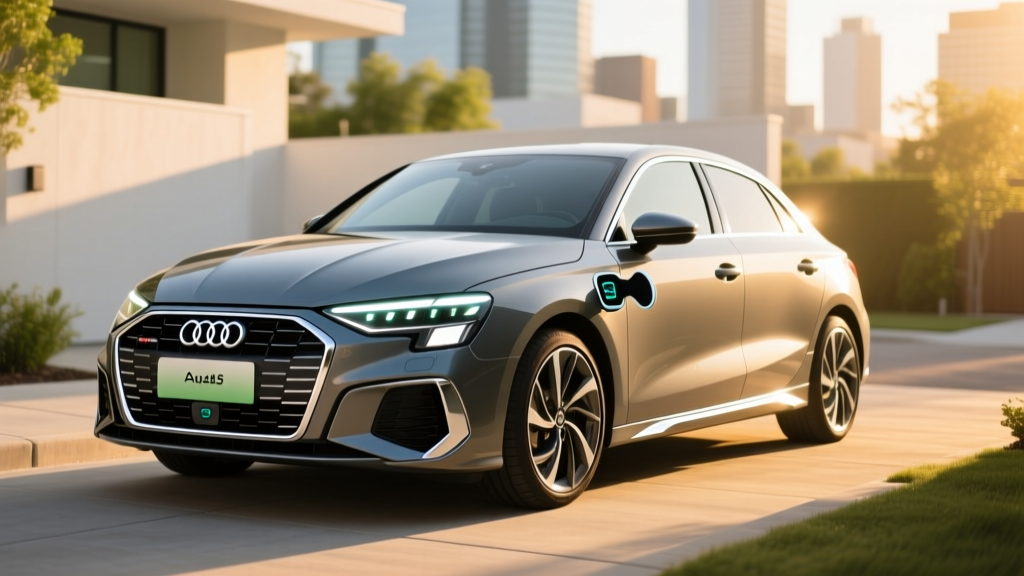
The Audi A3 has long been the entry point into the Audi lineup — a compact luxury sedan that punches above its weight in refinement and tech. For 2026, the Audi A3 hybrid arrives as a plug-in hybrid electric vehicle (PHEV), pairing a turbocharged 1.5-liter four-cylinder with an electric motor and a 19.7 kWh battery pack. It's positioned squarely against the BMW 2 Series Gran Coupe PHEV and the Mercedes-Benz CLA plug-in hybrid, targeting buyers who want electric commuting without range anxiety.
But does the A3 PHEV deliver enough electric-only range to matter, and how does it stack up against a full EV or a conventional hybrid? This guide breaks down every spec — from real-world MPG to battery warranty to federal tax credit eligibility — so you can decide if the A3 hybrid fits your daily driving.
HEV vs PHEV: Where the Audi A3 Hybrid Fits
Before examining specs, it's essential to understand the distinction. The 2026 Audi A3 is offered as a plug-in hybrid (PHEV), not a conventional hybrid (HEV). Here's the difference:
| Feature | Conventional Hybrid (HEV) | Plug-in Hybrid (PHEV) — Audi A3 |
|---|---|---|
| Battery size | ~1–2 kWh | 19.7 kWh |
| Plug-in charging | No — charges via regen/engine | Yes — Level 1/Level 2 AC |
| Electric-only range | 0–1 mile at low speed | ~33 miles (EPA est.) |
| Gas engine | Always available | Always available after battery depletes |
| Tax credit | None | Up to $3,750 (§30D, if eligible) |
The A3 PHEV can operate as a pure EV for short commutes, then seamlessly transitions to hybrid mode once the battery is depleted. You never need to plug it in to drive it — but you should plug it in to capture its efficiency and cost advantages.
Powertrain Specs: Engine, Motor, and Combined Output
| Specification | 2026 Audi A3 PHEV (40 TFSI e) |
|---|---|
| Engine | 1.5L turbocharged I4 |
| Electric motor | Permanent-magnet synchronous (integrated in 6-speed S tronic) |
| Combined horsepower | 245 hp |
| Combined torque | 295 lb-ft |
| Battery (usable) | 19.7 kWh (NMC chemistry) |
| Transmission | 6-speed S tronic dual-clutch automatic |
| Drivetrain | Front-wheel drive |
| 0–60 mph | 6.8 seconds |
| Top speed (EV mode) | 87 mph |
The 245-hp combined output makes the A3 PHEV the most powerful variant in the A3 lineup for 2026. The electric motor fills in torque at low RPMs, giving the sedan a responsive, linear feel off the line that the gas-only A3 40 TFSI can't match. Highway passing is confident, and the dual-clutch transmission shifts crisply in both hybrid and EV modes.
EPA Fuel Economy and Electric-Only Range
| Metric | EPA Estimate |
|---|---|
| MPGe (combined, EV + gas) | 78 MPGe |
| MPG (gas-only, combined) | 36 MPG |
| MPG (city, gas-only) | 38 MPG |
| MPG (highway, gas-only) | 34 MPG |
| Electric-only range | 33 miles |
| Total combined range (EV + gas) | ~440 miles |
| Energy consumption (EV mode) | 29 kWh/100 mi |
Real-world range check: The EPA's 33-mile electric-only estimate assumes moderate temperatures and mixed driving. In cold weather (below 35°F), expect the A3 PHEV's electric range to drop to roughly 24–27 miles due to cabin heating demand and reduced battery efficiency. On warm-weather city commutes at speeds under 45 mph, some drivers report squeezing out 35–37 miles before the engine kicks in. Highway driving at 70+ mph will reduce EV range to approximately 26–29 miles.
Once the battery depletes, the A3 operates as a conventional hybrid, returning an EPA-estimated 36 MPG combined. In real-world city driving with frequent stops and regenerative braking, owners of prior-generation Audi PHEVs routinely report 38–41 MPG in hybrid mode — slightly above the EPA sticker. Highway-only driving at sustained speeds typically yields 32–34 MPG, tracking close to the EPA figure.
Charging the Audi A3 PHEV: Speeds, Connectors, and Times
The 2026 Audi A3 PHEV charges via AC only — there is no DC fast charging capability, which is typical for compact PHEVs in this class. Here's what to expect:
| Charging Level | Power | 0–100% Time | Notes |
|---|---|---|---|
| Level 1 (120V household) | ~1.4 kW | ~14 hours | Emergency/trickle only |
| Level 2 (240V, home/public) | 7.2 kW (max onboard) | ~2 hours 45 min | Recommended daily charging |
The A3 PHEV uses a J1772 connector for AC charging (standard on all non-Tesla PHEVs in the US). A full charge on a Level 2 home charger takes under three hours, which means you can easily top off during a workday or between errands. Audi includes a dual-voltage charging cable (Level 1 and Level 2 capable) with the vehicle.
Home charging setup: Most A3 PHEV owners install a 240V Level 2 wallbox (such as a ChargePoint Home Flex or Emporia Vue) on a 40A circuit, which delivers the full 7.2 kW the car can accept. Installation costs typically range from $500–$1,500 depending on panel proximity and local permitting. Because the battery is only 19.7 kWh, a full charge costs roughly $2.50–$3.50 at the national average electricity rate of ~$0.16/kWh — far less than the gasoline equivalent for 33 miles.
Pricing, Trims, and Federal Tax Credit Eligibility
The 2026 Audi A3 PHEV (badged 40 TFSI e) is offered in two trims:
- Premium: $42,400 MSRP (includes destination)
- Premium Plus: $46,900 MSRP (adds navigation, adaptive cruise, parking assist)
Both trims are well-equipped with standard leather upholstery, Audi's 10.1-inch MMI touchscreen, wireless Apple CarPlay/Android Auto, and Audi Pre Sense safety systems.
§30D Federal Tax Credit: What You Need to Know
Under IRS §30D, plug-in hybrids with sufficient battery capacity may qualify for a partial federal tax credit. For the 2026 Audi A3 PHEV:
- Maximum potential credit: Up to $3,750 (based on battery capacity formula)
- MSRP cap: Sedans must be under $55,000 — both A3 trims qualify ✓
- Buyer income cap: $150,000 (single) / $300,000 (joint) modified AGI
- Battery sourcing: Critical minerals and battery component requirements phase in annually — verify current-year compliance on IRS.gov
- Point-of-sale transfer: Eligible buyers can transfer the credit to the dealer for an upfront price reduction
Important: Tax credit eligibility for PHEVs depends on battery sourcing and critical mineral requirements that tighten each year. The A3 PHEV's credit eligibility may be $0, $3,750, or some partial amount depending on when you purchase. Always verify on fueleconomy.gov before committing. Consult a tax professional for your specific situation.
Battery Warranty, Reliability, and Replacement Costs
Audi PHEV Battery Warranty: 8 years / 100,000 miles (whichever comes first) for defect coverage and capacity retention below 70% of original capacity. This meets the industry standard for electrified powertrains and aligns with EPA/CARB requirements for emissions-related components.
The A3 PHEV's 19.7 kWh NMC (nickel-manganese-cobalt) battery is liquid-cooled and managed by Audi's thermal management system, which keeps cells in their optimal temperature range during charging and discharging. This active management significantly slows degradation compared to passively cooled packs.
Real-world degradation data: Based on fleet data from prior-generation Audi/Volkswagen Group PHEVs (A3 e-tron, Golf GTE), NMC packs of this size typically lose 8–12% of capacity over 8 years under normal use patterns. That means a 33-mile EV range when new might drop to approximately 28–30 miles after eight years — still well within the warranty threshold.
Battery replacement cost: If the battery fails outside of warranty, a full pack replacement for a VW Group compact PHEV currently runs $6,000–$9,000 including parts and labor. However, out-of-warranty failures are rare — most PHEV batteries outlast the vehicle's ownership cycle. Individual cell module repairs (rather than full pack replacement) can sometimes be performed for $2,000–$4,000 at specialized shops.
Overall reliability: Audi's PHEV powertrain shares architecture with the Volkswagen Group's widely deployed plug-in hybrid system, which has proven durable across millions of vehicles globally. The primary maintenance items remain standard — brake fluid, cabin filters, and tire rotations. Brake pad life is typically extended significantly thanks to regenerative braking.
Who Should Buy the Audi A3 Hybrid — And Who Shouldn't
Choose the Audi A3 PHEV if:
- Your daily commute is under 30 miles round-trip and you can charge at home or work
- You want a luxury compact sedan but aren't ready to commit to a full EV
- You take regular road trips and need the security of a gas engine for 400+ mile range
- You value Audi's interior quality, ride refinement, and brand cachet
- You want to reduce fuel costs without changing your driving habits
Consider a full EV (like the Audi Q4 e-tron or Tesla Model 3) instead if:
- Your commute exceeds 35 miles one-way (you'll burn gas daily)
- You have reliable home charging and rarely take trips over 250 miles
- You want to eliminate oil changes and engine maintenance entirely
- You qualify for the full $7,500 EV tax credit on a comparable battery-electric vehicle
Stick with a conventional hybrid (HEV) or gas A3 if:
- You cannot charge at home or work (a PHEV unplugged is just a heavier, less efficient hybrid)
- Your budget is under $38,000 — the gas-only A3 40 TFSI starts around $36,000
- You drive primarily highway miles where the PHEV's EV range offers minimal benefit
Pros and Cons at a Glance
Pros
- 33-mile EV range covers most daily commutes gas-free
- 245 hp makes it the quickest A3 variant
- Refined ride and premium interior quality
- 440-mile total range eliminates road-trip anxiety
- Under $55K MSRP — qualifies for §30D MSRP cap
- Strong regenerative braking extends brake life
Cons
- No DC fast charging — AC only at 7.2 kW max
- EV range drops significantly in cold weather (~24 mi)
- Partial tax credit ($3,750 max) vs $7,500 for full EVs
- FWD only — no quattro AWD option on PHEV
- Trunk space reduced vs gas A3 (~8.5 cu ft vs 10.9 cu ft)
- Premium fuel recommended for optimal performance
Frequently Asked Questions
How many MPG does the Audi A3 hybrid get?
The 2026 Audi A3 PHEV achieves an EPA-estimated 78 MPGe when combining electric and gas driving. Once the battery depletes, it returns 36 MPG combined (38 city / 34 highway) as a conventional hybrid. Real-world city driving often yields 38–41 MPG in hybrid mode thanks to regenerative braking.
How far can the Audi A3 hybrid go on electric only?
The EPA estimates 33 miles of electric-only range. In warm-weather city driving, expect up to 35–37 miles. Highway driving at 70+ mph reduces this to about 26–29 miles, and cold weather (below 35°F) drops it to roughly 24–27 miles.
Does the Audi A3 hybrid qualify for a tax credit?
The A3 PHEV may qualify for up to $3,750 under the IRS §30D federal tax credit, depending on battery sourcing compliance and your income. Both trims fall under the $55,000 sedan MSRP cap. Verify current eligibility at IRS.gov before purchasing, as sourcing requirements change annually.
Is the Audi A3 hybrid reliable? What about battery replacement?
The A3 PHEV uses Volkswagen Group's proven plug-in hybrid architecture, which has demonstrated strong reliability across millions of vehicles. The battery is warrantied for 8 years/100,000 miles. Out-of-warranty replacement costs $6,000–$9,000, though full pack failures are rare. Expect 8–12% capacity loss over 8 years under normal use.
Can the Audi A3 hybrid charge at a DC fast charger?
No. The A3 PHEV supports AC charging only — Level 1 (120V) and Level 2 (240V at up to 7.2 kW). A full Level 2 charge takes approximately 2 hours and 45 minutes. This is standard for compact PHEVs; the relatively small 19.7 kWh battery doesn't require DC fast charging for practical daily use.
Hybrid vs PHEV vs EV — which is right for me?
A conventional hybrid (HEV) is best if you can't plug in at all — it requires no behavior change. A PHEV like the A3 is ideal if you can charge at home and commute under 30 miles but still take longer road trips. A full EV makes sense if you have home charging, drive under 250 miles daily, and want zero engine maintenance. The A3 PHEV occupies the middle ground: electric commuting with gas-engine backup.
Do I have to plug in the Audi A3 hybrid?
No — the A3 PHEV will drive perfectly fine without ever plugging in, operating as a conventional hybrid. However, you'll miss the entire point of the PHEV: the 33 miles of gas-free electric driving. To maximize savings and efficiency, plug in nightly at home using a Level 2 charger.