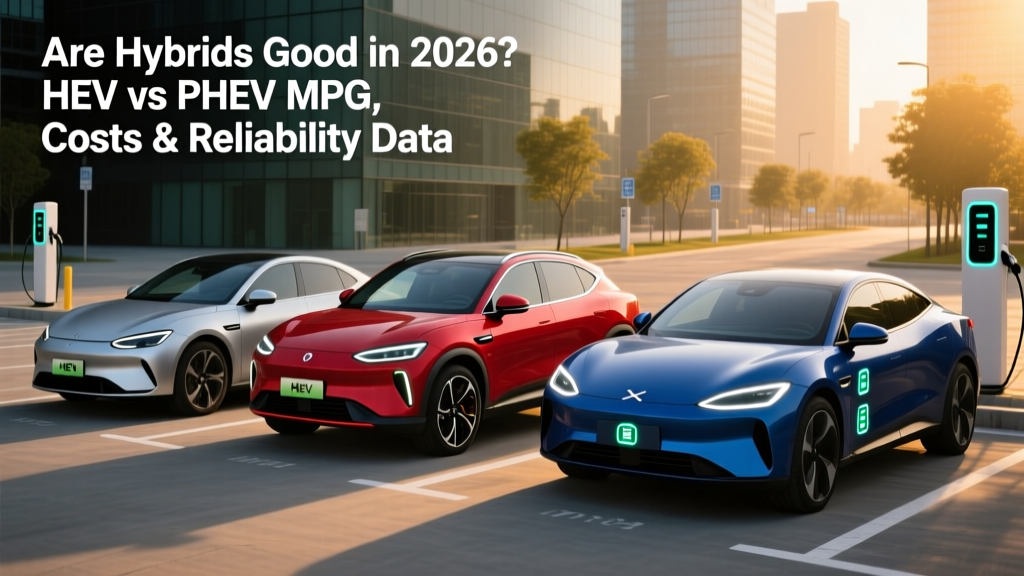
If you've been watching the EV transition from the sidelines, you're not alone. Millions of buyers in 2026 are asking a straightforward question: are hybrids good — or should you jump straight to a full battery-electric vehicle? The answer depends on your driving habits, charging access, and budget. Hybrids have quietly become some of the most efficient, reliable, and practical vehicles on the road, and the data backs it up.
This guide cuts through the noise with exact EPA fuel economy figures, battery warranty terms, real-world efficiency data, and a clear framework for choosing between a conventional hybrid (HEV), a plug-in hybrid (PHEV), or a full EV. We'll use two of the most popular 2026 models as concrete examples: the Toyota RAV4 Hybrid (HEV) and the Toyota RAV4 Prime (PHEV).
HEV vs PHEV: What's the Actual Difference?
Before comparing numbers, the distinction between hybrid types matters because it changes everything — how you fuel, how you charge, what you pay, and what tax credits you qualify for.
| Feature | HEV (Conventional Hybrid) | PHEV (Plug-in Hybrid) |
|---|---|---|
| Plug in to charge? | No — charges via regen & engine | Yes — has a charge port |
| Battery size | ~1.0–1.6 kWh (small buffer) | ~13–18 kWh (usable) |
| Electric-only driving | Minimal (low-speed assist only) | 25–50+ miles typical |
| Fuel type when battery depletes | Gasoline (always) | Gasoline (runs as HEV) |
| Federal tax credit (§30D) | Not eligible | Up to $7,500 (varies) |
| Home charging required? | No | Recommended for max benefit |
| Complexity / weight | Lower | Higher (larger battery + motor) |
The critical takeaway: conventional hybrids never need to be plugged in. They capture energy through regenerative braking and use the gas engine to charge the small battery. PHEVs give you an electric-only buffer for daily commuting but fall back to hybrid operation once the battery depletes.
Fuel Economy: EPA MPG and Real-World Numbers
Fuel economy is where hybrids earn their reputation. Let's look at two benchmark vehicles for the 2026 model year.
| Model | City MPG | Highway MPG | Combined MPG | MPGe (PHEV EV Mode) |
|---|---|---|---|---|
| 2026 Toyota RAV4 Hybrid (HEV) | 41 | 38 | 40 | N/A |
| 2026 Toyota RAV4 Prime (PHEV) | 40 (hybrid mode) | 36 (hybrid mode) | 38 (hybrid mode) | 94 MPGe |
| 2026 Honda CR-V Hybrid (HEV) | 43 | 36 | 40 | N/A |
| 2026 Hyundai Tucson PHEV | 35 (hybrid mode) | 34 (hybrid mode) | 35 (hybrid mode) | 80 MPGe |
Source: fueleconomy.gov, U.S. EPA
Hybrids frequently exceed their EPA city ratings in stop-and-go traffic because regenerative braking recovers more energy at low speeds. Owners of the RAV4 Hybrid routinely report 42–45 MPG in urban driving. Highway MPG, however, often falls 2–4 MPG below the EPA estimate at sustained 75+ mph speeds, where aerodynamic drag dominates and the electric motor contributes less. In cold weather (below 30°F), expect a 5–10% fuel economy reduction as the engine runs more often for cabin heat.
How Many MPG Does a Hybrid Actually Get?
For mainstream 2026 compact SUV hybrids, expect 38–43 MPG combined in real-world mixed driving. Sedans push higher — the 2026 Toyota Prius achieves an EPA-estimated 57 MPG combined on its LE trim, making it one of the most efficient non-plug-in vehicles ever sold. The bottom line: most hybrids deliver roughly 40–60% better fuel economy than their gasoline-only counterparts in the same class.
PHEV Electric-Only Range: How Far Can You Go Without Gas?
For PHEV buyers, electric-only range is the number that matters most. It determines whether your daily commute is effectively an EV commute — zero gas, zero tailpipe emissions — or whether the engine kicks in.
| Model | EV Range (EPA) | Battery (kWh usable) | Total Range (EV + Gas) | Level 2 Charge Time (0–100%) | DC Fast Charge? |
|---|---|---|---|---|---|
| Toyota RAV4 Prime | 42 miles | 14.9 kWh | ~600 miles | ~2.5 hours (6.6 kW) | No |
| Hyundai Tucson PHEV | 33 miles | 13.8 kWh | ~440 miles | ~2.0 hours (7.2 kW) | No |
| Jeep Wrangler 4xe | 22 miles | 17.3 kWh | ~370 miles | ~2.5 hours (7.2 kW) | No (some trims limited) |
| Chrysler Pacifica PHEV | 32 miles | 16.0 kWh | ~520 miles | ~2.0 hours (7.2 kW) | No |
How Far Can a PHEV Go on Electric Only?
Most 2026 PHEVs deliver 22–42 miles of electric-only range, which covers the average American's daily round-trip commute of roughly 30 miles, according to FHWA data. The RAV4 Prime's 42-mile range is a class leader, meaning many owners go weeks without visiting a gas station — provided they plug in nightly.
Important caveat: Electric-only range drops in cold weather (expect 20–30% loss below freezing) and at highway speeds. If your commute is 40 miles of 70-mph freeway driving, the engine will likely engage before you arrive. PHEVs are optimized for suburban and city driving where regenerative braking extends the electric buffer.
Powertrain Specs: What's Under the Hood
Hybrids pair a gasoline engine with one or more electric motors. The combined output is often significantly higher than the gas engine alone — a fact that surprises many first-time hybrid buyers who associate efficiency with sluggishness.
| Model | Engine | Electric Motor(s) | Combined HP | 0–60 mph | Drivetrain |
|---|---|---|---|---|---|
| RAV4 Hybrid (HEV) | 2.5L 4-cyl | Front + rear motors | 219 hp | 7.4 sec | AWD (e-AWD) |
| RAV4 Prime (PHEV) | 2.5L 4-cyl | Front + rear motors | 302 hp | 5.7 sec | AWD (e-AWD) |
| Honda CR-V Hybrid | 2.0L 4-cyl | Two front motors | 204 hp | 7.6 sec | FWD or AWD |
| Prius (HEV) | 2.0L 4-cyl | Front motor | 196 hp | 7.0 sec | FWD or AWD |
The RAV4 Prime's 302 combined horsepower makes it the quickest RAV4 Toyota sells — faster than the gas-only turbocharged variant. This is the PHEV paradox: you buy it for efficiency and discover it's also the performance option. The instant torque from electric motors eliminates the lag that small turbocharged engines exhibit.
Pricing, Tax Credits, and Total Cost
Hybrids carry a price premium over their gas-only equivalents, but the gap has narrowed significantly. PHEVs command a larger premium, offset partially by federal tax incentives.
| Model | Base MSRP | Federal Tax Credit (§30D) | Effective Price After Credit |
|---|---|---|---|
| RAV4 Hybrid LE (HEV) | ~$33,500 | $0 (HEVs not eligible) | ~$33,500 |
| RAV4 Prime SE (PHEV) | ~$44,500 | Up to $7,500* | ~$37,000* |
| Honda CR-V Hybrid LX | ~$35,500 | $0 | ~$35,500 |
| Hyundai Tucson PHEV SEL | ~$40,500 | Up to $7,500* | ~$33,000* |
*Federal tax credit eligibility under IRS §30D depends on multiple factors that change frequently.
- MSRP caps: SUVs/vans/pickups must have MSRP ≤ $80,000; sedans ≤ $55,000
- Income limits: Modified AGI ≤ $150,000 (single), $225,000 (head of household), $300,000 (joint)
- Battery sourcing: Critical minerals and battery components must meet phased-in domestic/free-trade sourcing thresholds — these thresholds tighten annually through 2029
- Point-of-sale transfer: As of 2024, eligible buyers can transfer the credit to the dealer for an upfront price reduction rather than waiting for a tax refund
- HEV exclusion: Conventional hybrids (HEVs) do NOT qualify for §30D — the vehicle must have a minimum 7 kWh battery and plug-in capability
Consult a tax professional before relying on credit eligibility. Battery sourcing requirements have disqualified several previously eligible PHEVs in recent years, and the rules continue to evolve. Check the latest qualified vehicle list at fueleconomy.gov.
Does a Hybrid Qualify for Any Tax Credit?
Conventional hybrids (HEVs) do not qualify for the federal §30D clean vehicle credit. Plug-in hybrids (PHEVs) may qualify for up to $7,500, but only if they meet MSRP caps, buyer income limits, and battery-sourcing requirements. Some states offer additional rebates for PHEVs — check your state energy office or AFDC incentive database for local programs.
Battery Reliability, Warranty, and Replacement Costs
Battery longevity is the single most common concern among hybrid shoppers — and the data here is overwhelmingly reassuring.
- Federal minimum (EPA/CARB): 8 years / 100,000 miles for hybrid battery and emissions components
- California-emissions states (16 states + DC): 10 years / 150,000 miles
- Toyota (2026): 10 years / 150,000 miles nationwide on hybrid battery
- Hyundai/Kia (2026): 10 years / 100,000 miles
- Capacity threshold: Warranty typically triggers if battery falls below 60–70% of original capacity
Is This Hybrid Reliable and What Is Battery Replacement Cost?
Yes — hybrid powertrains from Toyota, Honda, and Hyundai are among the most reliable in the industry. Toyota's hybrid synergy drive has been in continuous production since 1997, and real-world data from fleet operators shows hybrid batteries routinely lasting 150,000–200,000+ miles before significant degradation. The Prius taxi fleet in cities like Vancouver and London has documented examples exceeding 300,000 miles on original batteries.
If replacement is needed out of warranty:
- Toyota HEV battery replacement: $2,000–$4,000 (refurbished or new)
- PHEV battery replacement: $6,000–$12,000 (larger battery, more complex)
- Individual module repair: Many independent shops now replace individual battery modules for $500–$1,500 rather than the entire pack
The hybrid battery is not the ticking time bomb that early-2000s skepticism suggested. Modern nickel-metal hydride (NiMH) and lithium-ion hybrid batteries are conservatively engineered with large thermal buffers, and replacement costs have dropped significantly.
Hybrid vs PHEV vs EV: Which One Fits You?
This is the decision that actually matters. Each powertrain type serves a different buyer profile, and choosing wrong means either paying for capability you don't use or missing out on savings you could have had.
- You cannot install a home charger (apartment, street parking, no garage)
- You want maximum simplicity — no plugs, no charging apps, no range planning
- Your budget is under $40,000 and you want the best fuel economy per dollar
- You drive 10,000–15,000 miles/year in mixed city/highway conditions
- You want proven reliability with the lowest maintenance costs
- You have home or workplace Level 2 charging access
- Your daily commute is under 40 miles round-trip (within EV range)
- You take regular road trips and don't want to plan around DC fast chargers
- You qualify for the §30D federal tax credit, narrowing the price gap
- You want EV-like daily driving with gas-engine insurance for longer trips
- You have reliable home charging and your daily driving is under 250 miles
- You want zero tailpipe emissions and the lowest per-mile fuel cost
- You're ready to plan road trips around DC fast-charging networks
- You qualify for the full $7,500 federal credit and your state offers additional rebates
- You want minimal maintenance — no oil changes, no engine, no exhaust system
Ownership Economics: 5-Year Cost Comparison
| Cost Category | Gas SUV (25 MPG) | HEV (40 MPG) | PHEV (35 mi EV daily) | Full EV (300 mi range) |
|---|---|---|---|---|
| Purchase price (after credits) | $30,000 | $33,500 | $37,000 | $38,000 |
| Fuel / electricity (5 yr) | $10,500 | $6,560 | $3,800 | $3,200 |
| Maintenance (5 yr) | $4,500 | $3,800 | $3,600 | $2,200 |
| Insurance (5 yr avg) | $7,500 | $7,800 | $8,200 | $9,000 |
| Depreciation (est.) | $15,000 | $14,500 | $16,000 | $17,000 |
| Total 5-yr cost | $67,500 | $66,160 | $68,600 | $69,400 |
Assumptions: $3.50/gal gas, $0.14/kWh electricity, 15,000 mi/yr, PHEV charges nightly and drives 35 mi in EV mode daily. Insurance and depreciation are estimates based on industry averages. Actual costs vary by region, driving pattern, and incentives. Source for fuel cost baseline: fueleconomy.gov.
The numbers reveal a nuance most buyers miss: over five years, the HEV often has the lowest total cost because of its lower purchase price and strong fuel savings. PHEVs and EVs pull ahead in years 6–10 as fuel and maintenance savings compound, but the upfront cost gap takes time to close — especially if you don't qualify for the tax credit.
- ✓ No plug-in required — works with any lifestyle
- ✓ 38–57 MPG real-world combined
- ✓ Proven long-term reliability (20+ year track record)
- ✓ Lower purchase price than PHEV/EV
- ✗ No electric-only driving capability
- ✗ No federal tax credit eligibility
- ✗ Still emits CO₂ from tailpipe
- ✓ 22–42 miles electric-only for daily commute
- ✓ Gas engine eliminates range anxiety on road trips
- ✓ Up to $7,500 federal tax credit (if eligible)
- ✓ Combined 300+ hp in many models
- ✗ Requires home charging to realize EV benefits
- ✗ Heavier, more complex powertrain
- ✗ Higher base price than HEV equivalent
- ✗ Small cargo compromise from larger battery
Frequently Asked Questions
Are hybrids good for highway driving?
Hybrids are less advantageous on the highway than in the city. At steady 70+ mph speeds, the electric motor contributes less, and aerodynamic drag dominates fuel consumption. Expect highway MPG to be 2–5 MPG lower than the EPA estimate on many hybrids. That said, 35–38 MPG highway in a hybrid still significantly beats the 22–28 MPG of a comparable gas-only SUV.
Do hybrids cost more to maintain?
No — hybrids typically cost less to maintain than gas-only vehicles. Regenerative braking reduces brake pad wear (many hybrid owners report 80,000+ miles on original brake pads). There's no traditional starter motor or alternator to fail. The hybrid system itself is sealed and largely maintenance-free. Toyota's eCVT transmission has no conventional gears or clutch packs to wear out.
How long do hybrid batteries really last?
Data from Toyota's two decades of hybrid production shows the vast majority of hybrid batteries last 150,000–200,000 miles before meaningful degradation. Many exceed 250,000 miles. The 10-year/150,000-mile warranty (Toyota, in most states) provides a strong safety net. Complete battery failure before 100,000 miles is statistically rare.
Is a PHEV worth it if I can't charge at home?
Generally, no. Without regular plug-in charging, a PHEV operates as a heavier, more expensive conventional hybrid. You'll still get decent MPG in hybrid mode, but you're carrying 300+ lbs of battery you never use and paying a $5,000–$10,000 premium for it. If home charging isn't possible, a conventional HEV is the smarter financial choice.
Will hybrid tax credits change in 2026?
Federal §30D credit rules are subject to legislative and regulatory updates. Battery-sourcing thresholds tighten annually, and some previously qualifying PHEVs have been removed from the eligible list mid-year. Always verify current eligibility at irs.gov and fueleconomy.gov before purchasing. Point-of-sale credit transfer remains available, simplifying the process at the dealership.
Are hybrids good for towing?
Hybrid SUVs like the RAV4 Hybrid can tow up to 1,750 lbs (RAV4 Hybrid) — adequate for a small utility trailer but not a boat or camper. The RAV4 Prime increases that to 2,500 lbs thanks to its more powerful powertrain. For serious towing (5,000+ lbs), full-size hybrid trucks like the Ford F-150 PowerBoost (up to 12,700 lbs) or the Toyota Tundra i-FORCE MAX are the right choice. Expect fuel economy to drop significantly when towing at capacity.