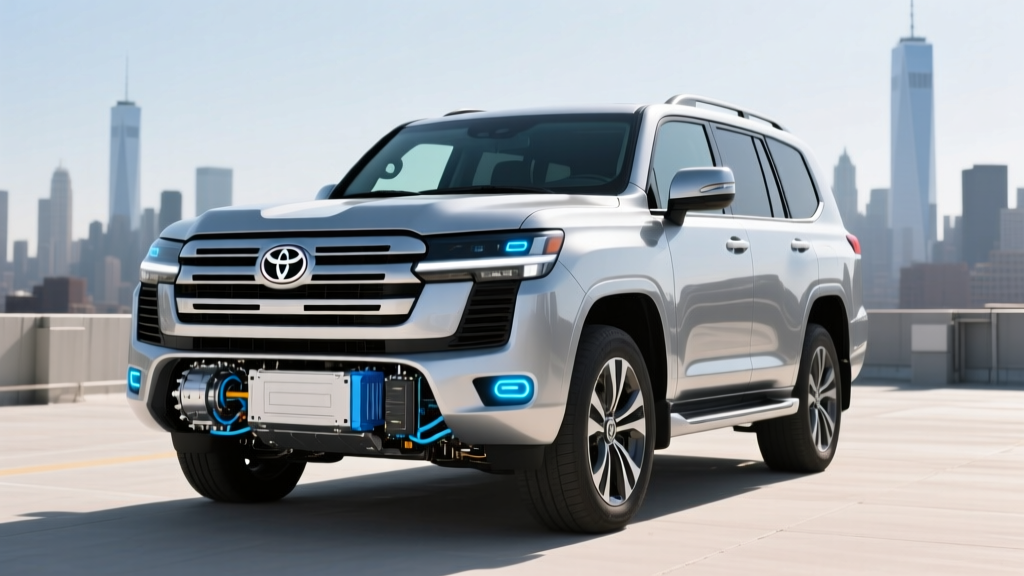
If you've been browsing Toyota dealer lots or scanning automotive forums, you've likely encountered a question that's tripping up a lot of SUV shoppers: are all Land Cruisers hybrid? The short answer, for the current generation sold in the United States, is yes — every new Toyota Land Cruiser comes equipped with Toyota's i-FORCE MAX hybrid powertrain. But the details matter. This isn't a plug-in hybrid you charge from a wall outlet; it's a conventional self-charging hybrid (HEV) designed for torque, efficiency, and off-road capability.
Below, we break down exactly what that means for your fuel bill, your driveway, and whether this hybrid SUV fits your needs compared to a PHEV or a full battery-electric vehicle.
The Short Answer: Yes, Every New Land Cruiser Is a Hybrid
Starting with the 2024 model year — when Toyota reintroduced the Land Cruiser to North America after a brief hiatus — the nameplate has been exclusively hybrid. The 2026 Toyota Land Cruiser carries forward with the same i-FORCE MAX powertrain. There is no gas-only variant available in the U.S. market. If you buy a new Land Cruiser today, you're buying a hybrid.
However, this is a conventional hybrid electric vehicle (HEV), not a plug-in hybrid (PHEV). You cannot plug it in. The battery recharges through regenerative braking and the gasoline engine. There's no electric-only driving range to speak of beyond very low-speed maneuvering. This distinction matters because it affects everything from your daily routine to your tax credit eligibility.
HEV vs. PHEV — What Land Cruiser Buyers Need to Know
| Feature | Conventional Hybrid (HEV) — Land Cruiser | Plug-In Hybrid (PHEV) — e.g., RAV4 Prime |
|---|---|---|
| Plug-in charging? | No — self-charging via engine + regen | Yes — plug into Level 1 or Level 2 |
| Electric-only range | None (motor assists engine) | 25–42 miles typical |
| Battery size | ~1.87 kWh (nickel-metal hydride) | 18.1 kWh (lithium-ion, RAV4 Prime) |
| Federal tax credit (§30D) | Not eligible | Up to $7,500 if eligible |
| Driving behavior change | None — drive like a gas car | Charge daily for max savings |
i-FORCE MAX Powertrain: Specs and How It Works
The i-FORCE MAX pairs a turbocharged 2.4-liter inline-four gasoline engine with an electric motor integrated between the engine and the 8-speed automatic transmission. The combined system output is substantial:
| Specification | 2026 Toyota Land Cruiser |
|---|---|
| Engine | 2.4L turbocharged I-4 |
| Electric motor | Integrated between engine & transmission |
| Combined horsepower | 326 hp |
| Combined torque | 465 lb-ft |
| Transmission | 8-speed automatic (Direct Shift) |
| Drivetrain | Full-time 4WD with locking center differential |
| Hybrid battery | ~1.87 kWh NiMH (self-charging) |
| 0–60 mph | ~6.2 seconds (est.) |
| Towing capacity | 6,000 lbs |
The electric motor fills in the torque gap at low RPMs — where turbo lag typically hurts — giving the Land Cruiser immediate off-the-line response. This is particularly useful off-road, where precise low-speed torque control matters. The system is engineered for capability, not hypermiling.
Fuel Economy: EPA MPG and Real-World Expectations
Here's where hybrid buyers want the hard numbers. According to fueleconomy.gov, the 2026 Toyota Land Cruiser carries the following EPA estimates:
| Driving Cycle | EPA MPG | Real-World Expectation |
|---|---|---|
| City | 22 MPG | 22–24 MPG (hybrids often exceed in stop-and-go) |
| Highway | 25 MPG | 22–24 MPG (aerodynamic drag, turbo at speed) |
| Combined | 23 MPG | 21–23 MPG |
Real-world context: Conventional hybrids tend to shine in city driving, where regenerative braking recaptures energy constantly and the engine shuts off at stops. On the highway, the Land Cruiser's boxy, off-road-oriented shape creates substantial aerodynamic drag, which erodes the hybrid advantage. Expect highway MPG to dip below the EPA sticker, especially above 70 mph or with a roof rack installed. In mixed suburban driving with moderate traffic, owners frequently report matching or slightly exceeding the 23 MPG combined figure.
For comparison, the previous-generation V8 Land Cruiser (discontinued in the U.S. after 2021) returned roughly 14–15 MPG combined. The i-FORCE MAX hybrid represents a roughly 50–60% improvement in fuel efficiency — meaningful savings if you drive 15,000 miles per year.
Pricing, Trims, and Tax Credit Eligibility
The 2026 Toyota Land Cruiser is offered in two primary trims:
| Trim | Base MSRP | Key Features |
|---|---|---|
| Land Cruiser 1958 | ~$57,345 | Heritage styling, cloth seats, round LED headlights |
| Land Cruiser | ~$62,395 | SofTex/leather, larger touchscreen, premium audio, heated seats |
Note: Prices include destination charge and are approximate based on manufacturer MSRP at time of publication. Dealer markups may apply in high-demand markets.
Does the Land Cruiser Qualify for a Federal Tax Credit?
No. The Land Cruiser is a conventional hybrid (HEV), not a plug-in vehicle. The federal §30D Clean Vehicle Credit applies only to battery electric vehicles (BEVs) and plug-in hybrids (PHEVs) that meet battery-sourcing, critical-mineral, MSRP, and buyer-income requirements. Since the Land Cruiser cannot be plugged in, it does not qualify for the federal EV tax credit or the point-of-sale transfer option.
Some states offer separate incentives for conventional hybrids, but these are increasingly rare as state programs shift toward zero-emission vehicles. Check your state's energy office or department of environmental quality for current programs — but plan your purchase assuming no incentive.
Battery Warranty, Reliability, and Replacement Cost
Hybrid battery anxiety is the number-one concern we hear from first-time hybrid buyers. Here's what Toyota provides:
Toyota Hybrid Battery Warranty
Coverage: 10 years / 150,000 miles (whichever comes first) for all 2020+ Toyota hybrids, including the Land Cruiser.
What's covered: Hybrid battery pack, hybrid control module, and related hybrid system components. Toyota warrants that the battery will retain sufficient capacity for normal hybrid operation.
Transferability: Fully transferable to subsequent owners — a significant resale-value factor.
Reliability track record: Toyota has been building hybrid powertrains since the 1997 Prius. The NiMH battery chemistry used in the Land Cruiser's hybrid system is mature, well-understood, and less prone to thermal runaway than high-energy-density lithium-ion packs. Real-world data from Toyota's hybrid fleet shows most NiMH packs last well beyond 150,000 miles with minimal capacity loss, because the system never deeply cycles the battery — it operates in a narrow state-of-charge window (roughly 40–80%) to maximize longevity.
Replacement cost: If the hybrid battery does fail out of warranty, expect a replacement to cost between $3,000 and $5,000 (parts and labor) at a Toyota dealer. Independent hybrid specialists may offer refurbished packs for $2,000–$3,500. For context, this is significantly less than a full EV battery replacement, which can exceed $10,000–$20,000 depending on the vehicle.
Who Should Buy the Land Cruiser Hybrid — and Who Shouldn't
Pros
- Massive low-end torque (465 lb-ft) from the hybrid system — excellent for off-road and towing
- ~50–60% fuel economy improvement over the old V8 Land Cruiser
- No charging infrastructure required — drive it like any gas vehicle
- 10-year/150,000-mile hybrid battery warranty
- Strong resale value and Toyota reliability reputation
- Legitimate off-road hardware: locking diffs, crawl control, multi-terrain select
Cons
- 23 MPG combined is modest — not a fuel-economy leader
- No federal tax credit eligibility (HEV, not PHEV/BEV)
- Highway MPG drops below EPA estimate due to aerodynamics
- Two-row seating only — no third row (unlike the 4Runner or Sequoia)
- Dealer markups are common in many markets
Hybrid vs. PHEV vs. Full EV — Which Fits You?
Choose the Land Cruiser (HEV) if: You want a rugged, off-road-capable SUV with better fuel economy than a gas-only rig, you don't want to think about charging, and you frequently tow or venture off-pavement. The hybrid system is a bonus, not a lifestyle change.
Choose a PHEV (like the Toyota RAV4 Prime) if: You have home charging access, your daily commute is under 40 miles, and you want electric-only weekday driving with gas-engine flexibility for weekend trips. PHEVs can qualify for the federal tax credit.
Choose a full EV (like the Rivian R1S or Tesla Model X) if: You want zero tailpipe emissions, the lowest per-mile fuel cost, home charging is available, and your off-road needs are light-to-moderate. Full EVs offer the strongest tax credit eligibility.
How the Land Cruiser Hybrid Compares
The Land Cruiser occupies a specific niche: body-on-frame, off-road-focused, mid-size SUV with hybrid efficiency. Its closest competitors include:
- Toyota 4Runner (2025+): Now also available with the i-FORCE MAX hybrid. Adds a third row but is slightly larger and less refined on-road.
- Toyota Sequoia: Full-size, three-row, standard i-FORCE MAX hybrid. More family-oriented, less trail-capable.
- Jeep Wrangler 4xe: A plug-in hybrid with ~21 miles of electric-only range, but significantly lower total range and a rougher ride.
- Lexus GX 550h: The Land Cruiser's luxury-platform sibling, also using a hybrid inline-four turbo, but with premium interior and higher pricing.
Frequently Asked Questions
Are all 2026 Land Cruisers hybrid?
Yes. Every 2026 Toyota Land Cruiser sold in the United States uses the i-FORCE MAX hybrid powertrain. There is no non-hybrid variant available.
How many MPG does the Land Cruiser hybrid get?
The EPA rates the 2026 Land Cruiser at 22 MPG city, 25 MPG highway, and 23 MPG combined. In real-world driving, expect 22–24 MPG in mixed suburban use and slightly less (20–22 MPG) in sustained highway driving above 70 mph.
Can I plug in the Land Cruiser to charge it?
No. The Land Cruiser is a conventional hybrid (HEV). Its small battery recharges automatically through regenerative braking and the gasoline engine. There is no plug and no electric-only driving range.
Does the Land Cruiser qualify for the $7,500 federal tax credit?
No. The federal §30D Clean Vehicle Credit applies only to plug-in vehicles (BEVs and PHEVs). Since the Land Cruiser is a conventional hybrid, it does not qualify for any federal EV tax credit.
How long will the Land Cruiser hybrid battery last?
Toyota warranties the hybrid battery for 10 years or 150,000 miles. Based on Toyota's extensive hybrid fleet history, NiMH packs commonly last 180,000–250,000+ miles before requiring replacement. The system's shallow charge cycles are designed to maximize battery longevity.
What does it cost to replace the Land Cruiser hybrid battery?
Out-of-warranty replacement typically runs $3,000–$5,000 at a Toyota dealer, or $2,000–$3,500 from an independent hybrid specialist using a refurbished pack. This is substantially less than a full EV battery replacement.
Is the Land Cruiser hybrid good for off-roading?
Yes. The i-FORCE MAX's 465 lb-ft of torque is available at very low RPM, which is ideal for rock crawling and technical terrain. The Land Cruiser includes a locking center differential, crawl control, and multi-terrain select. The hybrid system adds capability rather than compromising it.
How does the Land Cruiser hybrid compare to the old V8?
The current turbo-four hybrid produces 326 hp and 465 lb-ft of torque — competitive with or exceeding the old 5.7L V8's 381 hp and 401 lb-ft — while delivering roughly 50–60% better fuel economy (23 MPG combined vs. ~14 MPG combined for the V8).