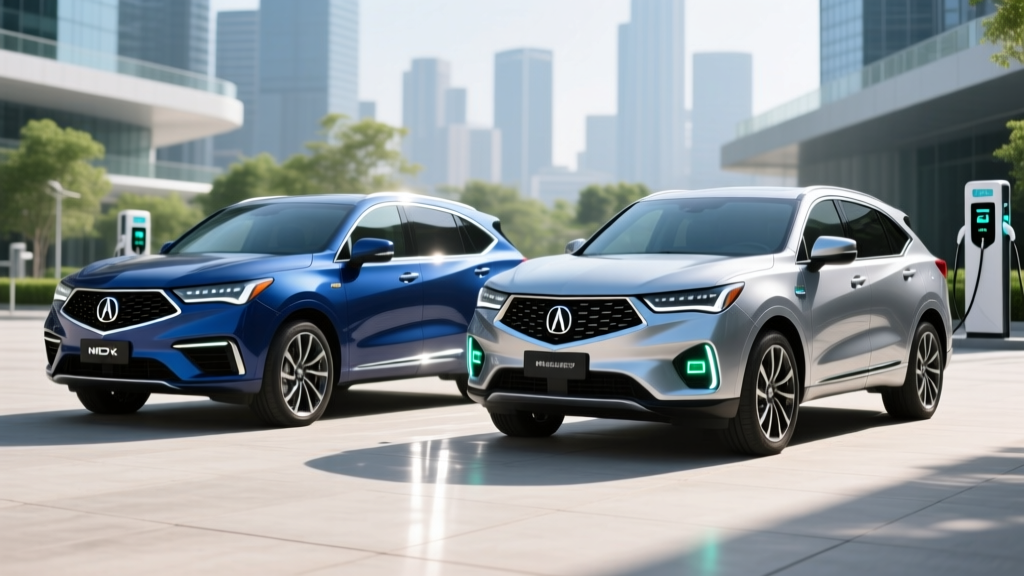
Acura has carved a distinct path in the luxury hybrid space — one that diverges sharply from full-electric commitments made by competitors like BMW and Mercedes-Benz. For 2026, Acura's electrified strategy centers on its proven Sport Hybrid powertrain (a conventional HEV) in the MDX, while the brand's first true plug-in hybrid (PHEV) arrives in the form of the redesigned RDX. If you've been searching for an Acura PHEV, this guide breaks down exactly what's available, what each powertrain delivers, and whether a plug-in Acura fits your garage.
HEV vs PHEV — What's the Difference?
Conventional Hybrid (HEV): Uses a small battery (typically 1–2 kWh) charged entirely by the engine and regenerative braking. No plug. You simply fuel up with gas. The electric motor assists the engine for better MPG, especially in city driving.
Plug-In Hybrid (PHEV): Carries a larger battery (15–25 kWh) that you charge via a wall outlet or charging station. This enables 25–50 miles of electric-only driving before the gas engine takes over. Once the battery depletes, it operates like a conventional hybrid.
2026 Acura MDX Sport Hybrid: The HEV Flagship
The three-row MDX Sport Hybrid remains Acura's volume electrified model. It pairs a 3.0-liter V6 with Acura's three-motor Sport Hybrid SH-AWD system — one motor integrated into the transmission and two independent motors driving the rear wheels. This isn't just a fuel-economy play; the torque-vectoring rear motors give the MDX genuinely athletic handling for a 4,800-pound SUV.
| Spec | Value |
|---|---|
| Powertrain | 3.0L V6 + 3 electric motors (SH-AWD) |
| Combined Horsepower | 355 hp |
| Combined Torque | 350 lb-ft |
| Hybrid Battery | ~1.3 kWh (lithium-ion, not plug-in) |
| 0-60 mph | 5.7 seconds |
| EPA MPG (City/Hwy/Combined) | 28 / 27 / 27 MPG |
| Fuel Tank | 18.5 gallons |
| Total Range | ~499 miles |
| Starting MSRP | $62,350 (Technology); $66,850 (Advance) |
2026 Acura RDX Plug-In Hybrid: Acura's First PHEV
The redesigned 2026 RDX introduces Acura's first plug-in hybrid variant, a significant milestone for the brand. Built on Honda's latest architecture (shared with the CR-V PHEV sold in other markets), the RDX PHEV pairs a turbocharged 2.0-liter four-cylinder with a more powerful electric motor and an 18.0 kWh (usable) lithium-ion battery pack mounted beneath the rear floor.
| Spec | Value |
|---|---|
| Powertrain | 2.0L turbo I-4 + electric motor (SH-AWD) |
| Combined Horsepower | 298 hp |
| PHEV Battery (usable) | 18.0 kWh (lithium-ion NMC) |
| Electric-Only Range (EPA) | 38 miles |
| Total Combined Range | ~440 miles (electric + gas) |
| MPGe (electric mode) | 88 MPGe |
| Hybrid-Mode MPG (after battery depletion) | 33 city / 30 hwy / 31 combined |
| Level 2 Charging (240V) | ~3.0 hours (7.2 kW onboard charger) |
| DC Fast Charging | Not available |
| 0-60 mph | 6.2 seconds |
| Starting MSRP | $52,400 (PHEV Technology) |
Fuel Economy Deep Dive: Real-World MPG vs EPA Sticker
| Model | City MPG | Highway MPG | Combined MPG | Electric Range |
|---|---|---|---|---|
| 2026 MDX Sport Hybrid | 28 | 27 | 27 | N/A (HEV) |
| 2026 RDX PHEV (hybrid mode) | 33 | 30 | 31 | 38 mi |
| 2026 RDX (gas-only baseline) | 21 | 27 | 24 | N/A |
For the MDX Sport Hybrid, real-world city driving often exceeds the EPA city estimate. Hybrid systems recapture the most energy in stop-and-go traffic, where regenerative braking and electric-only low-speed creep dominate. Owners who do predominantly city driving report 29–31 MPG. Highway cruising, where the engine does most of the work, tends to return 25–27 MPG — slightly below the EPA highway figure.
The RDX PHEV tells a different story. If your daily commute falls within the 38-mile electric window and you charge nightly, you may use very little gasoline for weeks at a time. Once the battery depletes, the 31 MPG combined hybrid-mode figure is competitive with the best compact luxury crossovers. Verify current EPA ratings at fueleconomy.gov, as final certification figures can shift slightly before launch.
Charging the RDX PHEV: What You Need at Home
The RDX PHEV charges exclusively via Level 1 (120V household outlet) or Level 2 (240V) AC charging. There is no DC fast-charge capability — a deliberate choice common among PHEVs, since the battery is small enough that overnight Level 2 charging fully replenishes it.
| Charging Level | Power | 0–100% Time |
|---|---|---|
| Level 1 (120V / 12A) | ~1.4 kW | ~13 hours |
| Level 2 (240V / 32A) | 7.2 kW | ~3.0 hours |
A dedicated Level 2 home charger (such as a ChargePoint Home Flex or Emporia Vue) installed on a 40-amp circuit will replenish the RDX PHEV's battery in roughly three hours — meaning even a midday top-up during work-from-home days is practical. Level 1 charging from a standard outlet is feasible for overnight replenishment if your daily electric driving stays under 25 miles, but it's tight for the full 38-mile range.
Pricing, Tax Credits, and Incentives
The 2026 RDX PHEV starts at $52,400 (Technology trim), while the MDX Sport Hybrid begins at $62,350. Here's where federal incentives come into play — and where buyers need to pay close attention.
- Battery capacity: Must be ≥7 kWh — RDX PHEV qualifies (18.0 kWh usable) ✓
- MSRP cap: SUVs/vans/pickups ≤$80,000 — RDX PHEV qualifies ✓
- Income cap: AGI ≤$150,000 (single) / ≤$300,000 (joint) — verify your situation
- Battery sourcing & critical minerals: Must meet phased-in thresholds per IRS §30D rules — partial or full $3,750/$7,500 depending on supply-chain compliance
- Point-of-sale transfer: Eligible buyers can apply the credit as a dealer discount at purchase
Note: The MDX Sport Hybrid, as a conventional HEV, does not qualify for the §30D federal EV/PHEV tax credit. Always consult a tax professional and check current IRS guidance before purchase, as sourcing requirements tighten annually.
State-level incentives vary widely. California's CVRP, Colorado's innovative motor vehicle credit, and various utility-company rebates may further reduce the RDX PHEV's effective price. Check your state's energy office and local utility for current programs.
Reliability and Battery Warranty
- MDX Sport Hybrid: 8 years / 100,000 miles (hybrid battery & components)
- RDX PHEV: 8 years / 100,000 miles (high-voltage battery, 70% capacity retention threshold)
- Powertrain warranty: 6 years / 70,000 miles
Acura's hybrid systems carry a strong reliability track record inherited from Honda's decades of hybrid engineering (the Insight, Accord Hybrid, and CR-V Hybrid all share lineage). Hybrid battery replacement costs for the MDX Sport Hybrid are estimated at $2,500–$4,000 out of warranty. The RDX PHEV's larger battery pack will cost more — likely $6,000–$9,000 — though failures within the warranty period are covered.
Real-world data from Honda/Acura hybrids shows most packs retain 85–90% capacity at 150,000 miles when properly maintained. Avoiding frequent deep discharges (letting the PHEV sit at 0% for extended periods) and extreme heat exposure extends longevity.
Acura PHEV vs Hybrid vs Full EV: Which Fits You?
Choose the MDX Sport Hybrid (HEV) if:
- You need three rows and 499+ miles of total range
- You can't install a home charger (apartment, street parking)
- You want zero behavior change — just fill up with gas
- Performance matters: 355 hp and torque-vectoring SH-AWD
Choose the RDX PHEV if:
- Your daily commute is under 38 miles round-trip
- You have access to Level 2 home or workplace charging
- You want to minimize gasoline use without range anxiety on road trips
- You want the potential federal tax credit (up to $7,500)
Choose a full EV (like the Acura ZDX) if:
- You want zero tailpipe emissions and no gasoline costs
- You have reliable home charging and access to DC fast chargers for road trips
- Your daily driving is predictable and within 250–300 miles
- You want the lowest per-mile fuel cost (~$0.04/mi on home electricity vs ~$0.14/mi on gas)
✓ Pros — Acura PHEV & Hybrids
- RDX PHEV: 38 miles electric covers most commutes gas-free
- No range anxiety — gas engine provides 440+ total miles
- MDX SH-AWD: class-leading hybrid performance SUV handling
- Potential $7,500 federal tax credit on RDX PHEV
- Proven Honda/Acura hybrid reliability with 8-yr battery warranty
- No charging infrastructure required for MDX HEV
✗ Cons — Acura PHEV & Hybrids
- RDX PHEV: no DC fast charging limits road-trip electric driving
- MDX Sport Hybrid: 27 MPG combined is modest for a hybrid SUV
- MDX HEV does not qualify for federal §30D tax credit
- PHEV battery replacement cost ($6K–$9K) after warranty is significant
- Electric-only range (38 mi) trails competitors like the Toyota RAV4 Prime (42 mi)
- Acura's EV/PHEV lineup is smaller than rivals (BMW, Volvo offer more PHEV options)
Frequently Asked Questions
How many MPG does the Acura MDX Sport Hybrid get?
The 2026 MDX Sport Hybrid is EPA-rated at 28 city / 27 highway / 27 combined MPG. In real-world city driving with frequent stops, many owners see 29–31 MPG thanks to regenerative braking. Highway cruising at 75+ mph typically returns 25–27 MPG.
How far can the Acura RDX PHEV go on electric only?
The 2026 RDX PHEV has an EPA-rated 38 miles of electric-only range. Real-world results vary: expect 30–34 miles on the highway and 25–28 miles in cold weather (below 32°F), where battery chemistry is less efficient and cabin heating draws power. Preconditioning while plugged in mitigates winter losses.
Does the Acura PHEV qualify for a federal tax credit?
The RDX PHEV may qualify for up to $7,500 under IRS §30D, subject to your income (≤$150K single / ≤$300K joint), the vehicle's MSRP (under the $80K SUV cap), and battery-sourcing/critical-mineral requirements that tighten each year. The credit can be applied as a point-of-sale dealer discount. The MDX Sport Hybrid (conventional HEV) does not qualify. Always verify current rules at irs.gov and consult a tax professional.
Is the Acura hybrid system reliable? What does battery replacement cost?
Acura's hybrid systems inherit Honda's extensive hybrid engineering history and carry an 8-year/100,000-mile battery warranty. Real-world data shows most Honda/Acura hybrid packs retain 85–90% capacity at 150,000 miles. Out-of-warranty replacement costs are estimated at $2,500–$4,000 for the MDX HEV and $6,000–$9,000 for the RDX PHEV's larger pack.
Can I charge the RDX PHEV at a public DC fast charger?
No. The RDX PHEV only supports AC charging — Level 1 (120V, ~13 hours) or Level 2 (240V, ~3 hours). This is standard for most PHEVs; the battery is small enough that overnight Level 2 charging is sufficient, and adding DC fast-charge hardware would add cost and weight.
Hybrid vs PHEV vs full EV — which Acura should I buy?
If you lack home charging access or regularly drive 400+ miles between fill-ups, the MDX Sport Hybrid (HEV) is the practical choice. If you can charge at home and your commute is under 38 miles, the RDX PHEV lets you drive mostly electric while keeping a gas engine for road trips. If you're ready to go fully electric and want zero gas costs, consider the Acura ZDX — Acura's all-electric SUV with ~300+ miles of range.