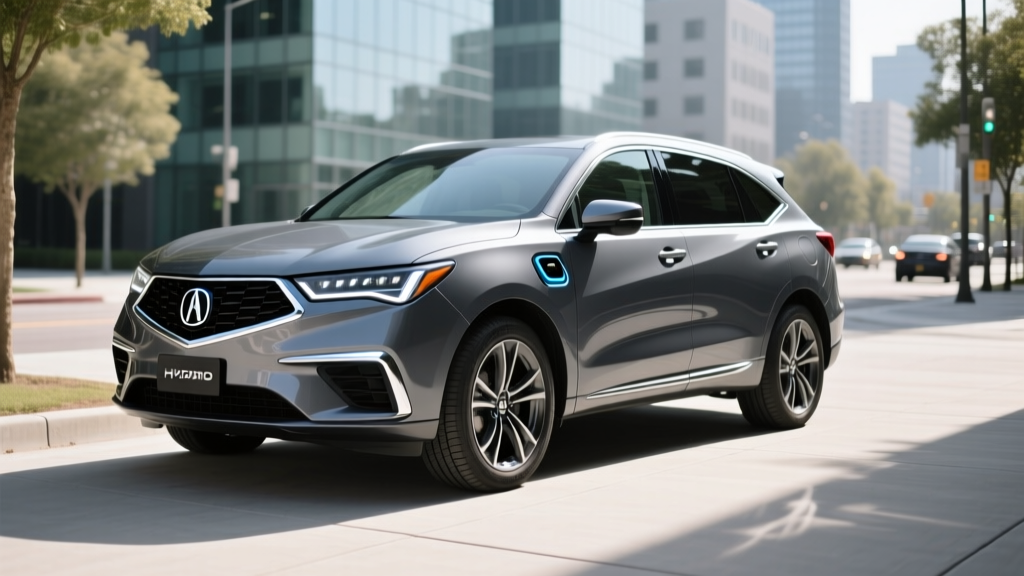
Does Acura Make a Hybrid MDX in 2026?
If you've been searching for a hybrid MDX, here's the straightforward answer: as of the 2026 model year, Acura does not offer a hybrid or plug-in hybrid version of the MDX. The three-row luxury SUV continues with its conventional gasoline powertrains — a 3.5-liter V6 in the standard MDX and a turbocharged 3.0-liter V6 in the MDX Type S. Despite the broader industry shift toward electrification, Acura has kept the MDX strictly internal combustion.
This is a meaningful gap. Competitors like the Lexus TX 500h, BMW X5 xDrive50e (PHEV), and Volvo XC90 Recharge (PHEV) all offer electrified three-row options. For buyers specifically seeking a hybrid MDX, the alternatives require looking at either the used market, competing models, or Acura's own evolving electrification roadmap.
| Specification | MDX (Standard) | MDX Type S |
|---|---|---|
| Engine | 3.5L V6 | 3.0L Turbo V6 |
| Horsepower | 290 hp | 355 hp |
| Torque | 267 lb-ft | 354 lb-ft |
| Transmission | 10-speed auto | 10-speed auto |
| Drivetrain | FWD or SH-AWD | SH-AWD standard |
| 0–60 mph | ~6.4 sec | ~5.5 sec |
| EPA Combined MPG | 22 mpg (FWD) / 21 mpg (AWD) | 19 mpg |
| Towing Capacity | 3,500–5,000 lbs | 5,000 lbs |
| Starting MSRP | ~$52,000 | ~$68,000 |
What MPG Does the 2026 MDX Actually Get?
Without a hybrid powertrain, the MDX delivers fuel economy typical of a 4,500-pound V6 SUV. Here's the EPA breakdown per fueleconomy.gov:
| Trim / Drivetrain | City | Highway | Combined |
|---|---|---|---|
| MDX FWD | 19 mpg | 26 mpg | 22 mpg |
| MDX SH-AWD | 19 mpg | 25 mpg | 21 mpg |
| MDX Type S SH-AWD | 17 mpg | 21 mpg | 19 mpg |
Real-world note: Owners report that highway cruising at 70–75 mph can yield 25–27 mpg in the standard V6, slightly above EPA estimates, thanks to the 10-speed transmission keeping revs low. City driving in stop-and-go traffic, however, typically drops to 16–18 mpg — below the EPA city sticker. This is the inherent limitation of a conventional gasoline powertrain in a heavy SUV: no electric motor to recapture energy during braking or assist during acceleration.
For comparison, the Lexus TX 500h hybrid achieves an EPA-estimated 27 mpg combined — roughly 25–30% better fuel economy in a similarly sized three-row package.
Why Doesn't Acura Offer a Hybrid MDX?
Acura's parent company, Honda, has been cautious with hybrid deployment in its premium lineup. Several factors explain the gap:
- Platform strategy: The current-generation MDX (introduced for 2022) was engineered on Honda's light-truck architecture, which was designed primarily for ICE powertrains. Integrating a hybrid system mid-cycle requires significant re-engineering.
- Prioritizing the Type S: Acura invested its MDX development budget in the performance-oriented Type S variant rather than an efficiency-focused hybrid.
- Honda's EV pivot: Honda has signaled a longer-term commitment to full battery-electric vehicles (the Prologue, built on GM's Ultium platform) rather than expanding its hybrid portfolio across every nameplate.
- Market calculus: The MDX has sold well in its gasoline-only form, reducing the short-term business case for a hybrid variant.
Industry reports suggest a next-generation MDX (potentially 2027–2028 model year) could adopt Honda's next hybrid architecture, but nothing has been officially announced as of early 2026.
The Used Market: Previous-Generation MDX Sport Hybrid
If a hybrid MDX is a must-have, the used market offers one option: the Acura MDX Sport Hybrid, sold from 2017 through 2020. This model paired a 3.0-liter V6 with a three-motor hybrid system (one front, two rear) producing a combined 321 horsepower.
| City | Highway | Combined |
|---|---|---|
| 26 mpg | 27 mpg | 27 mpg |
The Sport Hybrid's SH-AWD system used the twin rear motors for torque vectoring, offering genuinely impressive handling for a three-row SUV. Fuel economy represented a roughly 25% improvement over the non-hybrid V6 of that era. However, the Sport Hybrid was discontinued when Acura redesigned the MDX for 2022, and no direct successor has appeared.
Used-market considerations: A 2019–2020 MDX Sport Hybrid with 50,000–80,000 miles typically lists between $28,000 and $38,000 depending on condition and trim. The hybrid battery carries Honda's standard 8-year/100,000-mile warranty (10 years/150,000 miles in CARB states), so many used examples may still have partial coverage.
Hybrid vs PHEV vs EV: Which Three-Row SUV Fits You?
Since Acura doesn't offer an electrified MDX, buyers considering fuel-efficient three-row SUVs face a broader decision. Here's how the three electrification paths compare:
| Factor | Conventional Hybrid (HEV) | Plug-In Hybrid (PHEV) | Battery Electric (BEV) |
|---|---|---|---|
| Plug in required? | No — self-charging | Yes, for EV range | Yes, always |
| Electric-only range | None (motor assists engine) | 20–40 miles typical | 250–350+ miles |
| Combined MPG / MPGe | 25–36 mpg | 24–30 mpg + 50–80 MPGe | 80–110 MPGe |
| Home charging needed? | No | Recommended (Level 2) | Essential (Level 2) |
| Federal tax credit (§30D) | Not eligible | Up to $7,500* | Up to $7,500* |
| Example models | Lexus TX 500h, Toyota Grand Highlander Hybrid | BMW X5 xDrive50e, Volvo XC90 Recharge | Kia EV9, Tesla Model X, Rivian R1S |
| Best for | No charging access; want simplicity | Short commute + road trips | Home charging + mostly under 250 mi/day |
*§30D tax credit caveat: Eligibility for the federal plug-in vehicle credit depends on MSRP caps ($80,000 for SUVs), buyer income limits ($300,000 joint / $150,000 single), battery critical-mineral sourcing requirements, and North American final assembly. The credit can now be transferred to the dealer at point of sale. Always verify current eligibility on irs.gov before purchasing, as rules shift frequently.
Competitors to Consider Instead of a Hybrid MDX
If the hybrid MDX search has you exploring alternatives, these electrified three-row SUVs are the most direct substitutes:
Lexus TX 500h (HEV)
The closest analog to what a hybrid MDX would be. The TX 500h uses a 2.4-liter turbocharged four-cylinder hybrid system producing 366 combined horsepower. EPA-estimated 27 mpg combined with standard AWD. Starting around $65,000, it's priced near the MDX Type S but delivers far better fuel economy. No plug-in required.
Volvo XC90 Recharge (PHEV)
A plug-in hybrid with approximately 33 miles of electric-only range and a combined 455 horsepower. EPA rates it at 55 MPGe when factoring in electric operation, 27 mpg on gas alone. Requires Level 2 home charging to maximize value. Starting around $73,000, and potentially eligible for a partial federal credit depending on sourcing compliance.
BMW X5 xDrive50e (PHEV)
Roughly 38 miles of electric range, 483 combined horsepower, and 22 mpg on gas alone. The X5 is a five-seater (no third row), so it competes more directly with the Acura RDX segment, but buyers willing to forgo the third row find a compelling PHEV package starting around $74,000.
Kia EV9 (BEV)
A three-row battery-electric SUV with up to 304 miles of EPA range (Light Long Range RWD), 200 kW DC fast charging capability, and a starting price near $55,000. Requires commitment to electric-only driving and home Level 2 charging, but offers the lowest per-mile operating cost of any vehicle in this group.
Hybrid & PHEV Battery Warranty: What to Expect
Across the industry, hybrid and PHEV battery packs are covered by federally mandated minimum warranties of 8 years / 100,000 miles (extended to 10 years / 150,000 miles in CARB-emissions states including California, New York, Massachusetts, and others). This covers battery capacity loss below a manufacturer-defined threshold — typically 60–70% of original capacity.
Replacement costs for a hybrid battery pack range from $2,000 to $6,000 depending on the model. PHEV batteries, being larger (typically 15–25 kWh vs 1–2 kWh for HEVs), cost $6,000 to $15,000 to replace out of warranty. Real-world data shows most hybrid batteries last 150,000–200,000+ miles before significant degradation, making out-of-pocket replacement rare for original owners.
Does Any Hybrid or PHEV SUV Qualify for a Tax Credit?
Conventional hybrids (HEVs) like the Lexus TX 500h or Toyota Grand Highlander Hybrid do not qualify for the federal §30D clean vehicle credit. That credit applies only to plug-in vehicles — PHEVs and BEVs — with a battery capacity of at least 7 kWh.
For PHEVs like the Volvo XC90 Recharge or BMW X5 xDrive50e, the maximum credit is $7,500, but actual eligibility depends on:
- MSRP cap: Vehicle base price must not exceed $80,000 for SUVs/vans/pickups ($55,000 for sedans)
- Buyer income cap: Modified AGI must not exceed $300,000 (joint) / $225,000 (head of household) / $150,000 (single)
- Battery sourcing: Critical minerals and battery components must meet phased percentage thresholds from US or free-trade-agreement partners
- Final assembly: Vehicle must be assembled in North America (verify VIN on fueleconomy.gov)
- Point-of-sale transfer: As of 2024+, buyers can transfer the credit to the dealer for an immediate price reduction rather than waiting to claim it on taxes
Many PHEV SUVs from European and Asian automakers have struggled with the battery-sourcing and North American assembly requirements. Always confirm eligibility for the specific model year and build configuration before relying on the credit in your purchase decision.
Reasons to Buy the Gas MDX Anyway
- Proven 3.5L V6 reliability with decades of Honda/Acura service data
- SH-AWD torque-vectoring system is among the best mechanical AWD setups available
- Lower purchase price than electrified competitors ($52K vs $65K–$75K)
- No charging infrastructure required — ideal for apartment dwellers
- Strong resale value; Acura MDX consistently ranks in top residual-value forecasts
Reasons to Look Elsewhere
- 19–22 mpg combined is poor for a 2026 three-row SUV
- No hybrid or PHEV option means no federal tax credit eligibility
- Annual fuel cost at 15,000 miles/yr: ~$2,800–$3,200 (vs ~$1,600–$2,000 for a comparable hybrid)
- Type S fuel economy (19 mpg combined) rivals some V8 competitors
- Lexus TX 500h offers similar luxury and space with 27 mpg combined
The Bottom Line: Is the Gas MDX Worth It Without a Hybrid Option?
The 2026 Acura MDX remains a competent luxury three-row SUV — well-built, comfortable, and equipped with one of the best AWD systems in its class. If fuel economy isn't a primary concern, or if you lack home charging access and want the simplicity of a conventional powertrain, the standard MDX delivers a compelling package starting around $52,000.
However, the absence of a hybrid MDX is increasingly hard to justify in a segment where competitors deliver 25–35% better fuel economy without sacrificing space or luxury. If you drive more than 12,000 miles annually, the fuel-cost gap compounds quickly — roughly $800–$1,200 per year more than a hybrid competitor. Over a typical 5-year ownership period, that's $4,000–$6,000 in additional fuel expense, partially offset by the MDX's lower sticker price.
For buyers committed to the Acura brand and three-row practicality, the gas MDX is the only current option. For those open to alternatives, the Lexus TX 500h, Volvo XC90 Recharge, or Kia EV9 each offer meaningful efficiency advantages — with the trade-off of higher base prices or charging infrastructure requirements.
Frequently Asked Questions
Does Acura make a hybrid MDX for 2026?
No. The 2026 Acura MDX is available only with gasoline V6 engines (3.5L naturally aspirated or 3.0L turbocharged). Acura discontinued the MDX Sport Hybrid after the 2020 model year and has not introduced a replacement hybrid or PHEV variant.
How many MPG does the 2026 MDX get?
The standard MDX with FWD achieves an EPA-estimated 19 city / 26 highway / 22 combined mpg. With SH-AWD, it drops to 19/25/21 mpg. The Type S is rated at 17/21/19 mpg. Real-world highway driving can exceed EPA estimates by 2–4 mpg; city driving typically falls 1–3 mpg below.
Is there a plug-in hybrid version of the MDX?
No. Acura has never offered a plug-in hybrid MDX. The closest Acura PHEV-related product is the Acura ZDX, which is a fully electric SUV built on GM's Ultium platform — not a plug-in hybrid.
What hybrid SUV is most similar to the MDX?
The Lexus TX 500h is the closest competitor: a three-row luxury hybrid SUV with 366 hp, 27 mpg combined, and a starting price around $65,000. The Toyota Grand Highlander Hybrid offers even better fuel economy (34–36 mpg combined) at a lower price point, though with less premium branding.
Will Acura release a hybrid or electric MDX in the future?
Acura has not officially announced a hybrid or electric successor to the current MDX. Industry analysts expect the next-generation MDX (potentially 2027–2028) may adopt Honda's next-generation hybrid architecture, but this remains speculative. Acura's current EV focus is on the ZDX and upcoming models built on dedicated EV platforms.
What is the annual fuel cost for the MDX vs a hybrid competitor?
At 15,000 miles per year and $3.50/gallon premium fuel, the MDX SH-AWD (21 mpg combined) costs approximately $2,500 annually in fuel. The Lexus TX 500h (27 mpg combined) costs roughly $1,940 — a savings of about $560 per year or $2,800 over five years. Against a BEV like the Kia EV9, home-charging costs drop to approximately $600–$800 annually depending on local electricity rates.
Is the gas MDX reliable?
Yes. The 3.5L V6 and 10-speed automatic in the standard MDX are well-proven Honda/Acura components with extensive service history. The MDX consistently earns above-average reliability ratings from major automotive research firms. The gasoline powertrain avoids the complexity of hybrid battery systems, though it also forgoes the fuel-economy benefits.