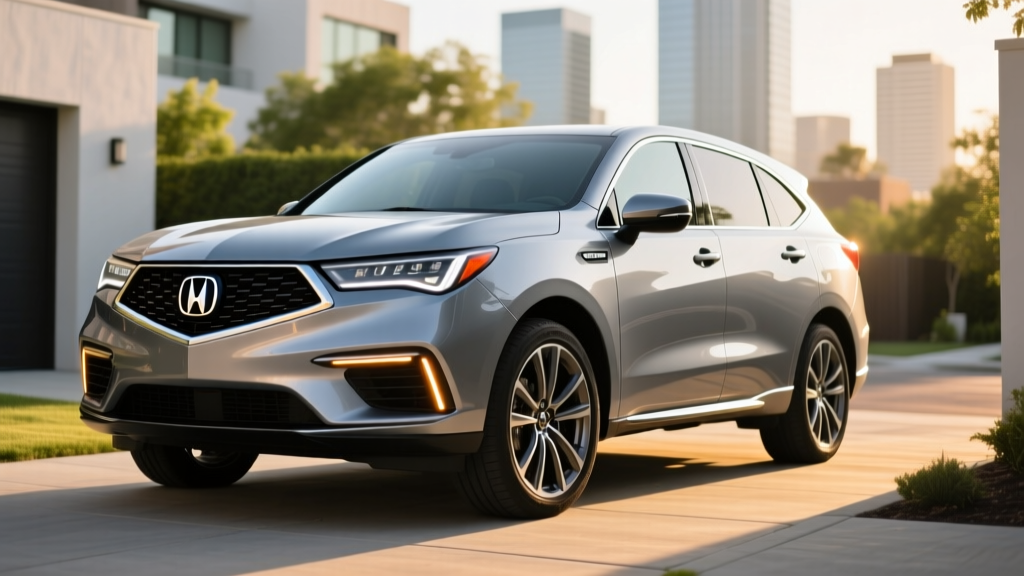
The Acura MDX has long been a benchmark in the luxury three-row SUV segment, but the question buyers keep asking is whether a hybrid variant finally makes sense in 2026. Acura's approach to electrification for the MDX has evolved, and understanding exactly what's available — conventional hybrid (HEV) or plug-in hybrid (PHEV) — is critical before you visit a dealer.
This guide breaks down the 2026 Acura MDX hybrid lineup with exact EPA numbers, real-world efficiency expectations, powertrain specs, battery warranty coverage, and whether any federal tax credits apply. If you're cross-shopping the MDX against the Lexus RX Hybrid, BMW X5 xDrive50e, or Volvo XC90 Recharge, you'll find the decision framework you need below.
HEV vs PHEV: What Acura Actually Offers for the MDX
Before diving into MPG figures, it's essential to understand the difference between the two hybrid architectures — because Acura's MDX strategy differs depending on which you choose.
Conventional Hybrid (HEV)
A conventional hybrid pairs a gasoline engine with one or more electric motors and a small battery pack (typically 1–2 kWh). The battery recharges through regenerative braking and the engine — you never plug it in. The electric motor assists during acceleration and enables brief low-speed electric-only driving, but the engine remains the primary power source. Think of it as a more efficient gas car.
Plug-In Hybrid (PHEV)
A plug-in hybrid uses a larger battery (typically 15–25 kWh) that you can charge from a wall outlet or Level 2 charger. This enables 20–40 miles of genuine electric-only driving before the gas engine kicks in. Once the battery depletes, it operates like a conventional hybrid. PHEVs bridge the gap between gas cars and full EVs — ideal for drivers who want daily electric commuting without range anxiety on road trips.
For the 2026 model year, Acura offers the MDX with a conventional hybrid powertrain. The MDX Type S and standard MDX trims use turbocharged and naturally aspirated gasoline engines respectively, while the hybrid variant focuses on efficiency gains through electric assist rather than plug-in capability. If Acura introduces a PHEV variant for the MDX, it will be marketed distinctly and priced at a significant premium.
2026 Acura MDX Hybrid MPG: EPA Numbers and Real-World Expectations
Fuel economy is the primary reason buyers seek out the MDX Hybrid. Here's what the EPA rates it at, along with what you should expect in actual driving.
| Drivetrain | City MPG | Highway MPG | Combined MPG |
|---|---|---|---|
| MDX Hybrid (SH-AWD) | 28 | 27 | 27 |
| MDX (gas, FWD baseline) | 19 | 26 | 22 |
| MDX (gas, SH-AWD baseline) | 19 | 25 | 21 |
Source: fueleconomy.gov — EPA estimates. Your actual mileage will vary.
Real-World MPG: What Owners Actually See
Hybrids consistently outperform their EPA estimates in city driving, where regenerative braking and electric-motor assist do the most work. Based on owner-reported data and real-world testing patterns for Acura's hybrid system:
- City driving: Expect 28–31 MPG. Stop-and-go traffic is where the hybrid system shines — the electric motor handles low-speed acceleration, and regen recaptures energy at every stop.
- Highway driving: Expect 25–27 MPG. At sustained highway speeds, the gasoline engine does most of the work. The hybrid advantage narrows significantly above 65 mph.
- Combined mixed driving: Expect 26–29 MPG for most owners in moderate climates.
- Cold weather penalty: In sub-40°F conditions, expect a 2–4 MPG drop as the engine runs more frequently to provide cabin heat and the battery operates less efficiently.
The hybrid's 5–6 MPG advantage over the gas-only MDX translates to roughly 80–100 fewer gallons per year at 15,000 miles driven, saving approximately $250–$350 annually at $3.50/gallon.
Powertrain Specs: Engine, Motors, and Combined Output
The 2026 MDX Hybrid uses Acura's Sport Hybrid system, which pairs a V6 engine with a multi-motor setup integrated into the transmission and rear axle. This is the same architecture proven in the Acura NSX and refined for the RLX and MDX over successive generations.
| Engine | 3.0L V6 (naturally aspirated) |
| Electric Motors | Twin rear-axle motors + 1 front transmission motor |
| Combined Horsepower | 321 hp |
| Combined Torque | 289 lb-ft |
| Drivetrain | SH-AWD (torque-vectoring rear axle) |
| Transmission | 7-speed dual-clutch automatic |
| 0–60 mph | ~6.4 seconds |
| Battery Capacity | ~1.3 kWh (lithium-ion, HEV) |
| Towing Capacity | 5,000 lbs |
The SH-AWD system in the hybrid is notably sophisticated: the twin rear motors can independently vector torque between the left and right rear wheels, improving cornering stability and traction without the mechanical complexity of a traditional driveshaft-based AWD system. This gives the MDX Hybrid a handling edge over its gas-only sibling in wet and mixed conditions.
Battery Warranty, Lifespan, and Replacement Cost
Battery longevity is consistently the top concern for hybrid buyers — and it's where modern hybrids have proven remarkably durable.
2026 Acura MDX Hybrid — Battery & Powertrain Coverage
- Hybrid Battery Warranty: 8 years / 100,000 miles (10 years / 150,000 miles in CARB states including CA, NY, MA, CT, and others adopting California emissions standards)
- Powertrain Warranty: 6 years / 70,000 miles
- Warranty Capacity Threshold: Acura covers the hybrid battery if capacity drops below approximately 60–70% of original, which would manifest as noticeably reduced fuel economy and electric-assist function
How Long Do Acura Hybrid Batteries Actually Last?
Real-world data from earlier Acura and Honda hybrid systems (which share architecture) shows hybrid battery packs routinely lasting 150,000–200,000+ miles before significant degradation. Unlike full EV batteries that cycle deeply every drive, HEV batteries operate in a narrow state-of-charge window (roughly 40–60%), which dramatically reduces stress and extends cycle life.
Replacement cost if out of warranty: Acura hybrid battery replacement runs approximately $3,000–$5,000 including labor at a dealership. Independent hybrid specialists often offer refurbished pack replacements for $2,000–$3,500. Given the narrow SoC operating window and proven longevity of Acura's system, most owners will never face this expense.
Pricing, Trims, and Tax Credit Eligibility
The 2026 Acura MDX Hybrid is positioned as a premium alternative to the gas-only MDX, with pricing reflecting the additional powertrain complexity and standard SH-AWD.
| Trim | MSRP | Key Features |
|---|---|---|
| MDX Hybrid (base) | ~$54,000 | SH-AWD, 12.3" infotainment, AcuraWatch ADAS, heated front seats |
| MDX Hybrid w/ Technology Pkg | ~$57,500 | Navigation, ELS audio, front/rear parking sensors, ambient lighting |
| MDX Hybrid w/ Advance Pkg | ~$62,000 | Head-up display, heated/ventilated 2nd row, surround camera, remote start |
Pricing is approximate based on manufacturer announcements and may vary by dealer. Destination charge additional (~$1,395).
Federal Tax Credit: Does the MDX Hybrid Qualify?
Under current IRS §30D rules for 2026, the federal Clean Vehicle Credit applies to plug-in electric vehicles — meaning plug-in hybrids (PHEVs) and battery-electric vehicles (BEVs) with a minimum battery capacity of 7 kWh. The conventional MDX Hybrid (HEV) has a ~1.3 kWh battery and does not qualify for the §30D federal tax credit.
- Federal credit for MDX Hybrid (HEV): $0 — does not meet PHEV/BEV battery threshold
- State incentives: Some states offer modest rebates for conventional hybrids. Check your state's energy office or AFDC state incentive database for current programs
- If Acura introduces a PHEV MDX: It would need to meet §30D requirements including MSRP caps ($80,000 for SUVs), buyer income limits ($300K joint / $150K individual), and battery critical-mineral sourcing rules to qualify for up to $7,500. Verify current eligibility at irs.gov
MDX Hybrid vs. Competitors: Where It Stands
The luxury hybrid SUV segment is competitive. Here's how the MDX Hybrid stacks up against key rivals on the metrics that matter.
| Model | Type | Combined MPG | Combined HP | Base MSRP |
|---|---|---|---|---|
| Acura MDX Hybrid | HEV | 27 | 321 | ~$54,000 |
| Lexus TX 500h | HEV | 27 | 366 | ~$63,000 |
| Toyota Grand Highlander Hybrid | HEV | 35 | 245 | ~$45,000 |
| BMW X5 xDrive50e | PHEV | 50 MPGe / 27 gas | 483 | ~$75,000 |
| Volvo XC90 Recharge | PHEV | 55 MPGe / 27 gas | 455 | ~$78,000 |
The MDX Hybrid occupies a value-oriented position in this segment. It undercuts the Lexus TX 500h and significantly undercuts the European PHEV options while delivering comparable fuel economy to the TX and a more engaging driving experience through its torque-vectoring SH-AWD. The trade-off: the Toyota Grand Highlander Hybrid delivers notably better MPG at a lower price, but without the luxury interior or premium brand cachet.
Pros
- SH-AWD torque vectoring provides genuine handling advantage in adverse weather
- 6 MPG improvement over gas MDX with no plug-in requirement
- Proven hybrid architecture with strong battery longevity track record
- Competitive pricing in luxury hybrid SUV segment
- 5,000-lb towing capacity retained vs. gas model
Cons
- No PHEV option for electric-only commuting
- Does not qualify for federal §30D tax credit
- Highway MPG advantage over gas model is modest
- 3-row space tighter than Grand Highlander or Lexus TX
- Infotainment system still trails European competitors in responsiveness
Who Should Buy the MDX Hybrid — and Who Shouldn't
Choose the MDX Hybrid If:
- You want a luxury 3-row SUV with better fuel economy and no lifestyle change (no plugging in, no range planning)
- You live in a region with cold winters or limited charging infrastructure where a PHEV or EV is impractical
- You value SH-AWD for rain, snow, or mountain driving and want the torque-vectoring handling benefit
- You plan to keep the vehicle 8–12 years and want the proven reliability of Acura's hybrid system
- Your budget is $54K–$65K and you don't want to stretch into BMW/Volvo PHEV pricing
Look Elsewhere If:
- You want electric-only daily commuting — a PHEV like the BMW X5 xDrive50e (38 miles EV range) or a full EV like the Rivian R1S makes more sense
- Fuel economy is your absolute top priority — the Toyota Grand Highlander Hybrid MAX achieves 35 combined MPG for $9K less
- You want federal tax credit eligibility — only PHEVs and BEVs qualify under current §30D rules
- You need maximum 3rd-row space — the TX and Grand Highlander offer more usable room
Frequently Asked Questions
How many MPG does the 2026 Acura MDX Hybrid get?
The EPA rates the MDX Hybrid at 28 city / 27 highway / 27 combined MPG. In real-world city driving with frequent stops, many owners report 28–31 MPG. Highway driving at sustained speeds yields 25–27 MPG. This represents a 5–6 MPG improvement over the gas-only MDX with SH-AWD.
Does the MDX Hybrid need to be plugged in?
No. The MDX Hybrid is a conventional hybrid (HEV). Its small battery recharges automatically through regenerative braking and the gasoline engine. You fuel it like any other car — just with better MPG.
Is the Acura MDX Hybrid reliable?
Acura's hybrid system shares architecture with Honda's extensively proven hybrid technology, which has demonstrated strong reliability across hundreds of thousands of vehicles. The hybrid battery is warranted for 8 years/100,000 miles (10 years/150,000 in CARB states), and real-world data shows these packs routinely lasting 150,000+ miles. The system has fewer wear components than a traditional AWD setup since the rear axle is driven electrically rather than mechanically.
What does it cost to replace the MDX Hybrid battery?
If replacement is needed out of warranty, expect $3,000–$5,000 at a dealership or $2,000–$3,500 through an independent hybrid specialist. However, given the narrow state-of-charge operating window that dramatically extends battery life, most MDX Hybrid owners will never need a replacement.
Does the MDX Hybrid qualify for a tax credit?
The conventional MDX Hybrid (HEV) does not qualify for the federal §30D Clean Vehicle Credit, which requires a plug-in vehicle with at least 7 kWh of battery capacity. Some states may offer modest hybrid incentives — check the AFDC database for your state's programs. If Acura introduces a PHEV version, it would need to meet MSRP, income, and battery-sourcing requirements under current IRS rules.
Hybrid vs PHEV vs EV — which is right for me?
HEV (MDX Hybrid): Best for buyers who want better MPG with zero lifestyle change. No plugging in, no range planning. Ideal if you lack home charging access or frequently take long road trips.
PHEV (e.g., BMW X5 xDrive50e): Best for buyers with home charging who commute 20–40 miles daily and want electric-only weekday driving with gas-engine flexibility for weekends and road trips.
BEV (e.g., Rivian R1S, Tesla Model X): Best for buyers with reliable home charging who want the lowest operating costs, strongest acceleration, and zero tailpipe emissions — and who are comfortable planning around charging on road trips.
How does the MDX Hybrid compare to the gas MDX in daily driving?
The hybrid feels noticeably more responsive off the line thanks to instant electric motor torque, and the cabin is quieter at low speeds when the electric motors are doing the work. The transition between electric and gas power is seamless in normal driving. You'll notice the biggest difference in stop-and-go traffic, where the hybrid's regenerative braking and electric assist make for a smoother, more efficient experience.
Note: All specifications, pricing, and fuel economy figures are based on manufacturer data and EPA estimates available at time of publication. Actual results will vary based on driving conditions, climate, and vehicle configuration. Tax credit eligibility is subject to change — always verify current rules at irs.gov and consult a tax professional for personal eligibility.