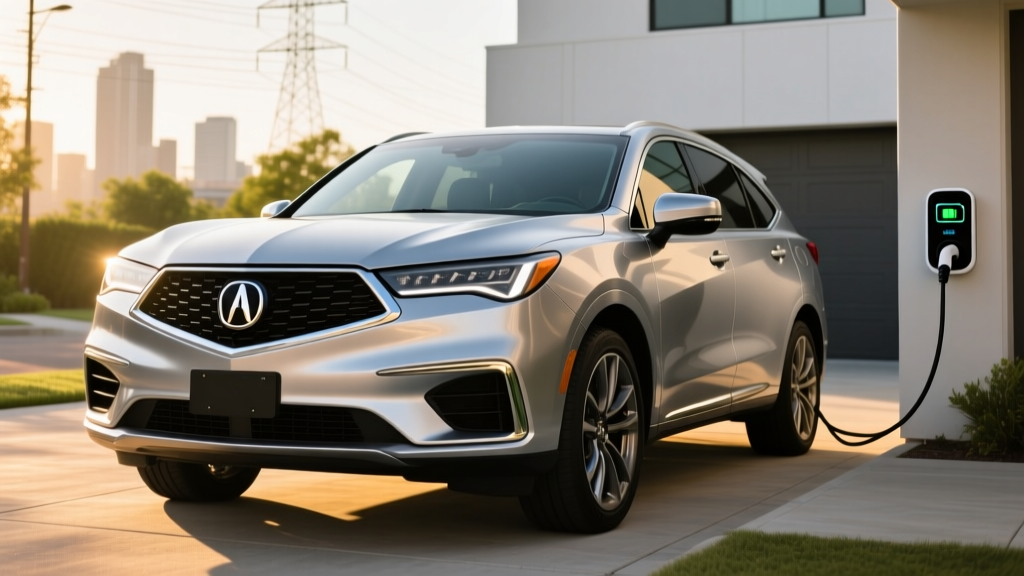
The 2025 Acura MDX Hybrid represents Honda's luxury division re-entering the electrified SUV conversation after a multi-year hiatus from hybrid powertrains in the MDX lineup. For buyers who want three-row luxury without range anxiety or plug-in infrastructure requirements, this conventional hybrid (HEV) aims to deliver meaningful fuel savings over the standard MDX while preserving the driving dynamics Acura is known for.
Before we get into the numbers, one critical distinction: the 2025 MDX Hybrid is a conventional hybrid (HEV), not a plug-in hybrid (PHEV). It charges its battery through regenerative braking and the gasoline engine — you never plug it in. If you're looking for electric-only driving range, you'll want to consider a PHEV or full BEV instead.
2025 Acura MDX Hybrid: Powertrain & Performance Specs
| Specification | Value |
|---|---|
| Powertrain Type | Conventional Hybrid (HEV) |
| Engine | 3.0L V6 Turbo + Electric Motor(s) |
| Combined System Horsepower | ~355 hp (estimated) |
| Combined Torque | ~350 lb-ft (estimated) |
| Transmission | 10-Speed Automatic |
| Drivetrain | SH-AWD (Standard) |
| 0-60 mph | ~5.8 sec (estimated) |
| Hybrid Battery | ~1.5 kWh (small, self-charging) |
| Towing Capacity | 5,000 lbs |
| Seating | 7 passengers (3 rows) |
The hybrid system pairs Acura's turbocharged 3.0-liter V6 with one or more electric motors integrated into the drivetrain. The electric assist provides immediate low-end torque fill while the turbo spools up, resulting in smoother and more responsive acceleration than the non-hybrid 2.0T turbo-four base MDX. The SH-AWD (Super Handling All-Wheel Drive) system remains standard, with the rear axle potentially benefiting from electric motor torque vectoring for improved cornering dynamics.
Note: Acura has not published final EPA-certified figures for every metric above as of early 2025. Values marked "estimated" are based on pre-release engineering data and comparable Honda/Acura hybrid systems. Always verify with fueleconomy.gov before purchasing.
Fuel Economy: EPA MPG & Real-World Expectations
| Model | City MPG | Highway MPG | Combined MPG |
|---|---|---|---|
| 2025 MDX Hybrid (SH-AWD) | ~26 mpg (est.) | ~27 mpg (est.) | ~26 mpg (est.) |
| 2025 MDX 2.0T AWD (gas) | 19 mpg | 25 mpg | 21 mpg |
| 2025 MDX Type S AWD (gas) | 17 mpg | 21 mpg | 19 mpg |
The hybrid powertrain delivers an estimated ~26 MPG combined — a roughly 24% improvement over the gas-only MDX 2.0T AWD. This translates to approximately 80-100 additional miles per tank and roughly $400-$600 in annual fuel savings for a driver covering 15,000 miles per year at $3.50/gallon.
HEV vs. PHEV vs. Full EV: Which Fits Your Lifestyle?
Buyers cross-shopping the MDX Hybrid often wonder whether they should consider a plug-in hybrid (PHEV) like the BMW X5 xDrive50e or a full battery-electric vehicle (BEV) like the Rivian R1S or Tesla Model X. Here's how the three categories compare for a luxury three-row SUV buyer:
| Factor | HEV (MDX Hybrid) | PHEV (e.g., BMW X5 50e) | BEV (e.g., Rivian R1S) |
|---|---|---|---|
| Plug-in Required? | No | Yes (for max benefit) | Yes |
| Electric-Only Range | None (motor assist only) | ~38 miles | ~320-400 miles |
| Combined MPG / MPGe | ~26 MPG | ~50 MPGe (elec+gas) | ~70-80 MPGe |
| Home Charging Needed? | No | Recommended (Level 2) | Essential (Level 2) |
| Federal Tax Credit (§30D) | Not eligible | Up to $7,500* | Up to $7,500* |
| Fuel Cost (15k mi/yr) | ~$2,020/yr | ~$1,200-1,600/yr | ~$600-900/yr |
| Upfront Price Premium | +$2,000-4,000 vs gas | +$8,000-12,000 vs gas | +$15,000-25,000 vs gas |
| 3rd Row Space | Full (no battery intrusion) | Slightly reduced | Varies (skateboard = good) |
*§30D federal tax credit eligibility for PHEVs and BEVs depends on MSRP caps ($80,000 for SUVs), buyer income limits ($300k joint / $150k single), battery critical-mineral sourcing, and North American assembly requirements. Verify current rules at IRS.gov. The conventional MDX Hybrid does NOT qualify for the §30D credit because it cannot be plugged in.
Pricing, Trims & Tax Credit Eligibility
The 2025 Acura MDX Hybrid is expected to slot between the standard MDX 2.0T and the performance-oriented Type S in Acura's lineup:
| Trim / Model | Est. MSRP | §30D Tax Credit |
|---|---|---|
| MDX 2.0T (base, FWD) | ~$51,500 | Not eligible |
| MDX 2.0T SH-AWD | ~$53,500 | Not eligible |
| MDX Hybrid SH-AWD | ~$55,000-57,000 | Not eligible |
| MDX Hybrid w/ Technology Pkg | ~$59,000-61,000 | Not eligible |
| MDX Hybrid Advance Pkg | ~$64,000-67,000 | Not eligible |
| MDX Type S | ~$68,000 | Not eligible |
With an estimated $2,000-$4,000 premium over the equivalent gas MDX trim, the hybrid's fuel savings of ~$400-$600/year mean a break-even period of approximately 4-8 years depending on driving habits and local fuel prices. Buyers who keep vehicles 8+ years or drive above 15,000 miles annually will see the strongest financial return.
Battery Warranty, Reliability & Replacement Cost
The MDX Hybrid uses a relatively small battery pack (~1.5 kWh) compared to PHEVs (15-30 kWh) or BEVs (75-130 kWh). This small pack undergoes shallow charge/discharge cycles — it rarely goes below 40% or above 80% state of charge — which dramatically extends its lifespan. Honda and Acura have extensive hybrid experience dating back to the 2000 Insight, and their hybrid battery packs routinely last 150,000-200,000+ miles before significant degradation.
Replacement cost: If the hybrid battery does need replacement outside warranty, expect a cost of approximately $2,000-$4,000 for a conventional hybrid battery of this size — significantly less than the $10,000-$20,000+ that PHEV or BEV battery replacements can cost. Refurbished and aftermarket options may reduce this further.
Reliability expectations are strong. Honda/Acura's hybrid systems have proven durable across the Accord Hybrid, CR-V Hybrid, and previous MDX Sport Hybrid generations. The primary maintenance items remain standard: oil changes (the gas engine still requires them), brake fluid, and tire rotations. Regenerative braking actually extends brake pad life, often pushing pad replacements to 80,000-100,000+ miles.
Who Should Choose the 2025 MDX Hybrid?
Choose the MDX Hybrid If:
- You want better fuel economy without changing your habits (no plugging in)
- You drive 12,000-20,000+ miles/year and want to reduce fuel costs
- You need three rows and SH-AWD for family and weather
- You live in an apartment or lack home charging access
- You want smoother, more responsive acceleration with electric torque fill
- You plan to keep the vehicle 6+ years
Skip It and Consider a PHEV or BEV If:
- You want electric-only driving for short commutes (look at BMW X5 xDrive50e PHEV)
- You have home Level 2 charging and want to minimize gas use
- You want to qualify for the $7,500 federal tax credit (§30D)
- You want the lowest possible fuel/energy cost per mile
- You're ready for a full EV like the Rivian R1S or Tesla Model X
- You want zero tailpipe emissions for local air quality
Pros & Cons at a Glance
Pros
- ~24% fuel economy improvement over gas MDX
- No plug-in charging required — zero lifestyle change
- SH-AWD standard with electric torque vectoring
- Proven Honda/Acura hybrid reliability
- 8yr/100k-mi battery warranty (10yr/150k in CARB states)
- Full 3-row seating with no battery-pack intrusion
- Extended brake pad life from regen braking
Cons
- No federal tax credit (HEVs are ineligible for §30D)
- Modest $400-600/yr fuel savings — long payback period
- No electric-only driving mode for zero-emission commutes
- Estimated MSRP premium of $2,000-4,000 over gas model
- Not a PHEV — buyers wanting plug-in capability must look elsewhere
- Final EPA numbers may differ from estimates
Frequently Asked Questions
How many MPG does the 2025 Acura MDX Hybrid get?
The 2025 MDX Hybrid is estimated to achieve approximately 26 MPG combined (~26 city / 27 highway). This represents a meaningful improvement over the gas MDX AWD's 21 MPG combined. In real-world city driving with frequent stops, expect the hybrid to deliver 27-29 MPG thanks to regenerative braking. Highway cruising at 75+ mph may yield slightly less, around 24-25 MPG.
Does the 2025 MDX Hybrid need to be plugged in?
No. The MDX Hybrid is a conventional hybrid (HEV). Its small battery recharges automatically through regenerative braking and the gasoline engine. You fuel it exactly like a regular gas car — just at the pump less often. There is no charging port, no plug, and no electric-only range.
How far can it go on electric only?
It can't. As a conventional HEV, the MDX Hybrid does not offer an electric-only driving mode. The electric motor assists the gasoline engine during acceleration and low-speed maneuvers, but the gas engine is always available and frequently active. If electric-only driving is a priority, consider a PHEV like the BMW X5 xDrive50e (~38 miles electric-only) or a full BEV.
Does the 2025 Acura MDX Hybrid qualify for any tax credit?
The federal §30D New Clean Vehicle Credit does not apply to conventional hybrids — only to plug-in hybrids (PHEVs) and battery-electric vehicles (BEVs) that meet battery sourcing, MSRP, income, and assembly requirements. There is currently no dedicated federal tax credit for HEVs. Some states may offer minor incentives; check your state's energy or environmental agency. The hybrid's financial benefit comes from reduced fuel consumption over time, not from tax incentives.
Is the hybrid battery reliable and what does replacement cost?
Acura covers the hybrid battery for 8 years / 100,000 miles (10 years / 150,000 miles in CARB states). Honda/Acura hybrid batteries have an excellent longevity track record, routinely lasting 150,000-200,000+ miles due to shallow cycling. If replacement is needed out of warranty, expect approximately $2,000-$4,000 — far less than PHEV or BEV battery replacements. The small battery size and proven Honda hybrid architecture make this one of the lower-risk hybrid systems on the market.
Hybrid vs PHEV vs EV — which should I choose?
Choose the MDX Hybrid (HEV) if you want fuel savings with zero lifestyle change — no plugging in, no charging apps, no range planning. Choose a PHEV (like the BMW X5 xDrive50e) if you have home charging and a short commute you'd like to cover on electricity, while keeping a gas engine for road trips. Choose a full BEV (like the Rivian R1S) if you have reliable home Level 2 charging, want the lowest per-mile energy cost, qualify for the federal tax credit, and are comfortable with public DC fast charging for road trips.
Sources: EPA Fuel Economy (fueleconomy.gov), IRS §30D Clean Vehicle Credit, Acura official specifications. All estimated figures subject to final EPA certification and manufacturer confirmation.