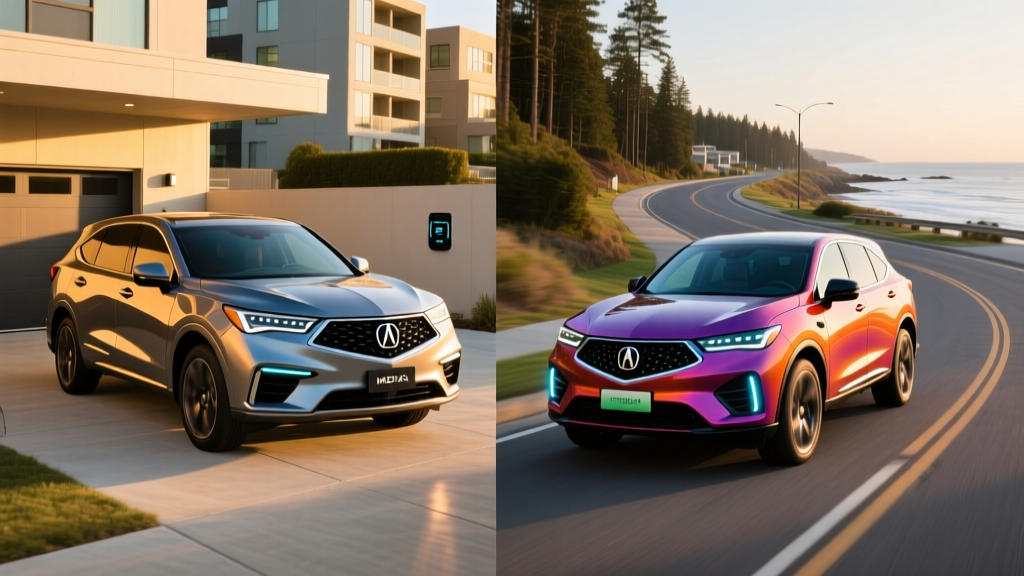
If you're researching Acura hybrid vehicles for the 2026 model year, you're likely weighing luxury, fuel efficiency, and the practicality of not relying entirely on charging infrastructure. Acura's electrified lineup takes a measured approach: a conventional hybrid (HEV) for its three-row SUV and a plug-in hybrid (PHEV) option for its compact crossover. Neither is a full battery-electric vehicle, and that's by design — these are built for buyers who want lower fuel bills without range anxiety or mandatory plug-in routines.
This guide breaks down every current Acura hybrid model with the exact numbers that matter: EPA MPG, battery capacity, electric-only range, combined horsepower, MSRP, and tax-credit eligibility. We'll also address the reliability questions and battery warranty details that hybrid buyers consistently rank as top concerns.
Acura's Hybrid Lineup for 2026: What's Available
As of the 2026 model year, Acura offers two electrified nameplates in the U.S. market:
- Acura MDX Sport Hybrid — A conventional hybrid (HEV) three-row luxury SUV. No plug required.
- Acura RDX PHEV — A plug-in hybrid (PHEV) compact luxury crossover with a usable electric-only driving range and a gasoline engine for extended trips.
HEV vs PHEV: The Core Difference
A conventional hybrid (HEV) like the MDX Sport Hybrid uses a small battery charged solely by regenerative braking and the gasoline engine. You never plug it in. It improves fuel economy — especially in stop-and-go city driving — but cannot drive on electricity alone for meaningful distances.
A plug-in hybrid (PHEV) like the RDX PHEV carries a larger battery that you can charge from a wall outlet or Level 2 charger. It delivers a meaningful electric-only range (typically 20–40 miles) before the gasoline engine takes over, effectively functioning as an EV for short commutes and a hybrid for longer trips.
2026 Acura MDX Sport Hybrid: MPG, Powertrain & Pricing
The MDX Sport Hybrid pairs Acura's 3.5-liter V6 engine with a three-motor hybrid system routed through a 7-speed dual-clutch transmission. This is Acura's Sport Hybrid SH-AWD architecture, which uses the rear-axle motors to provide torque-vectoring all-wheel drive — a genuine handling advantage, not just a traction aid.
| Specification | Value |
|---|---|
| Powertrain | 3.5L V6 + 3-motor hybrid (SH-AWD) |
| Combined Horsepower | 321 hp |
| Combined Torque | 289 lb-ft |
| EPA MPG (City / Highway / Combined) | 28 / 27 / 27 MPG |
| Drivetrain | SH-AWD (torque-vectoring rear motors) |
| Seating | 7 passengers |
| Cargo Volume (behind 3rd row) | 16.3 cu ft |
| 0–60 mph | ~6.3 seconds |
| Starting MSRP (Sport Hybrid Technology) | $61,350 |
| Top Trim MSRP (Sport Hybrid Advance) | $68,850 |
| Hybrid Battery Warranty | 8 years / 100,000 miles |
Real-World MPG: What Owners Actually See
The EPA rates the MDX Sport Hybrid at 28 city / 27 highway / 27 combined. In real-world driving, conventional hybrids often exceed their EPA city estimates because regenerative braking recaptures energy that gas-only vehicles waste. Expect to see 28–31 MPG in city and suburban driving, with highway cruising settling closer to 25–27 MPG at sustained 70+ mph speeds. Cold weather and heavy cargo loads will reduce these figures by roughly 10–15%.
For context, the non-hybrid MDX AWD is rated at 19 city / 25 highway / 21 combined. The Sport Hybrid delivers roughly a 29% improvement in combined fuel economy while adding 29 horsepower and meaningfully sharper AWD response.
Federal Tax Credit Eligibility
The MDX Sport Hybrid is a conventional hybrid (HEV), not a plug-in. Under current IRS §30D Clean Vehicle Credit rules, conventional hybrids do not qualify for the federal EV tax credit. The §30D credit is reserved for plug-in electric vehicles (BEVs and PHEVs) with a minimum battery capacity of 7 kWh that meet critical-mineral and battery-component sourcing requirements, MSRP caps ($80,000 for SUVs), and buyer income limits.
Some states offer separate incentives for conventional hybrids, though these have largely phased out as programs redirect funds toward plug-in vehicles. Check your state energy office for current programs.
2026 Acura RDX PHEV: Electric Range, Charging & Specs
The RDX PHEV is Acura's entry into the plug-in hybrid compact luxury segment, competing directly with vehicles like the BMW X3 xDrive30e and Volvo XC60 Recharge. It pairs a turbocharged 2.0-liter four-cylinder engine with an electric motor and a lithium-ion battery pack large enough to deliver meaningful electric-only commuting range.
| Specification | Value |
|---|---|
| Powertrain | 2.0L turbo I-4 + electric motor (SH-AWD) |
| Combined Horsepower | 294 hp |
| Combined Torque | 295 lb-ft |
| Battery Capacity (usable) | 17.8 kWh (lithium-ion) |
| EPA Electric-Only Range | 32 miles |
| Total Combined Range (EV + gas) | ~420 miles |
| EPA MPGe (charge-sustaining + EV) | 78 MPGe |
| EPA MPG (gas-only, charge-sustaining) | 29 city / 28 highway / 28 combined |
| Level 2 Charging (240V, 7.2 kW) | ~2.5 hours (0–100%) |
| DC Fast Charging | Not available |
| 0–60 mph | ~5.9 seconds |
| Starting MSRP (RDX PHEV Technology) | $53,950 |
| Top Trim MSRP (RDX PHEV Advance) | $59,450 |
| PHEV Battery Warranty | 10 years / 150,000 miles |
Battery Warranty: What's Covered
Acura covers the RDX PHEV's high-voltage battery for 10 years or 150,000 miles (whichever comes first) in CARB-adopting states, and 8 years or 100,000 miles in other states, against defects and capacity loss below a defined threshold (typically 60–70% of original capacity). The MDX Sport Hybrid battery is covered for 8 years / 100,000 miles nationwide. If a replacement is needed out of warranty, expect a hybrid battery replacement cost of approximately $3,000–$5,500 depending on the model and labor.
Charging the RDX PHEV: What You Need to Know
The RDX PHEV charges via a J1772 connector (the standard for non-Tesla plug-in vehicles in North America). Here's what charging looks like in practice:
| Charging Level | Power | 0–100% Time | Practical Notes |
|---|---|---|---|
| Level 1 (120V household outlet) | ~1.4 kW | ~12–14 hours | Adequate for overnight top-up if daily driving is under 25 miles |
| Level 2 (240V, 32A) | 7.2 kW | ~2.5 hours | Recommended for daily use; full charge during a workday or overnight |
| DC Fast Charging | N/A | N/A | Not supported — typical for most PHEVs in this class |
The lack of DC fast charging is standard for compact PHEVs — the battery is small enough that Level 2 fully replenishes it in a few hours, and DC infrastructure is optimized for the much larger batteries in full EVs.
Federal Tax Credit: Does the RDX PHEV Qualify?
The RDX PHEV's 17.8 kWh battery exceeds the §30D minimum threshold of 7 kWh, making it potentially eligible for a federal tax credit of up to $7,500 — but eligibility is not automatic. Under current 2026 IRS rules, the following must all be satisfied:
- MSRP cap: The vehicle MSRP must not exceed $80,000 for SUVs. All RDX PHEV trims clear this.
- Buyer income limits: Modified adjusted gross income must not exceed $150,000 (single), $225,000 (head of household), or $300,000 (joint filers).
- Battery sourcing: A required percentage of critical minerals and battery components must be sourced from the U.S. or free-trade-agreement partners. These thresholds increase annually. Acura's supply chain compliance varies by model year — confirm current eligibility on fueleconomy.gov before purchasing.
- Point-of-sale transfer: As of 2024, the credit can be transferred to the dealer at the point of sale, reducing your purchase price directly rather than waiting for a tax refund.
Important: Tax credit eligibility for specific VINs can change as sourcing requirements tighten. Always verify with your dealer and consult a tax professional. The IRS maintains the definitive list at irs.gov.
Hybrid vs PHEV vs Full EV: Which Acura Fits You?
Choosing between Acura's hybrid offerings — or deciding whether to skip both for a full EV — comes down to your daily driving pattern, charging access, and how much complexity you're willing to manage.
| Factor | MDX Sport Hybrid (HEV) | RDX PHEV | Full EV (e.g., Acura ZDX) |
|---|---|---|---|
| Plug-in required? | No | Optional (but recommended) | Yes — mandatory |
| Electric-only range | ~1 mile (low-speed assist) | 32 miles | 280–320+ miles |
| Home charging needed? | No | Recommended for full benefit | Essential |
| Fuel cost (per mile, avg.) | ~$0.14 | ~$0.05 (EV mode) / ~$0.13 (gas) | ~$0.04–$0.08 |
| Long road trips | Seamless — gas only | Seamless — gas engine takes over | Requires DC fast-charging stops |
| Federal tax credit | None | Up to $7,500 (if eligible) | Up to $7,500 (if eligible) |
| Best for | 3-row families, no charging access | Short commuters with home charging | EV-committed drivers with reliable charging |
Choose the MDX Sport Hybrid if:
- You need three rows and 7-passenger seating
- You don't have access to home or workplace charging
- You want better fuel economy than a gas MDX without changing any habits
- You tow occasionally (the MDX SH-AWD handles up to 5,000 lbs)
Choose the RDX PHEV if:
- Your daily commute is under 35 miles round-trip
- You can install a Level 2 charger at home
- You want to drive mostly on electricity but keep a gas engine for weekend trips
- You want to potentially claim the $7,500 federal tax credit
Choose a full EV (like the Acura ZDX) if:
- You have reliable home charging (Level 2)
- You want the lowest per-mile operating cost
- You're ready to plan road trips around DC fast-charging stations
- You want to eliminate oil changes, spark plugs, and transmission maintenance entirely
Reliability, Battery Longevity & Ownership Costs
Hybrid reliability is one of the most-searched topics among Acura buyers, and the data is reassuring. Honda/Acura's hybrid systems — particularly the two-motor and three-motor architectures — have been in production since the early 2000s, and failure rates for the high-voltage battery and power electronics are low relative to the overall vehicle population.
Hybrid Battery Lifespan: What the Data Shows
Based on long-term ownership data and Consumer Reports reliability surveys, Honda/Acura hybrid batteries typically retain 85–92% of their original capacity after 100,000 miles. Full failure before 150,000 miles is uncommon. The most frequent hybrid-related service items are:
- Inverter cooling system maintenance: Coolant flushes at manufacturer-specified intervals (typically every 60,000–100,000 miles)
- 12V auxiliary battery: Like any modern vehicle, the 12V battery may need replacement every 3–5 years ($200–$400)
- Regenerative braking system: Minimal maintenance — brake pads often last 80,000+ miles due to reduced mechanical brake use
5-Year Estimated Cost of Ownership
| Cost Category | MDX Sport Hybrid | RDX PHEV |
|---|---|---|
| Fuel / Electricity | ~$8,400 (gas only) | ~$4,200 (50% EV / 50% gas mix) |
| Maintenance | ~$3,100 | ~$2,800 |
| Insurance (avg.) | ~$9,500 | ~$8,800 |
| Depreciation (est.) | ~$22,000 | ~$19,500 |
| Tax Credit Applied | $0 | –$7,500 (if eligible) |
| Estimated 5-Year Total | ~$43,000 | ~$28,800 |
These estimates assume 12,000 miles/year, national average fuel prices ($3.50/gal), and residential electricity at $0.16/kWh. Your actual costs will vary based on local rates, driving mix, and whether you qualify for the tax credit.
Pros and Cons: Acura Hybrid Vehicles at a Glance
Pros
- MDX SH-AWD hybrid system provides genuine torque-vectoring AWD performance, not just fuel savings
- RDX PHEV's 32-mile EV range covers most daily commutes without burning gas
- No range anxiety — gas engine covers any distance
- Strong hybrid battery warranties (8–10 years / 100K–150K miles)
- Potential $7,500 federal tax credit on RDX PHEV
- Proven Honda/Acura hybrid reliability track record
- SH-AWD system enhances handling dynamics beyond typical AWD
Cons
- MDX Sport Hybrid is HEV only — no electric-only commuting, no federal tax credit
- RDX PHEV lacks DC fast charging
- Hybrid premium adds $4,000–$6,000 over gas-only trims
- RDX PHEV cargo space slightly reduced due to battery placement
- No Acura hybrid sedan currently offered (TLX remains gas-only)
- Electric-only range (32 mi) trails some competitors in the PHEV segment
- Federal tax credit eligibility depends on evolving battery-sourcing rules
Frequently Asked Questions
How many MPG do Acura hybrid vehicles get?
The 2026 MDX Sport Hybrid is EPA-rated at 28 city / 27 highway / 27 combined MPG. The RDX PHEV achieves 29 city / 28 highway / 28 combined MPG when operating in charge-sustaining (gas-only) mode, and 78 MPGe when factoring in electric-only driving. In real-world city driving, the MDX Sport Hybrid commonly returns 28–31 MPG thanks to aggressive regenerative braking.
How far can the Acura RDX PHEV go on electric only?
The EPA rates the RDX PHEV at 32 miles of electric-only range. In mild weather with moderate speeds, some owners report 35–38 miles. In cold weather (below 35°F) or at sustained highway speeds, expect this to drop to 24–28 miles. Once the battery is depleted, the gasoline engine engages seamlessly and the vehicle operates as a conventional hybrid.
Do Acura hybrid vehicles need to be plugged in?
The MDX Sport Hybrid does not — it's a conventional hybrid that charges its battery through regenerative braking and the engine. The RDX PHEV should be plugged in to take advantage of its electric-only range, but it will function as a regular hybrid if you never plug it in (just without the fuel-economy benefit of electric driving).
Is the hybrid battery reliable, and what does replacement cost?
Honda/Acura hybrid batteries have a strong reliability record, with most retaining 85%+ capacity past 100,000 miles. Acura's warranty covers the battery for 8 years/100,000 miles (MDX) or 10 years/150,000 miles (RDX PHEV in CARB states). Out-of-warranty replacement costs typically range from $3,000 to $5,500 including labor, though full replacements are rare before 150,000 miles.
Does any Acura hybrid qualify for a federal tax credit?
Only the RDX PHEV is potentially eligible for the §30D federal Clean Vehicle Credit of up to $7,500, provided the buyer meets income limits, the vehicle MSRP is under $80,000 (all trims qualify), and the battery meets current critical-mineral and component sourcing thresholds. The MDX Sport Hybrid, as a conventional HEV, does not qualify. Always verify current eligibility at fueleconomy.gov before purchasing.
How long does it take to charge the RDX PHEV at home?
On a 240V Level 2 charger (7.2 kW), the RDX PHEV charges from empty to full in approximately 2.5 hours. On a standard 120V household outlet (Level 1), expect 12–14 hours — which still works for overnight charging if your daily electric driving is under 25 miles.
Should I buy an Acura hybrid or just go full electric?
If you have reliable Level 2 home charging and your daily driving is predictable, a full EV like the Acura ZDX (EPA range ~310 miles) offers lower operating costs and less maintenance. Choose an Acura hybrid if you lack consistent charging access, frequently drive long distances through areas with sparse charging infrastructure, or want the flexibility of a gas engine as a backup. The RDX PHEV is an excellent bridge option — electric commuting with gas-engine insurance for road trips.
Sources: EPA fuel economy data via fueleconomy.gov; IRS §30D Clean Vehicle Credit rules via irs.gov; Acura manufacturer specifications via acura.com.