Quick Verdict: Which Midsize Hybrid Sedan Wins?
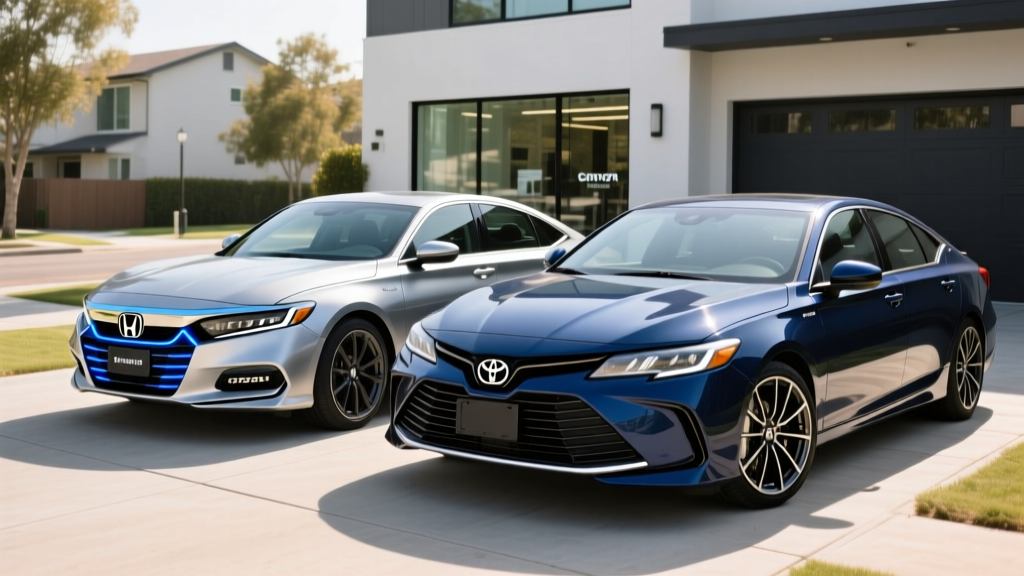
The Honda Accord Hybrid and Toyota Camry Hybrid are the two benchmarks every midsize sedan shopper cross-references — and for good reason. Both deliver over 44 MPG combined, carry top safety ratings, and cost under $35,000 to start. But their powertrain philosophies diverge in ways that matter on real roads.
The 2026 Camry Hybrid is now exclusively a hybrid (Toyota dropped the gas-only four-cylinder), pairing a 2.5-liter four with Toyota's fifth-generation hybrid system for up to 225 hp and an EPA-estimated 48 MPG combined on LE trims. The 2026 Accord Hybrid uses Honda's two-motor system with a 2.0-liter Atkinson-cycle engine, producing 204 hp and an EPA-estimated 48 MPG combined on Sport/LX trims. Neither is a plug-in hybrid — both are conventional (HEV) sedans that never need to be plugged in.
If you want the slightly quicker, more engaging drive, the Accord edges ahead. If you want maximum fuel economy and the availability of all-wheel drive, the Camry takes it. Below, we break down every spec that matters.
EPA Fuel Economy: City, Highway, and Combined MPG
| Model / Trim | City MPG | Highway MPG | Combined MPG |
|---|---|---|---|
| Camry Hybrid LE (FWD) | 53 | 50 | 52 |
| Camry Hybrid SE/XLE (FWD) | 48 | 47 | 47 |
| Camry Hybrid AWD | 51 | 49 | 50 |
| Accord Hybrid Sport/LX | 51 | 44 | 48 |
| Accord Hybrid EX-L/Touring | 46 | 41 | 44 |
Powertrain and Performance Specs
| Specification | 2026 Toyota Camry Hybrid | 2026 Honda Accord Hybrid |
|---|---|---|
| Engine | 2.5L 4-cyl Atkinson + 2 motors (5th-gen) | 2.0L 4-cyl Atkinson + 2 motors |
| Combined Horsepower | 225 hp (FWD) / 232 hp (AWD) | 204 hp |
| Drivetrain | FWD or AWD (electronic rear motor) | FWD only |
| Transmission | eCVT (planetary gearset) | eCVT (direct-drive + lock-up clutch) |
| 0–60 mph (est.) | ~7.2 sec (FWD) | ~7.5 sec |
| Towing Capacity | Not rated | Not rated |
| Hybrid Battery | ~1.0 kWh lithium-ion | ~1.1 kWh lithium-ion |
Both powertrains are conventional hybrids (HEV), meaning the small battery recharges via regenerative braking and the engine — no plug required. The Camry's fifth-generation system delivers a meaningful 21-hp advantage and offers electronic on-demand AWD, which adds a rear-axle motor for traction in rain and light snow. The Accord's system prioritizes seamless electric-motor-dominant driving at lower speeds, which gives it a smooth, EV-like feel around town.
Pricing, Trims, and Tax Credit Eligibility
| Camry Hybrid Trim | MSRP | Accord Hybrid Trim | MSRP |
|---|---|---|---|
| LE | $29,990 | LX | $30,990 |
| SE | $31,490 | Sport | $32,990 |
| XLE | $34,490 | EX-L | $35,490 |
| XSE | $35,990 | Sport-L | $36,290 |
| — | — | Touring | $39,490 |
Hybrid vs PHEV vs EV: Which Powertrain Fits You?
Both the Accord and Camry are conventional hybrids. If you've considered a plug-in hybrid (PHEV) or a full battery-electric vehicle (BEV), here's how the decision breaks down:
Conventional Hybrid (HEV)
Examples: Accord Hybrid, Camry Hybrid
No plug needed. The small battery charges through regen and the engine. Best for drivers without home charging access who want 45+ MPG with zero behavior change. Total range: 550–600+ miles per tank.
Plug-in Hybrid (PHEV)
Examples: Toyota RAV4 Prime, Hyundai Tucson PHEV
Plug in for 25–42 miles of electric-only range, then the gas engine takes over. Best for drivers with home Level 2 charging and short commutes who want EV-like daily driving plus gas-engine road-trip flexibility. Battery: 13–18 kWh. May qualify for the §30D federal credit.
Battery Electric (BEV)
Examples: Tesla Model 3, Hyundai Ioniq 6
100% electric, 250–360+ miles of range. Best for drivers with reliable home charging who want the lowest per-mile energy cost and zero tailpipe emissions. Requires planning for road-trip DC fast charging. Eligible for up to $7,500 federal credit (subject to sourcing/income rules).
The bottom line: If you can't charge at home or in your apartment garage, the Accord Hybrid or Camry Hybrid is the pragmatic choice — you get exceptional fuel economy with no infrastructure dependency. If you have Level 2 access and a commute under 35 miles, a PHEV gives you electric daily driving with gas backup. If you're ready to go fully electric, a BEV offers the lowest running costs but requires charging planning.
Battery Warranty, Lifespan, and Replacement Cost
- Toyota Camry Hybrid: 10 years / 150,000 miles (hybrid battery), 8 years / 100,000 miles (hybrid system components) — per Toyota's standard hybrid warranty.
- Honda Accord Hybrid: 10 years / 150,000 miles (hybrid battery) in CARB states; 8 years / 100,000 miles in non-CARB states. Confirm your state classification with your dealer.
Hybrid battery degradation in conventional HEVs is a much smaller concern than in BEVs because the battery is tiny (~1 kWh) and the system keeps it within a narrow state-of-charge window — typically between 40% and 80% — which dramatically extends cycle life. Real-world data from Consumer Reports and owner forums shows Toyota and Honda hybrid batteries routinely lasting 150,000–200,000+ miles before significant capacity loss.
If replacement is needed out of warranty:
- Camry Hybrid battery replacement: $2,500–$4,000 (OEM), with refurbished options available for $1,500–$2,500.
- Accord Hybrid battery replacement: $2,000–$3,500 (OEM), with refurbished units around $1,200–$2,000.
These costs are a fraction of BEV battery replacements because the hybrid battery packs are small. Most owners will sell the vehicle before ever needing a hybrid battery swap.
Safety Ratings and Driver-Assist Technology
Both sedans earn top marks. The Insurance Institute for Highway Safety (IIHS) has historically rated both the Camry and Accord as Top Safety Pick+ winners when equipped with their standard driver-assist suites.
- Toyota Safety Sense 3.0 (Camry): Pre-Collision System with pedestrian detection, full-speed adaptive cruise control, lane-departure alert with steering assist, lane-tracing assist, automatic high beams, and road-sign assist.
- Honda Sensing (Accord): Collision Mitigation Braking, Adaptive Cruise Control with Low-Speed Follow, Lane Keeping Assist, Road Departure Mitigation, Traffic Sign Recognition, and Traffic Jam Assist on higher trims.
Important: Both systems are SAE Level 2 driver-assist — meaning they provide steering and speed support but require the driver to remain fully engaged and hands-on (or eyes-on) at all times. Neither is a self-driving system.
Interior, Cargo, and Daily Practicality
| Feature | Camry Hybrid | Accord Hybrid |
|---|---|---|
| Rear Legroom | 38.0 in | 40.8 in |
| Cargo Volume (trunk) | 15.1 cu ft | 16.7 cu ft |
| Infotainment Screen | 8.0 in (LE/SE) / 12.3 in (XLE+) | 7.0 in (LX) / 12.3 in (Sport+) |
| Wireless Apple CarPlay / Android Auto | Yes (on 12.3-in trims) | Yes (on 12.3-in trims) |
| Wireless Charging Pad | Available | Standard (Sport+) |
| Heated Front Seats | Standard (SE+) | Standard (Sport+) |
The Accord's longer wheelbase gives it a clear rear-seat advantage — nearly three extra inches of legroom — making it the stronger pick for families or rideshare use. The Accord's trunk is also 1.6 cu ft larger. The Camry counters with a slightly lower entry price and available AWD, which the Accord does not offer.
Pros and Cons
Camry Hybrid Advantages
- Highest combined MPG in the segment (52 EPA on LE FWD)
- Available electronic AWD for all-weather traction
- 225 hp — strongest output in this comparison
- Proven 5th-gen Toyota hybrid system reliability
- Lowest starting MSRP ($29,990)
Camry Hybrid Drawbacks
- Smaller rear seat (38.0 in legroom vs Accord's 40.8)
- Smaller trunk (15.1 cu ft)
- Base 8.0-in screen feels dated
- AWD trims lose ~2 MPG combined vs FWD
Accord Hybrid Advantages
- Best-in-class rear legroom (40.8 in)
- Largest trunk (16.7 cu ft)
- More refined, EV-like low-speed driving feel
- Standard wireless phone integration on most trims
- Honda Sensing suite standard on every trim
Accord Hybrid Drawbacks
- No AWD option
- 204 hp — adequate but not quick for highway merging
- Higher starting price ($30,990)
- Touring trim pushes $39,490 — nearing luxury territory
Decision Framework: Which Should You Buy?
Choose the Camry Hybrid if:
- Maximum MPG is your top priority (52 combined LE)
- You need AWD for snow or rain
- You want the most horsepower in the segment (225 hp)
- Budget is tight and you want the lowest entry price
Choose the Accord Hybrid if:
- Rear-seat space matters (family, carpool, rideshare)
- You value cargo capacity (16.7 cu ft trunk)
- You prefer a smoother, more EV-like driving feel at city speeds
- You want Honda's reputation for interior ergonomics
Consider a PHEV or BEV instead if:
- You have home Level 2 charging and want electric-only daily driving
- You want to qualify for the federal §30D tax credit (up to $7,500)
- Your commute is under 35 miles round-trip (PHEV sweet spot)
Frequently Asked Questions
How many MPG does the Accord Hybrid get?
The 2026 Accord Hybrid achieves an EPA-estimated 51 city / 44 highway / 48 combined on Sport and LX trims. Higher trims (EX-L, Touring) with larger wheels drop to 46/41/44. Real-world owners typically report within ±2 MPG of these figures, with city driving sometimes exceeding the EPA estimate thanks to regenerative braking.
How many MPG does the Camry Hybrid get?
The 2026 Camry Hybrid LE (FWD) achieves an EPA-estimated 53 city / 50 highway / 52 combined — the highest in the midsize sedan class. SE and XLE trims return 48/47/47. AWD models achieve 51/49/50. These figures make the Camry Hybrid LE one of the most efficient non-plug-in sedans available.
Do these hybrids need to be plugged in?
No. Both the Accord Hybrid and Camry Hybrid are conventional hybrids (HEVs). Their small lithium-ion batteries recharge through regenerative braking and the gasoline engine. You simply fuel up at any gas station. If you want a vehicle you plug in for electric-only driving, you'd be looking at a PHEV (like the RAV4 Prime) or a BEV (like the Model 3).
Is the hybrid battery reliable, and what does replacement cost?
Both Toyota and Honda have decades of hybrid reliability data. Their hybrid batteries are warrantied for 10 years / 150,000 miles (in most states). Real-world lifespan often exceeds 200,000 miles. Out-of-warranty replacement runs $2,000–$4,000 for an OEM pack, with refurbished options costing $1,200–$2,500. Given the small battery size (~1 kWh), this is far less expensive than a BEV battery replacement.
Does either hybrid qualify for a federal tax credit?
No. The federal §30D new clean vehicle credit applies only to plug-in vehicles (BEVs and PHEVs) that meet battery-sourcing, MSRP cap, and buyer-income requirements. Conventional hybrids like the Accord Hybrid and Camry Hybrid are not eligible. Check IRS.gov for current rules and consult a tax professional for your specific situation.
Which is better in snow — Camry Hybrid AWD or Accord Hybrid FWD?
The Camry Hybrid's available electronic AWD gives it a clear traction advantage in snow and ice. The system adds a rear-axle electric motor that engages automatically when front-wheel slip is detected. The Accord Hybrid is FWD only, which is adequate for light snow with winter tires but less capable than AWD in sustained winter conditions.
How does the Accord Hybrid compare to a full EV?
A BEV like the Tesla Model 3 or Hyundai Ioniq 6 offers lower per-mile energy costs (roughly $0.04–$0.06/mile on home electricity vs $0.10–$0.14/mile on gas for the Accord Hybrid), zero tailpipe emissions, and eligibility for the federal tax credit. However, BEVs require home or workplace charging access, involve longer road-trip stops for DC fast charging, and carry higher upfront costs. The Accord Hybrid is the pragmatic choice if you lack charging infrastructure or frequently drive long distances in areas with sparse charging networks.