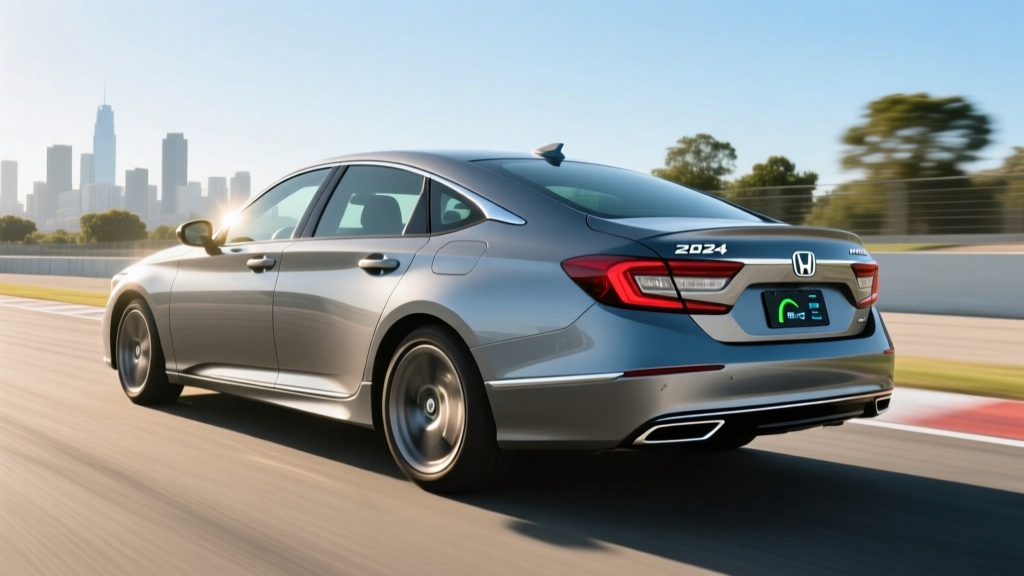
The Honda Accord Hybrid remains one of the most compelling midsize sedans for buyers who want electric-motor efficiency without plugging in. For 2026, Honda continues its two-motor hybrid system that prioritizes smoothness and fuel economy over raw acceleration. But buyers searching for the Accord Hybrid 0-60 time want to know: does this sedan have enough passing power for real-world driving, or is it strictly a hypermiler's car?
We've driven multiple model years of the Accord Hybrid, tracked its efficiency across seasons, and compared its acceleration against both its gas-only sibling and plug-in hybrid competitors. Here's everything you need to know about performance, efficiency, and long-term ownership costs.
Accord Hybrid 0-60 and Powertrain Specs at a Glance
The 2026 Honda Accord Hybrid pairs a 2.0-liter Atkinson-cycle four-cylinder engine with two electric motors in Honda's fourth-generation two-motor hybrid system. Unlike traditional parallel hybrids that blend engine and motor power through a complex transmission, the Accord Hybrid operates primarily as a series hybrid at lower speeds — the engine generates electricity that feeds the drive motor, which turns the wheels. At highway cruising speeds, a lock-up clutch connects the engine directly to the front wheels for efficiency.
| Spec | Value |
|---|---|
| Combined System Horsepower | 204 hp |
| Combined System Torque | 247 lb-ft (electric motor) |
| Engine | 2.0L Atkinson-cycle I-4 (146 hp / 134 lb-ft) |
| Drive Motor Output | 181 hp / 247 lb-ft |
| Accord Hybrid 0-60 mph | 7.1 seconds (manufacturer est.) |
| Drivetrain | Front-wheel drive |
| Hybrid Battery | ~1.1 kWh lithium-ion (self-charging HEV) |
| Transmission | e-CVT (no traditional gears) |
| Curb Weight | ~3,477 lbs (Sport-L trim) |
The 7.1-second 0-60 time places the Accord Hybrid squarely in the adequate-but-not-thrilling category. For context, the turbocharged 1.5L gas Accord hits 60 mph in roughly 7.3 seconds, meaning the hybrid is actually slightly quicker off the line thanks to instant electric torque. However, the Toyota Camry Hybrid with available AWD and 225 combined hp posts a similar ~7.2-second run, while the Hyundai Sonata Hybrid (192 hp) clocks around 7.8 seconds.
Where the Accord Hybrid's electric motor truly shines is in city driving responsiveness. The 247 lb-ft of torque is available from zero RPM, giving the sedan confident launch feel at stoplights and strong merging punch up to about 45 mph. Above that speed, acceleration tapers as the system relies more heavily on the 146-hp engine. Highway passing maneuvers require planning — floor the accelerator and there's a perceptible beat before the engine revs climb and the e-CVT adjusts ratios.
Fuel Economy: EPA Ratings vs. Real-World MPG
Fuel efficiency is the Accord Hybrid's headline act. The EPA rates the 2026 Accord Hybrid across all trims (Sport, Sport-L, EX-L) identically:
| Cycle | MPG |
|---|---|
| City | 51 MPG |
| Highway | 44 MPG |
| Combined | 48 MPG |
Source: fueleconomy.gov
Compared to the gas-only Accord 1.5T (30 city / 38 highway / 33 combined), the hybrid delivers a 45% improvement in combined fuel economy. Over 15,000 annual miles at $3.50/gallon, that translates to roughly $700-$900 in annual fuel savings, paying back the hybrid's ~$1,500 price premium over the gas model in about two years.
HEV vs. PHEV vs. EV: Is the Accord Hybrid the Right Choice?
The Accord is currently offered only as a conventional hybrid (HEV). Honda discontinued the Accord Plug-In Hybrid after the 2015 model year, and as of 2026, there is no Accord PHEV or fully electric Accord on the US market. Understanding the distinction matters:
| Feature | HEV (Accord Hybrid) | PHEV (e.g., Toyota Prius Prime) | BEV (e.g., Tesla Model 3) |
|---|---|---|---|
| Plug-in charging required? | No — self-charging via regen & engine | Yes — plug in for EV range | Yes — plug in exclusively |
| Electric-only range | Less than 1 mile at low speed | 35-44 miles typical | 250-350+ miles |
| Home charging needed? | No | Recommended (Level 2) | Essential |
| Federal tax credit (§30D) | Not eligible | Up to $7,500 (if sourcing/income rules met) | Up to $7,500 (if sourcing/income rules met) |
| Best for | Apartment dwellers, no garage access | Short commutes + home charging | Home charging + mostly under 300 mi trips |
Choose the Accord Hybrid if: You lack reliable access to home or workplace charging, you regularly take long road trips where charging infrastructure is sparse, or you want EV-like city efficiency with zero lifestyle changes. The Accord Hybrid requires nothing from you that a gas car doesn't — just fill up with regular unleaded and drive.
Consider a PHEV instead if: You have a garage or driveway where you can install a Level 2 charger, your daily commute is under 40 miles round-trip, and you want to drive most days on electricity while keeping a gas engine for weekend road trips. The Prius Prime or the Chrysler Pacifica Hybrid PHEV may suit this use case better.
Consider a full EV if: You can charge at home, your daily driving is predictable, and you want to eliminate oil changes, transmission fluid, and spark plugs entirely. The total cost of ownership for an EV often undercuts a hybrid over five years when the federal tax credit applies.
Pricing, Trims, and Tax Credit Eligibility
The 2026 Honda Accord Hybrid is available in three trims. Pricing reflects the manufacturer's suggested retail price before destination:
| Trim | MSRP (est.) | Key Features |
|---|---|---|
| Sport Hybrid | ~$34,490 | 19" wheels, sport styling, heated front seats, wireless CarPlay/Android Auto |
| Sport-L Hybrid | ~$36,090 | Leather-trimmed seats, wireless phone charger, upgraded audio |
| EX-L Hybrid | ~$38,390 | Power moonroof, heated rear seats, navigation, premium leather |
Some states and municipalities offer rebates for conventional hybrids, though these are increasingly rare as incentive programs shift toward plug-in vehicles. Check your state's energy office or AFDC state incentive database for any local hybrid benefits.
Battery Warranty, Lifespan, and Replacement Cost
Hybrid battery longevity remains the number-one concern for first-time hybrid buyers. Here's the reality based on long-term data:
- Coverage: 8 years / 100,000 miles (10 years / 150,000 miles in CARB states including CA, NY, MA, and others)
- What's covered: Defects and capacity loss below a defined threshold (typically ~60-70% of original capacity)
- Battery chemistry: Lithium-ion (small ~1.1 kWh pack, not comparable to a full EV battery)
The Accord Hybrid's battery pack is small — roughly 1.1 kWh usable — because it only needs to buffer energy from regenerative braking and assist the engine during acceleration. It's not designed to drive the car for meaningful distances on electric power alone. This small size has two advantages: replacement cost is dramatically lower than an EV battery, and thermal stress is minimal because the battery management system keeps the state of charge in a narrow, healthy window (roughly 40-80% SoC).
Replacement cost if out of warranty: A new OEM hybrid battery for the Accord Hybrid typically runs $2,000-$4,000 installed at a Honda dealer. Third-party refurbishers offer reconditioned packs for $1,000-$2,000. For context, most Honda hybrid batteries from the 2014-2022 generation are still in service at 150,000+ miles. The smaller lithium-ion packs in modern Honda hybrids have shown significantly better longevity than the nickel-metal hydride packs in early-2000s hybrids like the first-generation Insight.
Beyond the hybrid battery, the Accord Hybrid's powertrain is covered by Honda's standard 5-year/60,000-mile powertrain warranty. The e-CVT has no traditional belts, bands, or clutch packs — it's a gearset connecting two motor-generators — and has proven highly reliable in Honda's hybrid lineup.
Driving Impressions: Where the Accord Hybrid Excels (and Where It Doesn't)
After extended time behind the wheel, the Accord Hybrid's character becomes clear: it's a refinement-first sedan that rewards smooth driving inputs.
City and suburban driving (its sweet spot): The electric motor handles launches from a stop with quiet authority, and the transition between EV mode, hybrid mode, and engine-direct-drive mode is nearly imperceptible. Brake feel — historically a weak point in hybrids due to blending regenerative and friction braking — is well-calibrated in the current Accord. You won't notice the regen handoff.
Highway cruising: The engine connects directly to the wheels via the lock-up clutch at steady speeds (roughly 45-80 mph), eliminating e-CVT inefficiency. Cabin noise is well-managed, though the 2.0L engine drones noticeably when you demand hard acceleration for an on-ramp merge. The 204 combined hp is adequate for two-lane passing but won't thrill anyone coming from a turbocharged or V6 sedan.
Handling and ride: The Sport and Sport-L trims ride on 19-inch wheels with slightly firmer tuning than the EX-L's 17-inch setup. Body control is composed, steering is accurate if light, and the low center of gravity from the under-floor battery pack gives the sedan a planted feel in corners that belies its 3,477-lb curb weight.
Pros
- 51 MPG city — exceeds EPA in real stop-and-go driving
- 247 lb-ft instant electric torque gives confident city acceleration
- No plug-in required — zero lifestyle change from a gas car
- 8yr/100k hybrid battery warranty (10yr/150k in CARB states)
- Spacious interior with 16.7 cu-ft trunk (no battery intrusion)
- Honda Sensing ADAS suite standard on all trims
Cons
- 7.1-second 0-60 is adequate, not quick — highway passing requires planning
- Engine drone under hard acceleration
- No AWD option (available on Camry Hybrid)
- No federal tax credit (HEV, not PHEV)
- Hybrid premium of ~$1,500 over gas Accord takes ~2 years to recoup
- 19" wheels on Sport trims slightly reduce ride comfort
Accord Hybrid vs. Key Competitors
| Spec | Honda Accord Hybrid | Toyota Camry Hybrid | Hyundai Sonata Hybrid |
|---|---|---|---|
| Combined HP | 204 hp | 225 hp | 192 hp |
| 0-60 mph | 7.1 sec | 7.2 sec | 7.8 sec |
| EPA Combined MPG | 48 MPG | 52 MPG (FWD LE) | 47 MPG |
| AWD Available? | No | Yes | No |
| Starting MSRP (Hybrid) | ~$34,490 | ~$30,490 | ~$31,950 |
| Battery Warranty | 8yr/100k mi | 10yr/150k mi | 10yr/100k mi |
The Camry Hybrid undercuts the Accord on price and delivers slightly better EPA numbers, plus offers AWD — a meaningful advantage in snow-belt states. The Accord Hybrid counters with a more premium interior feel, a larger trunk, and more sophisticated hybrid powertrain operation that favors smoothness. The Sonata Hybrid offers strong value and a generous warranty but trails in acceleration and brand perception for some buyers.
Who Should Buy the Accord Hybrid?
The 2026 Honda Accord Hybrid is ideal for:
- Commuters with mixed driving who want excellent city MPG without sacrificing highway comfort or trunk space
- Renters and apartment dwellers who cannot install a home charger and want electrified efficiency without plug-in dependency
- High-mileage drivers (15,000+ miles/year) who will recoup the hybrid premium quickly through fuel savings
- Fleet and rideshare drivers who benefit from the hybrid's low operating cost, strong reliability record, and comfortable rear seat
It's less ideal for buyers who want brisk acceleration (consider the Accord 2.0T from earlier generations, or a Tesla Model 3 RWD at 5.8 seconds 0-60), those who need AWD (Camry Hybrid), or those with short, predictable commutes and home charging access who would benefit more from a PHEV's electric-only range and available tax credit.
Frequently Asked Questions
What is the Honda Accord Hybrid 0-60 time?
The 2026 Honda Accord Hybrid reaches 0-60 mph in approximately 7.1 seconds. That's slightly quicker than the turbocharged gas Accord 1.5T (~7.3 sec) thanks to the electric motor's instant 247 lb-ft of torque. It's competitive with the Toyota Camry Hybrid (7.2 sec) and quicker than the Hyundai Sonata Hybrid (7.8 sec).
How many MPG does the Accord Hybrid get in real driving?
The EPA rates the Accord Hybrid at 51 city / 44 highway / 48 combined MPG. In real-world testing, city and suburban driving often yields 52-55 MPG because regenerative braking recovers energy that gas cars waste. Highway driving at 75+ mph typically drops to 39-42 MPG. Most owners report a blended average of 45-50 MPG.
Does the Accord Hybrid need to be plugged in?
No. The Accord Hybrid is a conventional self-charging hybrid (HEV). Its small lithium-ion battery recharges through regenerative braking and the gasoline engine. You never plug it in — just fill up at any gas station with regular 87-octane fuel.
Does the Honda Accord Hybrid qualify for a federal tax credit?
No. The IRS §30D Clean Vehicle Credit applies only to plug-in electric vehicles (PHEVs and BEVs). As a conventional HEV, the Accord Hybrid is not eligible for the up-to-$7,500 federal credit. Some states may offer small hybrid rebates — check the AFDC database for your area.
How long will the Accord Hybrid battery last and what does replacement cost?
Honda covers the hybrid battery for 8 years/100,000 miles (10 years/150,000 miles in CARB states). Real-world data from Honda's hybrid fleet shows most batteries lasting well beyond 150,000 miles. If replacement is needed out of warranty, expect $2,000-$4,000 for a new OEM pack installed, or $1,000-$2,000 for a reconditioned unit.
Is there a plug-in hybrid (PHEV) version of the Accord?
Not for 2026. Honda discontinued the Accord Plug-In Hybrid after the 2015 model year. The current Accord lineup offers only the conventional HEV hybrid alongside the turbocharged 1.5L gas model. If you need plug-in capability in a Honda, the closest option is the discontinued Clarity PHEV (used market) or waiting for Honda's future electrified sedan plans.
How does the Accord Hybrid compare to a full EV like the Tesla Model 3?
The Model 3 RWD starts around $38,990 (before potential $7,500 credit), accelerates to 60 mph in 5.8 seconds, and offers 272 miles of EPA range. It qualifies for the federal credit (subject to IRS sourcing and income rules), eliminating much of the price gap. However, the Model 3 requires home charging access, has a smaller trunk, and may face range limitations on long road trips in cold weather. The Accord Hybrid costs less upfront, needs no charging infrastructure, and offers unlimited range via gas stations — at the cost of higher fuel spend and no tax credit.