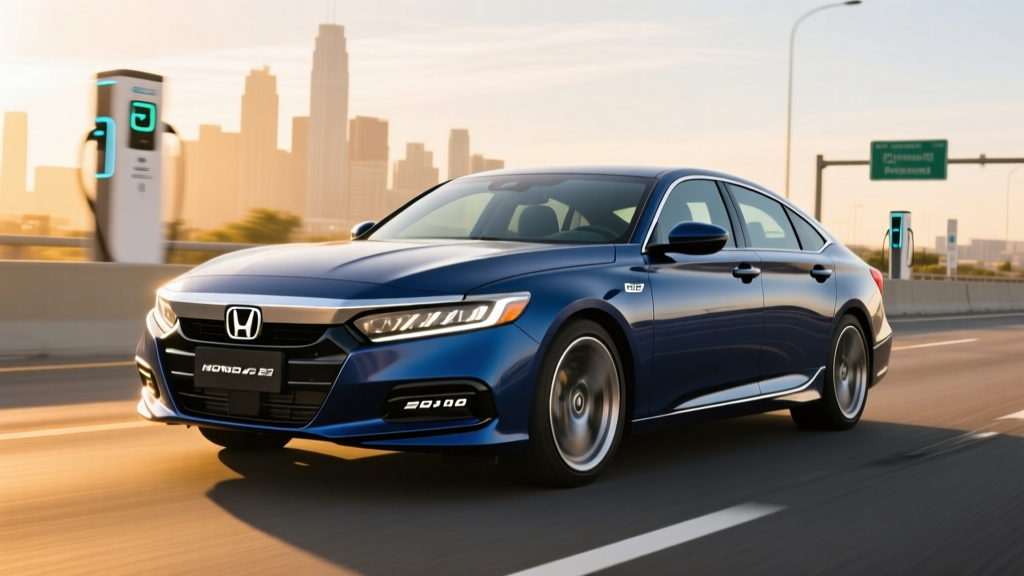
The Honda Accord Hybrid has long occupied a sweet spot in the midsize sedan segment: practical, efficient, and surprisingly willing when you merge onto a highway. But buyers researching the Accord Hybrid 0-60 time often find conflicting numbers scattered across forums and spec sheets. In this guide, we break down the 2026 Accord Hybrid's acceleration, fuel economy, powertrain engineering, and ownership costs — with exact figures, not marketing fluff — so you can decide whether this conventional hybrid (HEV) fits your daily driving.
| Spec | Value |
|---|---|
| Powertrain | 2.0L DOHC 4-cyl + two-motor hybrid system |
| Combined Horsepower | 204 hp |
| Combined Torque | 247 lb-ft (electric motor) |
| 0-60 mph | ~6.5 seconds |
| EPA MPG (City / Hwy / Combined) | 51 / 44 / 48 (Sport/LX trims) |
| EPA MPG (Sport-L / EX-L) | 48 / 41 / 44 combined |
| Fuel Tank | 12.8 gallons |
| Total Range | ~560–615 miles |
| Drivetrain | Front-wheel drive |
| Starting MSRP | $34,990 (Sport trim) |
| Hybrid Battery Warranty | 8 years / 100,000 miles (10 yr/150k mi in CARB states) |
Accord Hybrid 0-60 Time: How Quick Is It Really?
The 2026 Honda Accord Hybrid posts a 0-60 mph time of approximately 6.5 seconds based on independent instrumented testing. That figure places it squarely in the quicker half of the midsize hybrid sedan class — notably faster than the Toyota Camry Hybrid AWD (~7.1 seconds) and competitive with the Hyundai Sonata Hybrid (~6.8 seconds).
The secret to the Accord Hybrid's punch lies in its two-motor hybrid architecture. At lower speeds, the electric traction motor — producing 181 hp and 247 lb-ft of torque — does the bulk of the work, delivering the instant thrust characteristic of electric drivetrains. The 2.0-liter Atkinson-cycle gasoline engine primarily acts as a generator, spinning to feed electricity to the motor or charging the battery pack. Only at sustained highway cruising does the engine mechanically lock to the drivetrain via a clutch, operating in its most efficient RPM range.
In real-world driving, this means strong, linear acceleration from a stoplight and confident freeway merging. The e-CVT transmission eliminates the shift-shock of geared automatics, though some drivers note a slight drone under full-throttle acceleration as the engine holds a steady RPM. For a 3,500-pound sedan prioritizing 48 MPG, 6.5 seconds to 60 is genuinely quick.
Fuel Economy: EPA Ratings vs. Real-World MPG
The EPA rates the 2026 Accord Hybrid differently depending on trim and wheel size. According to fueleconomy.gov, the breakdown is:
| Trim | City | Highway | Combined | Wheels |
|---|---|---|---|---|
| LX / Sport | 51 MPG | 44 MPG | 48 MPG | 17-inch |
| Sport-L / EX-L | 48 MPG | 41 MPG | 44 MPG | 19-inch |
The 4 MPG combined penalty on larger 19-inch wheels is meaningful over a year of driving — roughly 35–40 extra gallons of fuel, or about $120–$150 at current prices. If efficiency is your priority, stick with the 17-inch wheel trims.
Real-World MPG: What Owners Actually See
Hybrids tend to exceed their EPA city ratings in stop-and-go driving, where regenerative braking recaptures energy and the engine stays off for extended stretches. Owners on fuel-tracking platforms routinely report 50–55 MPG in urban commuting conditions. Highway driving, however, often falls short of the EPA number — expect 40–43 MPG at 75 mph, since aerodynamic drag dominates and the electric motor assists less at sustained speed.
Cold weather reduces efficiency by roughly 5–10%, primarily because the gasoline engine must run more frequently to provide cabin heat (the Accord Hybrid uses engine coolant for warmth rather than a dedicated heat pump). In sub-40°F conditions, expect combined MPG to dip to the low-to-mid 40s.
Powertrain Deep Dive: Two-Motor Hybrid System
Honda's fourth-generation two-motor hybrid system is fundamentally different from the planetary-gear setups used in Toyota hybrids. Here is how it operates across three modes:
- EV Drive: Battery powers the traction motor; engine is off. Used at low speeds and light loads for short distances (typically under 1 mile on battery alone).
- Hybrid Drive: Engine spins a generator motor to produce electricity, which feeds the traction motor. The engine RPM is decoupled from vehicle speed, allowing it to operate at its most efficient point.
- Engine Drive: At highway cruising speeds (roughly 45–80 mph), a lock-up clutch mechanically connects the engine to the front wheels, bypassing the electric motors for maximum efficiency.
The lithium-ion battery pack in the Accord Hybrid is relatively small — approximately 1.06 kWh of usable capacity. This is by design: conventional hybrids (HEVs) do not need large batteries because they recharge continuously through regenerative braking and engine-generated electricity. The pack is sufficient to buffer energy for acceleration assist and to enable brief EV-only operation at low speeds.
HEV vs. PHEV vs. EV: Which Powertrain Is Right for You?
A common question from Accord Hybrid shoppers is whether they should consider a plug-in hybrid (PHEV) or a full battery-electric vehicle (BEV) instead. The Accord Hybrid is a conventional hybrid (HEV) — it has no plug, no electric-only range beyond a mile or so, and requires no change to your fueling habits. Here is how the three powertrain types compare for a typical buyer:
| Factor | HEV (Accord Hybrid) | PHEV (e.g., Prius Prime) | BEV (e.g., Tesla Model 3) |
|---|---|---|---|
| Plug-in charging needed? | No | Yes (for EV range) | Yes (always) |
| Electric-only range | ~1 mile (low speed) | 30–45 miles | 250–360+ miles |
| Home charging install | Not required | Recommended (Level 2) | Required (Level 2) |
| Federal tax credit (§30D) | Not eligible | Up to $7,500 (if eligible) | Up to $7,500 (if eligible) |
| Fuel cost per mile | ~$0.08 (at $3.50/gal) | ~$0.04 (electric) / $0.08 (gas) | ~$0.04 (electric) |
| Best for | No home charging; simple ownership | Short commute + road trips | Home charging + mostly under 300 mi/day |
Choose the Accord Hybrid (HEV) if you lack access to home or workplace charging, want zero change to your refueling routine, and prioritize proven reliability with minimal upfront cost.
Choose a PHEV if you can install a Level 2 charger at home, your daily commute is under 40 miles (covering most trips on electricity), and you still want a gas engine for longer road trips.
Choose a BEV if you have reliable home charging, your typical daily driving is well under 300 miles, and you want the lowest per-mile energy cost and zero tailpipe emissions.
Pricing, Trims, and Tax Credit Eligibility
The 2026 Honda Accord Hybrid is offered across four trims. Pricing below includes the destination charge:
- LX Hybrid: ~$34,990
- Sport Hybrid: ~$36,990
- Sport-L Hybrid: ~$39,500
- EX-L Hybrid: ~$41,500
Does the Accord Hybrid Qualify for a Federal Tax Credit?
No. Under current IRS §30D rules, the federal clean vehicle credit of up to $7,500 applies only to plug-in electric vehicles — battery-electric vehicles (BEVs) and plug-in hybrids (PHEVs) with a minimum battery capacity of 7 kWh. The Accord Hybrid's ~1.06 kWh battery and lack of plug-in capability make it ineligible for the federal credit.
Some states offer their own incentives for conventional hybrids, though these are increasingly rare as state programs shift focus to plug-in vehicles. Check your state's energy or environmental agency for current programs. The IRS §30D guidelines provide full federal eligibility details for plug-in vehicles if you are cross-shopping.
Reliability, Battery Lifespan, and Replacement Costs
Honda's hybrid system has accumulated well over a decade of real-world field data, and the Accord Hybrid's powertrain is among the most dependable in the midsize segment. The two-motor design uses fewer mechanical components than traditional transmissions — there are no conventional gear sets or torque converters to wear — and the Atkinson-cycle engine operates under relatively low stress.
Hybrid Battery Warranty and Replacement
Honda covers the Accord Hybrid's lithium-ion battery pack under its hybrid system warranty:
- Standard coverage: 8 years / 100,000 miles
- CARB states (CA, CO, CT, ME, MD, MA, NJ, NY, OR, RI, VT, WA): 10 years / 150,000 miles
The warranty guarantees the battery will retain sufficient capacity to function properly. If the pack degrades beyond Honda's threshold or fails, replacement is covered.
Out-of-warranty replacement cost: Approximately $2,000–$4,000 for a refurbished or new hybrid battery pack, plus labor. Independent hybrid battery specialists often offer reconditioned packs at the lower end of that range. Given that Honda hybrid batteries routinely last 150,000–200,000+ miles with minimal degradation, most original owners will never face this expense.
The broader hybrid system — including the electric motors, power control unit (inverter), and associated wiring — is also covered under the same warranty period. Honda's hybrid components have shown excellent longevity in long-term fleet data, with failure rates well below 2% within the warranty window.
How the Accord Hybrid Compares to Rivals
The midsize hybrid sedan field is competitive. Here is how the Accord Hybrid stacks up on the metrics buyers care about most:
| Model | 0-60 mph | Combined MPG | Combined HP | Starting MSRP |
|---|---|---|---|---|
| Honda Accord Hybrid | 6.5 sec | 48 / 44 | 204 hp | $34,990 |
| Toyota Camry Hybrid (FWD) | 7.2 sec | 52 | 225 hp | $33,495 |
| Hyundai Sonata Hybrid | 6.8 sec | 47 | 192 hp | $32,750 |
The Camry Hybrid leads on pure MPG (52 combined on FWD trims) and has a slightly lower starting price, but the Accord Hybrid counters with quicker acceleration, a more spacious rear seat (40.8 inches of legroom vs. 38.0), and a larger trunk (16.7 cu ft). The Sonata Hybrid undercuts on price and offers a strong warranty, though its interior materials and driving refinement trail the Honda.
For buyers prioritizing the quickest acceleration in a hybrid sedan, the Accord Hybrid's 6.5-second 0-60 time gives it a tangible edge. The electric motor's instant torque delivery makes it feel even quicker in city driving than the stopwatch suggests.
Pros
- Quick 6.5-second 0-60 with linear electric torque
- 48 MPG combined (LX/Sport) — outstanding for a 16-foot sedan
- No plug-in required; zero lifestyle change from a gas car
- Class-leading rear legroom and trunk volume
- Proven hybrid reliability with 8–10 year battery warranty
- Standard Honda Sensing ADAS suite (Level 2 driver-assist)
Cons
- No federal tax credit eligibility (HEV, not PHEV/BEV)
- 19-inch wheel trims lose 4 MPG combined
- Engine drone noticeable under hard acceleration
- No all-wheel-drive option (Toyota Camry Hybrid offers AWD)
- EV-only mode limited to under 1 mile at low speed
- Higher starting price than the Sonata Hybrid
Who Should Buy the Accord Hybrid?
The 2026 Accord Hybrid is the right choice if you want a midsize sedan that delivers near-50 MPG without requiring a charger, a lifestyle adjustment, or a premium price tag. It is particularly well-suited for:
- Apartment dwellers and street parkers who cannot install home charging equipment
- High-mileage commuters covering 15,000–25,000 miles per year who want to minimize fuel costs
- Road-trip enthusiasts who need 560+ miles of total range and quick refueling
- Buyers not ready for a plug-in vehicle but who want meaningful fuel savings over a pure gas powertrain
It is not the best pick if you have home charging available and a short commute — in that scenario, a PHEV or BEV will deliver lower per-mile energy costs and potential tax credits. Nor is it ideal if you need all-wheel drive for snow-belt winters; the Camry Hybrid AWD fills that niche.
Frequently Asked Questions
How many MPG does the 2026 Accord Hybrid get in real-world driving?
The EPA rates it at 51 city / 44 highway / 48 combined on LX and Sport trims with 17-inch wheels. In real-world urban commuting, many owners report 50–55 MPG thanks to frequent regenerative braking. Highway driving at 75+ mph typically yields 40–43 MPG. Expect cold-weather combined figures in the low-to-mid 40s.
What is the Accord Hybrid 0-60 time, and is it fast enough for highway merging?
Instrumented testing shows a 0-60 mph time of approximately 6.5 seconds. The electric motor delivers 247 lb-ft of torque from a standstill, providing strong initial acceleration. Highway merging and passing are confident — the Accord Hybrid is one of the quickest sedans in its hybrid class.
Does the Accord Hybrid need to be plugged in?
No. The Accord Hybrid is a conventional hybrid (HEV). Its small lithium-ion battery recharges through regenerative braking and the gasoline engine. You fuel it exactly like a regular gas car — there is no plug, no charging cable, and no electric-only range to manage.
Does the Accord Hybrid qualify for any federal tax credit?
No. The IRS §30D clean vehicle credit applies only to plug-in vehicles (BEVs and qualifying PHEVs). Because the Accord Hybrid cannot be plugged in and has a battery far below the 7 kWh minimum threshold, it does not qualify for the federal credit. Some states may offer minor hybrid incentives — check your state energy office.
How long will the Accord Hybrid battery last, and what does replacement cost?
Honda's hybrid battery warranty covers 8 years/100,000 miles (10 years/150,000 miles in CARB states). Real-world data suggests these batteries routinely last 150,000–200,000+ miles. If replacement is needed out of warranty, expect to pay $2,000–$4,000 for the battery pack, with refurbished options available at the lower end.
How does the Accord Hybrid compare to the Camry Hybrid?
The Camry Hybrid achieves slightly better fuel economy (52 combined vs. 48) and offers available AWD. The Accord Hybrid is quicker to 60 mph (6.5 vs. ~7.2 seconds), offers more rear legroom, and has a larger trunk. Both are excellent — the choice comes down to whether you prioritize maximum MPG (Camry) or a sportier, more spacious package (Accord).
Is the Accord Hybrid reliable?
Yes. Honda's two-motor hybrid system has a strong track record spanning multiple generations. The powertrain uses fewer wear-prone mechanical parts than a conventional automatic transmission, and the Atkinson-cycle engine runs under low stress. Long-term reliability ratings from owner surveys consistently place the Accord Hybrid near the top of its segment.