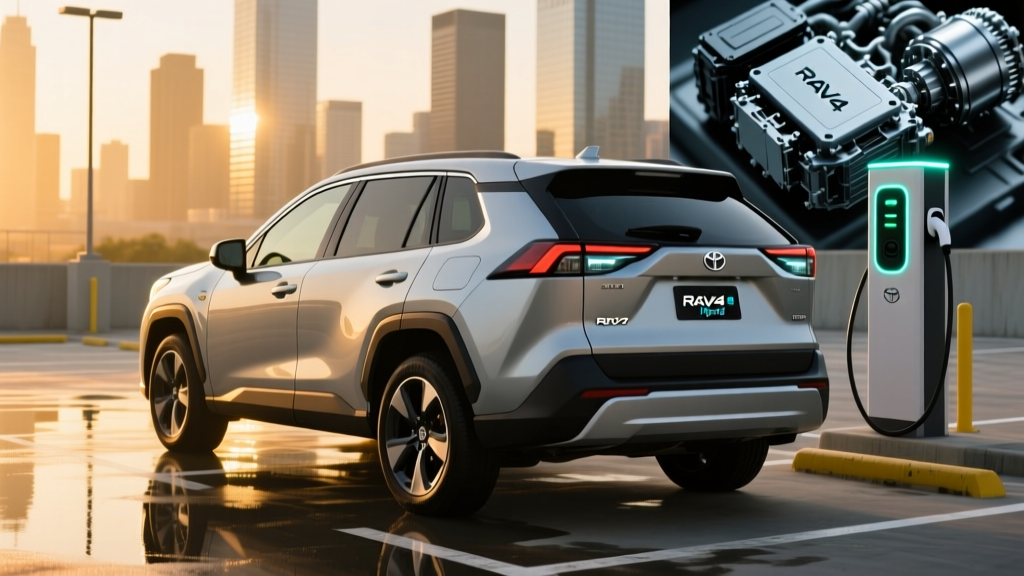
The Toyota RAV4 Hybrid has been America's best-selling hybrid SUV for years, and the 2027 Toyota RAV4 Hybrid arrives as part of the all-new sixth-generation RAV4 lineup. If you're researching this model, you likely have a stack of questions: What real-world MPG can you expect? Should you get the standard hybrid (HEV) or the plug-in hybrid (PHEV, badged as the RAV4 Prime)? And does either qualify for a federal tax credit?
This guide breaks down the 2027 RAV4 Hybrid with exact numbers — EPA fuel economy, powertrain output, battery warranty terms, and ownership economics — so you can decide whether it beats a full EV or a conventional gas crossover for your daily driving.
2027 Toyota RAV4 Hybrid: HEV vs. PHEV (Prime) at a Glance
Before diving into specs, let's clear up a common source of confusion. Toyota sells two electrified RAV4 variants:
RAV4 Hybrid (HEV)
- No plug required. The battery charges via regenerative braking and the gas engine.
- Smaller battery: ~1.6 kWh nickel-metal hydride (NiMH) traction pack.
- No electric-only driving range beyond low-speed creep (under 1 mile at very low speeds).
- Lower MSRP and no home charging infrastructure needed.
- Ideal for: Drivers who want maximum MPG without changing any habits.
RAV4 Prime (PHEV)
- Plugs in. Charges from a wall outlet or Level 2 charger.
- Larger battery: ~18.1 kWh lithium-ion traction pack.
- Electric-only range: EPA-estimated 42 miles before the gas engine engages.
- Higher MSRP but eligible for federal and some state incentives.
- Ideal for: Drivers with home charging who commute under 40 miles daily.
The conventional RAV4 Hybrid never needs to be plugged in. You fuel it like any gas car and the hybrid system handles energy recapture automatically. The RAV4 Prime gives you an electric commute buffer but reverts to hybrid operation once the battery is depleted.
Fuel Economy: EPA MPG and Real-World Expectations
Fuel economy is the headline reason buyers choose the RAV4 Hybrid. Here's how the 2027 lineup stacks up based on EPA testing data (source: fueleconomy.gov):
| Model | City MPG | Highway MPG | Combined MPG | Combined MPGe (PHEV EV mode) |
|---|---|---|---|---|
| 2027 RAV4 Hybrid (HEV) AWD | 41 | 38 | 39 | — |
| 2027 RAV4 Prime (PHEV) AWD | 40 (hybrid mode) | 36 (hybrid mode) | 38 (hybrid mode) | 94 MPGe |
Real-World MPG: What to Actually Expect
Toyota's hybrid system excels in stop-and-go city driving, where the electric motor handles low-speed propulsion and regenerative braking recaptures energy. In real-world testing, many RAV4 Hybrid owners report matching or slightly exceeding the EPA city figure of 41 MPG on suburban commutes with frequent stops.
Highway driving tells a different story. At sustained 70-80 mph speeds, the gas engine does most of the work, and real-world fuel economy typically drops to 34-36 MPG. Cold weather (below 35°F) further reduces efficiency by 5-10% due to increased engine runtime for cabin heating and reduced battery efficiency.
For the RAV4 Prime, the 42-mile electric-only range holds up well in moderate temperatures (50-80°F). Expect 32-36 miles of electric range in winter due to cabin heating load and reduced lithium-ion efficiency at low temperatures. Once the battery depletes, the Prime operates as a conventional hybrid at roughly 36-38 MPG combined.
Powertrain Specs: Horsepower, Engine, and Drivetrain
| Specification | RAV4 Hybrid (HEV) | RAV4 Prime (PHEV) |
|---|---|---|
| Engine | 2.5L 4-cylinder Atkinson cycle | 2.5L 4-cylinder Atkinson cycle |
| Combined System Horsepower | 219 hp | 302 hp |
| Electric Motors | 2 (front + rear, eAWD) | 2 (front + rear, eAWD) |
| Drivetrain | Electronic AWD (eAWD) | Electronic AWD (eAWD) |
| 0-60 mph | ~7.4 seconds | ~5.7 seconds |
| Transmission | eCVT | eCVT |
| Towing Capacity | 1,750 lbs | 1,750 lbs |
The RAV4 Prime's 302 combined horsepower makes it the quickest RAV4 Toyota sells — quicker, in fact, than many turbocharged gas crossovers in its class. The standard Hybrid's 219 hp is adequate for merging and passing, though it won't feel sporty. Both use Toyota's eAWD system, where a dedicated rear electric motor provides all-wheel-drive traction without a mechanical driveshaft, reducing weight and drivetrain losses.
RAV4 Prime (PHEV): Battery, Charging, and Electric Range
If you're considering the plug-in RAV4 Prime, charging logistics matter. Here are the key figures:
- Battery capacity: ~18.1 kWh lithium-ion (usable portion approximately 14-15 kWh)
- Electric-only range: EPA-estimated 42 miles
- Total combined range: ~520+ miles (electric + full gas tank)
- Level 1 charging (120V household outlet): ~12 hours from empty to full using the included 1.4 kW cordset
- Level 2 charging (240V): ~2.5 hours from empty to full at 6.6 kW (requires the optional upgraded onboard charger on some trims; base onboard charger is 3.3 kW / ~5.5 hours)
- DC fast charging: Not available. The RAV4 Prime does not support CCS or CHAdeMO DC fast charging.
The lack of DC fast charging is a deliberate engineering choice — the battery is small enough that Level 2 covers overnight needs, and adding DC hardware would increase cost and weight. For most Prime owners, a standard 240V Level 2 home charger is the optimal setup, delivering a full charge well before morning.
Pricing, Trims, and Tax Credit Eligibility
Based on Toyota's announced 2027 model-year positioning and prior-generation pricing trajectories:
- RAV4 Hybrid (HEV): Starting MSRP approximately $33,500-$35,000 (LE base), ranging up to ~$43,000 for fully loaded Limited/Woodland editions.
- RAV4 Prime (PHEV): Starting MSRP approximately $44,500-$46,000 (SE base), ranging up to ~$52,000 for XSE Premium.
Federal Tax Credit: Does the 2027 RAV4 Qualify?
Under current IRS §30D rules (source: irs.gov), the RAV4 Hybrid (HEV) does not qualify for the federal clean vehicle credit. Conventional hybrids without plug-in capability are excluded from §30D.
The RAV4 Prime (PHEV) may qualify for up to $7,500, but eligibility depends on several conditions that change periodically:
- MSRP cap: SUVs must have an MSRP at or below $80,000 (RAV4 Prime clears this easily).
- Buyer income cap: Modified adjusted gross income must not exceed $150,000 (single), $225,000 (head of household), or $300,000 (joint).
- Battery sourcing: A percentage of critical minerals and battery components must be sourced from the U.S. or free-trade-agreement countries — this requirement tightens annually and can disqualify otherwise eligible vehicles mid-year.
- Point-of-sale transfer: Eligible buyers can transfer the credit to the dealer at purchase, reducing the purchase price directly rather than waiting for a tax refund.
Always verify current eligibility on the IRS clean vehicle credit page and with your tax professional before purchasing. Battery sourcing requirements have disqualified several PHEVs in recent years with little advance notice.
Battery Warranty, Reliability, and Replacement Cost
Toyota Hybrid Battery Warranty
Hybrid battery: 10 years / 150,000 miles (whichever comes first) on 2020 and newer Toyota hybrids, covering capacity loss below a defined threshold and manufacturing defects.
Hybrid system components: 8 years / 100,000 miles (inverter, transaxle, control module).
Standard powertrain: 5 years / 60,000 miles.
Toyota's hybrid reliability record is among the strongest in the industry. The RAV4 Hybrid's NiMH battery pack is proven technology — Toyota has deployed similar packs in the Prius since 2000, with many exceeding 200,000 miles before significant degradation. Real-world failure data from owner communities and repair networks shows hybrid battery replacement rates under 5% within the first 10 years of service.
Battery Replacement Cost
If your hybrid battery fails outside warranty coverage:
- RAV4 Hybrid (HEV) NiMH replacement: $2,500-$4,000 (parts + labor at a dealership; independent hybrid specialists may offer refurbished packs for $1,500-$2,500).
- RAV4 Prime (PHEV) lithium-ion replacement: $6,000-$9,000 (larger, more complex pack; limited aftermarket options currently).
For context, most RAV4 Hybrid owners will sell or trade the vehicle long before the battery requires replacement. The 10-year/150,000-mile warranty provides coverage through the typical first- and second-ownership period.
RAV4 Hybrid vs. RAV4 Prime vs. Full EV: Which Fits Your Life?
Choose the RAV4 Hybrid (HEV) if:
- You don't have access to home or workplace charging.
- You want 39+ MPG combined with zero behavior changes.
- Budget is a priority — the HEV starts ~$10,000 below the Prime.
- You drive mostly city and suburban routes where the hybrid system shines.
Choose the RAV4 Prime (PHEV) if:
- You can install a Level 2 charger at home.
- Your daily commute is under 40 miles round-trip (mostly electric driving).
- You want 302 hp and the quickest acceleration in the RAV4 lineup.
- You qualify for the federal tax credit, narrowing the price gap with the HEV.
When a Full EV Makes More Sense
Consider a battery-electric SUV (like the Hyundai Ioniq 5, Tesla Model Y, or Toyota bZ4X) instead of either RAV4 variant if:
- You have reliable home Level 2 charging and your daily driving is under 250 miles.
- You want to eliminate gas expenses entirely (electricity at $0.14/kWh costs roughly $0.04/mile vs. $0.12-$0.14/mile for the RAV4 Hybrid at $3.50/gal).
- You're targeting the full $7,500 federal credit and your chosen EV qualifies under current sourcing rules.
- You rarely take road trips exceeding 300 miles without a planned charging stop.
The RAV4 Hybrid and Prime remain the better choice if you frequently drive long distances through areas with sparse charging infrastructure, tow regularly, or simply want the security of a gas tank for cross-country flexibility.
Ownership Economics: 5-Year Cost Snapshot
| Cost Factor (5 years / 75,000 mi) | RAV4 Hybrid (HEV) | RAV4 Prime (PHEV)* | Gas RAV4 (AWD) |
|---|---|---|---|
| Fuel / Electricity | ~$6,700 | ~$4,200 (mixed EV + gas) | ~$9,400 |
| Estimated Maintenance | ~$2,800 | ~$2,600 | ~$3,500 |
| Federal Tax Credit | $0 | Up to $7,500 (if eligible) | $0 |
| Estimated Insurance (avg) | ~$8,500 | ~$9,200 | ~$8,000 |
*PHEV fuel cost assumes 60% of miles driven on electricity at $0.14/kWh and 40% on gasoline at $3.50/gallon. Actual costs vary by electricity rate, driving pattern, and local fuel prices.
The RAV4 Hybrid saves roughly $2,700 in fuel over a gas-only RAV4 across 75,000 miles. The Prime narrows the gap further if you charge regularly and qualify for the tax credit — potentially offsetting most of its higher MSRP within the first few years of ownership.
Frequently Asked Questions
How many MPG does the 2027 Toyota RAV4 Hybrid get?
The 2027 RAV4 Hybrid (HEV) with AWD is EPA-rated at 41 city / 38 highway / 39 combined MPG. In real-world city and suburban driving, many owners match or slightly exceed 41 MPG. Highway-only driving at 75+ mph typically yields 34-36 MPG. The RAV4 Prime (PHEV) achieves 40/36/38 MPG in hybrid mode after the battery is depleted, plus 94 MPGe when operating on electricity.
How far can the RAV4 Prime go on electric only?
The 2027 RAV4 Prime offers an EPA-estimated 42 miles of electric-only range. In real-world conditions, expect 36-42 miles depending on temperature, terrain, and driving style. Winter driving with cabin heating reduces electric range to approximately 32-36 miles. After the battery depletes, the Prime operates as a standard hybrid with no range limitation beyond its 14.5-gallon fuel tank.
Do I need to plug in the RAV4 Hybrid?
No. The standard RAV4 Hybrid (HEV) has no plug and no electric-only driving range. Its small NiMH battery charges exclusively through regenerative braking and the gas engine. You fuel it at any gas station and drive normally. Only the RAV4 Prime (PHEV) requires plugging in to access its electric-only range — though it can also be driven without ever plugging in, operating as a conventional hybrid.
Is the RAV4 Hybrid reliable, and what does a battery replacement cost?
Toyota's hybrid powertrains are among the most reliable in the industry, with two decades of proven NiMH and lithium-ion hybrid battery deployments. The hybrid battery is covered by a 10-year/150,000-mile warranty. Out-of-warranty replacement costs approximately $2,500-$4,000 for the HEV and $6,000-$9,000 for the Prime's larger lithium-ion pack. Independent hybrid shops often offer refurbished packs at lower cost.
Does the 2027 RAV4 Hybrid qualify for a tax credit?
The conventional RAV4 Hybrid (HEV) does not qualify for the federal §30D clean vehicle credit — only plug-in vehicles are eligible. The RAV4 Prime (PHEV) may qualify for up to $7,500 depending on your income, the vehicle's battery sourcing compliance, and current IRS rules. Verify eligibility at irs.gov before purchasing, as battery component and critical mineral requirements tighten annually and can change a vehicle's eligibility status mid-year.
RAV4 Hybrid vs. a full EV — which should I choose?
Choose the RAV4 Hybrid if you lack home charging, frequently drive 300+ miles between stops, or want the lowest purchase price with strong fuel economy. Choose the RAV4 Prime if you have home charging and a short commute, want electric daily driving with gas backup, and qualify for the tax credit. Choose a full EV (like the Ioniq 5 or Model Y) if you have reliable home charging, want to eliminate gasoline entirely, and your longest regular trip is under 250 miles or along a well-served fast-charging corridor.