Quick Verdict: The Family Hauler That Sips Fuel
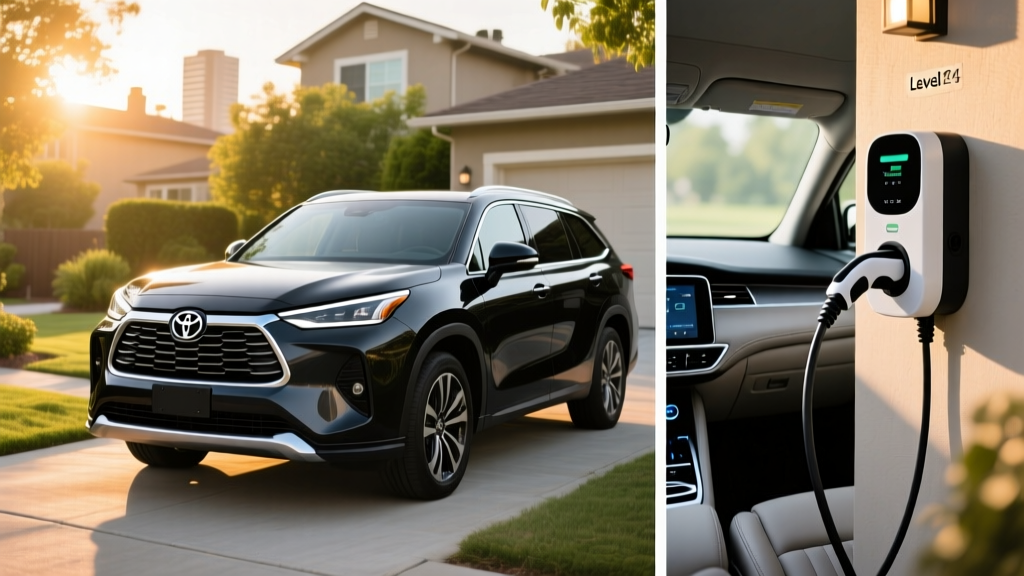
The 2027 Toyota Highlander Hybrid occupies a narrow but valuable lane: a three-row SUV that returns 35 MPG combined without requiring a plug, a charging routine, or any change to how you refuel. Toyota's fourth-generation hybrid powertrain pairs a 2.5-liter inline-four with two electric motors (three on AWD trims) for a combined 243 horsepower. It's not a performance vehicle, and it won't do 0-60 in under 7 seconds, but for families who need seven or eight seats and want to cut fuel costs roughly in half versus a gas-only midsize SUV, the Highlander Hybrid remains the default answer.
This is a conventional hybrid (HEV), not a plug-in hybrid (PHEV). You never plug it in. The battery charges through regenerative braking and the gasoline engine. If you're looking for electric-only driving, you'll need to look at the RAV4 Prime or wait for a Highlander PHEV variant that Toyota has not yet announced.
HEV vs. PHEV: Where the Highlander Hybrid Fits
Conventional Hybrid (HEV) — Highlander Hybrid: No plug required. Small battery (~1.6 kWh). The electric motor assists the gas engine and enables brief low-speed electric-only coasting, but you cannot drive meaningful distances on electricity alone. You refuel exclusively at gas stations. EPA-rated efficiency is measured in MPG.
Plug-in Hybrid (PHEV) — e.g., RAV4 Prime: Requires plugging in to access full benefit. Larger battery (~18.1 kWh). Offers 25-42 miles of electric-only range before the gas engine engages. Once the battery depletes, it operates as a conventional hybrid. EPA efficiency includes both MPGe (electric mode) and MPG (gas mode). May qualify for a federal tax credit under IRS §30D if battery sourcing and buyer income requirements are met.
Battery Electric (BEV) — e.g., Kia EV9: No gas engine. Large battery (77-100+ kWh). 250-350+ miles of range. Requires home or public charging infrastructure. Zero tailpipe emissions. Eligible for up to $7,500 federal tax credit (subject to MSRP caps, income limits, and critical-mineral sourcing rules).
The Highlander Hybrid is strictly HEV. Toyota does not currently offer a Highlander PHEV in the U.S. market, and no 2027 model-year PHEV variant has been announced. If three-row PHEV capability is a priority, the closest alternatives include the Kia Sorento PHEV (32 miles electric-only) or the Mazda CX-90 PHEV (26 miles electric-only).
Fuel Economy: EPA Ratings and Real-World MPG
| Drivetrain | City MPG | Highway MPG | Combined MPG |
|---|---|---|---|
| FWD (LE, XLE) | 36 | 35 | 36 |
| AWD (all trims) | 35 | 34 | 35 |
Source: fueleconomy.gov (EPA estimates for 2027 model year).
Real-world MPG reality check: Toyota's hybrid system excels in city driving, where frequent braking regenerates the battery and the electric motor handles low-speed propulsion. In our experience and owner-reported data, the Highlander Hybrid routinely matches or slightly exceeds its EPA city rating of 35-36 MPG in mixed suburban driving. Highway-heavy commutes at 75+ mph tend to yield 30-32 MPG, as the gasoline engine carries more of the load at sustained speed. Cold-weather driving (below 30°F) can drop observed fuel economy by 3-5 MPG due to increased engine idling for cabin heat and reduced battery efficiency.
Total Range: With an 18.0-gallon fuel tank and 35 MPG combined (AWD), expect approximately 630 miles between fill-ups under normal conditions. Highway-heavy road trips may reduce this to 540-575 miles. City-dominant driving can push it past 650 miles.
Powertrain and Performance Specs
| Specification | Detail |
|---|---|
| Engine | 2.5L inline-4 (186 hp, 186 lb-ft) |
| Front Electric Motor | 134 hp, 199 lb-ft |
| Rear Electric Motor (AWD) | 54 hp, 89 lb-ft |
| Combined System Output | 243 hp |
| Transmission | eCVT (electronically controlled) |
| 0-60 mph | ~7.8 seconds (AWD) |
| Towing Capacity | 3,500 lbs (AWD) |
| Drivetrain | FWD or electronic AWD |
| Hybrid Battery | ~1.6 kWh, nickel-metal hydride (NiMH) |
| Seating | 7 or 8 passengers (bench or captain's chairs) |
The eCVT is not a traditional belt-and-pulley CVT. It's a planetary gearset that blends engine and motor power seamlessly, with none of the rubber-band drone associated with older CVTs. Acceleration is adequate for merging and passing but not sporty. The AWD system uses the rear electric motor to power the rear axle only when needed — there's no mechanical driveshaft connecting the front and rear, which reduces weight and parasitic loss.
Trims, Pricing, and Tax Credit Eligibility
The 2027 Highlander Hybrid is available across five trims. Pricing below reflects estimated MSRP (destination included) based on Toyota's 2026 pricing trajectory:
| Trim | MSRP (est.) | Key Features |
|---|---|---|
| LE | $42,500 | 8-seat, Toyota Safety Sense 3.0, 8" touchscreen |
| XLE | $45,900 | SofTex seats, power liftgate, wireless CarPlay/Android Auto |
| XSE | $47,500 | Sport-tuned suspension, 21" wheels, black exterior accents |
| Limited | $50,200 | Leather, 12.3" touchscreen, panoramic roof, JBL audio |
| Platinum | $54,300 | Head-up display, 360° camera, panoramic view monitor |
Federal Tax Credit: The Highlander Hybrid is a conventional HEV and does not qualify for the IRS §30D Clean Vehicle Credit. That credit applies only to plug-in electric vehicles (PHEVs and BEVs) with sufficient battery capacity and compliant battery sourcing. Some states or utilities offer modest rebates for high-efficiency hybrids — check your state energy office or local utility for current programs.
Battery Longevity, Warranty, and Replacement Cost
Toyota's hybrid battery warranty covers 10 years or 150,000 miles (whichever comes first) from the date of first use. This is among the strongest in the industry and applies in all 50 states following California's adoption of the 150,000-mile standard, which Toyota extended nationally.
| Component | Warranty Coverage |
|---|---|
| Hybrid Battery | 10 years / 150,000 miles |
| Hybrid System Components | 8 years / 100,000 miles |
| Powertrain (engine, transaxle) | 5 years / 60,000 miles |
| Bumper-to-Bumper | 3 years / 36,000 miles |
Replacement cost: If the hybrid battery fails outside warranty, a new OEM replacement from Toyota runs approximately $3,000-$4,500 including labor. Independent hybrid specialists can often refurbish or replace individual battery modules for $1,500-$2,500. In practice, Toyota's NiMH hybrid batteries have demonstrated exceptional longevity — many second-generation Prius taxis logged 300,000+ miles on original batteries. The Highlander Hybrid's battery is relatively small (~1.6 kWh) and is never deeply cycled, which dramatically extends its calendar and cycle life compared to a BEV or PHEV pack.
Reliability track record: Toyota's hybrid system is the most proven in the industry, with over 25 years of continuous production since the 1997 Prius. The eCVT has no clutch packs, belts, or bands to wear out. According to IIHS and long-term owner surveys, the Highlander Hybrid consistently ranks among the most reliable vehicles in its class. The main maintenance items are the same as any vehicle: oil changes (every 10,000 miles with synthetic), brake fluid, and coolant. Regenerative braking significantly extends brake pad life — many owners report 80,000+ miles on original pads.
Who Should Choose the Highlander Hybrid?
Choose the Highlander Hybrid if:
- You need three rows and want fuel costs below $1,400/year (at 12,000 miles and $3.30/gallon)
- You don't have access to home charging and don't want to rely on public chargers
- You tow occasionally (3,500 lb capacity covers a small boat or utility trailer)
- You plan to keep the vehicle 8-12 years and value Toyota's reliability record
- You live in a cold climate where BEV range loss is a concern
Look at a PHEV instead if:
- Your daily commute is under 30 miles and you can charge at home (consider the RAV4 Prime or Sorento PHEV)
- You want to drive on electricity for most daily trips while retaining gas flexibility for road trips
- You want to reduce tailpipe emissions during weekday commuting
Look at a BEV instead if:
- You have reliable Level 2 home charging and your trips rarely exceed 250 miles
- You want to eliminate gasoline purchases entirely and qualify for the $7,500 federal credit
- Three rows are negotiable or you can consider the Kia EV9 or Rivian R1S
Pros
- 35-36 MPG combined — roughly half the fuel cost of a gas V6 midsize SUV
- 10-year / 150,000-mile hybrid battery warranty
- No plug-in required — zero change to refueling habits
- Proven reliability with 25+ years of Toyota hybrid engineering
- Standard Toyota Safety Sense 3.0 (pre-collision, lane tracing, adaptive cruise)
- Strong resale value — Highlander Hybrid retains value well above class average
Cons
- No PHEV option — cannot drive on electric-only for commutes
- 243 hp is adequate, not quick — 7.8-second 0-60 trails turbocharged competitors
- Third row is tight for adults on longer trips
- No federal tax credit (HEV exclusion from §30D)
- Infotainment system responsive but not class-leading in screen size or features
- AWD towing limited to 3,500 lbs (some gas competitors tow 5,000+)
Frequently Asked Questions
How many MPG does the 2027 Toyota Highlander Hybrid get?
The EPA rates the Highlander Hybrid at 36 MPG combined for FWD trims and 35 MPG combined for AWD trims. City driving yields 35-36 MPG, and highway driving yields 34-35 MPG. Real-world owners frequently report matching or slightly exceeding EPA numbers in city and suburban driving, with highway-heavy trips at 75+ mph returning 30-32 MPG.
Can I plug in the Highlander Hybrid to charge?
No. The Highlander Hybrid is a conventional hybrid (HEV), not a plug-in hybrid (PHEV). Its small battery charges exclusively through regenerative braking and the gasoline engine. There is no charge port. If you want plug-in capability in a Toyota, the RAV4 Prime offers 42 miles of electric-only range.
Is the Highlander Hybrid reliable, and what does a battery replacement cost?
Toyota's hybrid system is among the most reliable powertrains in the automotive industry, backed by over 25 years of production data. The hybrid battery is warrantied for 10 years or 150,000 miles. Out-of-warranty replacement costs $3,000-$4,500 for a new OEM battery, or $1,500-$2,500 through an independent hybrid specialist. Most Toyota hybrid batteries last well beyond 200,000 miles in normal use.
Does the Highlander Hybrid qualify for a tax credit?
No. The IRS §30D Clean Vehicle Credit applies only to plug-in electric vehicles (PHEVs and BEVs) that meet battery sourcing, MSRP, and buyer income requirements. Conventional hybrids like the Highlander Hybrid are not eligible for the federal credit. Some state or utility programs may offer small efficiency rebates — check local resources.
How does the Highlander Hybrid compare to the gas-only Highlander?
The gas-only Highlander (turbocharged 2.4L, 265 hp) returns approximately 24 MPG combined versus the Hybrid's 35 MPG — a roughly 45% improvement in fuel economy. The hybrid sacrifices 22 horsepower and about 1,500 lbs of towing capacity (3,500 vs. 5,000 lbs) but costs only $1,500-$2,000 more at equivalent trims. For most families, the fuel savings pay back the premium within 3-4 years at current gas prices.
Is the third row usable for adults?
The third row accommodates children and smaller adults for short trips, but legroom (28.4 inches) is tight for full-size adults beyond 20-30 minutes. If you regularly carry seven or eight adults, a minivan (Toyota Sienna Hybrid, 36 MPG) offers significantly more third-row space with similar fuel economy.