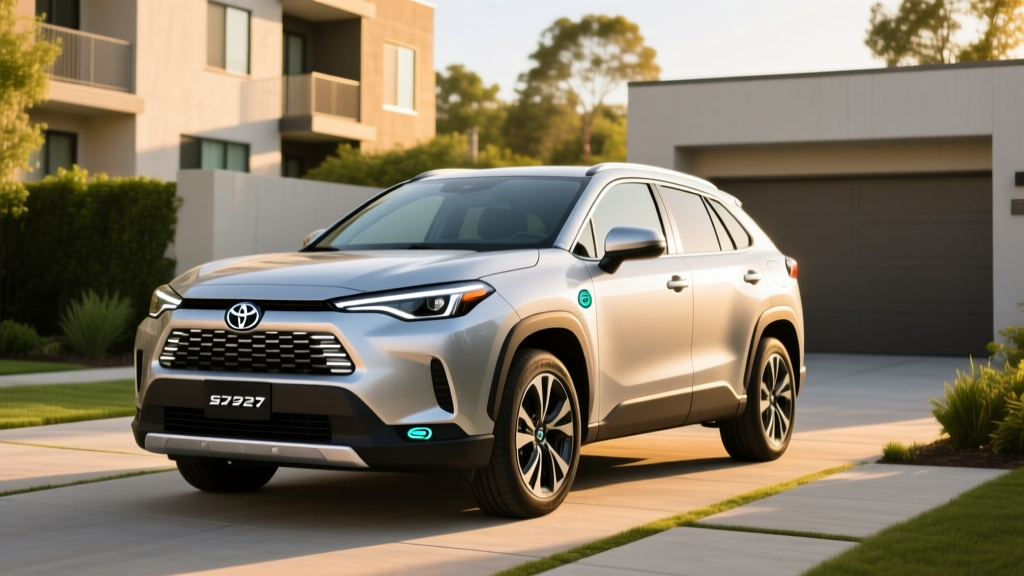
The Toyota Corolla Cross Hybrid occupies a specific niche that matters to a lot of buyers in 2027: a compact crossover that sips fuel without requiring a plug, a lifestyle change, or a six-figure budget. With the subcompact hybrid SUV segment growing rapidly, Toyota has kept the Corolla Cross Hybrid competitive by pairing its proven fifth-generation hybrid system with standard electronic all-wheel drive and practical cargo space. Below, we break down every spec that matters — from real-world MPG to powertrain architecture to long-term battery costs — so you can decide whether this hybrid fits your garage or whether a PHEV or full EV makes more sense.
HEV vs PHEV: What the Corolla Cross Hybrid Actually Is
Before examining the numbers, it's essential to understand what you're buying. The 2027 Toyota Corolla Cross Hybrid is a conventional hybrid electric vehicle (HEV), not a plug-in hybrid (PHEV). That distinction changes everything about how you use it.
| Feature | Corolla Cross Hybrid (HEV) | Typical Compact PHEV (e.g., Toyota RAV4 Prime) |
|---|---|---|
| Plug-in charging required? | No — self-charging via engine and regen | Yes — plug in for electric-only miles |
| Battery size | ~1.3 kWh (small buffer) | ~18.1 kWh usable |
| Electric-only range | Less than 1 mile at low speed | 42 miles EPA (RAV4 Prime) |
| Home charger needed? | No | Yes, Level 2 recommended |
| Federal tax credit (§30D) | Not eligible | Up to $7,500 if sourcing rules met |
| Driving behavior change | None — fill up with gas as usual | Plug in nightly for max EV benefit |
The Corolla Cross Hybrid recovers energy through regenerative braking and uses its gasoline engine to keep the small traction battery charged. You never plug it in. You never think about charging. You just drive it like a normal car and watch the fuel bills drop.
Fuel Economy: EPA Ratings and Real-World MPG
Fuel economy is the headline reason buyers choose this vehicle. For the 2027 model year, the Corolla Cross Hybrid carries over the powertrain that earned strong EPA ratings since its 2023 debut, with all trims featuring electronic AWD.
| Driving Cycle | EPA Rating | Real-World Expectation |
|---|---|---|
| City | 45 MPG | 46–50 MPG (hybrids excel in stop-and-go) |
| Highway | 38 MPG | 35–38 MPG (aerodynamic drag at 70+ mph) |
| Combined | 42 MPG | 40–44 MPG depending on driving mix |
According to fueleconomy.gov, the Corolla Cross Hybrid's 42 MPG combined rating places it among the most efficient AWD crossovers available. But the real story is the city number. Toyota's hybrid system shuts off the gasoline engine frequently in urban traffic, letting the electric motor handle low-speed propulsion. In real-world city commuting, many owners report exceeding the EPA city estimate — a rare phenomenon that's almost exclusive to hybrids.
Highway driving is a different story. At sustained speeds above 65 mph, the gasoline engine does most of the work, and the aerodynamic profile of a crossover creates more drag than a sedan. Expect highway fuel economy to settle around 35–38 MPG on road trips, which is still strong for the segment but noticeably lower than the city figure.
Powertrain and Performance Specs
The 2027 Corolla Cross Hybrid uses Toyota's fifth-generation hybrid architecture, which pairs a 2.0-liter four-cylinder engine with two motor-generators and an electronically controlled continuously variable transmission (eCVT). A third motor on the rear axle provides electronic all-wheel drive — there's no mechanical driveshaft connecting the front and rear axles.
| Specification | Value |
|---|---|
| Engine | 2.0L DOHC 4-cylinder (Atkinson cycle) |
| Engine output | 150 hp / 139 lb-ft torque |
| Front electric motor | 83 kW (111 hp) |
| Rear electric motor (AWD) | 30 kW (40 hp) |
| Net combined system horsepower | 196 hp |
| Transmission | eCVT (planetary gearset, no belt) |
| Drivetrain | Electronic AWD (standard all trims) |
| 0–60 mph | ~7.5 seconds (est.) |
| Towing capacity | Not rated for towing |
| Hybrid battery | ~1.3 kWh, lithium-ion |
| Fuel tank | 10.6 gallons |
| Fuel type | Regular unleaded (87 octane) |
The 196 combined horsepower figure represents a meaningful upgrade over the non-hybrid Corolla Cross (169 hp from a conventional 2.0L). The electric motors deliver instant torque from a stop, which makes the hybrid feel noticeably quicker in city driving than its gas-only sibling, even though the 0–60 time is only modestly improved. The eCVT uses a planetary gearset rather than a traditional belt-and-pulley CVT, which eliminates the "rubber-band" feel that older CVTs were known for.
Pricing, Trims, and Tax Credit Eligibility
Toyota offers the 2027 Corolla Cross Hybrid in three trims: S, SE, and XSE. Pricing has remained relatively stable, with modest year-over-year adjustments.
| Trim | MSRP (est.) | Key Features |
|---|---|---|
| S Hybrid | $29,990 | 8-inch touchscreen, Toyota Safety Sense 3.0, LED headlights, 17-inch alloy wheels |
| SE Hybrid | $31,490 | SofTex seats, heated front seats, wireless CarPlay/Android Auto, roof rails |
| XSE Hybrid | $33,690 | 18-inch wheels, JBL premium audio, power liftgate, ambient interior lighting |
Federal Tax Credit Status
The Corolla Cross Hybrid does not qualify for the federal §30D Clean Vehicle Credit. Under current IRS rules, the §30D credit applies only to plug-in electric vehicles (BEVs and PHEVs) with a minimum battery capacity of 7 kWh. Because the Corolla Cross Hybrid's battery is approximately 1.3 kWh and the vehicle cannot be plugged in, it falls outside the credit's scope entirely.
This is a common source of confusion. Conventional hybrids — no matter how efficient — are not eligible for the $7,500 federal credit. Some states may offer separate incentives for hybrid purchases, but these vary by jurisdiction and change frequently. Check your state's energy office or department of revenue for current programs.
Battery Warranty, Reliability, and Replacement Costs
Hybrid battery longevity is consistently the top concern among first-time hybrid buyers. Toyota has two decades of hybrid production experience (dating back to the 1998 Prius in Japan), and the data on battery durability is strong.
- Coverage: 10 years / 150,000 miles (whichever comes first)
- What's covered: Hybrid battery pack, hybrid control module, inverter, and related hybrid system components
- Capacity threshold: Toyota warrants the battery against defects and abnormal capacity loss — there is no published minimum State of Health (SoH) percentage, but dealerships will replace batteries that show significant degradation within the warranty period
- Transferability: Warranty transfers to subsequent owners automatically
Real-World Battery Longevity
Toyota's hybrid batteries are engineered for longevity rather than maximum energy density. The ~1.3 kWh pack in the Corolla Cross Hybrid operates within a narrow state-of-charge window — typically between 40% and 80% — which dramatically reduces stress on the cells. This "shallow cycling" strategy is why Toyota hybrid batteries routinely last well beyond 150,000 miles with minimal degradation.
Based on two decades of Prius fleet data, Toyota hybrid batteries commonly reach 180,000–250,000 miles before needing replacement. When replacement is necessary out of warranty, the cost for a Corolla Cross Hybrid battery pack is estimated between $2,500 and $4,000 (parts and labor) at a Toyota dealership. Independent hybrid specialists often offer refurbished packs for $1,500–$2,500.
Overall Reliability
Toyota consistently ranks among the top brands in long-term reliability surveys from Consumer Reports and J.D. Power. The hybrid powertrain actually has fewer wear components than a conventional gasoline powertrain — there's no traditional starter motor, no alternator, and the eCVT has no clutch packs or bands to wear out. Regenerative braking also extends the life of the friction brake pads, with many Toyota hybrid owners reporting original brake pads past 80,000 miles.
Who Should Choose the Corolla Cross Hybrid?
Choose the Corolla Cross Hybrid (HEV) if:
- You don't have access to home charging (apartment, street parking, no garage outlet)
- You want maximum fuel efficiency with zero behavior change — no plugging in, no range planning
- Your budget is under $35,000 and you want AWD
- You drive a mix of city and highway miles and want a vehicle that's efficient in both
- You prioritize long-term reliability and low maintenance costs
Choose a PHEV (e.g., Toyota RAV4 Prime, Hyundai Tucson PHEV) if:
- You can install a Level 2 home charger and want 30–42 miles of electric-only commuting
- Your daily commute is under 40 miles round-trip and you want to drive mostly on electricity
- You want eligibility for the §30D federal tax credit (up to $7,500, subject to income, MSRP caps, and battery sourcing rules)
Choose a Full EV (BEV) if:
- You have reliable home charging and want to eliminate gasoline entirely
- You want the lowest per-mile "fuel" cost (electricity at $0.12–0.16/kWh vs. gasoline at $3.20–$4.00/gal)
- You're eligible for the full §30D credit, which can offset the higher upfront price
- Your daily driving is under 250 miles and you're comfortable with DC fast charging on road trips
Corolla Cross Hybrid vs. the Competition
The compact hybrid crossover segment has expanded significantly. Here's how the Corolla Cross Hybrid stacks up against key rivals on the specs that matter.
| Spec | Toyota Corolla Cross Hybrid | Honda HR-V (non-hybrid) | Kia Niro Hybrid | Subaru Crosstrek Hybrid |
|---|---|---|---|---|
| Powertrain type | HEV (no plug) | Gasoline only | HEV (no plug) | PHEV (plug-in) |
| EPA combined MPG | 42 MPG | 28 MPG | 49 MPG (FWD) | 35 MPG + 17 mi EV |
| Horsepower | 196 hp | 158 hp | 139 hp | 148 hp |
| AWD | Standard | Optional | Not available | Standard |
| Starting MSRP | ~$29,990 | ~$26,400 | ~$28,590 | ~$35,345 |
| Cargo (rear seats up) | ~25 cu ft | ~24.4 cu ft | ~22.8 cu ft | ~20.8 cu ft |
The Kia Niro Hybrid beats the Corolla Cross on pure MPG (49 combined vs. 42), but it's front-wheel drive only and offers less cargo space. The Subaru Crosstrek Hybrid is a PHEV with electric-only range, but it costs roughly $5,000 more and delivers lower gas-only MPG once the battery is depleted. The Corolla Cross Hybrid's combination of standard AWD, strong horsepower, competitive pricing, and solid cargo volume makes it a balanced pick for buyers in snow-belt states who don't want to plug in.
Pros and Cons at a Glance
Pros
- 42 MPG combined with standard AWD — excellent efficiency for the class
- No plug-in required — zero lifestyle adjustment from a gas car
- 196 hp provides confident acceleration for merging and passing
- Toyota Safety Sense 3.0 standard on all trims (pre-collision, lane tracing, adaptive cruise)
- 10-year/150,000-mile hybrid battery warranty
- Strong resale value — Toyota hybrids historically depreciate slower than gas-only counterparts
- Regenerative braking extends brake pad life significantly
Cons
- Not eligible for the $7,500 federal §30D tax credit (HEV, not a PHEV/BEV)
- No electric-only driving range — the gas engine is always available
- Highway MPG drops to ~35–38 at sustained 70+ mph speeds
- Not rated for towing — not suitable for trailer or boat hauling
- Rear seat legroom is tighter than the RAV4 Hybrid or CR-V Hybrid
- Cargo area slightly compromised by hybrid battery packaging under the rear seat
Frequently Asked Questions
How many MPG does the 2027 Toyota Corolla Cross Hybrid get?
The EPA rates the Corolla Cross Hybrid at 45 MPG city, 38 MPG highway, and 42 MPG combined. In real-world driving, city commuters often exceed the EPA city figure thanks to frequent engine shutoff and regenerative braking. Highway-heavy drivers should expect 35–38 MPG at sustained speeds above 65 mph.
Does the Corolla Cross Hybrid need to be plugged in?
No. The Corolla Cross Hybrid is a conventional HEV, not a plug-in hybrid. It charges its small battery through regenerative braking and the gasoline engine. You fuel it with regular 87-octane gasoline like any other car.
How far can the Corolla Cross Hybrid drive on electric power alone?
Effectively less than one mile, and only at very low speeds (under 25 mph in ideal conditions). The hybrid system uses the electric motor to assist acceleration and enable brief engine-off coasting, but it is not designed for meaningful electric-only driving. If electric-only range is a priority, look at a PHEV like the Toyota RAV4 Prime (42 miles EV) or a full BEV.
Is the Corolla Cross Hybrid reliable, and what does a battery replacement cost?
Toyota's hybrid system has an extensive track record spanning 25+ years. The hybrid battery is covered by a 10-year/150,000-mile warranty. Out-of-warranty replacement costs are estimated at $2,500–$4,000 at a dealership, or $1,500–$2,500 through independent hybrid specialists. Based on long-term Prius and RAV4 Hybrid data, most Toyota hybrid batteries last 180,000–250,000 miles before significant degradation.
Does the Corolla Cross Hybrid qualify for any tax credits?
The Corolla Cross Hybrid does not qualify for the federal §30D Clean Vehicle Credit, which is limited to plug-in vehicles (BEVs and PHEVs) with at least 7 kWh of battery capacity. Some states may offer separate incentives for hybrid vehicles — check your state's energy or revenue department for current programs. The IRS §30D page has the definitive federal rules.
How does the Corolla Cross Hybrid compare to the RAV4 Hybrid?
The RAV4 Hybrid is larger, more powerful (219 hp), offers more cargo space (37.6 cu ft behind the rear seat), and is rated for 3,500 lbs of towing. It also starts about $4,000 higher. The Corolla Cross Hybrid is the right pick if you want a smaller, more affordable, and slightly more fuel-efficient crossover and don't need the extra space or towing capacity.
Is the eCVT in the Corolla Cross Hybrid the same as a regular CVT?
No. Toyota's eCVT uses a planetary gearset to blend power from the gasoline engine and electric motors. It has no belt, no pulleys, and no fixed gear ratios. This design is mechanically simpler and more durable than traditional belt-driven CVTs, and it avoids the "drone" associated with older CVT designs under hard acceleration.
The 2027 Toyota Corolla Cross Hybrid is a pragmatic choice for buyers who want crossover utility, standard AWD, and hybrid-level fuel economy without the complexity, cost, or charging requirements of a PHEV or full EV. Its 42 MPG combined EPA rating, 196 hp powertrain, and sub-$30,000 starting price make it one of the most accessible efficient crossovers on the market — and Toyota's long hybrid track record provides confidence that the efficiency gains will last well past the 10-year warranty window.