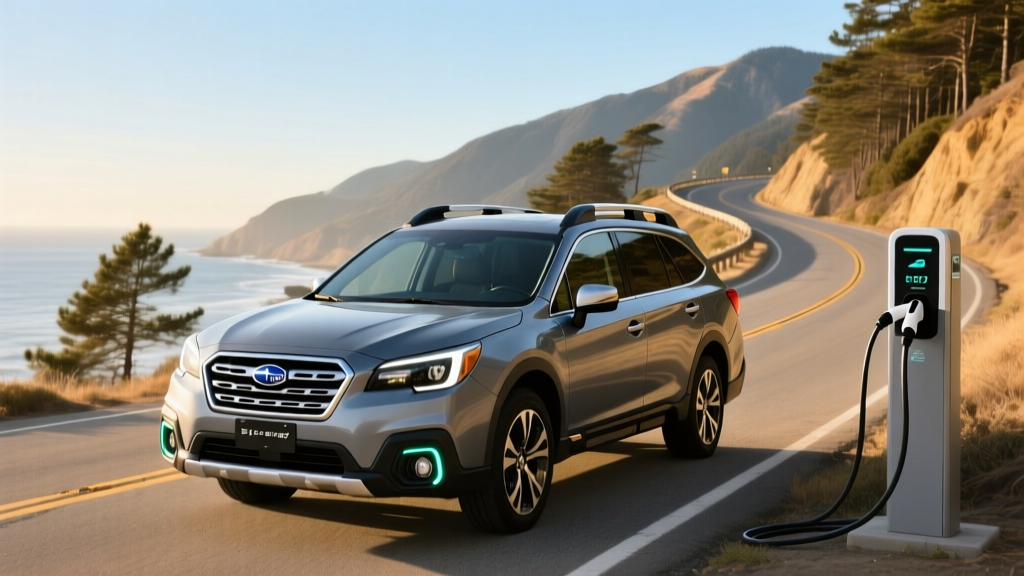
Subaru's next-generation Outback is expected to debut for the 2027 model year with a significant powertrain shift: a true hybrid system, and potentially a plug-in hybrid (PHEV) variant, replacing the aging e-Boxer setup that never gained serious traction in the U.S. market. With Toyota's hybrid expertise now available through the Subaru-Toyota partnership and growing pressure from CAFE standards, the 2027 Subaru Outback Hybrid could be the electrified wagon that loyal Subaru buyers have been waiting for. Here's everything we know — and what's still preliminary — about specs, pricing, and whether this hybrid will be worth the wait.
The 2027 Subaru Outback Hybrid has not been officially unveiled as of early 2026. Specs, pricing, and availability discussed below are based on industry reporting, Subaru-Toyota partnership disclosures, and analysis of comparable hybrid platforms. Final figures will be confirmed closer to the vehicle's launch, expected in late 2026 or early 2027.
Why Subaru Is Finally Going Hybrid on the Outback
Subaru has been one of the slowest mainstream automakers to electrify its core lineup. The current Outback offers no hybrid option in the U.S., and the Crosstrek Hybrid (a PHEV) was discontinued after the 2023 model year due to weak demand and limited electric range. But the landscape has shifted dramatically.
Subaru's partnership with Toyota — which deepened with the co-developed Solterra/bZ4X electric SUV — gives Subaru access to Toyota's world-class hybrid powertrain technology. Toyota's hybrid synergy drive system has been refined over 25+ years and powers millions of vehicles globally. Industry reports indicate Subaru is developing a new hybrid platform that leverages Toyota-sourced hybrid components paired with Subaru's signature boxer engine and symmetrical all-wheel drive.
The business case is clear: hybrid vehicles are outselling full EVs in many segments, buyers are wary of range limitations on wagons and SUVs meant for road trips, and federal CAFE standards are tightening. A hybrid Outback lets Subaru retain its adventure-ready identity — standard AWD, 8.7+ inches of ground clearance, rugged cladding — while delivering the fuel economy gains that current 2.5L and 2.4T Outback owners have been requesting for years.
HEV vs PHEV: What the 2027 Outback Hybrid Lineup Could Look Like
Subaru is expected to offer the 2027 Outback in at least one electrified variant, and possibly two. Understanding the difference is critical before you start comparing trims.
| Feature | Conventional Hybrid (HEV) | Plug-In Hybrid (PHEV) |
|---|---|---|
| Needs to plug in? | No — charges via regenerative braking and engine | Yes — plug in to access electric-only range |
| Battery size (estimated) | 1.0–1.5 kWh (small buffer) | 13–18 kWh (usable) |
| Electric-only driving | Minimal — assist only, ~1 mi at low speed | Estimated 25–35 miles |
| DC fast charging | Not applicable | Unlikely — most PHEVs are Level 2 AC only |
| Federal tax credit | No | Possible, depends on battery sourcing (§30D) |
| Price premium over gas | ~$1,500–$2,500 | ~$4,000–$6,000 |
Based on Subaru's current strategy and market positioning, the conventional hybrid (HEV) is more likely to arrive first and across more trims. A PHEV variant, if offered, would likely be limited to a single higher trim — similar to how Toyota positions the RAV4 Prime above the RAV4 Hybrid.
Projected Powertrain and Performance Specs
The most probable hybrid configuration for the 2027 Outback pairs Subaru's 2.5-liter boxer four-cylinder engine with one or two electric motors integrated into a revised CVT transaxle. If Subaru borrows from Toyota's hybrid architecture, expect a series-parallel system that can drive the wheels electrically at low speeds, blend engine and motor for acceleration, and recapture energy during braking.
| Specification | HEV (Estimated) | PHEV (Estimated) |
|---|---|---|
| Engine | 2.5L boxer-4 + electric motor(s) | 2.5L boxer-4 + electric motor(s) |
| Combined Horsepower | ~210–230 hp | ~260–300 hp |
| 0–60 mph | ~7.0–7.5 sec | ~5.5–6.5 sec |
| Drivetrain | Symmetrical AWD (standard) | Symmetrical AWD (standard) |
| Transmission | e-CVT (hybrid-optimized) | e-CVT (hybrid-optimized) |
| Towing Capacity | ~2,700–3,500 lbs | ~2,700–3,500 lbs |
| Ground Clearance | 8.7 in (expected) | 8.7 in (expected) |
The PHEV variant's higher combined output is typical of plug-in systems where a larger, more powerful electric motor supplements the gas engine. For reference, the Toyota RAV4 Prime PHEV produces 302 hp from a similar architecture. Subaru's boxer engine layout presents packaging challenges for the hybrid components, which is why the company has taken longer than competitors to bring this powertrain to market.
Fuel Economy: EPA MPG Estimates and Real-World Expectations
This is the number that matters most to hybrid shoppers. The current gas-only 2025 Subaru Outback 2.5L is rated at 26 city / 32 highway / 28 combined MPG according to fueleconomy.gov. A properly engineered hybrid should deliver a substantial improvement, especially in city driving where regenerative braking and electric assist shine.
| Powertrain | City MPG | Highway MPG | Combined MPG |
|---|---|---|---|
| 2025 Outback 2.5L (gas, AWD) | 26 | 32 | 28 |
| 2027 Outback HEV (estimated) | 35–38 | 34–37 | 35–37 |
| 2027 Outback PHEV (charge-sustaining, estimated) | 33–36 | 33–36 | 33–35 |
Real-world MPG note: Hybrids consistently exceed their EPA city ratings in stop-and-go traffic because regenerative braking recaptures energy that gas cars waste as heat. On the highway, the advantage narrows because the engine runs more continuously. Expect the Outback HEV to deliver 37–40 MPG in suburban and city driving, with highway figures closer to the EPA sticker or slightly below at sustained speeds above 70 mph. Cold weather will reduce MPG by roughly 10–15% due to reduced battery efficiency and increased engine idling for cabin heat — a meaningful factor for Outback buyers in northern climates.
For the PHEV variant, the electric-only range matters more than MPG for daily commuting:
Based on a projected 13–18 kWh usable battery and the Outback's weight and aerodynamics, a PHEV variant should cover most daily commutes on electricity alone. Total combined range (electric + gas tank) is projected at 450–520+ miles. For comparison, the discontinued Crosstrek Hybrid offered only 17 miles of electric range on a 8.8 kWh battery — a major reason it struggled in the market.
Charging the PHEV: What You Need to Know
If Subaru offers a PHEV Outback, charging logistics will be straightforward for most buyers but come with one notable limitation.
| Charging Level | Power | Full Charge Time | Notes |
|---|---|---|---|
| Level 1 (120V household outlet) | ~1.4 kW | 10–14 hours | Overnight, adequate for small battery |
| Level 2 (240V home/public) | ~3.3–6.6 kW | 2.5–5 hours | Recommended for daily use |
| DC Fast Charging | N/A | N/A | Not expected — typical for PHEVs |
Most PHEVs on the market — including the Toyota RAV4 Prime and Hyundai Tucson PHEV — do not support DC fast charging. The battery is small enough that Level 2 charging refills it in a few hours, which covers overnight and workplace charging scenarios. A standard 120V outlet will technically work but takes all night. If you plan to buy the PHEV variant, budget $500–$1,500 for a dedicated 240V Level 2 home charger installation (a licensed electrician should evaluate your panel capacity first).
The conventional HEV requires no charging infrastructure whatsoever — it charges its small battery entirely through regenerative braking and the gas engine. You simply fill up at a gas station as usual.
Pricing, Trims, and Tax Credit Eligibility
Subaru has not announced pricing for the 2027 Outback Hybrid, but we can build reasonable estimates from current Outback pricing and hybrid premiums across the industry.
| Trim / Variant | Estimated MSRP | Notes |
|---|---|---|
| Outback HEV (base, likely Premium trim) | $34,000–$36,000 | ~$2,000 premium over gas equivalent |
| Outback HEV (Limited/Touring) | $38,000–$43,000 | Higher trims, more features |
| Outback PHEV (if offered) | $42,000–$46,000 | Significant premium, limited trims |
Federal Tax Credit: The §30D Question
The conventional hybrid (HEV) does not qualify for any federal tax credit. The IRS §30D Clean Vehicle Credit applies only to plug-in electric vehicles — BEVs and PHEVs — with specific requirements around battery sourcing, MSRP caps, and buyer income limits.
If Subaru offers a PHEV Outback, it could qualify for up to $7,500 under §30D, but several conditions must be met:
- MSRP cap: The vehicle's MSRP must not exceed $80,000 for SUVs/wagons (the Outback should clear this easily).
- Buyer income cap: Modified adjusted gross income must not exceed $150,000 (single), $225,000 (head of household), or $300,000 (joint filing).
- Battery sourcing: Critical minerals and battery components must meet phased percentage thresholds from U.S. or FTA-partner countries. This is the hardest requirement — and the reason many PHEVs and EVs have lost eligibility in recent years. Check the IRS qualified vehicles list for the 2027 Outback PHEV once it's published.
- Point-of-sale transfer: Under current rules, you can transfer the credit to the dealer at purchase for an immediate price reduction, rather than waiting to claim it on your tax return.
Bottom line: Do not assume the PHEV Outback will qualify for the full credit until Subaru confirms battery sourcing compliance and the IRS lists the vehicle. Tax rules are subject to change — consult a tax professional before making a purchase decision based on credit eligibility.
Battery Warranty, Reliability, and Replacement Costs
Hybrid battery longevity is consistently the top concern for first-time hybrid buyers. The good news: modern hybrid batteries are engineered to last the life of the vehicle, and federal law mandates minimum warranty coverage.
HEV: Expect 8 years / 100,000 miles minimum (federal mandate for hybrid components). Subaru may extend to 10 years / 150,000 miles, as Toyota does.
PHEV: Same 8/100,000 minimum, with capacity retention guarantees typically set at 70% of original capacity over the warranty period.
Replacement cost (out of warranty): HEV battery pack: ~$2,000–$4,000. PHEV battery pack: ~$6,000–$10,000. These are estimates based on comparable Toyota and Hyundai hybrid systems; Subaru-specific pricing will depend on the final pack design.
Toyota's hybrid systems — which the Outback HEV may partially share — have demonstrated exceptional real-world longevity. Taxi fleets running Toyota Camry and Prius hybrids routinely exceed 300,000 miles on original battery packs. The smaller battery in a conventional HEV undergoes shallow charge cycles (never fully depleting or fully charging), which dramatically extends cell life compared to a full EV or PHEV battery that sees deeper cycles.
For the PHEV variant, battery degradation is more relevant because you'll cycle through a larger portion of the battery's capacity daily. Expect 85–90% capacity retention after 5 years of typical use, based on data from comparable PHEV systems. This still leaves ample electric-only range for commuting.
Subaru's overall reliability reputation is mixed — the brand has had issues with CVT transmissions and head gaskets in older models — but the hybrid powertrain components sourced from Toyota should carry that supplier's proven track record. Check IIHS for crash-test ratings once the 2027 Outback is tested.
Who Should Choose the Outback Hybrid vs a Full EV or Gas Model
The right choice depends on your driving patterns, charging access, and budget. Here's a practical decision framework:
- You want better fuel economy without changing your refueling habits
- You don't have access to home or workplace charging
- You regularly take long road trips into areas with sparse charging infrastructure
- You want the lowest upfront cost among electrified options
- You live in a cold climate where EV range loss is a concern
- Your daily commute is under 30 miles round-trip and you can charge at home
- You want electric-only commuting but need gas flexibility for weekend trips
- You qualify for the federal tax credit, offsetting the price premium
- You want the strongest acceleration (PHEV typically offers the most combined HP)
- You have reliable home Level 2 charging
- Your daily driving is under 200 miles and you rarely take road trips over 300 miles
- You want the lowest per-mile fuel cost and minimal maintenance
- You want to eliminate gas station visits entirely
- The hybrid price premium doesn't pencil out for your annual mileage (under 10,000 miles/year)
- You plan to keep the vehicle under 3 years (insufficient time to recoup the premium through fuel savings)
- You want maximum trim and option flexibility at the lowest entry price
What We're Still Waiting to Confirm
Until Subaru officially unveils the 2027 Outback, several key details remain unknown:
- Whether the hybrid will be a mild hybrid (48V system, minimal electric assist) or a full hybrid (Toyota-style series-parallel)
- Exact battery capacity and chemistry (LFP vs NMC for the PHEV, if offered)
- Whether a Wilderness trim will be available with the hybrid powertrain
- Final EPA fuel economy ratings and electric-only range for the PHEV
- Federal tax credit eligibility and battery sourcing compliance
- Whether Subaru will offer the hybrid globally or limit it to specific markets
We'll update this article with confirmed specifications as soon as Subaru releases official data. In the meantime, the hybrid Outback represents one of the most anticipated vehicles in Subaru's lineup — a wagon that could finally deliver the fuel economy its buyers want without sacrificing the all-weather capability that defines the brand.
Frequently Asked Questions
How many MPG will the 2027 Subaru Outback Hybrid get?
Based on comparable hybrid wagons and SUVs, we project the Outback HEV at 35–37 MPG combined (EPA estimated), with real-world city driving potentially reaching 38–40 MPG. This would represent a 25–32% improvement over the current gas-only Outback's 28 MPG combined.
Will the 2027 Outback Hybrid be a plug-in?
Subaru is expected to offer at least a conventional hybrid (HEV) that does not plug in. A plug-in hybrid (PHEV) variant is possible but not confirmed. The HEV charges its battery entirely through regenerative braking and the gas engine — no plug required.
How far can the Outback PHEV drive on electric only?
If a PHEV variant is offered, we estimate 25–35 miles of electric-only range based on the expected battery size and vehicle weight. This covers most daily commutes. Once the battery is depleted, the vehicle operates as a conventional hybrid with no range limitation beyond the gas tank.
Is the hybrid Outback reliable? What about battery replacement cost?
If Subaru uses Toyota-sourced hybrid components, reliability should be excellent — Toyota's hybrid systems have a 25-year track record of longevity. Hybrid battery replacement cost is estimated at $2,000–$4,000 for the HEV and $6,000–$10,000 for the PHEV, but most hybrid batteries outlast 150,000+ miles and are covered by an 8-year/100,000-mile federal warranty minimum.
Does the 2027 Outback Hybrid qualify for a tax credit?
The conventional hybrid (HEV) does not qualify for any federal tax credit. A PHEV variant could qualify for up to $7,500 under IRS §30D, but only if it meets battery sourcing, MSRP, and buyer income requirements. Check the IRS qualified vehicle list once the 2027 Outback is released. State incentives may also apply — check your state's energy office for current programs.
When will the 2027 Subaru Outback Hybrid be available?
Subaru has not announced an exact release date. Based on typical model-year cadences, a late 2026 or early 2027 dealership arrival is most likely. Official specs and pricing should be revealed several months before vehicles reach showrooms.