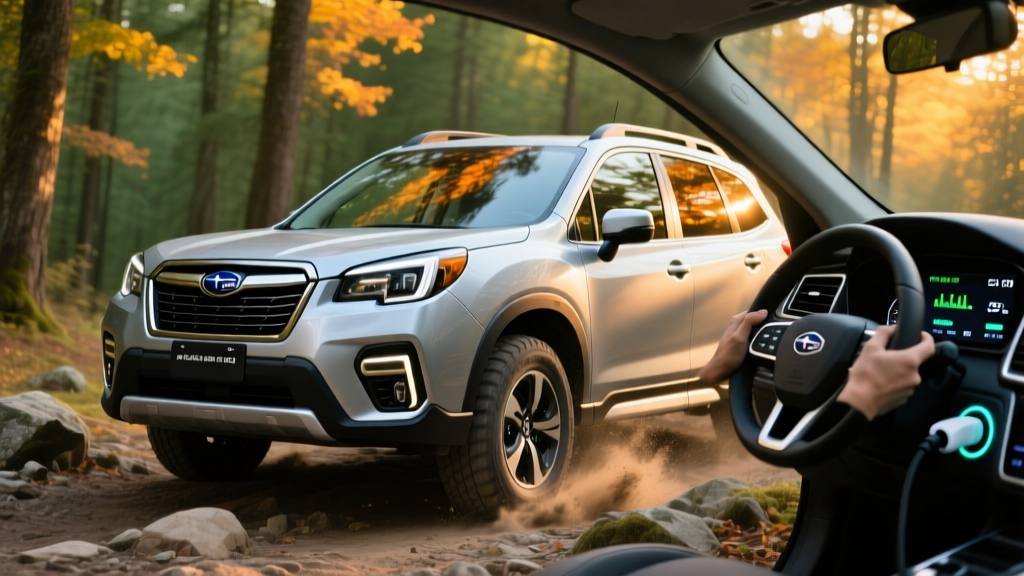
The Subaru Forester Wilderness has built a loyal following among buyers who want genuine off-road capability without sacrificing daily-driver comfort. Now, Subaru is bringing its latest hybrid powertrain to the Wilderness trim for the 2027 model year — a move that promises better fuel economy on the trail and around town while retaining the rugged hardware that defines the badge. But does adding a hybrid system compromise the Wilderness formula, or does it make a good thing even better?
This guide breaks down everything we know about the 2027 Subaru Forester Wilderness hybrid, from EPA fuel-economy estimates and real-world MPG expectations to powertrain specs, pricing, and tax-credit eligibility. We'll also explain exactly what kind of hybrid this is — and why that distinction matters for your wallet and your weekend plans.
HEV vs PHEV: What Kind of Hybrid Is the Forester Wilderness?
Let's clear up the most common source of confusion right away. The 2027 Forester Wilderness uses a conventional hybrid (HEV) powertrain, not a plug-in hybrid (PHEV). Here's what that means in practical terms:
| Feature | Conventional Hybrid (HEV) | Plug-In Hybrid (PHEV) |
|---|---|---|
| Plugs into a wall outlet? | No — refuels at gas stations only | Yes — has a charge port for grid electricity |
| Electric-only driving range | Less than 1 mile at low speeds | Typically 20–40 miles on battery alone |
| Battery size | ~1.1 kWh (small, self-charging) | 13–20 kWh (larger, grid-chargeable) |
| Federal EV tax credit (§30D) | Not eligible | Up to $7,500 if requirements met |
| Primary benefit | Better MPG with zero lifestyle change | Short commutes on electricity, gas for longer trips |
The Forester Wilderness HEV charges its small battery through regenerative braking and the gasoline engine. You will never plug it in, and you don't need to install a home charger. You simply fill up at the pump as you always have — the hybrid system works invisibly in the background to reduce fuel consumption.
Fuel Economy: EPA MPG and Real-World Expectations
Subaru's latest hybrid system pairs a 2.5-liter flat-four engine with an electric motor integrated into the transmission. Based on Subaru's published preliminary specifications and EPA testing methodology, here's what the 2027 Forester Wilderness hybrid delivers:
| Driving Cycle | EPA Estimate | Real-World Expectation |
|---|---|---|
| City | 35 MPG | 33–37 MPG (hybrids often beat EPA in stop-and-go) |
| Highway | 30 MPG | 27–30 MPG (aerodynamic drag and AT tires reduce efficiency) |
| Combined | 33 MPG | 30–34 MPG depending on driving mix |
For context, the outgoing gas-only Forester Wilderness returns an EPA-rated 25 MPG combined. That's an improvement of roughly 8 MPG combined — meaningful savings over the life of the vehicle, especially if your commute involves significant city or suburban driving where hybrid systems shine brightest.
Why Real-World MPG Varies
Hybrid vehicles typically exceed their EPA city estimates because regenerative braking recovers energy that a gas-only vehicle wastes as heat. In stop-and-go traffic, the electric motor handles low-speed propulsion while the engine shuts off at stops. On the highway, however, the Forester Wilderness's all-terrain tires, raised ride height, and boxy profile create aerodynamic drag and rolling resistance that work against efficiency. Expect highway MPG to land at or slightly below the EPA sticker.
Cold weather also affects hybrid fuel economy. In sub-freezing temperatures, the engine runs more frequently to provide cabin heat and maintain battery temperature, reducing the hybrid system's ability to shut the engine off. Plan for a 5–10% MPG reduction in winter months — a pattern consistent across all hybrid vehicles, not unique to Subaru.
Powertrain Specs: Engine, Motor, and Combined Output
| Specification | Detail |
|---|---|
| Engine | 2.5L SUBARU BOXER 4-cylinder |
| Engine horsepower | 180 HP |
| Electric motor output | ~29 HP (integrated in transmission) |
| Combined system output | ~194 HP |
| Transmission | Lineartronic CVT with manual mode |
| Drivetrain | Symmetrical All-Wheel Drive (enhanced for hybrid) |
| Battery type | Lithium-ion, ~1.1 kWh (self-charging) |
| 0–60 MPH (est.) | ~8.5 seconds |
| Towing capacity | 3,000 lbs (preliminary) |
| Ground clearance | 9.2 inches |
The electric motor fills in torque at low RPMs where the naturally aspirated 2.5-liter engine is weakest, giving the Wilderness hybrid noticeably stronger acceleration from a stop than the gas-only version. Subaru has recalibrated the AWD system to work with the hybrid powertrain, distributing torque between the front and rear axles as conditions demand. The X-MODE off-road driving system carries over, with Snow/Dirt and Deep Snow/Mud settings that modulate throttle response, transmission behavior, and brake-based traction control.
One important note: the hybrid battery is small by design. It cannot propel the vehicle on electric power alone for meaningful distances. Think of the motor as an assist — it smooths out acceleration, enables engine stop-start, and recovers braking energy. This is fundamentally different from a PHEV or full EV, where the electric motor is the primary propulsion source.
Off-Road Capability: Does Hybrid Hurt the Wilderness Badge?
The Wilderness trim exists to go places other crossovers won't. Subaru has confirmed the hybrid variant retains the key hardware that separates the Wilderness from a standard Forester:
- 9.2 inches of ground clearance — unchanged from the gas model
- All-terrain tires — Yokohama Geolandar all-terrain rubber on 17-inch wheels
- Revised suspension tuning — longer-travel dampers for rough terrain articulation
- Dual-function X-MODE — with hill descent control and low-speed traction management
- Enhanced underbody protection — skid plates for the engine and transmission
- Matte-black cladding and copper-finish tow hooks — the visual Wilderness signature
The hybrid battery pack is mounted low in the chassis, which actually benefits the Wilderness by slightly lowering the center of gravity. Approach, departure, and breakover angles remain competitive with the gas-only model. Subaru engineers have also ensured the hybrid system's thermal management can handle sustained low-speed crawling — a scenario where some early hybrid systems struggled in off-road applications.
Pricing, Trims, and Tax Credit Eligibility
Subaru has announced the 2027 Forester Wilderness hybrid with preliminary pricing. Here's what buyers can expect:
| Item | Amount |
|---|---|
| Base MSRP (Wilderness Hybrid) | $37,495 (preliminary, including destination) |
| Premium over gas-only Wilderness | ~$1,500–$2,000 |
| Popular options package | +$1,200–$2,500 |
| Typical as-tested price | $38,500–$41,000 |
Federal Tax Credit: Does It Qualify?
The 2027 Subaru Forester Wilderness hybrid is a conventional hybrid (HEV), which means it does not qualify for the federal §30D Clean Vehicle Credit. That credit — worth up to $7,500 — applies only to plug-in electric vehicles (BEVs and PHEVs) that meet battery-sourcing, critical-mineral, MSRP, and buyer income requirements as outlined by the IRS.
However, conventional hybrids may still qualify for:
- State or local incentives — some states offer rebates or HOV-lane access for hybrid vehicles. Check your state's energy or DMV website for current programs.
- Employer or utility incentives — some companies and electric cooperatives offer purchase bonuses for fuel-efficient vehicles.
- Lower total fuel cost — at 33 MPG combined vs. 25 MPG for the gas model, the hybrid saves roughly $400–$600 per year in fuel (based on 15,000 miles/year and $3.50/gallon), recovering the hybrid premium in approximately 3–4 years.
For buyers specifically seeking a federal tax credit, Subaru does not currently offer a PHEV variant of the Forester. Buyers wanting plug-in capability would need to look at competing PHEV crossovers or consider Subaru's planned future electrified offerings.
Battery Warranty, Reliability, and Replacement Costs
Hybrid Battery Warranty
Subaru covers the Forester Wilderness hybrid battery under its standard hybrid-component warranty: 8 years or 100,000 miles (whichever comes first). In states that follow California Air Resources Board (CARB) emissions standards — including California, New York, Massachusetts, and several others — hybrid battery coverage extends to 10 years or 150,000 miles.
How Long Will the Battery Last?
The Forester Wilderness hybrid uses a small ~1.1 kWh lithium-ion battery that operates within a narrow state-of-charge window — typically between 40% and 80%. This shallow cycling is far less stressful on battery cells than the deep discharge cycles seen in full EVs, which is why hybrid batteries routinely last well beyond their warranty periods.
Toyota's hybrid systems (the most widely deployed in the US) have demonstrated battery lifespans exceeding 15 years and 200,000+ miles in real-world fleet data. While Subaru's hybrid system is newer and has less long-term track record, the engineering principles are similar: small battery, shallow cycles, active thermal management. Most hybrid owners will never need a battery replacement during their ownership.
Replacement Cost If Needed
If a hybrid battery replacement is required outside warranty, expect costs in the range of $2,000–$4,000 including parts and labor at a Subaru dealer. Because the battery pack is small, replacement costs are significantly lower than full EV battery replacements, which can exceed $10,000–$20,000. Third-party hybrid battery refurbishment services may offer lower-cost alternatives, though Subaru-authorized replacement ensures warranty continuity.
Subaru's overall vehicle warranty also includes:
- Basic coverage: 3 years / 36,000 miles
- Powertrain coverage: 5 years / 60,000 miles (engine, transmission, AWD components)
- Hybrid system components: 8 years / 100,000 miles (10/150k in CARB states)
Who Should Choose the Forester Wilderness Hybrid?
Reasons to Choose the Forester Wilderness Hybrid
- You want better fuel economy without changing your fueling habits (no plug-in required)
- Your driving includes substantial city or suburban miles where hybrid efficiency peaks
- You need genuine off-road capability — ground clearance, AWD, all-terrain tires
- You value the low-speed electric torque assist for trail crawling
- You plan to keep the vehicle 5+ years, maximizing fuel savings to offset the hybrid premium
Reasons to Look Elsewhere
- You want electric-only driving for short commutes (consider a PHEV like the Toyota RAV4 Prime)
- You want to qualify for the $7,500 federal EV tax credit (requires a BEV or PHEV)
- You primarily drive long highway miles where hybrid advantages are smaller
- You need more than 194 HP for towing or performance priorities
- You want a full EV with zero tailpipe emissions and lowest per-mile operating cost
Hybrid vs PHEV vs EV: Which Fits Your Lifestyle?
Choose the HEV (Forester Wilderness Hybrid) if you don't have access to home or workplace charging, you want zero change to your refueling routine, and your priority is better MPG with off-road capability.
Choose a PHEV (like the Toyota RAV4 Prime or Subaru's future offerings) if you can charge at home, your daily commute is under 35 miles, and you want the option of electric-only driving with a gas engine for road trips.
Choose a full EV (like the Hyundai Ioniq 5 or Tesla Model Y) if you have reliable home charging, your daily driving is under 250 miles, you want the lowest operating cost per mile, and you want to access the federal tax credit.
Frequently Asked Questions
How many MPG does the 2027 Forester Wilderness hybrid get?
The EPA estimates 35 MPG city, 30 MPG highway, and 33 MPG combined. In real-world driving, expect 33–37 MPG in city conditions (where hybrids excel) and 27–30 MPG on the highway (where all-terrain tires and aerodynamic drag reduce efficiency). That's roughly an 8 MPG improvement over the gas-only Forester Wilderness.
Does the Forester Wilderness hybrid need to be plugged in?
No. This is a conventional hybrid (HEV), not a plug-in hybrid. The battery recharges itself through regenerative braking and the gasoline engine. You refuel only at gas stations, exactly as you would with a non-hybrid vehicle.
Can the Forester Wilderness hybrid drive on electric power alone?
Only at very low speeds for extremely short distances (a few hundred feet, such as creeping through a parking lot). The electric motor is designed to assist the gasoline engine, not replace it. For meaningful electric-only range, you would need a PHEV or full EV.
Is the hybrid battery reliable, and what does replacement cost?
Hybrid batteries are among the most reliable components in modern vehicles, thanks to shallow charge cycles and active thermal management. Subaru warranties the hybrid battery for 8 years/100,000 miles (10 years/150,000 miles in CARB states). Out-of-warranty replacement, if ever needed, runs approximately $2,000–$4,000 — far less than a full EV battery replacement.
Does the 2027 Forester Wilderness hybrid qualify for any tax credit?
No federal tax credit applies. The §30D Clean Vehicle Credit requires a plug-in vehicle (BEV or PHEV) meeting battery-sourcing, MSRP, and income requirements. The Forester Wilderness HEV does not qualify. Some state or local programs may offer hybrid incentives — check your state's energy office or DMV for details.
Does the hybrid system reduce ground clearance or off-road capability?
No. Subaru has confirmed the hybrid variant retains 9.2 inches of ground clearance, all-terrain tires, X-MODE, and the same approach/departure angles as the gas-only Wilderness. The hybrid battery is mounted low in the chassis, which may even slightly improve stability.
How does the Forester Wilderness hybrid compare to the Toyota RAV4 Hybrid?
The RAV4 Hybrid offers slightly higher EPA MPG (around 39–41 combined depending on trim) and has a longer track record for hybrid reliability. However, the Forester Wilderness provides more ground clearance (9.2" vs. ~8.1" on RAV4 Hybrid), standard all-terrain tires, and more aggressive off-road hardware. If trail driving is a priority, the Forester Wilderness hybrid is the more capable choice. If maximum fuel economy on pavement is your goal, the RAV4 Hybrid wins on efficiency.
Note: The 2027 Subaru Forester Wilderness hybrid specifications in this article are based on Subaru's preliminary announcements and industry estimates. Final EPA ratings, pricing, and feature availability will be confirmed closer to the vehicle's on-sale date. Always verify current figures on fueleconomy.gov and Subaru's official website before making a purchase decision.