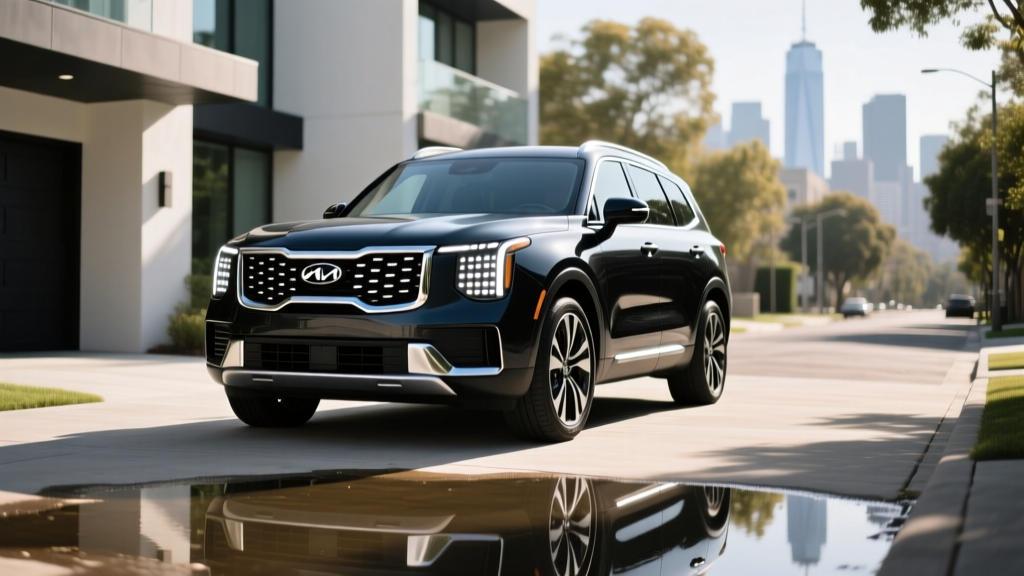
Kia's three-row Telluride has dominated the midsize SUV segment since its 2020 debut, but one glaring omission has persisted: a hybrid powertrain. With the next-generation Telluride expected for the 2027 model year, that changes. Kia has confirmed a hybrid variant is in development, and based on the powertrain architecture already deployed in the Hyundai Palisade Hybrid (its platform sibling), we can build a data-grounded picture of what buyers should expect.
This guide covers every confirmed and projected specification for the 2027 Kia Telluride Hybrid, clearly separating what Kia has officially announced from what we're estimating based on the shared Hyundai-Kia platform. We'll also break down the critical HEV vs. PHEV decision, tax credit eligibility under current IRS §30D rules, and whether this hybrid makes sense versus a full EV like the Kia EV9.
What We Know: 2027 Telluride Hybrid Powertrain
Kia has not yet published final specifications for the 2027 Telluride Hybrid as of early 2026. However, the next-generation Telluride rides on an evolution of the Hyundai-Kia N3 platform, which already supports hybrid and plug-in hybrid configurations. The Hyundai Palisade Hybrid — unveiled for the Korean market in late 2025 — gives us the closest look at the powertrain hardware the Telluride will share.
| Specification | Estimated HEV | Estimated PHEV |
|---|---|---|
| Engine | 1.6L turbocharged 4-cylinder | 1.6L turbocharged 4-cylinder |
| Electric Motor | 47.7 kW (64 hp) | 72 kW (97 hp) |
| Combined System Output | ~245 hp / 271 lb-ft | ~300+ hp / 310+ lb-ft |
| Transmission | 6-speed automatic | 6-speed automatic |
| Battery Capacity | ~1.5 kWh (NiMH or small Li-ion) | ~18-22 kWh (lithium-ion) |
| Drivetrain | AWD (standard) | AWD (standard) |
| Towing Capacity | ~5,000 lbs (est.) | ~4,500 lbs (est.) |
The HEV (conventional hybrid) uses a small battery that recharges through regenerative braking and the engine — no plug required. The PHEV (plug-in hybrid) carries a substantially larger lithium-ion pack that enables electric-only driving and requires plug-in charging to realize its full efficiency advantage.
HEV vs. PHEV: Which Telluride Hybrid Fits Your Driving?
This distinction matters enormously for your daily routine and fuel budget. Here's how the two variants compare in practical terms:
| Factor | Telluride HEV (Conventional Hybrid) | Telluride PHEV (Plug-In Hybrid) |
|---|---|---|
| Plug-in charging needed? | No — self-charging via regen and engine | Yes — plug in to access electric-only range |
| Electric-only range | ~1 mile at low speeds (creep mode) | ~30-37 miles (est.) |
| Total combined range | ~550-600 miles | ~500+ miles (electric + gas) |
| Home charging setup | None required | Level 2 (240V) recommended; Level 1 (120V) included |
| Ideal driver | No garage/driveway access; wants simplicity | Home charging access; short weekday commutes |
| Federal tax credit | Not eligible under §30D | Up to $7,500 (subject to sourcing/income rules) |
If you live in an apartment without charging access or simply don't want to think about plugging in, the HEV is the pragmatic choice. If you have a garage with a 240V outlet and your weekday driving stays under 35 miles round-trip, the PHEV lets you commute almost entirely on electricity while keeping a gas engine for weekend road trips.
Fuel Economy: Expected EPA MPG Breakdown
Official EPA numbers won't arrive until closer to the Telluride Hybrid's on-sale date, but the Palisade Hybrid's published figures and the Telluride's similar weight and aerodynamics give us a solid projection.
| Configuration | City (EPA est.) | Highway (EPA est.) | Combined (EPA est.) |
|---|---|---|---|
| Telluride HEV AWD | 28-30 MPG | 26-28 MPG | 27-29 MPG |
| Telluride PHEV AWD (charge-depleting) | 80-85 MPGe | 75-80 MPGe | 78-82 MPGe |
| Telluride PHEV AWD (gas-only after battery) | 26-28 MPG | 25-27 MPG | 26-27 MPG |
| Current gas Telluride AWD (baseline) | 18 MPG | 24 MPG | 21 MPG |
Real-world MPG note: Hyundai-Kia turbo-hybrid systems tend to match or slightly exceed EPA city estimates in stop-and-go driving, where regenerative braking recaptures the most energy. Highway fuel economy is typically closer to the sticker or 1-2 MPG below, especially at speeds above 70 mph or with a full cargo load. For the current gas Telluride AWD, owners on fueleconomy.gov report real-world combined averages between 19-22 MPG — the hybrid should deliver a meaningful 30-40% improvement over that baseline.
PHEV Electric-Only Range and Charging Details
For buyers considering the plug-in variant, electric-only range is the make-or-break number. Based on the Palisade PHEV's ~20 kWh battery pack and the Telluride's comparable weight (~4,700 lbs), expect 30-37 miles of electric-only range on a full charge. That covers the average American commute (approximately 32 miles round-trip per FHWA data) without burning a drop of gasoline.
| Charging Metric | Telluride PHEV (Estimated) |
|---|---|
| Battery capacity | ~18-22 kWh usable |
| Level 1 (120V) full charge | ~10-12 hours |
| Level 2 (240V, 32A) full charge | ~3-4 hours |
| DC fast charging | Not expected (typical for PHEVs) |
| Electric-only range | 30-37 miles (EPA est.) |
| Charge connector | J1772 (Level 1/2) |
A critical detail: PHEVs in this class almost never support DC fast charging. The onboard charger is typically limited to 7.2 kW (Level 2 AC), meaning you'll charge at home or at workplace Level 2 stations — not at highway DC fast chargers. That's fine for overnight replenishment but worth understanding if you expected quick top-ups on road trips. On gas power alone, the PHEV operates as a conventional hybrid.
Pricing, Trims, and Federal Tax Credit Eligibility
Kia has not announced official MSRP figures for the 2027 Telluride Hybrid, but we can project based on the current gas Telluride lineup and the hybrid premium Kia applies to the Sorento Hybrid.
| Trim (Projected) | Gas Telluride MSRP (2026) | Est. HEV MSRP | Est. PHEV MSRP |
|---|---|---|---|
| LX / Base | ~$38,000 | ~$41,000 | — |
| S / EX | ~$43,000 | ~$46,000 | ~$52,000 |
| SX / SX-Prestige | ~$49,000 | ~$52,000 | ~$57,000 |
The hybrid premium typically runs $2,500-$4,000 over equivalent gas trims. The PHEV commands an additional $4,000-$6,000 over the HEV due to the larger battery and more powerful electric motor.
Federal Tax Credit: §30D Eligibility
Under current IRS §30D rules, the conventional HEV Telluride Hybrid does not qualify for any federal tax credit — only plug-in hybrids and full EVs with sufficient battery capacity are eligible.
For the PHEV variant, eligibility for the full $7,500 credit depends on several requirements that shift annually:
- MSRP cap: SUVs must be priced at or below $80,000 (the Telluride PHEV should clear this easily)
- Buyer income cap: Modified AGI must not exceed $150,000 (single), $225,000 (head of household), or $300,000 (joint)
- Battery component sourcing: Increasingly strict critical mineral and battery component requirements must be met — Kia's sourcing from South Korean battery suppliers (SK On, LG Energy Solution) has historically helped, but annual rule tightening means eligibility is not guaranteed
- Point-of-sale transfer: If eligible, the credit can be transferred to the dealer at purchase, reducing your out-of-pocket cost immediately rather than waiting for tax filing
Important: Consult a tax professional before relying on credit eligibility. Sourcing requirements tighten each year under the Inflation Reduction Act, and a vehicle that qualifies in early 2027 may face different rules by year-end. Check the official fueleconomy.gov tax credit page for the most current list of qualifying vehicles.
Battery Warranty, Reliability, and Replacement Costs
Hybrid battery longevity is the top concern we hear from buyers moving from a conventional gas SUV. Here's what the data shows:
| Coverage Item | Kia's Standard Hybrid Warranty |
|---|---|
| Hybrid battery pack | 10 years / 100,000 miles |
| Hybrid system components (motor, inverter) | 10 years / 100,000 miles |
| Powertrain (engine, transmission) | 10 years / 100,000 miles |
| Battery capacity retention threshold | Typically 70% of original capacity |
| Basic vehicle warranty | 5 years / 60,000 miles |
Kia's 10-year/100,000-mile hybrid battery warranty is among the strongest in the segment. If the battery degrades below approximately 70% of its original capacity within that window, Kia replaces it at no cost.
Out-of-warranty replacement cost: Based on current Hyundai-Kia hybrid battery pricing, a replacement pack for the HEV (small ~1.5 kWh unit) runs approximately $2,500-$4,000 including labor. The PHEV's larger ~20 kWh pack would likely cost $6,000-$9,000 to replace. For context, Toyota Prius hybrid batteries routinely last 150,000-200,000+ miles before significant degradation, and Hyundai-Kia's turbo-hybrid architecture uses similar lithium-polymer chemistry with active thermal management. The realistic risk of needing a replacement within typical ownership (8-12 years) is low.
Kia's overall reliability ratings have improved substantially. The current Telluride holds strong marks from both IIHS (Top Safety Pick+) and consumer reliability surveys. The hybrid powertrain adds complexity but removes the traditional starter motor and alternator (the hybrid motor handles those functions), which can reduce certain maintenance costs over time.
Telluride Hybrid vs. EV9 vs. Gas Telluride: Decision Framework
Three-row SUV buyers in Kia's showroom now face a genuine three-way choice. Here's how to decide:
Choose the Telluride HEV (conventional hybrid) if:
- You want significantly better fuel economy without changing your refueling habits
- You don't have access to home or workplace charging
- You tow regularly (hybrids maintain strong towing capacity)
- You want the lowest-complexity path to ~28 MPG combined
Choose the Telluride PHEV if:
- You have a garage or driveway with a 240V outlet (or can install one for ~$500-$1,200)
- Your weekday driving stays under 35 miles round-trip
- You want electric commuting with gas-engine flexibility for road trips
- You qualify for the §30D tax credit, effectively reducing the PHEV premium
Choose the Kia EV9 (full electric) if:
- You have reliable home Level 2 charging
- Your typical trips stay within the EV9's ~270-300 mile EPA range
- You want zero tailpipe emissions and the lowest per-mile fuel cost
- You're comfortable planning DC fast-charging stops on longer road trips
Stick with the gas Telluride if:
- Upfront cost is the primary concern (gas models start ~$3,000-$5,000 lower)
- You drive very low annual miles (the hybrid fuel savings take longer to pay back)
- You plan to keep the vehicle only 2-3 years
When Will the 2027 Telluride Hybrid Be Available?
Kia has confirmed the next-generation Telluride will debut for the 2027 model year, with the hybrid variant arriving alongside or shortly after the gas models. Based on Kia's typical production timeline, expect:
- Official reveal: Late 2026 (likely at the LA Auto Show or a dedicated Kia event)
- Final EPA ratings and MSRP: Early-to-mid 2027
- Dealer deliveries: Mid-to-late 2027 for the HEV; PHEV may follow 3-6 months later
All specifications in this article are projections based on the shared Hyundai-Kia platform and confirmed Palisade Hybrid data. Final numbers may differ when Kia publishes official specs. We'll update this guide as confirmed information becomes available.
Frequently Asked Questions
How many MPG does the 2027 Telluride Hybrid get?
Based on the Palisade Hybrid's published figures, expect approximately 27-29 MPG combined for the HEV (AWD), a significant jump from the current gas Telluride's 21 MPG combined. The PHEV variant is estimated at 78-82 MPGe when operating on its electric charge, dropping to roughly 26-27 MPG once the battery is depleted and the gas engine takes over.
How far can the Telluride PHEV drive on electric only?
We estimate 30-37 miles of electric-only range based on the expected ~18-22 kWh battery pack and vehicle weight. That covers most daily commutes without using gasoline. Once the battery is depleted, the PHEV operates as a conventional hybrid with no range limitation beyond its gas tank.
Does the Telluride Hybrid qualify for a federal tax credit?
The conventional HEV does not qualify for the §30D federal tax credit — only plug-in hybrids and full EVs are eligible. The PHEV variant may qualify for up to $7,500, but eligibility depends on your income, the vehicle's MSRP, and battery component sourcing requirements that tighten annually. Always verify current eligibility on fueleconomy.gov and consult a tax professional.
Is the hybrid battery reliable, and what does replacement cost?
Kia covers the hybrid battery for 10 years/100,000 miles, replacing it free if capacity drops below ~70%. Out-of-warranty replacement is estimated at $2,500-$4,000 for the HEV pack and $6,000-$9,000 for the PHEV pack. Hyundai-Kia hybrid batteries in similar vehicles have demonstrated strong longevity, with most lasting well beyond 150,000 miles without significant degradation.
Do I need to plug in the Telluride Hybrid?
Only if you choose the PHEV variant. The conventional HEV charges its small battery through regenerative braking and the gasoline engine — you never plug it in. The PHEV requires plug-in charging (Level 1 or Level 2) to access its 30-37 miles of electric-only range; without plugging in, it simply operates as a slightly heavier conventional hybrid.
Will the Telluride Hybrid support DC fast charging?
The HEV has no charging port at all. The PHEV is expected to support Level 2 AC charging (up to ~7.2 kW via J1772 connector) but not DC fast charging. This is standard for PHEVs in this class — the battery is small enough that Level 2 charging fully replenishes it in 3-4 hours, typically overnight.