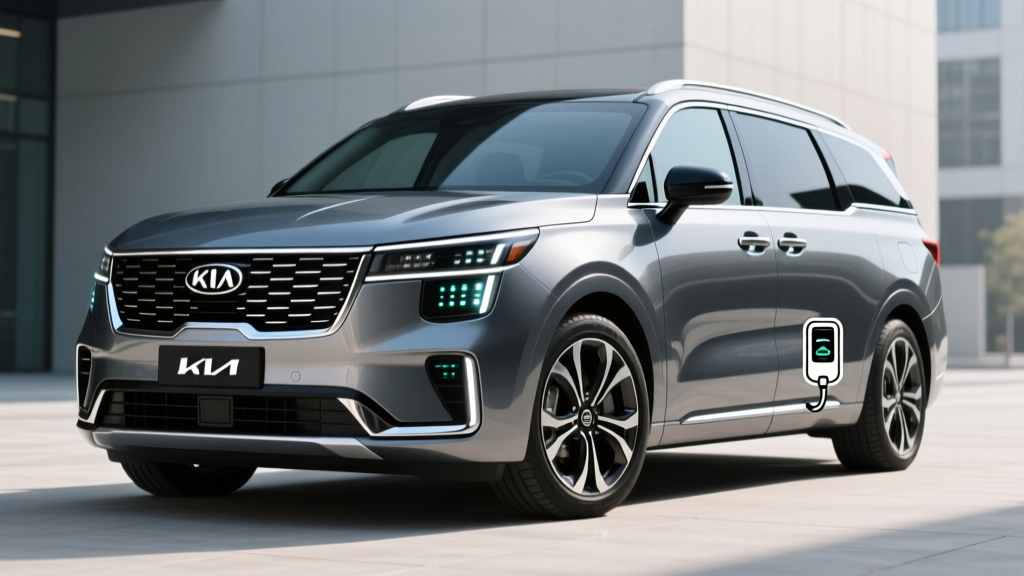
The minivan segment is finally catching up to the electrification wave, and the 2027 Kia Carnival Hybrid arrives as one of the most compelling family haulers to wear a hybrid badge. Building on the Carnival's bold SUV-inspired redesign that debuted for the 2025 model year, the hybrid variant swaps the conventional V6 for a turbocharged 1.6-liter four-cylinder paired with an electric motor — delivering meaningful fuel savings without sacrificing the three-row practicality buyers expect.
As a conventional hybrid (HEV), the 2027 Carnival Hybrid requires no plug, no behavior change, and no range anxiety. You fuel it like any other vehicle and let the hybrid system manage energy recapture automatically. For families who drive 15,000+ miles a year and want lower fuel bills without the complexity of home charging infrastructure, this is the value proposition. Let's break down exactly what you're getting.
HEV vs. PHEV: What Kind of Hybrid Is the 2027 Carnival?
Before we get into the numbers, it's critical to understand what the 2027 Kia Carnival Hybrid is — and isn't. Kia offers this minivan exclusively as a conventional hybrid (HEV). There is currently no plug-in hybrid (PHEV) version of the Carnival sold in the U.S. market.
HEV vs. PHEV — Key Differences
| Feature | HEV (Carnival Hybrid) | PHEV (e.g., Chrysler Pacifica Hybrid) |
|---|---|---|
| Plug-in required? | No — self-charging via regen & engine | Yes — plug in for EV-only miles |
| Electric-only range | ~1 mile at low speed | 30–40 miles typical |
| Battery size | ~1.5 kWh (small buffer) | 16–18 kWh |
| Federal tax credit (§30D) | Not eligible | Up to $7,500 (if requirements met) |
| Home charger needed? | No | Recommended (Level 2, 240V) |
The Carnival Hybrid's advantage is simplicity: no charging setup, no plug-in routine, no electric-range management. You just drive.
Fuel Economy: EPA Ratings and Real-World MPG
The headline number for the 2027 Kia Carnival Hybrid is an EPA-estimated 34 MPG combined — a substantial improvement over the gas-only Carnival's 22 MPG combined. Here is the full EPA breakdown based on the most recent fueleconomy.gov data for the Carnival Hybrid powertrain:
| Cycle | EPA MPG | Real-World Expectation |
|---|---|---|
| City | 36 MPG | 35–38 MPG (hybrids often beat EPA in stop-and-go) |
| Highway | 31 MPG | 28–30 MPG (aerodynamic drag at 75+ mph reduces gains) |
| Combined | 34 MPG | 31–34 MPG depending on driving mix |
Powertrain Specs: Turbo Hybrid Performance
Kia's hybrid system in the Carnival pairs a 1.6-liter turbocharged GDI four-cylinder engine with a 54 kW (72 hp) electric motor integrated into the transmission housing. The combined system output is 245 horsepower and 271 lb-ft of torque, routed through a 6-speed automatic transmission to the front wheels.
| Specification | 2027 Kia Carnival Hybrid |
|---|---|
| Engine | 1.6L Turbo GDI I-4 |
| Electric Motor | 54 kW (72 hp) |
| Combined System Output | 245 hp / 271 lb-ft |
| Transmission | 6-speed automatic |
| Drivetrain | FWD |
| 0–60 mph (est.) | ~7.8 seconds |
| Towing Capacity | 3,500 lbs |
| Fuel Tank | 19.0 gallons |
| Total Range (est.) | ~646 miles |
The 245-hp figure is competitive with the gas-only Carnival's 290-hp V6, but the hybrid's electric motor delivers instant low-end torque that makes the minivan feel surprisingly responsive around town. Highway merging and passing are confident, though the turbo four can get vocal under hard acceleration — a trade-off for the fuel savings. The 3,500-lb towing rating matches the gas model, which matters for families hauling a small trailer or boat.
Pricing, Trims, and Tax Credit Eligibility
Based on Kia's current pricing structure and the hybrid premium carried over from the 2025–2026 model years, the 2027 Kia Carnival Hybrid is expected to start at approximately $40,500 MSRP (including destination) for the LXS Hybrid trim, ranging up to approximately $50,000 for the fully loaded SX Prestige Hybrid.
| Trim Level | Est. MSRP | Key Features |
|---|---|---|
| LXS Hybrid | ~$40,500 | 8-passenger, 12.3" display, Smart Power Tailgate |
| EX Hybrid | ~$43,500 | Leatherette, heated front seats, power sliding doors |
| SX Hybrid | ~$46,500 | Navigation, Bose audio, Highway Driving Assist |
| SX Prestige Hybrid | ~$50,000 | Nappa leather, dual sunroof, VIP lounge seats, HUD |
Battery Warranty, Reliability, and Replacement Cost
Kia Hybrid Battery Warranty
Kia covers the Carnival Hybrid's battery and hybrid system components with a 10-year / 100,000-mile limited warranty — one of the longest in the industry. This covers the hybrid battery pack, electric motor, inverter, and related control modules against defects and excessive capacity loss.
For the original owner, this coverage is transferable to subsequent owners at 5 years / 60,000 miles under Kia's standard powertrain terms.
Hybrid battery longevity is a top concern for buyers, but the data is reassuring. Modern HEV battery packs — especially the relatively small ~1.5 kWh unit in the Carnival Hybrid — operate within a conservative state-of-charge window (roughly 40–60%) managed by the vehicle's battery management system. This shallow cycling dramatically reduces degradation compared to full BEV batteries that regularly cycle from 10% to 90%.
Based on long-term data from Kia's hybrid fleet (Sorento Hybrid, Niro) and comparable Toyota/Honda systems, hybrid battery packs routinely last 150,000–200,000+ miles before any meaningful capacity loss. If replacement is ever needed outside warranty, expect a cost range of $2,500–$4,500 for the hybrid battery module, depending on labor rates and whether refurbished units are available.
Kia's overall reliability ratings have climbed steadily, with the Carnival earning strong marks from IIHS for crashworthiness. The hybrid powertrain adds complexity (electric motor, inverter, regen system) but eliminates the traditional starter motor and reduces brake wear thanks to regenerative braking — a net maintenance benefit.
Who Should Buy the Carnival Hybrid vs. a Full EV or Gas Minivan?
Decision Framework: Which Powertrain Fits Your Family?
Choose the 2027 Carnival Hybrid if:
- You drive 12,000–20,000 miles per year, mostly city/suburban
- You lack access to home Level 2 charging (apartment, no garage outlet)
- You want fuel savings without changing your refueling habits
- You need 3 rows + 3,500-lb towing without a fuel-cost penalty
Consider a full EV (e.g., Kia EV9) if:
- You can install a Level 2 home charger and drive under 300 miles daily
- You want zero tailpipe emissions and the lowest per-mile energy cost
- You qualify for the full $7,500 §30D tax credit
Stick with the gas Carnival if:
- You drive under 8,000 miles/year (hybrid premium won't pay back)
- You frequently tow near the 3,500-lb limit in mountainous terrain
- You prioritize maximum cargo volume (hybrid battery slightly reduces under-floor storage)
The sweet spot for the Carnival Hybrid is the high-mileage family. At 15,000 miles per year and $3.40/gallon fuel, the hybrid's 34 MPG vs. the gas model's 22 MPG saves approximately $970 per year in fuel — paying back the ~$2,500 hybrid premium in under three years. Over a 7-year ownership period, that's roughly $4,300 in net fuel savings after accounting for the premium.
Pros and Cons at a Glance
✓ Pros
- 34 MPG combined — best in the minivan segment for a non-plug-in
- No charging infrastructure required
- 245 hp with strong low-end electric torque
- 10-year/100,000-mile hybrid battery warranty
- 3,500-lb towing capacity retained
- 8-passenger seating with VIP lounge seat options
✗ Cons
- No federal §30D tax credit (HEV, not PHEV)
- Highway MPG gains modest vs. city (31 highway)
- Turbo four-cylinder audible under hard acceleration
- FWD only — no AWD option unlike Toyota Sienna hybrid
- Hybrid premium adds ~$2,500 over gas model
- No electric-only driving beyond very low-speed creep
Frequently Asked Questions
How many MPG does the 2027 Kia Carnival Hybrid get?
The EPA rates the Carnival Hybrid at 36 city / 31 highway / 34 combined MPG. In real-world mixed driving, expect 31–34 MPG. City-heavy commuters may see 35–38 MPG thanks to regenerative braking, while sustained highway driving at 75+ mph typically returns 28–30 MPG.
Does the Carnival Hybrid need to be plugged in?
No. The 2027 Carnival Hybrid is a conventional hybrid (HEV) that charges its small battery through regenerative braking and the gasoline engine. You never plug it in. Simply fill up at any gas station as you would with a conventional vehicle.
Does the 2027 Kia Carnival Hybrid qualify for any tax credit?
The federal §30D Clean Vehicle Credit (up to $7,500) does not apply to conventional hybrids — only to plug-in EVs and PHEVs. The Carnival Hybrid is not eligible. However, some states and utilities offer separate incentives for hybrid purchases. Consult your tax professional and check your state's energy office for current programs.
Is the hybrid battery reliable, and what does replacement cost?
Kia's hybrid battery packs have demonstrated strong longevity, typically lasting 150,000–200,000+ miles. The battery is covered by a 10-year / 100,000-mile warranty. If replacement is needed out of warranty, expect $2,500–$4,500 depending on parts availability and labor. The shallow charge-discharge cycles in an HEV are far less stressful on battery chemistry than full BEV cycling.
How does the Carnival Hybrid compare to the Toyota Sienna Hybrid?
The Toyota Sienna Hybrid offers standard AWD and achieves a slightly higher EPA combined rating (36 MPG combined vs. the Carnival Hybrid's 34 MPG). However, the Sienna's 245-hp hybrid system uses a naturally aspirated 2.5L engine that feels less responsive than the Carnival's turbocharged setup. The Carnival also offers more premium interior features at the SX Prestige level and Kia's longer 10-year warranty vs. Toyota's 8-year/100,000-mile hybrid coverage. Both are strong choices — the Sienna wins on AWD availability and a slight MPG edge; the Carnival wins on interior luxury and warranty length.
What is the total driving range of the 2027 Carnival Hybrid?
With a 19.0-gallon fuel tank and 34 MPG combined, the Carnival Hybrid delivers an estimated 646 miles of total range. In city-heavy driving at 36 MPG, range can stretch past 680 miles before refueling — meaning many families will visit the gas station only once per month.
Sources: EPA fuel economy data via fueleconomy.gov; IRS §30D credit rules via irs.gov; Kia manufacturer specifications. Pricing is estimated based on current model-year trends and may vary at time of sale. Always verify current specs and incentives with your local Kia dealer.