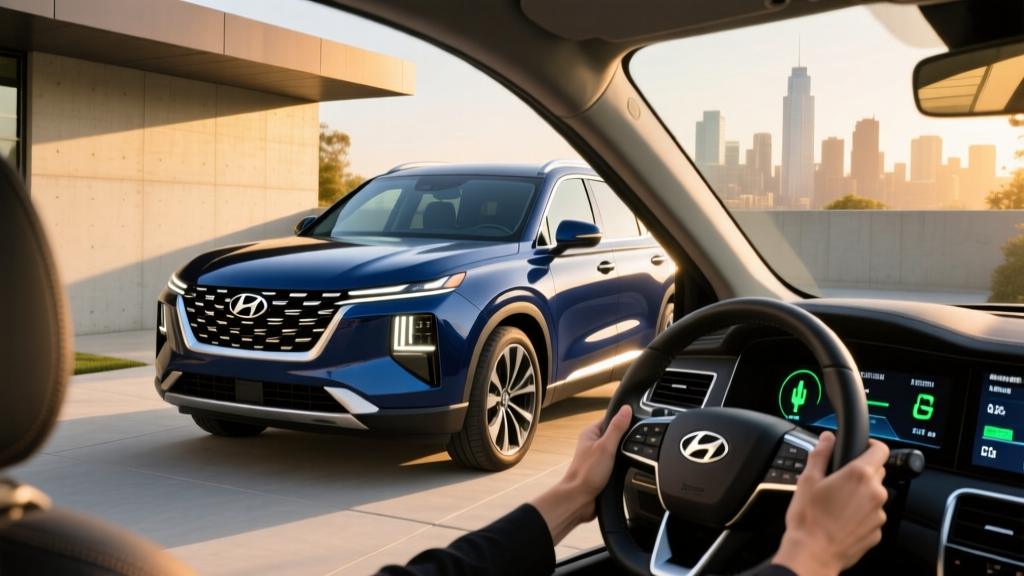
The current Hyundai Palisade has been a three-row SUV staple since 2020, but it has always shipped with a single 3.8-liter V6 and no electrified option. That changes with the next generation. The 2027 Hyundai Palisade is expected to debut in late 2026 as a 2027 model, and Hyundai has signaled that a hybrid powertrain — potentially in both conventional (HEV) and plug-in hybrid (PHEV) forms — will join the lineup for the first time.
This guide compiles everything confirmed and credibly projected about the 2027 Hyundai Palisade Hybrid, from powertrain architecture and EPA MPG targets to pricing, tax credit eligibility, and how it stacks up against three-row rivals that already offer electrified variants.
Note: As of early 2026, the 2027 Palisade Hybrid has not been officially released. Specs below are based on Hyundai's confirmed hybrid platform technology (shared with the Santa Fe Hybrid and Tucson PHEV), supplier reports, and Korean-market previews. Final US specifications may differ. We will update this article when official figures are published.
The 2027 Hyundai Palisade Hybrid is expected but not yet on sale in the US. All specs are estimated based on Hyundai's current hybrid systems and should be treated as preliminary until Hyundai Motor America confirms final figures.
HEV vs PHEV: Which Palisade Hybrid Are We Talking About?
Before diving into specs, it's critical to understand the difference between the two hybrid types Hyundai is likely to offer, because they serve very different buyers.
Conventional Hybrid (HEV)
- No plug required — the battery charges via regenerative braking and the engine
- Smaller battery (~1.5–2.0 kWh)
- Electric motor assists the engine at all speeds; cannot drive on electric power alone for meaningful distances
- Primary benefit: significantly improved MPG, especially in city driving
- No range anxiety, no charging infrastructure needed
Plug-in Hybrid (PHEV)
- Plugs in to charge — has a larger battery (typically 13–20+ kWh)
- Can drive 25–40+ miles on electric power alone before the engine starts
- After electric range is depleted, operates as a conventional hybrid
- Primary benefit: daily commutes on electricity, gas-engine backup for road trips
- Requires home charging access to realize full benefit
Hyundai's current US hybrid lineup includes both types: the Santa Fe Hybrid (HEV) and the Tucson Plug-in Hybrid (PHEV). It is highly probable the 2027 Palisade will follow this dual approach, though Hyundai Motor America has not confirmed which variants will reach the US market at launch.
Estimated Powertrain and Performance Specs
Hyundai's latest hybrid architecture pairs a turbocharged four-cylinder engine with one or more electric motors integrated into the transmission. For a vehicle of the Palisade's size (likely 4,600–5,000 lbs curb weight), Hyundai will need its most powerful hybrid system.
| Attribute | HEV (Estimated) | PHEV (Estimated) |
|---|---|---|
| Engine | 1.6L Turbo-4 + electric motor | 1.6L Turbo-4 + electric motor |
| Combined Horsepower | ~232–250 hp | ~260–280 hp |
| Combined Torque | ~275–290 lb-ft | ~290–320 lb-ft |
| Battery Capacity | ~1.5–2.0 kWh (Li-ion) | ~16–20 kWh (NMC Li-ion) |
| Electric-Only Range | N/A (motor assist only) | ~30–38 miles (est.) |
| Transmission | 6-speed automatic w/ integrated motor | 6-speed automatic w/ integrated motor |
| Drivetrain | AWD (HTRAC) | AWD (HTRAC) |
| 0–60 mph (est.) | ~7.5–8.0 sec | ~7.0–7.5 sec |
| Towing Capacity | ~4,500–5,000 lbs (est.) | ~4,000–4,500 lbs (est.) |
Why a 1.6L turbo instead of the current V6? Hyundai's hybrid system is built around its Smartstream turbocharged four-cylinder family. The current Palisade's 3.8L V6 produces 291 hp but averages just 22 MPG combined. The hybrid four-cylinder plus electric motor can match or exceed that output while cutting fuel consumption by 25–40%. This is the same engineering logic Toyota uses in the Grand Highlander Hybrid.
Fuel Economy: How Many MPG Will the Palisade Hybrid Get?
This is the headline question for hybrid buyers. The current gas-only Palisade returns an EPA-rated 22 MPG combined (19 city / 26 highway) with AWD. Based on Hyundai's existing hybrid systems and the efficiency gains seen in the Santa Fe Hybrid (which achieves 36 MPG combined from a similar powertrain in a lighter vehicle), here are our estimates:
| Powertrain | City MPG | Highway MPG | Combined MPG |
|---|---|---|---|
| Current Palisade V6 AWD (baseline) | 19 | 26 | 22 |
| Palisade HEV (est.) | 28–31 | 27–30 | 28–30 |
| Palisade PHEV (est., charge-sustaining) | 27–30 | 26–29 | 27–29 |
| Palisade PHEV (est., MPGe w/ full charge) | ~70–80 MPGe (first ~35 miles) | ||
Real-world MPG expectations: Hyundai's hybrids historically perform well in real-world city driving — often exceeding EPA city estimates thanks to aggressive regenerative braking and frequent electric-motor assist in stop-and-go traffic. Highway MPG tends to align closely with EPA figures or drop slightly at sustained 75+ mph speeds. Expect real-world combined driving to land within 1–2 MPG of the EPA sticker under normal conditions.
MPGe explained: For the PHEV variant, MPGe (miles per gallon equivalent) measures efficiency during the electric-only portion of driving. It only applies when the battery is charged. Once the battery depletes and the engine takes over, the PHEV reverts to standard MPG ratings (the "charge-sustaining" row above).
PHEV Electric-Only Range and Charging
If Hyundai offers a Palisade PHEV, the electric-only range will be the deciding factor for commuters. Based on the Tucson PHEV's 33-mile EPA electric range (from an 18.0 kWh battery) and the Palisade's greater weight and frontal area, we estimate:
Real-world expectation: 25–34 miles depending on temperature, terrain, and driving style. Cold weather (below 32°F) can reduce electric range by 20–30% due to cabin heating demands and battery chemistry limitations.
Total combined range (electric + gas): ~430–480 miles
Charging the PHEV:
| Charging Method | Power | 0–100% Time (est.) | Miles Added per Hour |
|---|---|---|---|
| Level 1 (120V household outlet) | ~1.4 kW | 12–15 hours | ~2–3 mi/hr |
| Level 2 (240V home/public) | ~7.2 kW | 2.5–3.5 hours | ~10–14 mi/hr |
| DC Fast Charge | Not expected | N/A | N/A |
Important PHEV charging note: Hyundai's current PHEVs (Tucson, Santa Fe) do not support DC fast charging. The Palisade PHEV is expected to follow this pattern — Level 2 AC charging only. This is standard for most PHEVs: the battery is small enough that overnight Level 2 charging fully replenishes it. A 240V Level 2 home charger is strongly recommended to maximize daily electric driving.
Pricing, Trims, and Tax Credit Eligibility
The current 2025 Palisade starts at $38,100 (SE FWD) and tops out around $52,000 (Calligraphy AWD). A hybrid powertrain will command a premium, as it does across Hyundai's lineup:
| Variant | Estimated Base MSRP | Hybrid Premium vs. Gas |
|---|---|---|
| Palisade HEV SEL (mid-trim) | $44,000–$47,000 | +$2,500–$4,000 |
| Palisade HEV Limited/Calligraphy | $50,000–$56,000 | +$2,500–$4,000 |
| Palisade PHEV (if offered) | $50,000–$55,000 | +$6,000–$9,000 |
Federal Tax Credit: Does the Palisade Hybrid Qualify?
This is where HEV and PHEV diverge sharply under current IRS §30D rules:
- Conventional Hybrid (HEV): Does not qualify for the federal §30D new clean vehicle credit. The credit requires a minimum 7 kWh battery capacity and plug-in capability. HEVs have neither.
- Plug-in Hybrid (PHEV): May qualify for up to $7,500, but only if it meets all current requirements. As of 2026, these include:
- Battery capacity ≥ 7 kWh (likely met by the Palisade PHEV)
- MSRP ≤ $80,000 for SUVs (likely met)
- Buyer income ≤ $300,000 (MFJ) / $150,000 (single)
- Battery components and critical minerals must meet phased-in domestic sourcing thresholds — this is the requirement that has disqualified many Hyundai/Kia models in prior years
- Final assembly in North America (the Palisade is currently built in Ulsan, South Korea — unless Hyundai shifts production to the US, the PHEV will not qualify)
Battery Warranty, Reliability, and Replacement Costs
Hybrid battery longevity is consistently a top concern for buyers transitioning from conventional vehicles. Here's what Hyundai's track record tells us:
Duration: 10 years / 100,000 miles (original owner)
Coverage: Defects and capacity loss below a manufacturer-defined threshold (typically 70% state of health)
Transferability: Hyundai's 10-year warranty typically transfers to second owners as 5 years / 60,000 miles — verify at purchase
Hybrid system components: Motor, inverter, and related electronics also covered under the 10-year powertrain warranty
Real-world reliability data: Hyundai's hybrid systems have been in production since the Ioniq (2017) and have proven robust. The lithium-ion polymer batteries used in Hyundai/Kia hybrids show minimal degradation in normal use — most owners report negligible capacity loss over 5–7 years. Unlike full EV batteries, hybrid batteries are smaller, undergo shallower charge cycles, and are actively managed to avoid deep discharge or full saturation, all of which extend lifespan.
Battery replacement cost: If the hybrid battery fails outside warranty, replacement costs are significantly lower than full EV batteries:
- HEV battery replacement: ~$2,000–$3,500 (parts + labor)
- PHEV battery replacement: ~$5,000–$8,000 (parts + labor, larger pack)
For context, a full EV battery replacement can run $10,000–$20,000+. The hybrid's smaller pack keeps this risk manageable.
Palisade Hybrid vs. Three-Row Competitors
The 2027 Palisade Hybrid won't enter an empty segment. Several three-row SUVs already offer hybrid powertrains:
| Vehicle | Type | Combined MPG | HP | Starting MSRP |
|---|---|---|---|---|
| Toyota Grand Highlander Hybrid | HEV | 36 | 245 | $45,020 |
| Kia Sorento Hybrid | HEV/PHEV | 34 / 79 MPGe | 227 / 261 | $38,490 |
| Toyota Highlander Hybrid | HEV | 35 | 243 | $42,320 |
| Mazda CX-90 PHEV | PHEV | 25 / 56 MPGe | 323 | $51,400 |
| 2027 Palisade Hybrid (est.) | HEV/PHEV | 28–30 / ~75 MPGe | ~240 / ~270 | ~$44,000 / ~$50,000 |
The Grand Highlander Hybrid is the efficiency benchmark at 36 MPG combined — a high bar for the heavier Palisade to match. The Palisade's likely advantage will be in interior space, ride quality, and Hyundai's value proposition (longer warranty, competitive pricing).
Who Should Buy the Palisade Hybrid vs. a Full EV or Gas Model?
Choose the Palisade HEV if:
- You want better fuel economy with zero lifestyle change
- You lack home charging access (apartment, street parking)
- You regularly take long road trips and don't want to plan charging stops
- You want a three-row SUV under $50,000 that gets 28+ MPG
- You don't need a tax credit to justify the purchase
Choose the Palisade PHEV if:
- Your daily commute is under 35 miles round-trip
- You can install a Level 2 charger at home
- You want electric daily driving but gas-engine flexibility for road trips
- You want to reduce fuel costs significantly without full EV commitment
- The vehicle qualifies for the §30D credit (confirm US assembly)
Consider a full EV instead (e.g., Kia EV9, Tesla Model X) if:
- You have reliable home and/or workplace charging
- You want maximum fuel savings ($0.04–$0.12/mile vs. $0.14–$0.18/mile for hybrid)
- You qualify for the full $7,500 federal credit on an EV (more models qualify than PHEVs)
- You want zero tailpipe emissions and minimal drivetrain maintenance
- You're comfortable with 250–310 miles of range and DC fast charging on road trips
What We're Still Waiting to Confirm
Until Hyundai Motor America officially unveils the 2027 Palisade Hybrid, these key details remain unconfirmed:
- Exact powertrain output and battery capacity
- EPA-certified MPG and electric-only range (PHEV)
- US trim levels and MSRP
- Assembly location (critical for tax credit eligibility)
- Whether both HEV and PHEV variants will be offered in the US simultaneously, or if one launches first
- Towing capacity certification for hybrid variants
We will update this article as soon as Hyundai publishes official US specifications. Check Hyundai's official newsroom for the latest press releases.
Frequently Asked Questions
How many MPG does the 2027 Hyundai Palisade Hybrid get?
Estimated at 28–30 MPG combined for the HEV variant (28–31 city, 27–30 highway). The current gas Palisade gets 22 MPG combined, so the hybrid represents a 27–36% improvement. The PHEV variant will achieve similar MPG when the battery is depleted, plus ~70–80 MPGe during the electric-only phase. These are estimates — official EPA figures will be published closer to launch.
How far can the Palisade PHEV go on electric power alone?
Estimated at 30–38 miles EPA on a full charge, based on Hyundai's current PHEV systems and the Palisade's expected weight. Real-world range will be 25–34 miles depending on weather and driving conditions. Cold weather can reduce this by 20–30%. This range covers most daily commutes, after which the gas engine takes over seamlessly.
Does the 2027 Palisade Hybrid qualify for the $7,500 federal tax credit?
The conventional HEV does not qualify — it lacks the required battery size and plug-in capability. The PHEV may qualify, but only if Hyundai assembles it in North America (currently the Palisade is built in South Korea). Even with US assembly, the PHEV must meet battery sourcing requirements under §30D. Always verify on fueleconomy.gov before purchase. Consult a tax professional for personal eligibility.
Is the Palisade Hybrid reliable, and what does battery replacement cost?
Hyundai's hybrid systems have been in production since 2017 and have a strong reliability record. The hybrid battery is covered by a 10-year / 100,000-mile warranty. Replacement cost outside warranty is estimated at $2,000–$3,500 for the HEV and $5,000–$8,000 for the PHEV — significantly less than full EV battery replacements.
Does the Palisade Hybrid need to be plugged in?
Only the PHEV variant. The conventional HEV charges its small battery entirely through regenerative braking and the engine — no plug, no charging station needed. The PHEV should be plugged in (ideally to a 240V Level 2 charger) nightly to maximize electric-only driving. Without plugging in, the PHEV still functions as a regular hybrid but you lose the fuel-cost benefit of electric miles.
When will the 2027 Palisade Hybrid be available?
Hyundai is expected to reveal the next-generation Palisade in late 2026, with US sales beginning in early-to-mid 2027 as a 2027 model year vehicle. Exact timing has not been confirmed.