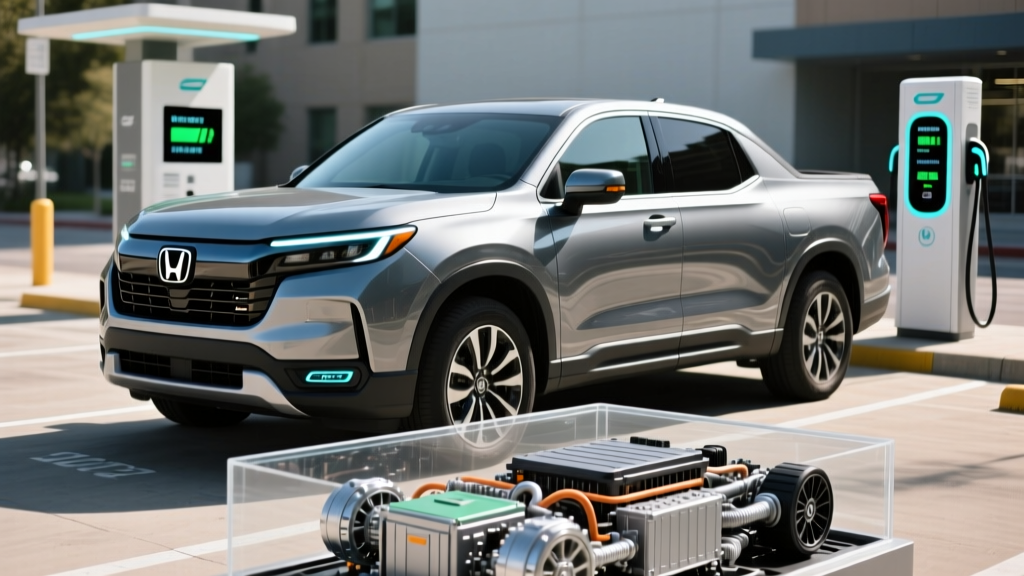
The midsize pickup segment is overdue for electrification, and the 2027 Honda Ridgeline Hybrid is shaping up to be one of the most anticipated entries. With the Ford Maverick Hybrid already proving that buyers want efficient trucks and Toyota preparing hybrid Tacoma variants, Honda's next-generation Ridgeline is expected to follow suit. Here's what we know — and what remains preliminary — about Honda's electrified pickup.
HEV or PHEV? Understanding the Ridgeline Hybrid Options
Honda has signaled a hybrid Ridgeline, but the exact configuration matters enormously for buyers. There are two distinct hybrid architectures Honda could deploy:
Conventional Hybrid (HEV)
- No plug required — charges via regenerative braking and engine
- Small battery (~1.5–2.0 kWh)
- Improves MPG across all driving, especially city
- No electric-only driving range
- Lower upfront cost, simpler ownership
Plug-In Hybrid (PHEV)
- Plugs in to charge — larger battery (~15–20 kWh)
- 25–40 miles of electric-only range
- Can qualify for federal tax credits (§30D)
- Higher upfront cost, needs home charging access
- Best for short commutes + occasional long hauls
Based on Honda's current trajectory — the CR-V is offered as both HEV and PHEV in various markets, and the Accord Hybrid uses a conventional HEV setup — the most likely scenario is a conventional hybrid (HEV) as the volume model, with a PHEV variant possible for higher trims or specific markets. Honda's two-motor hybrid system, already proven in the CR-V Hybrid and Accord Hybrid, is the logical foundation.
Estimated Powertrain and Performance Specs
Honda's fourth-generation two-motor hybrid system pairs a 2.0-liter Atkinson-cycle four-cylinder engine with dual electric motors. In the CR-V Hybrid, this setup produces 204 hp and 247 lb-ft of torque. For a pickup application, expect Honda to tune for higher torque output to support towing.
| Specification | HEV (Estimated) | PHEV (If Offered) |
|---|---|---|
| Engine | 2.0L Atkinson I-4 + 2 motors | 2.0L Atkinson I-4 + 2 motors |
| Combined Horsepower | ~220–240 hp | ~240–270 hp |
| Combined Torque | ~260–280 lb-ft | ~280–310 lb-ft |
| Battery Capacity | ~1.5–2.0 kWh (NMC) | ~17–20 kWh (NMC) |
| Electric-Only Range | N/A | ~28–38 miles |
| Drivetrain | AWD (i-VTM4 expected) | AWD (i-VTM4 expected) |
| Towing Capacity | ~5,000 lb (est.) | ~5,000 lb (est.) |
| DC Fast Charge | N/A | Unlikely (Level 2 only) |
Key context on towing: The current gas Ridgeline is rated at 5,000 pounds. Hybrid systems add weight from the battery and motors, but electric torque can offset this. Honda will likely maintain the 5,000-lb rating to stay competitive with the Maverick Hybrid (2,000 lb) and Tacoma Hybrid (expected ~6,000 lb).
Fuel Economy: How Many MPG Will the Ridgeline Hybrid Get?
This is the question driving most buyer interest. The current gas-only Ridgeline achieves an EPA-estimated 18 city / 24 highway / 21 combined MPG. A hybrid powertrain should deliver substantial gains, particularly in city driving where Honda's two-motor system excels.
| Configuration | City MPG | Highway MPG | Combined MPG |
|---|---|---|---|
| 2026 Ridgeline (gas, AWD) | 18 | 24 | 21 |
| 2027 Ridgeline HEV (est.) | 28–32 | 27–30 | 28–31 |
| 2027 Ridgeline PHEV (est., gas mode) | 26–29 | 26–28 | 26–28 |
Real-world MPG expectations: Honda's hybrid system tends to perform very close to — or even exceed — EPA city estimates in stop-and-go traffic, because the electric motors handle low-speed propulsion while the engine acts primarily as a generator. Highway MPG may run 1–3 MPG below the sticker at sustained 75+ mph speeds, especially when loaded or towing. Expect a real-world combined average of roughly 26–29 MPG for the HEV in mixed driving.
PHEV Electric-Only Range and Charging (If Offered)
If Honda offers a PHEV variant, expect an electric-only range in the 28–38 mile window, based on the larger battery required for a body-on-frame-ish unibody pickup. For context, the Toyota RAV4 Prime delivers 42 miles on a 18.1 kWh pack, but the Ridgeline is heavier and less aerodynamic.
Charging a Ridgeline PHEV:
- Level 1 (120V household outlet): ~12–16 hours for a full charge — adequate for overnight if you drive less than the electric range daily
- Level 2 (240V home charger, ~7.2 kW): ~2.5–3.5 hours for a full charge
- DC Fast Charging: Unlikely to be offered. Most PHEVs in this class (RAV4 Prime, CR-V PHEV) do not include DC fast-charge capability due to the smaller battery size. This is normal and not a limitation for daily use.
A PHEV Ridgeline would offer a total combined range (electric + gas) of approximately 450–520 miles, eliminating range anxiety for road trips while covering most daily commutes on electricity alone.
Pricing, Tax Credits, and Ownership Costs
The current 2026 Honda Ridgeline starts around $40,000 for the Sport trim and climbs to approximately $47,000 for the Black Edition. A hybrid powertrain will add cost — typically $1,500–$3,000 over the gas equivalent based on Honda's CR-V Hybrid pricing strategy.
| Trim (Estimated) | HEV MSRP | PHEV MSRP (If Offered) |
|---|---|---|
| Sport / Base | ~$42,000–$43,500 | ~$47,000–$49,000 |
| RTL / Mid | ~$45,000–$47,000 | ~$50,000–$53,000 |
| Touring / Black Edition | ~$48,000–$50,000 | ~$54,000–$57,000 |
Federal Tax Credit Eligibility
Here's where the HEV vs PHEV distinction becomes critical for your wallet:
- Conventional Hybrid (HEV): Does NOT qualify for the federal §30D Clean Vehicle Credit. HEVs have no plug and no meaningful electric-only range, making them ineligible.
- Plug-In Hybrid (PHEV): MAY qualify for up to $7,500 under IRS §30D, but eligibility depends on multiple requirements that change frequently:
- MSRP must not exceed $80,000 for trucks (the Ridgeline should clear this)
- Buyer income caps: $300,000 joint / $225,000 head of household / $150,000 individual (modified AGI)
- Battery critical minerals and components must meet escalating domestic-sourcing thresholds — this has eliminated several PHEVs from eligibility in recent years
- Point-of-sale transfer available, reducing your purchase price at the dealer
Important: Tax credit rules are subject to change. Consult a tax professional and check the IRS Clean Vehicle Credit page before relying on credit eligibility for your purchase decision.
Battery Warranty, Reliability, and Replacement Costs
Honda's hybrid battery warranty is expected to follow the industry standard: 8 years / 100,000 miles (or 10 years / 150,000 miles in CARB states including California, New York, Massachusetts, and others). This covers battery capacity degradation below a defined threshold, typically 60–70% of original capacity.
Reliability outlook: Honda's two-motor hybrid system has been in production since 2014 (Accord Hybrid) and is now in its fourth generation. The system has proven durable — the CR-V Hybrid and Accord Hybrid have strong reliability records per consumer surveys. The hybrid components (power control unit, electric motors) are generally less failure-prone than a conventional automatic transmission.
Battery replacement cost: If the hybrid battery fails outside of warranty, replacement costs for a Honda hybrid battery pack currently range from $2,000–$4,000 for an HEV pack (smaller, ~1.5–2.0 kWh) and $5,000–$8,000 for a PHEV pack (~17–20 kWh). However, out-of-warranty failures are uncommon within the first 150,000 miles based on Honda's track record. Many hybrid batteries last the life of the vehicle.
Who Should Choose the Ridgeline Hybrid vs a Full EV or Gas Truck?
✅ Choose the Ridgeline Hybrid If:
- You want 30%+ better MPG without changing your fueling habits
- You tow occasionally but commute daily
- You don't have reliable home charging access
- You want a midsize truck with car-like ride quality
- You plan to keep the truck 8+ years
❌ Consider a Full EV Instead If:
- You have home Level 2 charging and a predictable commute
- You want to eliminate gas station visits entirely
- You qualify for the full $7,500 federal credit on an EV
- Your daily driving is under 250 miles (most EVs' real range)
- You want minimal maintenance (no oil changes, fewer moving parts)
The gas-only Ridgeline still makes sense if: you regularly tow near max capacity, drive predominantly highway miles at high speed (where hybrid advantages diminish), or need the lowest possible purchase price. But for the majority of midsize truck buyers who use their truck as a daily driver first and a hauler second, the hybrid is the smarter buy.
Pros
- Significant MPG improvement over gas model (est. 28–31 combined)
- Proven Honda hybrid reliability
- Strong city MPG from electric motor assist
- No charging infrastructure needed (HEV)
- Expected 5,000-lb towing maintained
- Honda Sensing ADAS suite standard
Cons
- Higher MSRP than gas Ridgeline ($1,500–$3,000 premium)
- HEV does not qualify for federal tax credit
- PHEV eligibility for §30D uncertain (sourcing rules)
- Not a body-on-frame truck — limited off-road capability
- No DC fast charging on PHEV variant
- Final specs and pricing not yet confirmed
Frequently Asked Questions
How many MPG does the 2027 Honda Ridgeline Hybrid get?
Based on Honda's hybrid system performance in the CR-V and Accord, we estimate the HEV Ridgeline will achieve approximately 28–32 MPG city, 27–30 MPG highway, and 28–31 MPG combined. Final EPA numbers will be confirmed before launch. Expect real-world combined MPG of 26–29 in mixed driving.
Will the Ridgeline Hybrid be a plug-in (PHEV) or regular hybrid (HEV)?
Honda has confirmed a hybrid Ridgeline but has not specified the architecture. The most likely scenario is a conventional HEV as the standard offering, with a PHEV possible on higher trims. HEVs do not plug in and have no electric-only range. PHEVs plug in and offer 28–38 miles of electric driving before the gas engine engages.
Does the 2027 Ridgeline Hybrid qualify for a tax credit?
The conventional hybrid (HEV) does not qualify for any federal tax credit. A PHEV variant could qualify for up to $7,500 under IRS §30D, but eligibility depends on battery sourcing requirements, buyer income limits, and MSRP caps that are subject to change. Always verify current rules at irs.gov before purchasing.
How much will a hybrid battery replacement cost?
HEV battery replacement is estimated at $2,000–$4,000; PHEV at $5,000–$8,000. However, Honda's hybrid batteries carry an 8-year/100,000-mile warranty (10 years/150,000 miles in CARB states), and real-world data shows most Honda hybrid batteries last well beyond 150,000 miles without significant issues.
Can the Ridgeline Hybrid tow as much as the gas model?
Honda is expected to maintain the current 5,000-pound towing rating for the hybrid variant. Hybrid systems add weight but also provide instant electric torque, which helps with trailer launches. Fuel economy will drop to an estimated 15–18 MPG combined when towing near max capacity.
When will the 2027 Ridgeline Hybrid be available?
Honda has not confirmed an exact on-sale date. Based on typical model-year timing and industry reporting, expect the next-generation Ridgeline with hybrid options to arrive at dealers in late 2026 or early 2027 as a 2027 model-year vehicle. We'll update this article as Honda releases official specifications.
Sources: EPA fuel economy data via fueleconomy.gov; IRS Clean Vehicle Credit rules at irs.gov; Honda powertrain specifications from Honda Newsroom.