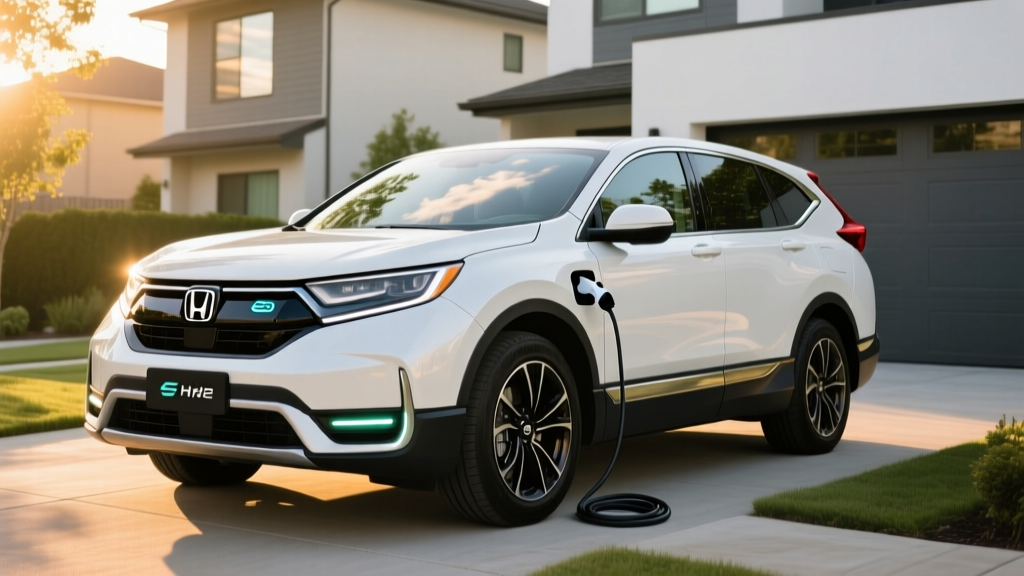
The compact SUV segment doesn't reward inefficiency, and the 2027 Honda CR-V Hybrid makes a compelling case for electrification without the plug. Honda's two-motor hybrid system pairs a 2.0-liter Atkinson-cycle four-cylinder with dual electric motors to deliver 204 combined horsepower and an EPA-estimated 40 MPG combined. For buyers who want meaningful fuel savings without altering their fueling habits, the CR-V Hybrid occupies a practical middle ground between a conventional gas SUV and a full battery-electric vehicle.
This guide covers the 2027 CR-V Hybrid's fuel economy, powertrain, pricing, battery longevity, and how it stacks up against both plug-in hybrid and full EV alternatives.
HEV vs PHEV: What the CR-V Hybrid Actually Is
Before diving into specs, it's important to distinguish what the 2027 CR-V Hybrid is — and what it isn't. Honda sells the CR-V Hybrid as a conventional hybrid electric vehicle (HEV). That means it has a small battery pack (approximately 1.06 kWh) that charges itself through regenerative braking and the gasoline engine. You never plug it in. There is no electric-only driving range beyond brief low-speed assist.
| Feature | HEV (CR-V Hybrid) | PHEV (e.g., Toyota RAV4 Prime) | Full BEV (e.g., Tesla Model Y) |
|---|---|---|---|
| Plug-in required? | No | Yes (Level 1/2) | Yes (Level 2/DC) |
| Battery capacity | ~1.06 kWh | ~18.1 kWh | 60–82 kWh |
| Electric-only range | N/A (motor assist only) | 35–42 miles | 260–330 miles |
| Typical combined efficiency | 38–40 MPG | 38 MPG gas + 94 MPGe electric | 110–130 MPGe |
| Federal tax credit (§30D) | No | Up to $7,500 (if eligible) | Up to $7,500 (if eligible) |
| Starting price range | ~$34,000–$40,000 | ~$43,000–$48,000 | ~$44,000–$55,000 |
Honda does not currently offer a plug-in hybrid (PHEV) version of the CR-V in the U.S. market. If you want 30+ miles of electric-only commuting before the gas engine engages, you'll need to look at competitors like the Toyota RAV4 Prime or the Hyundai Tucson PHEV. The CR-V Hybrid is strictly a self-charging HEV.
Fuel Economy: EPA Ratings and Real-World MPG
The 2027 CR-V Hybrid carries over Honda's proven two-motor hybrid powertrain, which prioritizes electric-motor drive in most conditions and uses the gas engine primarily as a generator at lower speeds. The result is strong city efficiency — exactly where conventional gas SUVs struggle most.
| Drivetrain | City MPG | Highway MPG | Combined MPG |
|---|---|---|---|
| FWD (Sport / Sport Touring) | 43 | 36 | 40 |
| AWD (Sport / Sport Touring) | 40 | 34 | 37 |
Source: EPA Fuel Economy
Real-World MPG vs. EPA Sticker
Conventional hybrids like the CR-V Hybrid tend to exceed their EPA city rating in stop-and-go traffic, where regenerative braking recaptures energy and the electric motor handles most of the work. On the highway, expect the opposite: sustained high-speed driving relies more on the gas engine, and real-world highway MPG typically falls 2–4 MPG below the EPA estimate.
Based on owner-reported data and third-party testing of the current-generation CR-V Hybrid:
- City / suburban driving: 41–46 MPG (FWD), 38–43 MPG (AWD)
- Highway (70–75 mph): 32–35 MPG (FWD), 30–33 MPG (AWD)
- Mixed driving: 36–41 MPG depending on terrain and climate
- Cold-weather penalty: Expect 3–5 MPG reduction in winter months due to cabin heating demands and reduced battery efficiency
For a driver covering 15,000 miles per year in mixed conditions, the FWD CR-V Hybrid at ~39 real-world MPG uses roughly 385 gallons of fuel annually. At $3.40/gallon, that's about $1,309 per year in fuel — compared to ~$1,870 for a comparable gas-only compact SUV at 27 MPG combined.
Powertrain and Performance Specs
Honda's hybrid system uses a series-parallel architecture. At low speeds, the electric motor does nearly all the driving while the gas engine acts as a generator. At highway speeds, the engine can mechanically couple to the wheels through a clutch for more efficient cruising.
| Specification | 2027 Honda CR-V Hybrid |
|---|---|
| Engine | 2.0L Atkinson-cycle 4-cylinder |
| Engine output | 145 HP @ 6,100 rpm |
| Electric motors | Dual-motor (propulsion + generator) |
| Combined system output | 204 HP / 247 lb-ft torque |
| Transmission | e-CVT (direct drive with lock-up clutch) |
| Drivetrain | FWD or Real Time AWD |
| 0–60 mph | ~7.6 seconds |
| Towing capacity | 1,000 lbs |
| Hybrid battery | ~1.06 kWh lithium-ion |
| Fuel tank | 14.0 gallons |
| Total driving range | ~520–560 miles |
The 204 HP combined output is competitive in the segment, providing confident highway merging and passing. The e-CVT is smooth and avoids the rubber-band feel of some older CVTs, though it won't satisfy drivers who prefer stepped gear ratios. The AWD system uses a rear-mounted electric motor rather than a mechanical driveshaft, which improves packaging and response time.
Pricing, Trims, and Tax Credit Eligibility
The 2027 CR-V Hybrid is available exclusively in the sport-oriented trims, which sit in the middle-to-upper range of the CR-V lineup.
| Trim | Drivetrain | MSRP (est.) |
|---|---|---|
| Sport Hybrid | FWD | $34,450 |
| Sport Hybrid | AWD | $35,950 |
| Sport Touring Hybrid | AWD | $39,850 |
Note: MSRP figures are estimated based on current-generation pricing. Confirm with Honda at time of purchase. Destination charges apply.
Federal Tax Credit Status
The 2027 Honda CR-V Hybrid does not qualify for the federal §30D clean vehicle tax credit. Under current IRS rules, the §30D credit applies only to plug-in electric vehicles (BEVs and PHEVs) with sufficient battery capacity (at least 7 kWh) and qualifying battery/critical-mineral sourcing. Conventional hybrids like the CR-V Hybrid are excluded.
Some states offer rebates or incentives for hybrid vehicles through separate programs, but these vary widely by jurisdiction. Check your state's energy or environmental agency for current programs.
Battery Longevity, Warranty, and Replacement Cost
Hybrid battery longevity is a top concern for buyers, but the data on Honda's hybrid systems is reassuring. The CR-V Hybrid's lithium-ion battery pack is relatively small (~1.06 kWh) and operates within a narrow state-of-charge window — typically between 20% and 80% — which significantly reduces stress and degradation compared to full EV batteries that cycle through wider ranges.
| Coverage | Term |
|---|---|
| Hybrid battery warranty | 8 years / 100,000 miles (10 years / 150,000 miles in CARB states) |
| Hybrid system components | 8 years / 100,000 miles |
| Powertrain warranty | 5 years / 60,000 miles |
| New vehicle limited warranty | 3 years / 36,000 miles |
Real-world battery lifespan: Honda's hybrid batteries in the Accord Hybrid and CR-V Hybrid have demonstrated strong longevity, with most units lasting well beyond 150,000 miles without significant capacity loss. The narrow charge window and conservative thermal management keep degradation minimal.
Out-of-warranty replacement cost: If the hybrid battery does require replacement outside the warranty period, expect to pay between $2,000 and $3,500 for a new OEM battery pack including labor. Third-party refurbishment shops offer reconditioned units for $1,200–$2,000. Given the battery's small size and Honda's track record, this is a relatively low-risk expense compared to the $10,000–$20,000 replacement costs associated with full EV battery packs.
Reliability and Ownership Costs
Honda's hybrid powertrain has built a strong reliability record over successive generations. The two-motor system eliminates the traditional transmission (no gears, torque converter, or clutch packs to wear), and regenerative braking reduces wear on the friction brake pads — many hybrid owners report original brake pads lasting 80,000+ miles.
Estimated 5-year ownership advantages vs. gas-only CR-V:
- Fuel savings: ~$2,800 over 5 years / 75,000 miles (at 39 MPG hybrid vs. 28 MPG gas, $3.40/gal)
- Brake savings: ~$300–$500 fewer brake service visits
- Insurance: Comparable to gas trims; no significant EV premium
- Maintenance: Same oil-change intervals as gas CR-V; no hybrid-specific scheduled maintenance
The hybrid trims carry a ~$1,200–$1,500 price premium over equivalent gas-only trims. At typical fuel savings, the hybrid pays for itself in roughly 3–4 years of average driving.
Who Should Choose the CR-V Hybrid vs. a PHEV or Full EV?
Choose the CR-V Hybrid (HEV) if:
- You lack access to home or workplace charging (apartment, street parking)
- You want fuel savings without changing your fueling routine
- Your budget is under $40,000 and you want AWD
- You take frequent long road trips and don't want to plan charging stops
- You want Honda's reliability record and strong resale value
Consider a PHEV (RAV4 Prime, Tucson PHEV) if:
- You can charge at home (Level 2, 240V) and have a short commute (under 35 miles)
- You want electric-only daily driving with gas-engine backup for road trips
- You want to qualify for the federal §30D tax credit (up to $7,500, subject to income and sourcing rules)
Consider a full BEV (Tesla Model Y, Hyundai Ioniq 5) if:
- You have reliable home Level 2 charging
- Your daily driving is under 250 miles and you're comfortable with public DC fast charging for road trips
- You want the lowest per-mile energy cost and zero tailpipe emissions
- You want to maximize federal and state incentives
Pros
- 40 MPG combined (FWD) — among the best in the compact SUV class
- No plug-in required — fuel like a normal gas car
- 204 HP provides confident acceleration
- Spacious cargo area (36.3 cu ft behind rear seats)
- Proven hybrid reliability with 8–10 year battery warranty
- Strong resale value
Cons
- AWD drops combined MPG to 37
- No PHEV option — no electric-only commuting range
- No federal tax credit eligibility
- 1,000-lb towing capacity is low for the segment
- Sport trim pricing pushes close to $40K for top trim
- Highway MPG lags behind city MPG significantly
Frequently Asked Questions
How many MPG does the 2027 Honda CR-V Hybrid get?
The FWD CR-V Hybrid achieves an EPA-estimated 43 city / 36 highway / 40 combined MPG. AWD models are rated at 40 city / 34 highway / 37 combined. In real-world driving, expect 38–43 MPG mixed for FWD and 35–40 MPG for AWD, with city driving often exceeding the EPA estimate and highway driving falling slightly below.
Does the CR-V Hybrid need to be plugged in?
No. The CR-V Hybrid is a conventional hybrid (HEV), not a plug-in hybrid. The battery charges itself through regenerative braking and the gasoline engine. You fuel it exactly like a conventional gas car at any gas station.
How far can the CR-V Hybrid drive on electric power alone?
The CR-V Hybrid cannot drive on electric power alone for any meaningful distance. The electric motor assists the gas engine and can propel the vehicle at very low speeds (under 15 mph) for brief periods, but the gas engine is always part of the powertrain operation. If you want 30+ miles of electric-only range, you need a PHEV or full EV.
Is the CR-V Hybrid reliable and what does a battery replacement cost?
Honda's hybrid system has demonstrated strong reliability over multiple generations. The hybrid battery is warrantied for 8 years/100,000 miles (10 years/150,000 miles in CARB states). Out-of-warranty replacement runs $2,000–$3,500 for an OEM pack. Most Honda hybrid batteries last well beyond 150,000 miles without issues due to the conservative charge-window management.
Does the 2027 CR-V Hybrid qualify for any tax credit?
No. The federal §30D clean vehicle tax credit applies only to plug-in vehicles (BEVs and PHEVs). The CR-V Hybrid is a conventional HEV and is not eligible. Some states may offer separate hybrid incentives — check your state's energy agency for current programs.
How does the CR-V Hybrid compare to the Toyota RAV4 Hybrid?
The Toyota RAV4 Hybrid is rated at 41 MPG combined (AWD standard), giving it a slight edge over the CR-V Hybrid AWD's 37 MPG combined. However, the CR-V Hybrid offers more cargo space (36.3 vs. 37.5 cu ft is comparable), a more refined interior at higher trims, and slightly quicker acceleration (204 HP vs. 219 HP for the RAV4, but Honda's e-CVT tuning feels more responsive in city driving). Both are segment leaders — the choice often comes down to brand preference and dealer pricing.