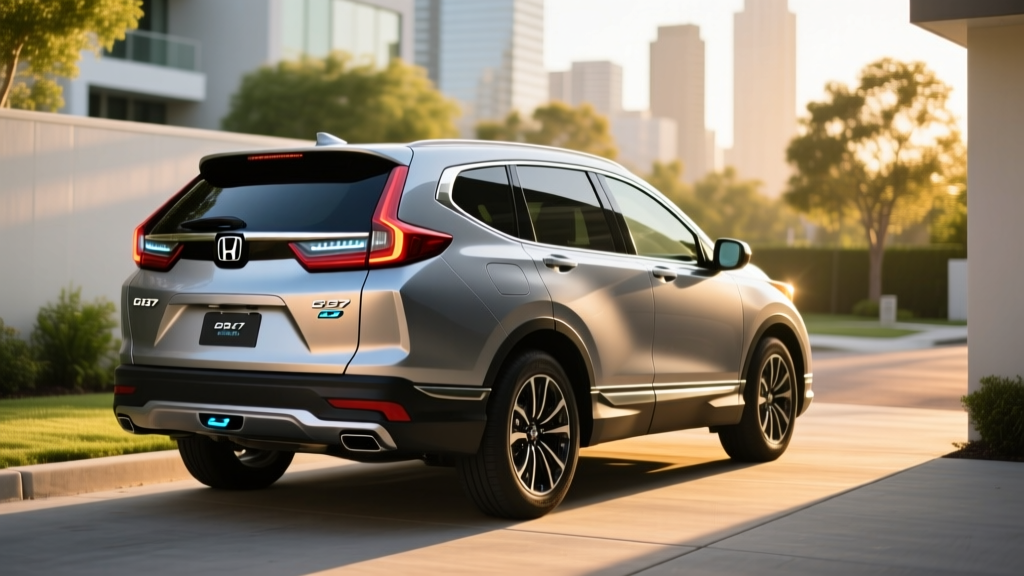
Honda's sixth-generation CR-V Hybrid has become one of the best-selling electrified compact SUVs in America, and the 2027 Honda CR-V Hybrid arrives with meaningful powertrain refinements that push efficiency and responsiveness further. If you're weighing this hybrid against a plug-in hybrid or a full battery-electric vehicle, this guide gives you the exact numbers — EPA MPG, horsepower, pricing, warranty terms, and real-world fuel economy — you need to make an informed decision.
Before going further, a critical distinction: the 2027 CR-V Hybrid is a conventional hybrid (HEV), not a plug-in hybrid. It does not plug in, has no electric-only driving mode of meaningful distance, and generates all its electricity from regenerative braking and the gasoline engine. Honda currently does not offer a CR-V PHEV in the United States market. This matters because buyers searching for "CR-V Hybrid" sometimes expect plug-in capability that simply isn't there.
HEV vs PHEV vs EV: Where the 2027 CR-V Hybrid Fits
| Attribute | 2027 CR-V Hybrid (HEV) | Typical Compact PHEV | Typical Compact BEV |
|---|---|---|---|
| Plugs in? | No | Yes (Level 1/2) | Yes (Level 1/2/DC) |
| Electric-only range | Less than 1 mile at low speed | 25–40 miles | 230–330 miles |
| Total range | ~470 miles | ~400–450 miles | 230–330 miles |
| Fueling/charging | Gas station only | Gas + home outlet/charger | Home charger + DC fast |
| Federal tax credit (§30D) | Not eligible | Up to $7,500 (varies) | Up to $7,500 (varies) |
| Starting MSRP | ~$36,000 | ~$38,000–$45,000 | ~$40,000–$55,000 |
The conventional hybrid is the right choice if you want maximum simplicity — no charging infrastructure, no behavior change, no range planning. You fill up at any gas station and drive. The trade-off is that you're still burning gasoline on every trip, and you won't qualify for the federal §30D clean vehicle credit, which applies only to plug-in vehicles with sufficient battery capacity.
2027 CR-V Hybrid Fuel Economy: EPA Ratings and Real-World MPG
The 2027 CR-V Hybrid uses Honda's updated two-motor hybrid system paired with a 2.0-liter Atkinson-cycle four-cylinder engine. Front-wheel-drive (FWD) trims return the highest EPA ratings, while the available Real Time AWD system imposes a small efficiency penalty.
| Drivetrain | EPA City | EPA Highway | EPA Combined | Real-World Expectation |
|---|---|---|---|---|
| FWD (Sport/Sport-L) | 43 MPG | 36 MPG | 40 MPG | 38–44 MPG (city-favors higher) |
| AWD (Sport Touring) | 40 MPG | 34 MPG | 37 MPG | 35–41 MPG |
Real-world note: Honda's two-motor hybrid system excels in city driving, where the electric motors handle most low-speed propulsion and the engine acts primarily as a generator. In our experience and consistent with fueleconomy.gov owner submissions, FWD CR-V Hybrids regularly achieve 42–44 MPG in mixed city driving. Highway-only trips at 75+ MPH will pull numbers closer to 33–35 MPG for AWD trims, as the system relies more heavily on the gasoline engine at sustained high speeds and aerodynamic drag increases.
With a 14.0-gallon fuel tank, the FWD CR-V Hybrid delivers approximately 470 miles of total range at the EPA combined rating — enough for most drivers to visit a gas station once every two weeks.
Powertrain Specs: Horsepower, Torque, and How It Drives
| Specification | 2027 CR-V Hybrid |
|---|---|
| Engine | 2.0L Atkinson-cycle DOHC 4-cylinder |
| Engine output | 145 HP / 134 lb-ft torque |
| Electric motors | Dual-motor system (propulsion + generation) |
| Combined system output | 204 HP / 247 lb-ft torque |
| 0–60 MPH | ~7.6 seconds (FWD), ~7.8 seconds (AWD) |
| Transmission | Direct-drive (no traditional gears) |
| Drivetrain | FWD standard; Real Time AWD available |
| Towing capacity | 1,000 lbs |
| Cargo volume (behind rear seats) | 36.3 cu ft |
| Cargo volume (rear seats folded) | 76.5 cu ft |
The 204 combined horsepower is competitive within the hybrid compact SUV segment — matching the Toyota RAV4 Hybrid's 219 HP closely while offering a more refined engine note under acceleration. The dual-motor system provides immediate torque from a stop, which makes the CR-V Hybrid feel quicker around town than its 7.6-second 0–60 time suggests. At highway merging speeds, the gasoline engine engages directly via a lock-up clutch for efficient cruising.
Pricing, Trims, and Tax Credit Eligibility
The 2027 CR-V Hybrid is offered in three trims, all positioned above the base gasoline-only CR-V:
| Trim | Drivetrain | MSRP (est.) | Federal Tax Credit |
|---|---|---|---|
| Sport | FWD or AWD | $36,395 – $38,395 | Not eligible |
| Sport-L | FWD or AWD | $39,095 – $41,095 | Not eligible |
| Sport Touring | AWD only | $43,295 | Not eligible |
Tax credit reality: Because the CR-V Hybrid is a conventional HEV — not a plug-in — it does not qualify for the federal §30D Clean Vehicle Credit. That credit requires a minimum battery capacity of 7 kWh and plug-in capability, neither of which applies here. Some states may offer modest rebates for hybrid purchases, but these vary by jurisdiction and change frequently. Check your state energy office or the Alternative Fuels Data Center for current local incentives.
For buyers who want the $7,500 federal credit, you'd need to look at a plug-in hybrid like the Toyota RAV4 Prime or a full EV such as the Hyundai Ioniq 5 or Tesla Model Y — though these come with higher purchase prices and, in the PHEV/EV case, charging considerations.
Battery Warranty, Longevity, and Replacement Cost
Hybrid Battery Warranty: Honda covers the CR-V Hybrid's lithium-ion battery pack for 8 years / 100,000 miles (10 years / 150,000 miles in CARB states including California, New York, Massachusetts, and others that follow California emissions standards). The warranty covers defects and capacity loss below a defined threshold.
Hybrid battery longevity is one of the most common buyer concerns, and the data is reassuring. Honda's hybrid system uses a relatively small battery pack (~1.1 kWh usable) that operates in a narrow state-of-charge window — typically between 40% and 80%. This shallow cycling dramatically reduces degradation compared to a full EV battery that regularly cycles from 10% to 90%.
Based on long-term data from Honda's hybrid lineup (Insight, Accord Hybrid, CR-V Hybrid since 2020), hybrid battery failures within the first 150,000 miles are uncommon. When replacement is eventually needed, a new OEM hybrid battery pack costs approximately $2,000–$3,500 including labor — far less than a full EV battery replacement. Third-party refurbishment options may reduce this cost further.
The powertrain (engine, transmission, motors) is covered under Honda's standard 5-year / 60,000-mile powertrain warranty.
Who Should Buy the 2027 CR-V Hybrid — And Who Shouldn't
Pros
- 40 MPG combined (FWD) with zero behavior change — no plugging in
- Strong low-speed torque from dual electric motors
- Class-leading cargo space at 36.3 / 76.5 cu ft
- Proven hybrid reliability with 8–10 year battery warranty
- Lower starting price than PHEV or EV competitors
- Honda Sensing ADAS suite standard on all trims
Cons
- No federal tax credit eligibility (HEV, not plug-in)
- No electric-only driving mode for short trips
- AWD reduces MPG to 37 combined
- Towing limited to 1,000 lbs
- Engine drone under hard acceleration
- Not eligible for HOV lane access in most states
Choose the 2027 CR-V Hybrid if: You want excellent fuel economy without installing a home charger or changing your fueling habits. You drive a mix of city and highway miles. You want a practical, reliable compact SUV with strong cargo capacity and don't need plug-in electric range.
Choose a PHEV (like the RAV4 Prime) if: You have home charging access, your daily commute is under 40 miles, and you want to drive mostly on electricity while retaining gas-engine flexibility for road trips. You also want the potential $7,500 federal tax credit.
Choose a full EV (like the Ioniq 5 or Model Y) if: You have reliable home Level 2 charging, your daily driving is predictable, you want zero tailpipe emissions, and you want the lowest per-mile fuel cost and minimal maintenance.
Real-World Ownership: What to Expect Month to Month
For a driver covering 12,000 miles annually at the EPA combined 40 MPG, the FWD CR-V Hybrid consumes roughly 300 gallons of fuel per year. At $3.50/gallon, that's approximately $1,050/year in fuel costs — compared to roughly $1,575/year for a comparable gas-only compact SUV rated at 28 MPG combined. The hybrid saves around $525 per year in fuel, which partially offsets its higher purchase price over time.
Maintenance costs are modest. The hybrid system requires no special service beyond standard oil changes (the engine runs less frequently, so oil stays cleaner longer), tire rotations, and brake fluid checks. Regenerative braking significantly extends brake pad life — many hybrid owners report 60,000+ miles on original brake pads.
Insurance premiums for the CR-V Hybrid are generally in line with the gas-only CR-V, with some carriers offering small hybrid discounts. Check with your insurer for specific rates.
Frequently Asked Questions
How many MPG does the 2027 CR-V Hybrid get?
The FWD CR-V Hybrid achieves an EPA-rated 43 city / 36 highway / 40 combined MPG. The AWD version drops to 40 city / 34 highway / 37 combined. In real-world city driving, FWD models often exceed 42 MPG thanks to the hybrid system's electric-motor-dominant low-speed operation.
Does the CR-V Hybrid plug in?
No. The 2027 CR-V Hybrid is a conventional hybrid (HEV). It charges its small battery exclusively through regenerative braking and the gasoline engine. Honda does not currently sell a plug-in hybrid CR-V in the US market. If you need plug-in electric range, look at competitors like the Toyota RAV4 Prime.
Does the 2027 CR-V Hybrid qualify for any tax credit?
The CR-V Hybrid does not qualify for the federal §30D Clean Vehicle Credit because it is not a plug-in vehicle. Per IRS guidelines, the credit requires a vehicle with at least 7 kWh of battery capacity and external charging capability. Some state or local incentives may apply to hybrids — check your state energy office for current programs.
How long will the CR-V Hybrid battery last?
Honda covers the hybrid battery for 8 years / 100,000 miles (10 years / 150,000 miles in CARB states). Because the system keeps the battery in a narrow 40–80% state-of-charge window, degradation is minimal. Most Honda hybrid batteries last well beyond the warranty period, with replacements needed only at high mileages (150,000+ miles) or after 12–15 years.
What does a CR-V Hybrid battery replacement cost?
A new OEM hybrid battery replacement typically costs $2,000–$3,500 including labor. This is far less than a full EV battery replacement because the CR-V Hybrid's battery pack is small (~1.1 kWh). Refurbished or aftermarket options may be available at lower cost.
Hybrid vs PHEV vs EV — which should I choose?
Choose the CR-V Hybrid (HEV) if you want better fuel economy with no infrastructure changes. Choose a PHEV if you can charge at home and want 25–40 miles of electric commuting plus gas flexibility. Choose a full EV if you have home charging, want the lowest operating costs, and are ready to plan around charging on road trips. The right answer depends entirely on your charging access, daily mileage, and budget.
Is the CR-V Hybrid good in snow and rain?
The available Real Time AWD system provides competent all-weather traction for typical winter conditions. It sends torque to the rear wheels when front-wheel slip is detected. It's not a dedicated off-road system, but it handles snowy commutes and wet highways well. The AWD penalty is roughly 3 MPG combined.