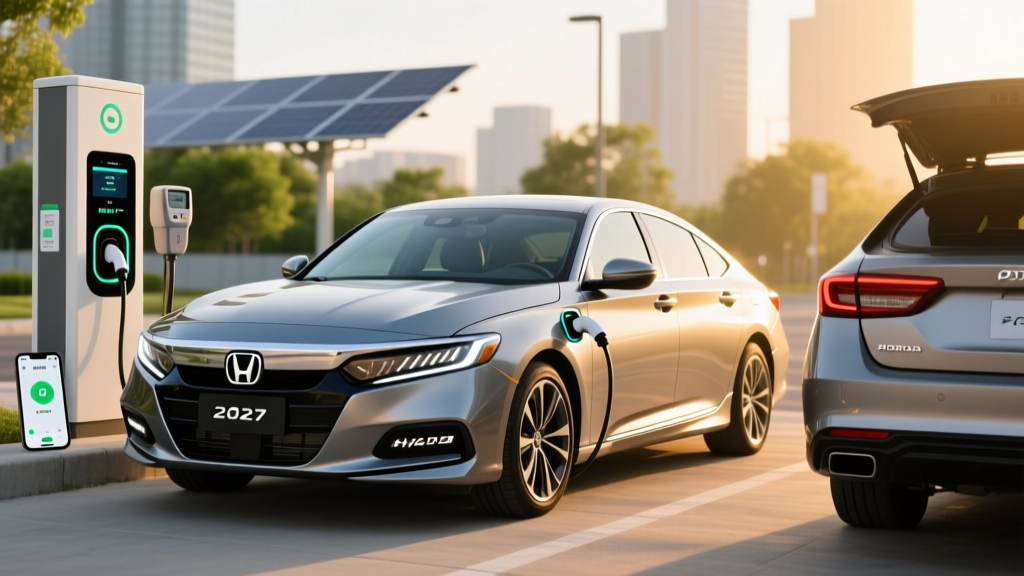
The Honda Accord Hybrid has anchored the midsize sedan segment for over a decade, and the 2027 Honda Accord Hybrid continues that tradition with a refined two-motor powertrain, strong real-world fuel economy, and Honda's proven hybrid reliability. If you're cross-shopping this car against full EVs, plug-in hybrids, or traditional gas sedans, this guide gives you every number you need to decide.
| Spec | 2027 Honda Accord Hybrid |
|---|---|
| Powertrain | 2.0L Atkinson-cycle I4 + dual-motor hybrid system |
| Combined Horsepower | 204 hp (system net) |
| Combined Torque | 247 lb-ft (electric motor peak) |
| Transmission | e-CVT (no traditional gears) |
| EPA MPG (City / Hwy / Combined) | 51 / 44 / 48 MPG (Sport/LX trims); 48 city / 47 hwy / 48 combined (Sport Touring) |
| Fuel Tank | 12.8 gallons |
| Total Driving Range | ~614 miles (EPA combined estimate) |
| 0–60 mph | ~7.1 seconds |
| Battery Type | Lithium-ion (self-charging, no plug) |
| Drivetrain | Front-wheel drive |
| Base MSRP | ~$33,990 (LX Hybrid, including destination) |
| Battery Warranty | 8 years / 100,000 miles (10 yr / 150,000 mi in CARB states) |
HEV vs. PHEV: The Accord Hybrid Is a Conventional Hybrid
Before examining specs further, a critical distinction: the 2027 Honda Accord Hybrid is a conventional hybrid electric vehicle (HEV), not a plug-in hybrid (PHEV). This matters because it shapes everything about how you own and fuel this car.
| Feature | HEV (Accord Hybrid) | PHEV (e.g., Toyota Prius Prime) | BEV (e.g., Tesla Model 3) |
|---|---|---|---|
| Plug-in charging required? | No — gasoline only | Yes — plug in for EV range | Yes — plug in for all driving |
| Electric-only range | ~1 mile at low speed | 25–44 miles typical | 250–360+ miles |
| Total range | ~614 miles | ~400–500 miles (EV + gas) | 250–360+ miles |
| Home charging needed? | No | Recommended (Level 1 or 2) | Essential (Level 2 strongly recommended) |
| Federal tax credit (§30D) | Not eligible | Up to $7,500 (subject to rules) | Up to $7,500 (subject to rules) |
| Best for | No home charging; high-mileage drivers | Short commutes + road trips | Home charging access; lower running costs |
The Accord Hybrid recharges its small lithium-ion battery entirely through regenerative braking and the gasoline engine. You never plug it in. You fuel it at any gas station. For buyers who lack access to home or workplace charging, this is a significant advantage — you get hybrid-level efficiency with zero infrastructure changes.
Fuel Economy: EPA Ratings and Real-World MPG
| Trim | City MPG | Highway MPG | Combined MPG |
|---|---|---|---|
| LX Hybrid | 51 | 44 | 48 |
| Sport Hybrid | 51 | 44 | 48 |
| EX-L Hybrid | 51 | 44 | 48 |
| Sport-L Hybrid | 51 | 44 | 48 |
| Sport Touring Hybrid | 48 | 47 | 48 |
Source: EPA Fuel Economy (fueleconomy.gov). Note that Sport Touring trims carry slightly different city/highway splits due to larger 19-inch wheels and additional equipment weight, but the combined figure remains 48 MPG.
Real-World MPG: What Owners Actually See
Honda's hybrid system excels in city driving, where the electric motors handle low-speed propulsion and the engine operates primarily as a generator. In real-world ownership, many Accord Hybrid drivers report exceeding the EPA city estimate — seeing 52–55 MPG on suburban routes with frequent stops. This is a common hybrid phenomenon: regenerative braking recaptures energy that a gas car wastes as heat.
Highway driving tells a different story. At sustained 70–80 mph speeds, the engine drives the wheels directly (via a lock-up clutch), and aerodynamic drag dominates. Expect 40–44 MPG on the highway in real-world conditions, roughly matching or slightly below the EPA figure. Cold weather (below 40°F) typically reduces fuel economy by 5–10% due to increased engine warm-up time and cabin heating demands.
For a 12,000-mile-per-year driver averaging 48 MPG combined at $3.50/gallon fuel, annual fuel cost runs approximately $875. A comparable gas-only midsize sedan at 30 MPG would cost roughly $1,400 — a savings of over $500 per year with the hybrid.
Powertrain Deep Dive: Two-Motor Hybrid System
The Accord Hybrid uses Honda's fourth-generation two-motor hybrid system, which operates in three distinct modes:
- EV Drive: The electric propulsion motor powers the wheels alone using battery energy. Used for gentle acceleration from a stop and low-speed cruising (typically under 1 mile of pure EV operation).
- Hybrid Drive: The gasoline engine spins a generator motor that produces electricity, which feeds the propulsion motor. The engine does not directly drive the wheels. This mode covers most city and suburban driving and is where the Accord Hybrid achieves its best efficiency.
- Engine Drive: At highway cruising speeds, a lock-up clutch connects the 2.0L Atkinson-cycle engine directly to the front wheels for maximum mechanical efficiency. The electric motor can add torque for passing.
The 2.0L engine produces 146 hp and 134 lb-ft of torque on its own, while the propulsion motor delivers 184 hp and 247 lb-ft. System net output is 204 hp. The e-CVT has no traditional belt or pulleys — it's an electromechanical coupling system, which contributes to Honda's strong hybrid reliability record.
Acceleration is respectable at approximately 7.1 seconds to 60 mph. The instant torque from the electric motor (247 lb-ft available from near zero RPM) makes the Accord Hybrid feel punchy around town, even if it won't win drag races. Drive modes (ECON, Normal, Sport) adjust throttle mapping and regeneration aggressiveness.
Pricing, Trims, and Tax Credit Eligibility
The 2027 Honda Accord Hybrid is available across five trims, with pricing that reflects Honda's strategy of making hybrid the default powertrain for the Accord lineup:
- LX Hybrid: ~$33,990 — 17-inch wheels, Honda Sensing suite, 10.2-inch digital cluster, wireless Apple CarPlay/Android Auto
- Sport Hybrid: ~$35,290 — Black 19-inch wheels, sport-tuned suspension, heated front seats, leather-wrapped steering wheel
- EX-L Hybrid: ~$37,390 — Leather-trimmed interior, power moonroof, wireless phone charger, heated rear seats
- Sport-L Hybrid: ~$37,890 — Sport exterior styling with leather interior and premium audio
- Sport Touring Hybrid: ~$40,490 — Bose 12-speaker audio, navigation, heated/ventilated front seats, low-speed braking control
Federal Tax Credit: What You Need to Know
Because the 2027 Honda Accord Hybrid is a conventional hybrid (HEV), it does not qualify for the federal §30D Clean Vehicle Credit. That credit — up to $7,500 — applies only to battery electric vehicles (BEVs) and plug-in hybrids (PHEVs) that meet specific battery sourcing, critical mineral, MSRP, and buyer income requirements under current IRS rules.
Some states offer their own incentives for hybrids, though these are less common than EV incentives. Check your state's energy or environmental agency for current programs. Honda occasionally offers manufacturer incentives or low-APR financing on the Accord Hybrid — check with local dealers.
Hybrid Battery Warranty & Replacement Cost
Honda covers the Accord Hybrid's lithium-ion battery pack with a warranty of 8 years / 100,000 miles in most states. In California Air Resources Board (CARB) states — including California, New York, Massachusetts, and several others — the warranty extends to 10 years / 150,000 miles.
The warranty guarantees that the battery will retain sufficient capacity to function properly. If the battery fails within the warranty period, Honda replaces it at no cost.
Out-of-warranty replacement cost: Based on current Honda hybrid battery pricing, a full replacement runs approximately $2,500–$4,500 including parts and labor at a dealership. Independent hybrid specialists may offer lower pricing. However, widespread failures of Honda's hybrid batteries are rare — the system is designed for longevity, and many Accord Hybrid owners exceed 150,000+ miles without battery issues. Honda's hybrid system uses a relatively small battery that rarely cycles through full charge/discharge, reducing degradation stress.
Reliability and Long-Term Ownership
Honda's hybrid powertrain has accumulated a strong reliability track record across the Accord, CR-V, and Civic Hybrid lineages. The two-motor e-CVT design eliminates traditional transmission wear components (no clutch packs, torque converters, or belt-driven CVTs to fail). The IIHS has historically rated the Accord as a Top Safety Pick, and Honda Sensing (standard adaptive cruise, lane-keeping, automatic emergency braking, and road departure mitigation) provides robust Level 2 driver assistance.
Key reliability considerations:
- Hybrid battery: As noted, failures are uncommon. Honda's battery management system keeps the pack within a conservative state-of-charge window, avoiding the deep cycles that accelerate degradation.
- Brake wear: Regenerative braking handles most deceleration, so friction brake pads often last 80,000+ miles — significantly longer than on gas-only vehicles.
- No oil changes? You still need them — the 2.0L engine requires regular oil changes per Honda's maintenance minder (typically every 7,500–10,000 miles with synthetic oil).
- Coolant: The hybrid system has a separate inverter coolant circuit; Honda recommends inspection at scheduled intervals.
Who Should Buy the 2027 Honda Accord Hybrid?
Choose the Accord Hybrid If:
- You lack access to home or workplace EV charging (apartment, street parking, no garage)
- You drive 12,000+ miles per year and want to minimize fuel costs without behavioral changes
- You take frequent long road trips and don't want to plan around charging stops
- You want a proven, low-risk powertrain with strong resale value and dealer support
- You prefer a midsize sedan with a spacious rear seat and 16.7 cu-ft trunk
Consider a PHEV Instead If:
- You have home charging and a short commute (under 30 miles) — a PHEV like the Toyota Prius Prime lets you drive most days on electricity alone
- You want to reduce gasoline consumption to near-zero for daily driving while keeping gas for road trips
- You want eligibility for the federal §30D tax credit (up to $7,500, subject to income and sourcing rules)
Consider a Full EV Instead If:
- You have reliable Level 2 home charging and rarely drive more than 250 miles in a single day
- You want the lowest per-mile energy cost (electricity at $0.14/kWh ≈ $0.04/mile vs. gas at $3.50/gal at 48 MPG ≈ $0.07/mile)
- You want zero tailpipe emissions and minimal drivetrain maintenance (no oil changes, no spark plugs)
Pros and Cons at a Glance
Pros
- 48 MPG combined EPA — among the best in the midsize sedan class
- No plug-in charging required — zero infrastructure barriers
- Strong city MPG (51) with real-world potential to exceed EPA
- Spacious cabin with 16.7 cu-ft trunk; no battery intrusion into cargo area
- Honda Sensing standard on all trims (Level 2 ADAS)
- Proven hybrid reliability with 8–10 year battery warranty
- Refined, quiet operation in EV and Hybrid Drive modes
Cons
- Not eligible for the federal §30D EV tax credit
- Highway MPG (44) trails city MPG — less efficient on long highway trips
- No all-wheel-drive option (AWD available on CR-V Hybrid but not Accord)
- FWD only may limit appeal in heavy snow regions
- 204 hp is adequate but not sporty — not a performance sedan
- Infotainment can feel dated compared to EV competitors' large screens
Frequently Asked Questions
How many MPG does the 2027 Honda Accord Hybrid get?
The EPA rates most Accord Hybrid trims at 51 city / 44 highway / 48 combined MPG. The Sport Touring trim is rated at 48 city / 47 highway / 48 combined. In real-world driving, city MPG often exceeds the EPA estimate (52–55 MPG), while highway driving at 75+ mph typically yields 40–44 MPG.
Does the Accord Hybrid need to be plugged in?
No. The Accord Hybrid is a conventional hybrid (HEV). It charges its battery entirely through regenerative braking and the gasoline engine. You fuel it exclusively at gas stations.
Is the Accord Hybrid a PHEV or HEV?
It is an HEV (conventional hybrid). Honda does not currently offer a plug-in hybrid version of the Accord in the US market. If you want a Honda PHEV, you would need to look at other models or consider a competitor like the Toyota Prius Prime or Hyundai Sonata PHEV.
How long does the Accord Hybrid battery last?
Honda's hybrid batteries are designed to last the life of the vehicle. The battery is covered by an 8-year/100,000-mile warranty (10 years/150,000 miles in CARB states). Many Honda hybrid owners report no battery issues well past 150,000 miles. Out-of-warranty replacement costs approximately $2,500–$4,500 if needed.
Does the 2027 Honda Accord Hybrid qualify for any tax credit?
Not the federal §30D Clean Vehicle Credit — that credit applies only to BEVs and PHEVs meeting specific battery-sourcing, MSRP, and income requirements. Some states may offer hybrid-specific incentives, and Honda may offer manufacturer financing deals. Consult a tax professional or IRS.gov for current eligibility details.
How does the Accord Hybrid compare to a full EV on cost?
At 48 MPG and $3.50/gallon gas, the Accord Hybrid costs roughly $0.073 per mile in fuel. A comparable EV at 3.5 miles/kWh and $0.14/kWh home electricity costs about $0.04 per mile. Over 12,000 miles per year, the EV saves approximately $400 in energy costs. However, the Accord Hybrid avoids any home charging installation cost ($500–$2,000+) and eliminates range-planning concerns on long trips.
Is the Accord Hybrid good for highway driving?
It's competent but not exceptional on the highway. The engine-drive mode provides efficient cruising, and Honda Sensing makes long trips less fatiguing. However, highway fuel economy (44 MPG EPA, sometimes lower in real-world 75+ mph driving) is the hybrid's weakest efficiency scenario. For predominantly highway commuters, the advantage over a efficient gas sedan narrows.
Note: Pricing and specifications are based on Honda's announced 2027 model-year information and are subject to change. Verify final MSRP, trim availability, and specifications with your local Honda dealer. Tax credit rules referenced are current as of publication; consult IRS.gov or a tax professional for your specific eligibility.