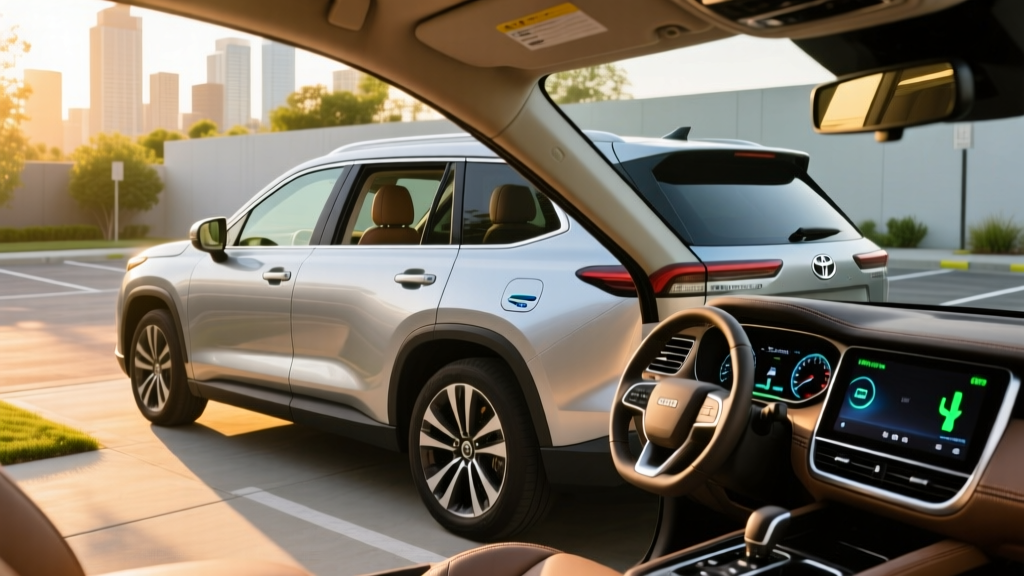
Toyota's three-row family hauler continues into the 2027 model year with the same two hybrid powertrains that have made it a segment standout since its debut. The standard Grand Highlander Hybrid pairs a 2.5-liter four-cylinder with electric motors for maximum efficiency, while the Hybrid MAX swaps in a turbocharged 2.4-liter for buyers who want more passing power at a modest fuel-economy penalty. Neither variant requires plugging in — this is a conventional hybrid (HEV), not a plug-in hybrid (PHEV).
Below, we break down the real-world MPG you can expect, the trim and pricing structure for 2027, warranty coverage on the hybrid battery, and whether the Grand Highlander Hybrid is the right choice versus a full EV or a conventional gas SUV.
HEV vs PHEV: What the Grand Highlander Hybrid Actually Is
A common source of confusion in Toyota's lineup is the difference between a hybrid and a plug-in hybrid. Here's the quick distinction:
| Feature | HEV (Grand Highlander Hybrid) | PHEV (e.g., RAV4 Prime) | BEV (e.g., bZ4X) |
|---|---|---|---|
| Plugs in to charge? | No — charges via engine & regen | Yes — Level 1/2 charging | Yes — Level 1/2/DC fast |
| Electric-only driving | Brief, low-speed EV mode | 25–42 mi on battery alone | 200–300+ mi on battery |
| Federal tax credit (§30D) | Not eligible | Up to $7,500 (if sourcing/income rules met) | Up to $7,500 (if sourcing/income rules met) |
| Gas engine | Yes — primary power source | Yes — kicks in after EV range | None |
| Best for | No home charging access; long trips | Home charging + daily commute under 40 mi | Home charging + mostly under 300 mi/day |
Toyota does not currently offer a Grand Highlander plug-in hybrid variant. If you want PHEV three-row capability from Toyota, the closest option is the Sienna (minivan) or the Highlander PHEV expected for future model years. For 2027, the Grand Highlander remains HEV-only in its electrified form, alongside the gas-only 2.4T turbo model.
2027 Grand Highlander Hybrid Fuel Economy: EPA and Real-World MPG
The standard hybrid powertrain — a 2.5-liter inline-four paired with front and rear electric motors producing a combined 245 horsepower — is the efficiency champion of the lineup. According to EPA data on fueleconomy.gov, the AWD Grand Highlander Hybrid returns:
| Powertrain | City MPG | Highway MPG | Combined MPG | Total Range (est.) |
|---|---|---|---|---|
| 2.5L Hybrid AWD | 36 | 35 | 36 | ~519 mi (14.3 gal tank) |
| 2.5L Hybrid FWD | 37 | 36 | 37 | ~529 mi |
| Hybrid MAX AWD (2.4T) | 27 | 28 | 27 | ~386 mi |
| Gas 2.4T AWD (non-hybrid) | 21 | 27 | 24 | ~343 mi |
Real-world MPG reality check: Toyota hybrids routinely match or slightly exceed their EPA city estimates in stop-and-go driving because regenerative braking recovers energy that gas-only vehicles waste as heat. On the highway, expect the standard hybrid to deliver 33–35 MPG at 70 mph — close to the sticker. The Hybrid MAX, with its turbo engine and sportier tuning, will typically return 25–27 MPG in mixed driving. In cold weather (below 30°F), both powertrains lose roughly 5–8% efficiency as the engine runs longer to provide cabin heat and reach operating temperature.
Powertrain Specs: Standard Hybrid vs Hybrid MAX
| Specification | 2.5L Hybrid | Hybrid MAX (2.4T) |
|---|---|---|
| Engine | 2.5L 4-cyl Atkinson cycle | 2.4L turbo 4-cyl |
| Combined horsepower | 245 hp | 362 hp |
| Combined torque | 173 lb-ft (engine) + electric motor torque | 400 lb-ft |
| Transmission | eCVT (planetary gearset) | 6-speed automatic |
| Drivetrain | FWD or AWD (eAxle rear motor) | AWD standard (eAxle rear) |
| 0–60 mph (est.) | ~7.8 sec | ~6.3 sec |
| Towing capacity | 3,500 lb | 5,000 lb |
| Hybrid battery | ~1.6 kWh NiMH (sealed) | ~1.6 kWh NiMH (sealed) |
The standard hybrid uses Toyota's proven series-parallel hybrid system: the engine and electric motors can drive the wheels independently or together, with the eCVT managing power blending seamlessly. The Hybrid MAX uses a different architecture — the turbo engine is the primary driver, with electric motors providing torque fill and AWD capability via the rear eAxle. The result is a much more responsive, V6-rivaling feel at the cost of about 9 MPG combined.
Pricing and Trims for 2027
Based on Toyota's published MSRP structure, the 2027 Grand Highlander Hybrid lineup is expected to carry forward with minimal changes from 2026 pricing:
- LE Hybrid: ~$42,100 (FWD) / ~$43,700 (AWD)
- XLE Hybrid: ~$45,800 (FWD) / ~$47,400 (AWD)
- Limited Hybrid: ~$50,200 (FWD) / ~$51,800 (AWD)
- Hybrid MAX Limited: ~$55,500 (AWD only)
- Hybrid MAX Platinum: ~$59,000 (AWD only)
Tax credit eligibility: The Grand Highlander Hybrid is a conventional HEV, not a plug-in vehicle. It does not qualify for the federal §30D Clean Vehicle Credit of up to $7,500. That credit is reserved for battery-electric vehicles (BEVs) and plug-in hybrids (PHEVs) that meet battery-sourcing, critical-mineral, MSRP-cap, and buyer-income requirements. Some states offer smaller rebates for conventional hybrids — check your state energy office or Alternative Fuels Data Center for local incentive details, as these vary by jurisdiction.
Battery Warranty, Reliability, and Replacement Cost
Hybrid battery warranty: Toyota covers the hybrid battery and all hybrid system components for 10 years / 150,000 miles, whichever comes first, on all 2020-and-newer models. This is one of the longest hybrid warranties in the industry.
Powertrain warranty: 5 years / 60,000 miles.
Basic warranty: 3 years / 36,000 miles.
Toyota's hybrid system is among the most proven in the industry, with over 25 years of continuous refinement since the original Prius. The 2.5L hybrid powertrain in the Grand Highlander shares architecture with the Camry Hybrid, RAV4 Hybrid, and Sienna — all high-volume models with extensive real-world reliability data.
The hybrid battery itself is a small (~1.6 kWh) nickel-metal-hydride pack that undergoes shallow charge/discharge cycles, which dramatically extends its lifespan compared to a full EV battery. In practice, Toyota hybrid batteries routinely last 150,000–200,000+ miles before significant degradation. If replacement is ever needed out of warranty, a refurbished hybrid battery for this platform typically runs $2,000–$3,500 installed at an independent hybrid specialist, or roughly $4,000–$5,500 at a Toyota dealer with a new OEM unit. For comparison, a full EV battery replacement can cost $10,000–$20,000+.
Who Should Choose the Grand Highlander Hybrid vs an EV or Gas SUV?
Pros
- 36 MPG combined in a 3-row SUV — best-in-class efficiency
- No charging infrastructure needed; fill up at any gas station
- 519+ mile total range eliminates range anxiety entirely
- 10-year/150,000-mile hybrid battery warranty
- 3,500-lb towing (standard hybrid) or 5,000-lb (Hybrid MAX)
- Strong resale value — Toyota hybrids hold value well
Cons
- No federal tax credit — HEV is ineligible for §30D
- No electric-only commuting capability (unlike a PHEV)
- Standard hybrid is adequate, not quick (7.8 sec 0–60)
- Hybrid MAX fuel economy (27 MPG) trails standard hybrid significantly
- Third row is usable but tight for adults on long trips
- Higher starting price than gas-only Grand Highlander (~$4,000 premium)
Choose the Grand Highlander Hybrid if: You need three rows, want to minimize fuel costs without changing your refueling habits, take regular road trips where charging infrastructure is sparse, or don't have access to home Level 2 charging. The standard hybrid is the clear value pick — 36 MPG in a vehicle this size is exceptional.
Consider a PHEV instead if: You have home charging and your daily commute is under 30 miles. A plug-in hybrid like the Chrysler Pacifica PHEV (32 mi electric-only) lets you drive most weekdays on electricity while keeping a gas engine for road trips.
Consider a full EV if: You have reliable home Level 2 charging, your daily driving is under 250 miles, and you want to eliminate gasoline entirely while qualifying for the federal tax credit. The Kia EV9 (279 mi EPA, starting ~$55,000 before credits) is the closest three-row electric competitor, though at a higher price point.
Frequently Asked Questions
How many MPG does the 2027 Grand Highlander Hybrid get?
The standard 2.5L Hybrid achieves 36 MPG combined (36 city / 35 highway) with AWD, or 37 combined with FWD. The performance-oriented Hybrid MAX returns 27 MPG combined. Both figures are EPA-estimated; real-world results vary with driving style, terrain, and temperature.
Does the Grand Highlander Hybrid need to be plugged in?
No. The Grand Highlander Hybrid is a conventional hybrid (HEV). It charges its small battery through regenerative braking and the gasoline engine. You never plug it in — you simply fill it with gasoline like any other car.
Is there a plug-in hybrid (PHEV) version of the Grand Highlander?
Not for the 2027 model year. Toyota has not announced a Grand Highlander PHEV. If you want a Toyota plug-in hybrid with three rows, the Sienna minivan offers a hybrid powertrain (though also not a PHEV as of 2027). The RAV4 Prime offers 42 miles of electric-only range but only seats five.
Does the Grand Highlander Hybrid qualify for a federal tax credit?
No. The federal §30D Clean Vehicle Credit applies only to battery-electric vehicles (BEVs) and plug-in hybrids (PHEVs) that meet specific battery-sourcing, MSRP, and buyer-income requirements. Conventional hybrids like the Grand Highlander Hybrid are not eligible. Some states may offer modest hybrid rebates — check your local programs.
How reliable is the Grand Highlander Hybrid, and what does a battery replacement cost?
Toyota's hybrid system has over 25 years of proven reliability. The hybrid battery is covered by a 10-year/150,000-mile warranty. Out-of-warranty replacement typically costs $2,000–$3,500 with a refurbished unit or $4,000–$5,500 for a new OEM battery at a dealer. In practice, most Toyota hybrid batteries last 150,000–200,000+ miles before needing replacement.
What is the difference between the standard Hybrid and the Hybrid MAX?
The standard Hybrid uses a 2.5L four-cylinder with electric motors for 245 combined horsepower and 36 MPG. The Hybrid MAX uses a turbocharged 2.4L engine with electric assist for 362 horsepower and 27 MPG, plus a 5,000-lb towing capacity (vs. 3,500 lb). The MAX is significantly quicker (6.3 sec 0–60 vs. 7.8 sec) but costs roughly $5,000–$7,000 more and sacrifices 9 MPG.
Hybrid vs PHEV vs EV — which three-row SUV is right for me?
If you lack home charging or regularly drive over 300 miles between stops, the Grand Highlander Hybrid (HEV) is the safest choice — no infrastructure needed, 519-mile range. If you have home charging and a short commute, a PHEV gives you electric-only weekday driving with gas backup. If you have home charging, mostly drive under 250 miles daily, and want to maximize savings and incentives, a three-row BEV like the Kia EV9 eliminates gasoline entirely and may qualify for a $7,500 federal credit.