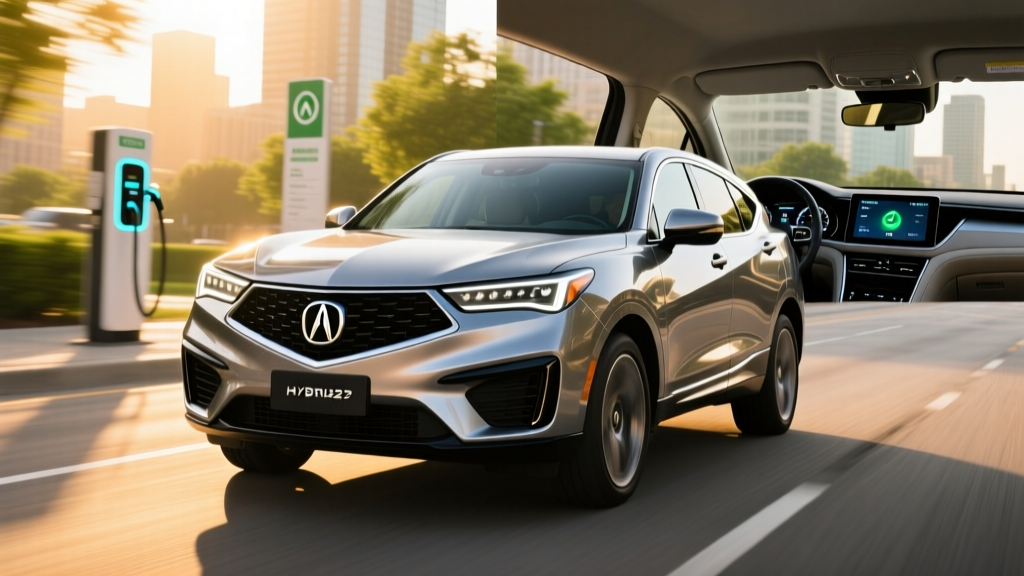
Acura's compact luxury SUV has been overdue for an electrified powertrain, and the 2027 Acura RDX Hybrid is poised to deliver one. Following the brand's broader electrification push — which includes the all-electric ZDX and the redesigned 2025 MDX with its available hybrid variant — the next-generation RDX is expected to adopt a hybrid system that bridges the gap between Acura's turbocharged gas models and its full-EV ambitions.
As of early 2026, Acura has not published final specifications for the 2027 RDX Hybrid. The details below are based on Acura's announced powertrain strategy, the hybrid architecture already deployed in the MDX and Honda CR-V Hybrid, and industry reporting on the next-gen RDX platform. All figures are preliminary estimates and subject to change before the vehicle goes on sale.
What We Know About the 2027 Acura RDX Hybrid Powertrain
Acura's parent company Honda has invested heavily in its fourth-generation two-motor hybrid system, which pairs a 2.0-liter Atkinson-cycle four-cylinder engine with dual electric motors. This is the same architecture that underpins the Accord Hybrid and CR-V Hybrid, both of which have earned strong efficiency marks. For the RDX, expect a tuned version of this system optimized for the luxury compact SUV's weight and performance targets.
The anticipated combined output is approximately 290–310 horsepower, a meaningful bump over the current RDX's 272-hp turbocharged 2.0L. The hybrid system's electric motors provide instant torque from standstill, which should improve both 0–60 mph times (estimated 6.5–7.0 seconds) and low-speed responsiveness in city driving.
| Specification | Estimated Figure |
|---|---|
| Engine | 2.0L Atkinson-cycle 4-cylinder |
| Hybrid System | Two-motor (Honda 4th-gen) |
| Combined Horsepower | ~290–310 hp |
| Combined Torque | ~290–310 lb-ft |
| Transmission | e-CVT (no traditional gears) |
| Drivetrain | SH-AWD (expected standard) |
| 0–60 mph | ~6.5–7.0 sec (est.) |
Acura's Super Handling All-Wheel Drive (SH-AWD) is expected to remain standard or widely available. In the hybrid implementation, the rear axle may be driven partly or wholly by an electric motor, improving both traction and efficiency versus a mechanical AWD system.
HEV vs. PHEV: Which RDX Hybrid Is Coming?
Industry reports and Acura's product roadmap suggest the 2027 RDX will launch first as a conventional hybrid (HEV) — meaning it does not plug in and recharges its small battery entirely through regenerative braking and the gasoline engine. A plug-in hybrid (PHEV) variant could follow in a subsequent model year, mirroring Honda's strategy with the CR-V, which offers both HEV and PHEV trims in global markets.
| Feature | Conventional Hybrid (HEV) | Plug-In Hybrid (PHEV) |
|---|---|---|
| Plug-in charging? | No — self-charging | Yes — plug in to charge |
| Battery size | ~1.0–1.5 kWh | ~15–18 kWh (est.) |
| Electric-only range | ~1 mile or less at low speed | ~30–38 miles (est.) |
| Federal tax credit | Not eligible under §30D | Up to $7,500 (if eligible) |
| Home charging needed? | No | Recommended for full benefit |
For buyers who cannot install a home charger or lack access to workplace charging, the conventional HEV is the more practical choice — it requires zero behavioral change versus a gas-only RDX. The PHEV, if offered, would suit drivers with short commutes (under 35 miles round-trip) who can charge nightly at home.
Estimated Fuel Economy: MPG Breakdown
The current gas-only 2025 Acura RDX achieves an EPA-estimated 21 city / 27 highway / 23 combined MPG with SH-AWD, per fueleconomy.gov. The hybrid variant should deliver a substantial improvement, particularly in city driving where the electric motors handle low-speed propulsion and regenerative braking recaptures energy.
| Configuration | City MPG | Highway MPG | Combined MPG |
|---|---|---|---|
| RDX Hybrid (HEV, AWD est.) | ~36 | ~33 | ~35 |
| RDX Gas (2025 SH-AWD, actual EPA) | 21 | 27 | 23 |
| Improvement (HEV vs. gas) | +71% | +22% | +52% |
These estimates are informed by the Honda CR-V Hybrid AWD, which achieves an EPA-rated 40 city / 34 highway / 37 combined MPG in a lighter, less powerful package. The RDX's additional weight, luxury insulation, and SH-AWD system will reduce efficiency somewhat, but the city-driving advantage of hybridization should remain pronounced.
If a PHEV Arrives: Electric-Only Range and Charging
Should Acura introduce a PHEV variant of the next-gen RDX, the most likely battery configuration would be a 15–18 kWh lithium-ion pack, yielding an estimated 30–38 miles of electric-only range. This would cover the daily commute for a majority of U.S. drivers — the FHWA's National Household Travel Survey shows the average American drives roughly 37 miles per day.
| Charging Method | Power | 0–100% Time (Est.) |
|---|---|---|
| Level 1 (120V household outlet) | ~1.4 kW | ~11–13 hours |
| Level 2 (240V home charger) | ~3.3–6.6 kW | ~2.5–5 hours |
| DC Fast Charging | Unlikely to be supported | N/A |
Most Honda/Acura PHEVs to date have not supported DC fast charging, relying on Level 2 for overnight replenishment. If this holds for the RDX PHEV, owners would need a Level 2 home charger (240V) for practical daily use. A standard 120V outlet would technically work but would require nearly a full day for a complete charge — feasible only for very low daily mileage.
Pricing, Trims, and Tax Credit Eligibility
The 2025 Acura RDX starts at approximately $44,350 (including destination) for the base SH-AWD trim, with the range-topping RDX Type S Advance Package reaching roughly $55,000. A hybrid powertrain typically commands a $1,500–$3,000 premium over the equivalent gas model in Honda/Acura's lineup.
| Trim (Est.) | Gas RDX MSRP | Hybrid Premium | Est. Hybrid MSRP |
|---|---|---|---|
| Base / Technology | ~$45,000 | +$2,000 | ~$47,000 |
| A-Spec | ~$49,000 | +$2,000 | ~$51,000 |
| Advance | ~$53,000 | +$2,500 | ~$55,500 |
Federal tax credit eligibility: Under the current IRS §30D Clean Vehicle Credit rules, conventional hybrids (HEVs) do not qualify for the up-to-$7,500 federal tax credit. Only plug-in hybrids with a battery capacity of at least 7 kWh and all-electric vehicles are eligible — and even then, the vehicle must meet MSRP caps ($80,000 for SUVs), buyer income limits ($300,000 joint / $150,000 single), and critical-mineral/battery-component sourcing requirements.
If a PHEV RDX is eventually offered and meets all sourcing requirements, it could qualify for a partial or full credit. However, given the stringent battery-component rules that tighten annually, buyers should verify eligibility on the IRS website or consult a tax professional at the time of purchase. The credit can now be transferred to the dealer at the point of sale, effectively reducing the purchase price upfront — but only if the specific vehicle VIN is confirmed eligible.
Reliability and Battery Warranty: What to Expect
Honda's hybrid systems have compiled an excellent reliability track record over two decades, from the early Insight and Civic Hybrid to the current Accord and CR-V Hybrid. The fourth-generation two-motor system is simpler than a traditional transmission-based hybrid — it eliminates the conventional gearbox entirely, using the electric motors as the primary drive mechanism at most speeds.
- Hybrid battery warranty: Expected 8 years / 100,000 miles (standard for Honda/Acura hybrids; 10 years/150,000 miles in CARB states like California, New York, and others)
- Hybrid system components warranty: Expected 8 years / 100,000 miles
- Estimated battery replacement cost: $2,500–$4,500 (based on current Honda/Acura hybrid battery pricing)
- Real-world longevity: Honda hybrid batteries routinely last 150,000–200,000+ miles before significant capacity loss
The smaller battery in a conventional HEV (roughly 1–1.5 kWh) is far less expensive to replace than a full EV battery pack ($10,000–$20,000+). And because HEV batteries are shallow-cycled — they never fully discharge or fully charge — degradation is minimal over the vehicle's lifetime. Most hybrid owners will never need a battery replacement.
Who Should Choose the RDX Hybrid vs. a Full EV or Gas Model?
- You want 35+ MPG without changing your fueling habits
- You don't have access to home or workplace charging
- You take frequent road trips and don't want to plan around chargers
- You want SH-AWD for snow/rain with better efficiency than a gas SUV
- You plan to keep the vehicle 8+ years and value proven reliability
- You can install a Level 2 home charger
- Your daily driving is under 250 miles and you rarely road-trip
- You want to eliminate gasoline costs entirely
- You're eligible for the full $7,500 federal credit on a qualifying EV
- You want the lowest possible maintenance costs (no oil, filters, or spark plugs)
The conventional hybrid is the pragmatic middle ground: it delivers roughly 50% better fuel economy than the gas RDX with zero lifestyle adjustment. For luxury compact SUV buyers who aren't ready to commit to a full EV — whether due to apartment living, limited charging infrastructure, or frequent long-distance travel — the 2027 RDX Hybrid should be one of the most compelling options in its class.
How the RDX Hybrid Stacks Up Against Competitors
The luxury compact SUV segment has been slow to adopt hybridization, but several rivals already offer electrified powertrains:
| Model | Type | Combined MPG / MPGe | Est. Combined HP | Starting MSRP (2025) |
|---|---|---|---|---|
| 2027 Acura RDX Hybrid (est.) | HEV | ~35 MPG | ~300 hp | ~$47,000 |
| Lexus NX 350h | HEV | 39 MPG | 244 hp | $43,815 |
| BMW X3 xDrive30e | PHEV | 60 MPGe (combined gas+elec) | 292 hp | $56,595 |
| Volvo XC60 Recharge | PHEV | 63 MPGe / 35 mi EV range | 455 hp | $59,595 |
| Lincoln Corsair Grand Touring | PHEV | 78 MPGe / 28 mi EV range | 266 hp | $55,420 |
The Lexus NX 350h is the efficiency benchmark in this segment at 39 MPG combined, but it sacrifices performance (244 hp). The European PHEVs (BMW, Volvo) offer electric-only commuting but at significantly higher price points and with the requirement to plug in regularly to realize their efficiency advantage. The RDX Hybrid's positioning — roughly 300 hp with ~35 MPG at a sub-$50,000 starting price — could make it the best-balanced option for buyers who want both performance and efficiency without plugging in.
Frequently Asked Questions
How many MPG does the 2027 Acura RDX Hybrid get?
Based on the Honda/Acura hybrid architecture and the RDX's weight class, we estimate approximately 36 city / 33 highway / 35 combined MPG for the HEV with AWD. Final EPA figures will be published closer to launch. Real-world city driving may exceed the EPA estimate; highway driving at 75+ mph will likely return 30–32 MPG.
Will the 2027 RDX Hybrid need to be plugged in?
The initial hybrid variant is expected to be a conventional HEV, which does not plug in. It charges its battery through regenerative braking and the gasoline engine. If a PHEV variant follows later, that version would require plugging in for optimal efficiency but could still operate as a regular hybrid when the battery is depleted.
Does the 2027 Acura RDX Hybrid qualify for a tax credit?
A conventional hybrid (HEV) does not qualify for the federal §30D Clean Vehicle Credit. Only plug-in hybrids and full EVs are eligible, subject to MSRP, income, and battery-sourcing requirements. Check the IRS Clean Vehicle Credit page for the latest rules at the time of purchase.
Is the RDX Hybrid reliable, and what does a battery replacement cost?
Honda's hybrid systems have demonstrated strong long-term reliability over 20+ years of production. The hybrid battery warranty is expected at 8 years/100,000 miles (10 years/150,000 miles in CARB states). Replacement cost, if ever needed, is estimated at $2,500–$4,500 — far less than an EV battery. Most hybrid batteries last 150,000+ miles without issue.
When will the 2027 Acura RDX Hybrid be available?
Acura has not confirmed an exact on-sale date. Based on the typical product cycle and industry reporting, the next-generation RDX is expected to debut in late 2026 as a 2027 model, with deliveries beginning in the first half of 2027. Acura will publish official specifications and pricing closer to launch.
Hybrid vs. PHEV vs. EV — which is right for me?
HEV (conventional hybrid): Best if you want better MPG with zero behavior change. No plug, no range anxiety, just fill up at any gas station. PHEV (plug-in hybrid): Best if you have home charging and a short commute — you can drive on electricity most days and use gas for longer trips. BEV (full electric): Best if you can charge at home, want the lowest operating costs, and don't mind planning around DC fast chargers on road trips. Each has trade-offs; the right choice depends on your driving patterns, charging access, and budget.