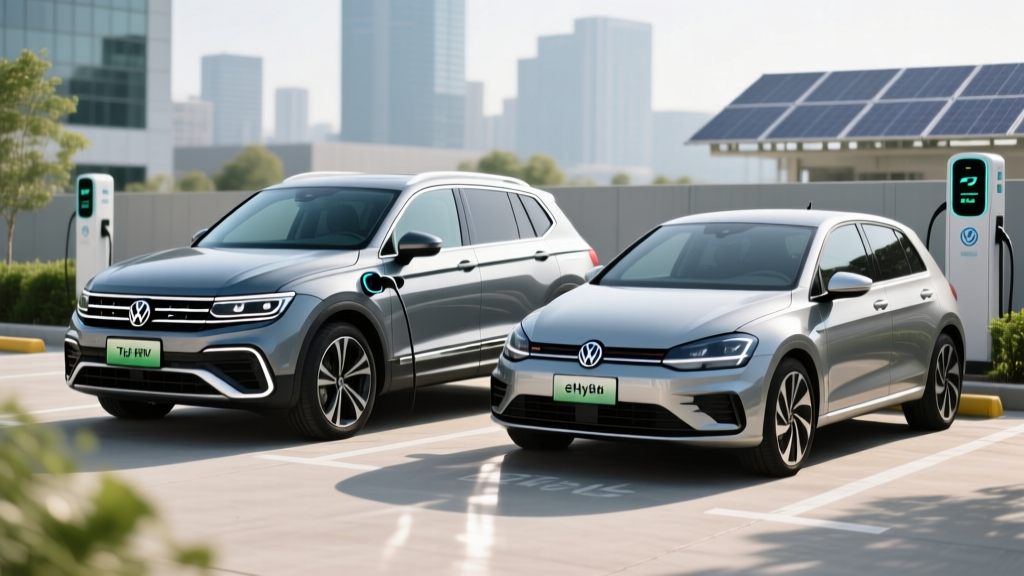
Volkswagen has reshaped its electrification strategy for the US market, and for 2026, the brand's hybrid offerings center on two distinct models: the compact Tiguan eHybrid (a plug-in hybrid SUV) and the Golf eHybrid (a plug-in hybrid hatchback). If you've been searching for a hybrid VW that balances electric commuting capability with gasoline road-trip range, these are the models to evaluate.
This guide covers everything US buyers need to know — EPA fuel economy, electric-only range, powertrain specs, charging requirements, federal tax credit eligibility, and how VW's plug-in hybrids stack up against full EVs and conventional gas vehicles.
VW's 2026 Hybrid Strategy: PHEV, Not HEV
Before diving into specs, it's essential to understand what Volkswagen is — and isn't — selling in the US hybrid market for 2026.
Conventional Hybrid (HEV) vs. Plug-in Hybrid (PHEV)
| Feature | Conventional Hybrid (HEV) | Plug-in Hybrid (PHEV) |
|---|---|---|
| Plug-in charging? | No — charges via regenerative braking and engine | Yes — plug in to maximize electric range |
| Electric-only range | 0–2 miles at very low speeds | 20–50+ miles at highway speeds |
| Battery size | 1–2 kWh | 13–26 kWh |
| Federal tax credit | Not eligible under §30D | Eligible — up to $7,500 (varies by sourcing/income) |
| Best for | Drivers who can't charge at home | Drivers with home/work charging who want EV commuting + gas backup |
Key point: Volkswagen does not currently sell a conventional (non-plug-in) hybrid in the US market. Every electrified VW available stateside for 2026 is either a PHEV or a full BEV. If you see references to "VW hybrid" models like the mild-hybrid Golf sold in Europe, those variants are not offered in North America.
2026 VW Tiguan eHybrid: Range, MPG & Powertrain
The redesigned Tiguan eHybrid is VW's most accessible plug-in hybrid for American families. Built on the updated MQB Evo platform, it pairs a turbocharged gasoline engine with a more powerful electric motor and a larger battery than its predecessor.
| Specification | Value |
|---|---|
| Powertrain | 1.5L turbo I4 + electric motor (6-speed DSG) |
| Combined horsepower | 245 hp (system net) |
| Combined torque | 295 lb-ft |
| Battery capacity | 19.7 kWh (usable, NMC lithium-ion) |
| EPA electric-only range | 38 miles |
| Total combined range | ~420 miles (electric + gasoline) |
| EPA MPGe (electric mode) | 94 MPGe |
| EPA MPG (gasoline, combined) | 35 MPG combined / 37 city / 33 highway |
| 0–60 mph | 7.3 seconds |
| AC charging (Level 2) | 3.6 kW onboard charger (~5 hrs 10–100%) |
| DC fast charging | Not available |
| Drivetrain | Front-wheel drive |
| Cargo volume (rear seats up) | 33.0 cu ft |
| Base MSRP (SE trim) | $38,490 |
Real-World MPG vs. EPA Estimates
The EPA rates the Tiguan eHybrid at 35 MPG combined once the battery is depleted and the gasoline engine takes over. In real-world driving, PHEV fuel economy depends heavily on your charging habits:
- Charge daily, short commute (<35 miles): You'll use almost zero gasoline — effective economy can exceed 100 MPGe over weeks of driving.
- No charging, highway driving: Expect 31–33 MPG at 70+ mph sustained. The EPA's 33 MPG highway figure is realistic, though cold weather and mountain grades will reduce this to 28–30 MPG.
- Mixed driving with occasional charging: Most owners report 38–45 MPG combined when charging 3–4 times per week.
2026 VW Golf eHybrid: The Commuter's PHEV
For buyers who don't need SUV cargo space, the Golf eHybrid returns to the US market as a practical, efficient plug-in hatchback. It shares its powertrain architecture with the Tiguan but benefits from a lighter curb weight and lower drag coefficient.
| Specification | Value |
|---|---|
| Powertrain | 1.5L turbo I4 + electric motor (6-speed DSG) |
| Combined horsepower | 245 hp (system net) |
| Battery capacity | 19.7 kWh (usable, NMC lithium-ion) |
| EPA electric-only range | 44 miles |
| Total combined range | ~480 miles |
| EPA MPGe (electric mode) | 107 MPGe |
| EPA MPG (gasoline, combined) | 40 MPG combined / 43 city / 37 highway |
| 0–60 mph | 6.9 seconds |
| AC charging (Level 2) | 3.6 kW onboard charger (~5 hrs 10–100%) |
| DC fast charging | Not available |
| Base MSRP (S trim) | $34,990 |
The Golf eHybrid's lighter weight gives it a meaningful edge: 6 more miles of electric range and 5 better MPG on gasoline compared to the Tiguan. For single drivers or couples with commutes under 40 miles round-trip, the Golf can operate as a pure EV on most weekdays.
Charging Your VW PHEV: What You Need to Know
One of the most common questions from prospective PHEV buyers is about charging logistics. Here's the practical breakdown:
| Charging Level | Power | Time (10–100%) | Miles of Range Added per Hour |
|---|---|---|---|
| Level 1 (120V household outlet) | ~1.4 kW | ~13 hours | ~7 miles/hr |
| Level 2 (240V home/public charger) | 3.6 kW (max) | ~5 hours | ~20 miles/hr |
| DC Fast Charging | Not supported | N/A | N/A |
Critical distinction — kW vs kWh: The battery capacity is measured in kWh (kilowatt-hours — the energy "tank size"), while the charger output is measured in kW (kilowatts — the "flow rate"). The Tiguan and Golf eHybrid both have a 19.7 kWh usable battery and a 3.6 kW onboard charger, which is why a full Level 2 charge takes roughly 5 hours.
Do You Need a Home Charger?
Technically, no — you can charge a VW PHEV on a standard 120V outlet (Level 1). However, Level 1 adds only about 7 miles of electric range per hour, meaning a full charge takes roughly 13 hours. For daily commuters who deplete the battery each day, this is impractical.
A Level 2 home charger (240V) is strongly recommended. Installation costs vary widely:
| Component | Cost Range |
|---|---|
| Level 2 charger hardware (e.g., ChargePoint Home Flex, Emporia) | $300–$700 |
| Electrician labor (240V circuit run, 20–50 ft) | $500–$1,500 |
| Permit & inspection | $50–$250 |
| Electrical panel upgrade (if needed, 100A → 200A) | $1,500–$3,500 |
| Total (no panel upgrade) | $850–$2,450 |
| Total (with panel upgrade) | $2,350–$5,950 |
For a PHEV with a 3.6 kW onboard charger, you do not need a 48-amp hardwired charger — a 16-amp, 240V circuit is sufficient. This can reduce installation costs compared to full EVs that require 40–80 amp circuits. Consult a licensed electrician for your specific home setup.
Federal Tax Credits & Incentives for VW PHEVs
Under the current IRS §30D Clean Vehicle Credit rules, qualifying plug-in hybrids can receive up to $7,500 in federal tax credits — but eligibility is far from automatic. Here's the 2026 checklist:
- MSRP cap: SUVs (Tiguan) must be under $80,000; sedans/hatchbacks (Golf) under $55,000. Both VW PHEVs qualify on price.
- Buyer income cap: Modified adjusted gross income must not exceed $150,000 (single), $225,000 (head of household), or $300,000 (joint filers).
- Battery sourcing requirements: A percentage of critical minerals and battery components must be sourced from the US or free-trade-agreement countries. This requirement tightens annually — verify current-year compliance on IRS.gov §30D guidance.
- Point-of-sale transfer: As of 2024, you can transfer the credit to the dealer at purchase, reducing your out-of-pocket cost immediately rather than waiting to claim it on your tax return.
- Final assembly: Vehicle must undergo final assembly in North America. Verify the specific VIN on the fueleconomy.gov tax credit lookup tool.
Bottom line: The Tiguan eHybrid and Golf eHybrid are potentially eligible for up to $7,500, but battery-sourcing rules may reduce this to $3,750 (half-credit) depending on the model year's component sourcing. Always confirm with your dealer and a tax professional before purchasing.
Reliability, Battery Warranty & Replacement Costs
Hybrid battery longevity is the single most common concern for first-time hybrid buyers. Here's what VW provides:
VW PHEV Battery & Powertrain Warranty
- High-voltage battery warranty: 8 years / 100,000 miles (whichever comes first), with a capacity retention threshold of 70% of original capacity.
- Powertrain warranty: 4 years / 50,000 miles (engine, transmission, electric motor).
- Bumper-to-bumper: 4 years / 50,000 miles.
The 8-year/100,000-mile battery warranty is federally mandated for PHEVs and EVs sold in the US, so VW's coverage matches the industry standard set by Toyota, Hyundai, and others. In practice, NMC lithium-ion batteries in PHEVs tend to degrade more slowly than in full EVs because the battery is smaller and operates within a narrower state-of-charge window — the vehicle's software manages a top and bottom buffer to prevent deep cycling.
Battery Replacement Cost
If the high-voltage battery fails outside warranty, replacement costs for VW's 19.7 kWh PHEV battery pack are estimated at $5,000–$8,000 including labor, based on current dealer pricing for MQB-platform PHEV packs. This is significantly less than full EV battery replacements ($12,000–$20,000+) because the pack is physically smaller.
Real-world data from earlier-generation VW PHEVs (the 2016–2020 Golf GTE sold in Europe, and US-market Audi PHEVs sharing the same architecture) suggests that most packs retain 85–90% capacity at the 8-year mark under normal use. Catastrophic failure within the warranty period is uncommon but does occur — that's what the warranty is for.
Hybrid VW vs. Full EV vs. Gas: Which Fits You?
Choosing between a VW PHEV, a full EV like the ID.4, or a conventional gas vehicle depends on your charging access, driving patterns, and budget. Here's a decision framework:
Choose a VW PHEV (Tiguan eHybrid or Golf eHybrid) if:
- You have reliable home or workplace Level 2 charging
- Your daily commute is under 40 miles round-trip (you'll run on electricity most days)
- You take road trips of 300+ miles several times a year and don't want to plan around DC fast chargers
- You live in an area with limited public charging infrastructure
- You want to reduce fuel consumption without full EV commitment
Choose a full EV (e.g., VW ID.4, Hyundai Ioniq 5) if:
- You have home charging and your daily driving is under 250 miles
- You want zero tailpipe emissions and minimal maintenance (no oil changes, no spark plugs)
- You want the full $7,500 federal tax credit with fewer sourcing-complication risks
- You're comfortable planning road-trip charging stops
Choose a conventional gas vehicle if:
- You have no access to home or workplace charging whatsoever
- Your budget is under $28,000 and you need the lowest possible purchase price
- You drive very low annual miles (<5,000/yr) where fuel savings don't offset a higher purchase price
2026 VW Tiguan eHybrid vs. Golf eHybrid: Side-by-Side
| Attribute | Tiguan eHybrid (SE) | Golf eHybrid (S) |
|---|---|---|
| Body style | Compact SUV | 5-door hatchback |
| EPA electric range | 38 miles | 44 miles |
| EPA MPG (gas, combined) | 35 MPG | 40 MPG |
| Combined HP | 245 hp | 245 hp |
| 0–60 mph | 7.3 sec | 6.9 sec |
| Battery (usable) | 19.7 kWh | 19.7 kWh |
| Cargo volume | 33.0 cu ft | 19.9 cu ft |
| Starting MSRP | $38,490 | $34,990 |
| Est. price after max credit | ~$30,990 | ~$27,490 |
| Best for | Families, cargo needs | Commuters, urban drivers |
VW PHEV Lineup — Pros
- 38–44 miles of electric range covers most daily commutes
- 420–480 miles total range eliminates road-trip charging anxiety
- Strong acceleration (245 hp) from combined powertrain
- Potential $7,500 federal tax credit dramatically reduces effective price
- Lower maintenance than gas-only vehicles (regen braking saves pads, smaller engine runs less)
- VW's IQ.DRIVE Level 2 driver-assist suite standard
VW PHEV Lineup — Cons
- No DC fast charging — long road trips require gas, not quick electric top-ups
- 3.6 kW onboard charger is slow by modern standards (5 hours for full charge)
- Battery-sourcing rules may reduce tax credit to $3,750
- FWD only — no AWD option (unlike the RAV4 Prime or Tucson PHEV)
- Cargo space compromised by battery placement vs. gas-only Tiguan
- No conventional (non-plug-in) hybrid option for those without charging access
Frequently Asked Questions
How many MPG does the VW hybrid get?
The 2026 Tiguan eHybrid achieves 35 MPG combined (37 city / 33 highway) on gasoline after the battery is depleted. The Golf eHybrid is more efficient at 40 MPG combined (43 city / 37 highway). In electric mode, they achieve 94 MPGe and 107 MPGe respectively. Real-world MPG when charged regularly will be significantly higher than these gas-only figures.
How far can the VW PHEV go on electric only?
The Tiguan eHybrid delivers an EPA-rated 38 miles on electricity alone; the Golf eHybrid extends to 44 miles. Expect 25–30 miles in cold weather (below 35°F) and 30–33 miles at sustained highway speeds of 70+ mph. For commutes within these ranges, you can drive weeks without visiting a gas station.
Is the VW hybrid reliable? What about battery replacement?
VW's PHEV powertrain uses proven MQB-platform components shared with Audi PHEVs. The high-voltage battery is covered by an 8-year/100,000-mile warranty with a 70% capacity retention guarantee. Out-of-warranty battery replacement is estimated at $5,000–$8,000. Historical data from VW Group PHEVs suggests most packs retain 85–90% capacity at 8 years under normal use.
Does the VW hybrid qualify for a tax credit?
Both the Tiguan eHybrid and Golf eHybrid are potentially eligible for the federal §30D Clean Vehicle Credit of up to $7,500, provided the buyer meets income limits ($150K single / $300K joint), the vehicle meets battery critical-mineral and component sourcing requirements, and final assembly occurs in North America. Check the fueleconomy.gov database for VIN-specific eligibility. State incentives (e.g., California, Colorado, New York) may stack on top — check your state's energy office for current programs.
Do I have to plug in a VW hybrid?
Yes — VW's US hybrid models are all plug-in hybrids (PHEVs). You don't have to plug them in to drive (the gasoline engine works independently), but you'll miss the entire benefit of 38–44 miles of electric range if you never charge. If you cannot charge at home or work, a PHEV may not be the right choice — consider a conventional hybrid from Toyota or Honda instead.
Can the VW PHEV DC fast charge?
No. Neither the Tiguan eHybrid nor the Golf eHybrid supports DC fast charging. The maximum charge rate is 3.6 kW on a Level 2 (240V) AC connection. This is typical for PHEVs — the smaller battery doesn't justify the cost and weight of DC fast-charge hardware. A full charge takes approximately 5 hours on Level 2 or 13 hours on a standard 120V outlet.
VW PHEV vs. Toyota RAV4 Prime — which is better?
The RAV4 Prime offers 42 miles of electric range, 302 hp, standard AWD, and a proven reliability track record — making it the segment benchmark. The Tiguan eHybrid counters with a lower starting price (after tax credit), a more refined interior, and competitive electric range. If AWD is essential, the RAV4 Prime wins. If you prioritize value and interior quality, the Tiguan is compelling.
Sources: EPA fuel economy data via fueleconomy.gov; IRS §30D Clean Vehicle Credit rules via irs.gov; Volkswagen of America specifications via vw.com. All specifications reflect 2026 model year data available at time of publication. Tax credit eligibility is subject to change — consult a tax professional.