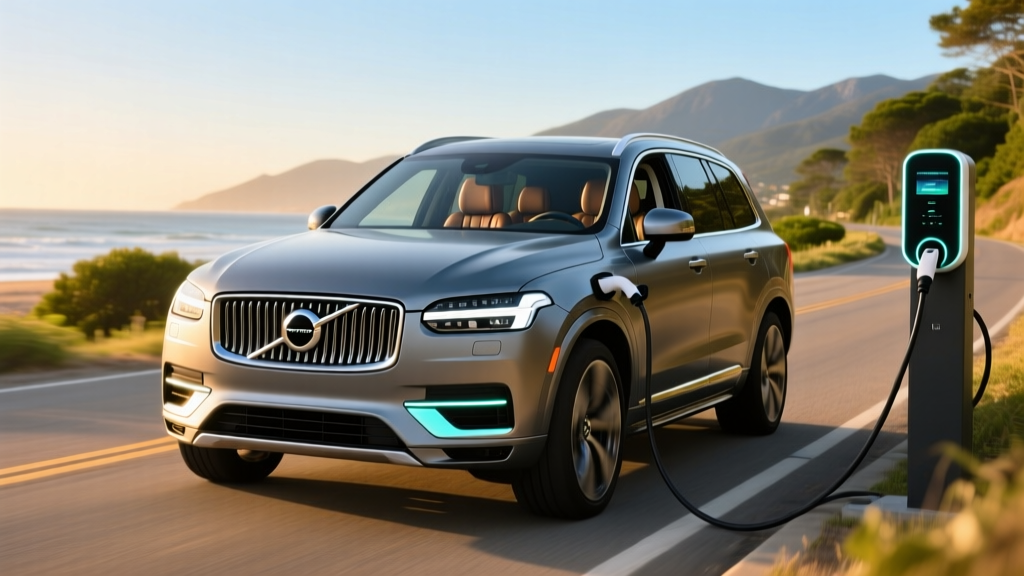
The 2026 Volvo XC90 Recharge (the PHEV variant of Volvo's flagship three-row SUV) occupies a specific niche: luxury-family buyers who want daily electric commuting without surrendering the gas engine for road trips. With a refreshed powertrain, a larger battery pack than its predecessor, and Volvo's hallmark safety engineering, the XC90 PHEV is worth a serious look — but only if its particular blend of electric range and fuel economy matches your driving pattern.
Below, we break down every number that matters: EPA-rated MPGe and MPG, real-world electric range, battery capacity and charging speeds, powertrain output, pricing by trim, federal tax credit eligibility under current IRS §30D rules, and long-term battery reliability. We'll also help you decide whether this plug-in hybrid, a conventional hybrid, or a full battery-electric vehicle (BEV) is the right move.
2026 Volvo XC90 PHEV: Key Specifications at a Glance
| Attribute | Value |
|---|---|
| Powertrain | 2.0L turbocharged + supercharged 4-cyl + rear electric motor (AWD) |
| Combined Horsepower | 455 hp / 523 lb-ft torque |
| 0–60 mph | 5.0 seconds |
| Battery (usable) | 18.8 kWh (lithium-ion NMC) |
| EPA Electric-Only Range | 35 miles |
| EPA MPGe (combined) | 55 MPGe |
| EPA MPG (gas-only, combined) | 27 MPG combined (26 city / 28 highway) |
| Total Combined Range | ~430 miles (electric + gas) |
| Level 2 Charge Time (0–100%) | ~5 hours at 3.6 kW (no DC fast charging) |
| Battery Warranty | 8 years / 100,000 miles (capacity retention ≥70%) |
| Base MSRP (Core) | $72,350 (destination included) |
| Federal Tax Credit (§30D) | Up to $7,500 — subject to sourcing, income, and MSRP caps |
HEV vs. PHEV vs. BEV: Where the XC90 Recharge Fits
Before evaluating the XC90 PHEV on its merits, it helps to understand the three electrified powertrain types available in the SUV segment — because Volvo itself offers the XC90 in multiple configurations, and confusing them is a common buyer mistake.
| Feature | Conventional Hybrid (HEV) | Plug-In Hybrid (PHEV) | Battery Electric (BEV) |
|---|---|---|---|
| Plugs in? | No — self-charges via regenerative braking and engine | Yes — charges from grid + regenerative braking | Yes — grid-only charging |
| Electric-only range | ~1 mile or less | 20–45 miles typical | 200–400+ miles |
| Gas engine? | Yes (primary propulsion assist) | Yes (kicks in after battery depletes) | No |
| Example (Volvo) | XC90 B6 (mild-hybrid) | XC90 Recharge (this review) | Volvo EX90 |
| Best for | Drivers with no home charging access | Home-charging commuters who also road-trip | Full electric lifestyle, home charging available |
The XC90 Recharge is a PHEV. It has a gas engine and a plug. You can charge it overnight at home and drive ~35 miles on electricity alone for daily errands and school runs. Once the battery depletes, the turbocharged/supercharged gas engine takes over seamlessly, and you drive it like a conventional hybrid — no range anxiety, no charging-desert risk. The Volvo XC90 B6 (mild-hybrid) is the HEV variant: it cannot be plugged in and has negligible electric-only range.
Fuel Economy and Electric Range: EPA Numbers vs. Real World
The EPA rates the 2026 XC90 Recharge at 55 MPGe combined when operating in hybrid mode using both battery and gasoline. MPGe (miles per gallon equivalent) converts electrical energy into a gasoline-equivalent figure for comparison purposes. Once the battery is depleted and you're running purely on gasoline, the EPA rates it at 27 MPG combined (26 city / 28 highway).
| Mode | City | Highway | Combined |
|---|---|---|---|
| Charge-sustaining (gas only) | 26 MPG | 28 MPG | 27 MPG |
| Charge-depleting (hybrid, electric + gas) | 55 MPGe combined | ||
| Electric-only consumption | ~63 kWh/100 mi | ||
Real-world expectations: According to fueleconomy.gov, PHEV owners who charge daily and commute within the electric range often report effective fuel economy well above the EPA combined figure — some seeing 70+ MPGe equivalent over months of city-heavy driving. Conversely, if you rarely plug in and drive the XC90 Recharge like a conventional gas car, expect the 27 MPG combined figure — or slightly less in heavy traffic or cold weather. Highway-only road trips at 75+ mph will yield closer to 25–26 MPG once the battery is depleted.
Electric-Only Range Reality Check: The EPA rates the XC90 Recharge at 35 miles of electric-only driving. In real-world conditions — especially in cold weather (below 40°F) or at sustained highway speeds — expect 25–30 miles. In mild weather with city driving and regenerative braking active, some owners squeeze out 37–38 miles. Your commute distance and climate matter enormously here.
Powertrain and Performance: 455 HP of Swedish Muscle
The XC90 Recharge pairs a 2.0-liter four-cylinder engine (both turbocharged and supercharged) with a rear-axle electric motor. The combined output is 455 horsepower and 523 lb-ft of torque, routed through an 8-speed automatic transmission to all four wheels. The electric motor handles the rear axle exclusively, giving the XC90 Recharge a rear-biased AWD feel under electric power and balanced traction when the gas engine joins in.
The 0–60 mph sprint takes 5.0 seconds — genuinely quick for a three-row luxury SUV weighing over 5,000 lbs. The instant torque from the electric motor fills in the low-RPM gap that turbo lag typically creates, making the XC90 Recharge feel responsive around town. In Pure (electric-only) mode, acceleration is softer but adequate for merging and city driving. In Power mode, both the engine and motor deliver maximum output simultaneously.
Battery, Charging, and What You Need to Know About Plugging In
The 2026 XC90 Recharge carries an 18.8 kWh usable battery pack (NMC lithium-ion chemistry). This is the energy that powers the electric motor for those 35 EPA-rated miles. Here's what you need to know about charging it:
| Level | Power (kW) | Charge Time (0–100%) | Typical Use Case |
|---|---|---|---|
| Level 1 (120V household outlet) | ~1.4 kW | ~13–14 hours | Overnight top-up, no dedicated equipment |
| Level 2 (240V home/public charger) | 3.6 kW (max onboard) | ~5 hours | Primary home charging, workplace charging |
| DC Fast Charging | Not supported — the XC90 Recharge cannot use DC fast chargers | ||
Critical detail: The XC90 Recharge's onboard charger is limited to 3.6 kW. Even if you connect it to a 48-amp Level 2 home charger capable of delivering 11.5 kW, the car will only accept 3.6 kW. This means a full charge from empty takes roughly 5 hours — perfectly fine for overnight charging, but it won't replenish during a quick stop at a public Level 2 station while you grab lunch. For most PHEV owners, this is acceptable: you plug in at night, wake up to a full battery, and your 35-mile electric range covers the day's local driving.
The absence of DC fast charging is standard for PHEVs in this class. The battery is small enough that Level 2 is adequate, and adding DC fast-charge hardware would increase cost and weight. If you regularly need to recharge mid-trip at high speed, a full BEV (like the Volvo EX90) with DC fast-charge capability is the better fit.
Pricing, Trims, and Federal Tax Credit Eligibility
The 2026 Volvo XC90 Recharge is offered in three trim levels:
- Core: $72,350 MSRP (includes destination) — well-equipped with adaptive cruise, 360° camera, Harman Kardon audio, and Volvo's Google-based infotainment
- Plus: ~$77,500 MSRP — adds premium leather, head-up display, and additional driver-assist features
- Ultra: ~$82,150 MSRP — adds Bowers & Wilkins audio, air suspension, and full Nappa leather
Does the XC90 Recharge Qualify for the Federal Tax Credit?
Under current IRS §30D rules for 2026, the XC90 Recharge may qualify for up to $7,500 in federal tax credit — but eligibility depends on several factors that change periodically:
- MSRP Cap: SUVs must be at or below $80,000 MSRP. The Core and Plus trims qualify; the Ultra trim ($82,150) exceeds the cap and is ineligible.
- Buyer Income Limits: Modified AGI must not exceed $150,000 (single), $225,000 (head of household), or $300,000 (joint filers).
- Battery Sourcing Requirements: A percentage of critical minerals and battery components must be sourced from the US or FTA-partner countries. Volvo has worked to meet these thresholds, but the exact credit amount ($3,750 or $7,500) depends on current-year sourcing compliance. Confirm with your dealer at time of purchase.
- Point-of-Sale Transfer: As of 2024+, buyers can transfer the credit to the dealer at purchase, reducing the sale price directly rather than waiting for a tax refund.
Bottom line: Do not assume you will receive the full $7,500. Battery sourcing requirements are the most volatile variable. Check the latest fueleconomy.gov tax credit listings and consult a tax professional before relying on the credit in your purchase budget.
Battery Reliability, Warranty, and Replacement Cost
Volvo PHEV Battery Warranty: 8 years or 100,000 miles (whichever comes first), covering defects and capacity loss below 70% of original capacity. This is the industry-standard PHEV battery warranty and is federally mandated for emissions-related hybrid components.
Volvo's PHEV battery packs have demonstrated solid reliability in the field. The 18.8 kWh NMC pack in the XC90 Recharge is liquid-cooled, which significantly slows degradation compared to passively cooled packs. Based on data from earlier-generation XC90 T8 models (which used a similar architecture), owners typically see 5–8% capacity loss over the first 5 years — meaning your 35-mile electric range might become 32–33 miles after half a decade. This is well within the warranty threshold.
Battery replacement cost: If the pack fails outside warranty coverage, a full replacement runs approximately $8,000–$12,000 including parts and labor at a Volvo dealership. However, out-of-warranty failures on modern liquid-cooled PHEV packs are rare. Most PHEV batteries outlast 150,000+ miles with gradual (not catastrophic) degradation. The XC90's battery is modular, meaning a technician can sometimes replace individual cell modules rather than the entire pack, reducing cost.
For peace of mind, Volvo's hybrid system warranty (8 yr / 100k mi) covers the battery, electric motor, power electronics, and related control modules. This aligns with NHTSA-tracked reliability data showing PHEV drivetrains are among the least failure-prone electrified systems, owing to the redundancy of having both a gas engine and an electric motor.
Who Should Buy the XC90 PHEV — And Who Shouldn't
Choose the XC90 Recharge PHEV if:
- You have access to Level 1 or Level 2 home charging (even a standard 120V outlet works overnight)
- Your daily commute and errands total under 35 miles, letting you drive electric most days
- You take road trips several times a year and don't want to plan around DC fast-charging stations
- You need three rows and a premium interior but aren't ready for a full BEV
- You value the safety and build quality Volvo is known for
Choose a full BEV (like the Volvo EX90) instead if:
- You have reliable home Level 2 charging and rarely drive more than 300 miles in a day
- You want zero tailpipe emissions and lower per-mile energy costs
- You want DC fast charging for road trips (200+ kW capability)
- You want to eliminate oil changes, spark plugs, and gas-engine maintenance entirely
Choose the XC90 B6 mild-hybrid (HEV) instead if:
- You have no access to any plug-in charging at home or work
- You want a simpler ownership experience with no battery-management considerations
- Your budget is closer to $58,000–$65,000
Pros and Cons: The Honest Assessment
Pros
- 35 miles of electric range covers most daily commutes
- 455 hp provides genuinely quick acceleration for a three-row SUV
- No range anxiety — gas engine provides 400+ total miles of range
- Premium interior materials and Volvo's top-tier safety suite standard
- Qualifies for up to $7,500 federal tax credit on Core and Plus trims
- Liquid-cooled battery with solid long-term degradation data
Cons
- No DC fast charging — Level 2 only, capped at 3.6 kW
- 27 MPG gas-only is modest for the class; some rivals do better
- Ultra trim exceeds $80,000 MSRP cap, losing tax credit eligibility
- Cold weather reduces electric range to 25–30 miles
- Google-based infotainment can be slow to respond at times
- Third row is best suited for children; adults will find it tight
Frequently Asked Questions
How many MPG does the 2026 Volvo XC90 PHEV get?
The EPA rates the XC90 Recharge at 55 MPGe combined when using both electric and gas power. Once the battery is depleted and you're running on gasoline alone, it returns 27 MPG combined (26 city / 28 highway). Real-world results vary: daily-charging commuters who stay within the electric range may use almost no gasoline for weeks, while long highway trips will yield 25–27 MPG.
How far can the XC90 Recharge go on electric only?
The EPA rates it at 35 miles of electric-only range. In real-world conditions, expect 25–30 miles in cold weather or at highway speeds, and up to 37–38 miles in mild weather with city driving. Total combined range (electric + gas tank) is approximately 430 miles.
Is the XC90 PHEV reliable, and what does battery replacement cost?
Volvo's PHEV powertrain has demonstrated solid reliability. The liquid-cooled 18.8 kWh battery typically loses 5–8% capacity over 5 years. The battery is warrantied for 8 years / 100,000 miles (minimum 70% capacity retention). Out-of-warranty replacement costs approximately $8,000–$12,000, though full pack failures are rare.
Does the 2026 XC90 Recharge qualify for the federal tax credit?
It may qualify for up to $7,500 under IRS §30D, but eligibility depends on the buyer's income (≤$300,000 joint), the trim's MSRP (must be ≤$80,000 — so Core and Plus qualify, Ultra does not), and current battery-sourcing compliance. The credit can be transferred at point of sale to reduce the purchase price directly. Always verify current eligibility on fueleconomy.gov and consult a tax professional.
Can I charge the XC90 Recharge at a DC fast charger?
No. The XC90 Recharge does not support DC fast charging. It charges exclusively via Level 1 (120V) or Level 2 (240V) at a maximum rate of 3.6 kW. A full charge from empty takes about 5 hours on Level 2, or 13–14 hours on a standard household outlet.
Should I buy the XC90 PHEV or the all-electric Volvo EX90?
If you have reliable home charging and your daily driving is under 300 miles, the EX90 offers lower running costs, DC fast charging, and zero tailpipe emissions. If you frequently take long road trips, lack consistent charging access, or want the safety net of a gas engine, the XC90 Recharge PHEV is the more flexible choice.