Quick Verdict: Toyota's Full-Size Hybrid Workhorse
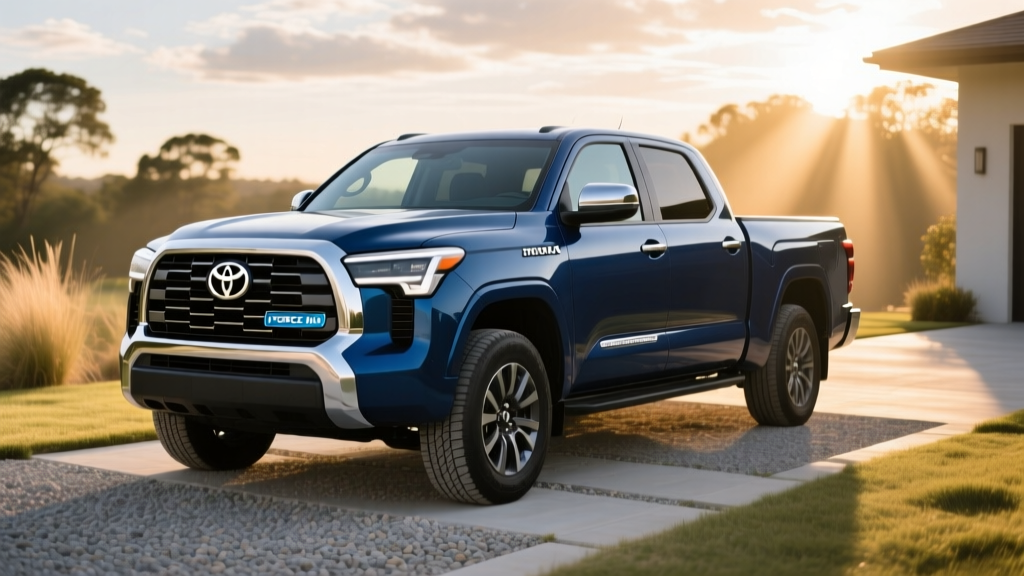
The 2026 Toyota Tundra Hybrid (officially the i-FORCE MAX powertrain) occupies a specific niche: a full-size, body-on-frame truck that uses hybridization not primarily for hypermiling, but for torque multiplication and modest fuel savings under heavy loads. With 437 horsepower and 583 lb-ft of torque available from near idle, it outpulls most gas-only V6 competitors while delivering EPA-estimated 20–22 MPG combined depending on configuration.
Before we get into the numbers, one critical clarification: the Tundra Hybrid is a conventional hybrid (HEV), not a plug-in hybrid (PHEV). You never plug it in. The 1.87 kWh nickel-metal hydride battery recharges through regenerative braking and the engine. This matters because buyers expecting 30+ miles of electric-only driving or federal tax-credit eligibility will be disappointed — this is a self-charging system designed to augment a twin-turbo V6, not replace it at the pump.
i-FORCE MAX Powertrain: Specs and How It Works
The i-FORCE MAX pairs a 3.4-liter twin-turbo V6 with a 36 kW (48 hp) electric motor sandwiched between the engine and a 10-speed automatic transmission. Combined output reaches 437 hp and 583 lb-ft of torque — figures that rival or exceed many V8 trucks from the previous generation.
| Specification | Value |
|---|---|
| Engine | 3.4L Twin-Turbo V6 |
| Electric Motor | 36 kW (48 hp) / 184 lb-ft |
| Combined Output | 437 hp / 583 lb-ft torque |
| Transmission | 10-speed automatic |
| Battery | 1.87 kWh NiMH (under rear seat) |
| Drivetrain | RWD or 4WD (part-time or full-time) |
| Max Towing | 10,200 lbs (properly equipped) |
| Max Payload | 1,630 lbs |
| 0–60 mph | ~5.7 seconds (4WD crew cab) |
The electric motor's contribution is most noticeable at low RPM — the torque fill eliminates the turbo lag you'd feel in a non-hybrid twin-turbo setup. In practice, the Tundra Hybrid launches with the immediacy of a larger displacement engine. The hybrid system also enables engine-off coasting at highway speeds under light load and extends idle-stop duration at traffic lights.
EPA Fuel Economy and Real-World MPG
Per fueleconomy.gov, the 2026 Tundra Hybrid achieves the following EPA estimates depending on cab and drivetrain configuration:
| Configuration | City MPG | Highway MPG | Combined MPG |
|---|---|---|---|
| CrewMax 4x2 | 22 | 24 | 22 |
| CrewMax 4x4 | 20 | 24 | 21 |
| Double Cab 4x4 | 20 | 24 | 21 |
The hybrid's advantage over the gas-only Tundra (EPA 17–20 combined) is real but narrow — roughly 2–3 MPG combined. That translates to about $200–$350 in annual fuel savings at 15,000 miles/year with $3.50/gallon regular unleaded. The hybrid premium over equivalent gas trims (typically $3,000–$4,000 depending on configuration) takes 8–12 years to recoup purely on fuel. The real value proposition is performance: you're getting V8-rivaling torque with V6 fuel consumption.
HEV vs PHEV vs EV: Which Truck Fits Your Needs?
The Tundra Hybrid is an HEV. Here's how that compares to the other electrified truck options on the market:
| Factor | HEV (Tundra Hybrid) | PHEV (e.g., upcoming trucks) | BEV (F-150 Lightning, Silverado EV) |
|---|---|---|---|
| Plug-in Required? | No | Yes (for EV range) | Yes (always) |
| Electric-Only Range | 0 miles | 20–40 miles typical | 230–380 miles |
| Fuel/Energy Cost per Mile | ~$0.16 | ~$0.08–$0.14 | ~$0.04–$0.06 |
| Towing Range Impact | Moderate MPG drop | EV range eliminated | Range halved or worse |
| Home Charging Needed? | No | Recommended | Essential |
| Federal Tax Credit | None | Up to $7,500 (§30D) | Up to $7,500 (§30D) |
| Refueling Time | 5 minutes (gas) | 5 min gas / 2–5 hr charge | 20–45 min DC fast |
- Choose the Tundra Hybrid (HEV) if: You tow frequently, drive in remote areas without charging infrastructure, lack home charging access, or want a full-size truck with no lifestyle compromise vs. a gas truck.
- Choose a PHEV truck if: You have home charging, commute under 30 miles daily, but still need long-distance and towing capability without range anxiety.
- Choose a BEV truck if: You have reliable home Level 2 charging, rarely tow heavy loads long distances, want the lowest per-mile operating cost, and your daily driving stays within ~200 miles.
2026 Tundra Hybrid Pricing and Tax Credit Eligibility
The i-FORCE MAX hybrid powertrain is available across multiple Tundra trims for 2026. Pricing starts in the mid-$50,000 range:
| Trim Level | Starting MSRP (4x2) | Starting MSRP (4x4) |
|---|---|---|
| Limited | $56,035 | $59,035 |
| Platinum | $62,335 | $65,335 |
| 1794 Edition | $62,535 | $65,535 |
| TRD Pro | — | $72,335 |
| Capstone | $70,035 | $73,035 |
Without the federal credit, the Tundra Hybrid competes on total cost of ownership through fuel savings, Toyota's resale value reputation, and the hybrid warranty package rather than upfront incentives.
Battery Warranty, Reliability, and Replacement Cost
Hybrid battery longevity is the top concern for buyers considering a used or high-mileage Tundra Hybrid. Here's what Toyota provides:
- Hybrid Battery: 10 years / 150,000 miles (whichever comes first)
- Hybrid System Components: 8 years / 100,000 miles
- Powertrain (engine, transmission): 5 years / 60,000 miles
- Basic Bumper-to-Bumper: 3 years / 36,000 miles
The 1.87 kWh NiMH battery pack sits under the rear seat, protected from road debris and temperature extremes. NiMH chemistry is proven and conservative — Toyota has used similar hybrid batteries in the Prius and Highlander Hybrid for two decades with well-documented longevity. Many Toyota hybrids exceed 200,000 miles on the original battery pack.
If replacement becomes necessary out of warranty, expect to pay $2,500–$4,000 for a new OEM hybrid battery, plus $300–$600 in labor. Refurbished and aftermarket options can reduce this to $1,500–$2,500. This is dramatically less expensive than a full EV battery replacement ($10,000–$20,000+), reflecting the Tundra's much smaller battery capacity.
Toyota's hybrid reliability track record is among the strongest in the industry. The i-FORCE MAX is newer (introduced for the 2022 Tundra redesign), so long-term data is still accumulating, but the underlying twin-turbo V6 and hybrid motor have shown no systemic failure patterns through the 2025 model year.
Pros and Cons: The Honest Assessment
Pros
- 583 lb-ft torque from near zero RPM — exceptional towing launch
- 2–3 MPG improvement over gas Tundra in city driving
- No plug-in required — zero lifestyle change vs. gas truck
- 10-year/150,000-mile hybrid battery warranty
- 10,200-lb max towing capacity maintained
- Strong resale value (Toyota truck reputation)
Cons
- Only 20–22 MPG combined — still a thirsty truck
- $3,000–$4,000 hybrid premium with long payback period
- No federal tax credit eligibility
- Hybrid battery reduces under-seat storage slightly
- Modest electric-only assist (no EV driving mode)
- Towing fuel economy drops to 11–14 MPG like any gas truck
Frequently Asked Questions
How many MPG does the 2026 Tundra Hybrid get?
The EPA estimates 20–22 MPG combined depending on configuration (22 city/24 highway for 4x2 CrewMax, 20 city/24 highway for 4x4). Real-world mixed driving typically yields 19–21 MPG. The hybrid system's biggest advantage is in city traffic, where it can match or slightly exceed its EPA city rating.
Does the Tundra Hybrid need to be plugged in?
No. The Tundra i-FORCE MAX is a conventional hybrid (HEV), not a plug-in hybrid. The 1.87 kWh battery charges exclusively through regenerative braking and the gasoline engine. You fuel it like any other truck — there is no charging port.
How far can the Tundra Hybrid drive on electric power alone?
Effectively zero miles. Unlike a PHEV, the Tundra Hybrid has no meaningful electric-only driving range. The electric motor assists the engine during acceleration and enables brief engine-off coasting, but it cannot propel the truck independently at normal speeds for any useful distance.
Is the Tundra Hybrid good for towing?
Excellent. With 583 lb-ft of torque available from 2,400 RPM and a max tow rating of 10,200 lbs (properly equipped), the i-FORCE MAX is one of the most capable half-ton truck powertrains for towing. The electric motor's low-RPM torque fill makes trailer launches noticeably smoother than the non-hybrid V6. Expect 11–14 MPG while towing 5,000–7,000 lbs.
What is the hybrid battery replacement cost?
Out-of-warranty replacement for the Tundra's NiMH hybrid battery runs $2,500–$4,000 for an OEM unit, plus $300–$600 labor. Refurbished options are available for $1,500–$2,500. The battery carries a 10-year/150,000-mile warranty, and Toyota's hybrid battery track record suggests most will last the life of the truck.
Does the 2026 Tundra Hybrid qualify for a tax credit?
No. The IRS §30D Clean Vehicle Credit applies only to plug-in electric vehicles (BEVs and PHEVs). Conventional hybrids like the Tundra i-FORCE MAX are not eligible for the federal $7,500 credit. Some states may offer small hybrid incentives — check your local programs.
Should I buy the Tundra Hybrid or the gas-only Tundra?
Choose the hybrid if you want maximum low-RPM torque for towing, slightly better city fuel economy, and don't mind the $3,000–$4,000 premium. Choose the gas-only i-FORCE V6 if fuel economy isn't a priority, you want the lowest entry price, or you prefer a simpler powertrain. The hybrid's fuel savings alone won't justify the premium for most buyers — consider it a performance upgrade that happens to save some gas.