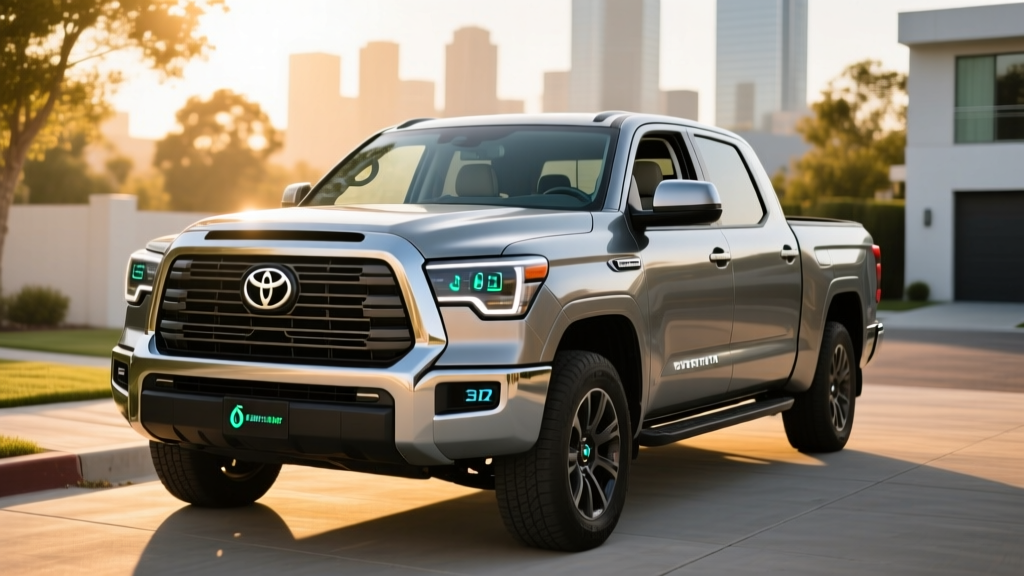
The full-size pickup segment doesn't usually reward fuel-sippers, but the Toyota Tundra i-FORCE MAX has carved out a niche as the go-to hybrid workhorse for buyers who need a body-on-frame truck without the punishing fuel bills of a traditional V8. If you've been searching for the 2026 Tundra Hybrid MPG figures, real-world efficiency, and whether the hybrid premium pays off, this guide covers every number that matters.
Let's be clear up front: the Tundra Hybrid is a conventional hybrid (HEV), not a plug-in. You never plug it in. It recovers energy through regenerative braking and its gasoline engine to self-charge a small battery pack. That distinction matters because it changes how you drive, fuel, and think about the truck daily.
2026 Tundra Hybrid MPG: EPA Numbers vs. Real-World Results
The 2026 Toyota Tundra i-FORCE MAX carries over the powertrain that debuted with the third-generation Tundra refresh. Here are the official EPA fuel economy ratings as published on fueleconomy.gov:
| Drivetrain | City MPG | Highway MPG | Combined MPG |
|---|---|---|---|
| 4×2 (Rear-Wheel Drive) | 20 | 24 | 22 |
| 4×4 (Four-Wheel Drive) | 19 | 22 | 20 |
The hybrid system shines in stop-and-go traffic and city driving, where the electric motor handles low-speed movement and the turbocharged V6 avoids the fuel-wasteful idle and launch cycles of a conventional engine. If your commute is urban or suburban, you'll land closer to the EPA city number or even slightly above it. If you spend 90% of your time on the interstate, the hybrid advantage narrows considerably.
i-FORCE MAX Powertrain: Specs That Move 5,800 Pounds
The i-FORCE MAX is Toyota's performance hybrid system — and "performance" is the operative word. This isn't a Prius-style efficiency-first setup. It pairs a twin-turbo 3.4-liter V6 with a 48-horsepower electric motor integrated between the engine and the 10-speed automatic transmission.
| Specification | Value |
|---|---|
| Engine | 3.4L Twin-Turbo V6 |
| Electric Motor | 48 HP / 184 lb-ft (integrated in bell housing) |
| Combined System Output | 437 HP / 583 lb-ft of torque |
| Transmission | 10-speed automatic |
| Hybrid Battery | 1.87 kWh (NiMH, sealed) |
| 0–60 MPH | ~5.7 seconds (4×2 crew cab) |
| Max Towing Capacity | Up to 11,175 lbs (properly equipped) |
| Max Payload | Up to 1,735 lbs |
The 583 lb-ft of torque arrives low in the rev range thanks to the electric motor's instant response, which gives the Tundra Hybrid a noticeably stronger launch feel than the non-hybrid i-FORCE (389 HP / 479 lb-ft). That torque advantage matters when merging onto highways with a load or pulling away from a stoplight with a bed full of lumber.
The 1.87 kWh nickel-metal hydride battery is small by EV standards — it's not designed for electric-only driving. Instead, it buffers energy captured from regenerative braking and engine excess to deploy torque-fill during acceleration and enable brief engine-off coasting at low speeds. You will never see an "EV mode" range figure for this truck because it isn't a plug-in.
HEV vs. PHEV vs. Full EV: Which Truck Is Right for You?
One of the most common questions from truck shoppers is whether they should choose a conventional hybrid, a plug-in hybrid, or a full battery-electric truck. The 2026 Tundra Hybrid is an HEV only — Toyota does not offer a Tundra PHEV. Here's how the three powertrain types compare for truck buyers:
| Factor | HEV (Tundra Hybrid) | PHEV (e.g., no current full-size option) | Full EV (e.g., F-150 Lightning, Silverado EV) |
|---|---|---|---|
| Plug in to charge? | No — self-charging | Yes — for electric range | Yes — always |
| Electric-only range | None (motor assist only) | Typically 25–50 mi | 230–400+ mi |
| Home charging needed | No | Recommended (Level 2) | Essential (Level 2) |
| Fuel cost per mile | ~$0.16–$0.20 | ~$0.05–$0.15 (varies) | ~$0.04–$0.10 |
| Towing range impact | ~50% MPG drop | Electric range eliminated | Range cut by 50–70% |
| Federal tax credit | Not eligible (§30D) | Eligible if requirements met | Eligible if requirements met |
Pricing, Trims, and Tax Credit Reality
The i-FORCE MAX hybrid powertrain is available across most of the Tundra lineup for 2026, from the mid-tier SR5 up through the Capstone. Here's a look at starting MSRPs for key trims (all prices are manufacturer-stated base MSRP before destination):
| Trim | Base MSRP (4×2) | Base MSRP (4×4) |
|---|---|---|
| SR5 | ~$49,500 | ~$52,500 |
| Limited | ~$57,000 | ~$60,000 |
| Platinum | ~$65,500 | ~$68,500 |
| 1794 Edition | ~$65,000 | ~$68,000 |
| TRD Pro | N/A | ~$74,000 |
| Capstone | ~$75,000 | ~$78,000 |
The hybrid powertrain typically adds $3,500–$4,000 over the equivalent non-hybrid i-FORCE trim. Whether that premium pays back depends on your annual mileage and fuel costs. At 15,000 miles per year and $3.50/gallon, the 4×4 hybrid's ~2 MPG combined advantage over a comparable non-hybrid V6 saves roughly $350–$450 annually — meaning a 7-to-10-year payback on the hybrid premium through fuel savings alone. The performance and torque benefits, of course, are immediate and not captured in that calculation.
Does the 2026 Tundra Hybrid Qualify for a Federal Tax Credit?
No. The Tundra i-FORCE MAX is a conventional hybrid (HEV), and the IRS §30D Clean Vehicle Credit applies only to plug-in electric vehicles (BEVs and PHEVs) that meet battery sourcing, critical minerals, MSRP caps, and buyer income limits. Conventional hybrids do not qualify for the federal credit. Some states offer modest rebates for hybrids — check your state energy office or department of environmental quality for current programs, but most state incentives have also shifted to plug-in vehicles.
Hybrid Battery Warranty and Long-Term Reliability
Hybrid battery longevity is the single most common concern from first-time hybrid truck buyers. Toyota has built deep institutional experience with hybrid systems — the Tundra's i-FORCE MAX benefits from two decades of hybrid engineering that began with the Prius.
- Hybrid Battery: 10 years / 150,000 miles (whichever comes first)
- Hybrid System Components: 8 years / 100,000 miles
- Powertrain (engine, transmission): 5 years / 60,000 miles
- Bumper-to-Bumper: 3 years / 36,000 miles
The 1.87 kWh NiMH battery pack in the Tundra Hybrid is far less stressed than a large EV battery. Because it never cycles through deep charge and discharge — it operates in a narrow state-of-charge window managed by the hybrid control system — degradation is minimal. Toyota's hybrid batteries in the Camry, RAV4, and Highlander have demonstrated 150,000–200,000+ mile lifespans routinely, with many original packs still in service well past 200,000 miles.
If replacement is ever needed outside warranty, a Tundra hybrid battery replacement is estimated at $3,000–$5,000 including labor at a Toyota dealer, though third-party refurbishment options may be lower. Given the 10-year/150,000-mile warranty coverage, most original owners will never face this cost.
Overall Reliability Outlook
The third-generation Tundra (2022+) had a rough launch year with some early-build quality issues and a recall for the twin-turbo V6 related to debris in the engine machining. By the 2025–2026 model years, Toyota had addressed most of these through running production changes. The i-FORCE MAX hybrid system itself has been trouble-free in Toyota's larger SUVs (Sequoia, Land Cruiser) that share the same architecture. Consult NHTSA.gov for the latest recall and technical service bulletin data before purchasing.
Who Should Buy the 2026 Tundra Hybrid?
✅ Buy It If…
- You drive 12,000–20,000 miles/year in mixed city/suburban conditions
- You want a full-size truck with strong towing (11,175 lbs) but better fuel economy than a traditional V8
- You don't have access to home charging and don't want to plan around charging stations
- You value the low-end torque advantage of the electric motor for towing and hauling
- You plan to keep the truck 8+ years (well within the hybrid battery warranty)
❌ Skip It If…
- You drive almost exclusively on the highway at 75+ MPH (the hybrid advantage shrinks)
- You tow heavy trailers daily — the MPG benefit vanishes under load regardless of powertrain
- You want electric-only commuting — you need a PHEV or full EV for that
- You're chasing a federal tax credit — HEVs don't qualify under §30D
- The $3,500–$4,000 hybrid premium doesn't fit your budget and you don't need the extra torque
Tundra Hybrid vs. the Competition: Fuel Economy Context
To put the Tundra Hybrid's MPG in perspective, here's how it stacks up against other full-size trucks in the 2026 model year:
| Truck | Powertrain | Combined MPG (4×4) | HP / Torque |
|---|---|---|---|
| Toyota Tundra i-FORCE MAX | Turbo V6 Hybrid (HEV) | 20 | 437 HP / 583 lb-ft |
| Ford F-150 PowerBoost | Turbo V6 Hybrid (HEV) | 22 | 430 HP / 570 lb-ft |
| Ford F-150 Lightning | Full EV (BEV) | 70–78 MPGe | 580 HP / 775 lb-ft |
| Chevy Silverado 1500 | Turbo 4-cyl (gas) | 20 | 310 HP / 430 lb-ft |
| Ram 1500 (2025+ gen) | Turbo I-6 (gas) | 19–21 | 420 HP / 468 lb-ft |
The Ford F-150 PowerBoost hybrid edges the Tundra by 2 MPG combined in 4×4 configuration, making it the segment's MPG leader among conventional hybrids. However, the Tundra's torque figure (583 lb-ft) and Toyota's hybrid reliability reputation keep it competitive. The F-150 Lightning delivers dramatically lower per-mile energy costs but requires home charging infrastructure and suffers severe range loss when towing — a trade-off that doesn't suit every truck buyer.
Frequently Asked Questions
How many MPG does the 2026 Tundra Hybrid get?
The EPA rates the 2026 Tundra i-FORCE MAX at 20 city / 24 highway / 22 combined (4×2) and 19 city / 22 highway / 20 combined (4×4). Real-world results cluster around 20–23 MPG combined for the 4×2 and 18–21 MPG for the 4×4 in mixed driving. Highway-only driving at high speeds and towing will reduce these figures.
Do I need to plug in the Tundra Hybrid?
No. The Tundra i-FORCE MAX is a conventional hybrid (HEV). It charges its own battery through regenerative braking and the gasoline engine. There is no plug, no charging cable, and no electric-only driving range. You fuel it at a gas station exactly like any other truck.
Is the Tundra Hybrid reliable? What about battery replacement cost?
Toyota's hybrid systems have a strong long-term reliability record, with many hybrid batteries lasting 150,000–200,000+ miles. The Tundra's hybrid battery is covered by a 10-year/150,000-mile warranty. If replacement is needed outside warranty, expect $3,000–$5,000 at a dealer. The small NiMH pack is far less stressed than an EV battery and rarely fails prematurely.
Does the 2026 Tundra Hybrid qualify for any tax credit?
The Tundra Hybrid does not qualify for the federal §30D Clean Vehicle Credit, which is limited to plug-in vehicles (BEVs and PHEVs). Some states may offer minor incentives for hybrids, but most have shifted to plug-in vehicle programs. Consult the IRS Clean Vehicle Credits page and your state's energy office for current details.
How does the Tundra Hybrid compare to the F-150 PowerBoost hybrid?
The F-150 PowerBoost returns approximately 2 MPG more combined in 4×4 trim (22 vs. 20) and offers a built-in generator (Pro Power Onboard). The Tundra Hybrid delivers slightly more torque (583 vs. 570 lb-ft) and benefits from Toyota's hybrid durability reputation. Both are strong choices — the decision often comes down to brand loyalty, dealer relationships, and specific trim/option preferences.
Can the Tundra Hybrid tow as much as the gas-only Tundra?
Yes — the i-FORCE MAX hybrid actually has a slightly higher max towing rating than the base i-FORCE gas engine in several configurations (up to 11,175 lbs properly equipped). The electric motor's instant torque makes it particularly effective for getting heavy trailers moving from a stop. However, towing cuts fuel economy roughly in half regardless of powertrain — expect 10–13 MPG with a loaded 7,000-lb trailer.