The full-size pickup segment has been slow to adopt electrification, and the 2026 Toyota Tundra i-FORCE MAX remains one of the few conventional hybrid trucks you can actually buy. Unlike Ford's PowerBoost F-150 Hybrid or the upcoming Ramcharger EREV, Toyota's approach is straightforward: a twin-turbo V6 paired with an electric motor sandwiched inside the transmission bell housing. No plug required, no range-extender complexity — just better fuel economy and a serious torque bump.
But what does that actually mean at the pump, on the highway, and while towing a 7,000-pound trailer? This guide breaks down the 2026 Toyota Tundra hybrid MPG with EPA figures, real-world expectations, and a clear look at whether this powertrain makes financial sense versus the standard gas Tundra or a full EV truck.
2026 Toyota Tundra Hybrid MPG: The Official EPA Numbers
The 2026 Tundra i-FORCE MAX uses a 3.4-liter twin-turbo V6 combined with a 48-hp electric motor integrated into the 10-speed automatic transmission. Total system output is 437 horsepower and 583 lb-ft of torque. Toyota pairs this with a small 1.87 kWh nickel-metal hydride (NiMH) battery pack mounted under the rear seat — this is a conventional hybrid (HEV), not a plug-in. You never plug it in; the battery recharges through regenerative braking and engine-driven generation.
| Drivetrain | City MPG | Highway MPG | Combined MPG |
|---|---|---|---|
| 4x2 (Rear-Wheel Drive) | 20 | 24 | 22 |
| 4x4 (Four-Wheel Drive) | 19 | 22 | 20 |
For context, the non-hybrid Tundra with the standard i-FORCE 3.4L V6 (389 hp) rates at 17 city / 23 highway / 19 combined for 4x4 models. The hybrid advantage is most pronounced in city driving, where the electric motor handles low-speed launches and stop-and-go traffic, letting the engine shut off frequently. That 19 vs. 17 city MPG gap is meaningful for work-truck duty cycles involving job sites and urban delivery routes.
Data source: fueleconomy.gov (EPA official ratings).
Real-World MPG: What Owners Actually See
EPA stickers are a starting point, not a guarantee. The Tundra i-FORCE MAX's real-world efficiency depends heavily on driving style, payload, and terrain.
- City/suburban mixed driving: 19–21 MPG (matches or slightly exceeds EPA)
- Highway cruising (70 mph, unloaded): 20–22 MPG (close to EPA 22)
- Highway towing (~6,000–7,000 lb trailer): 12–14 MPG
- Heavy payload/bed load: 15–17 MPG
- Cold weather (below 30°F): Expect a 1–2 MPG drop due to extended engine warm-up and denser air
The hybrid system's biggest real-world advantage is in city driving, where regenerative braking recovers energy that a conventional truck wastes as heat. Owners who commute in stop-and-go traffic consistently report beating the EPA city number by 1–2 MPG. Highway efficiency is less impressive because the electric motor contributes minimally at sustained speeds — the twin-turbo V6 does most of the work, and aerodynamic drag dominates at 70+ mph.
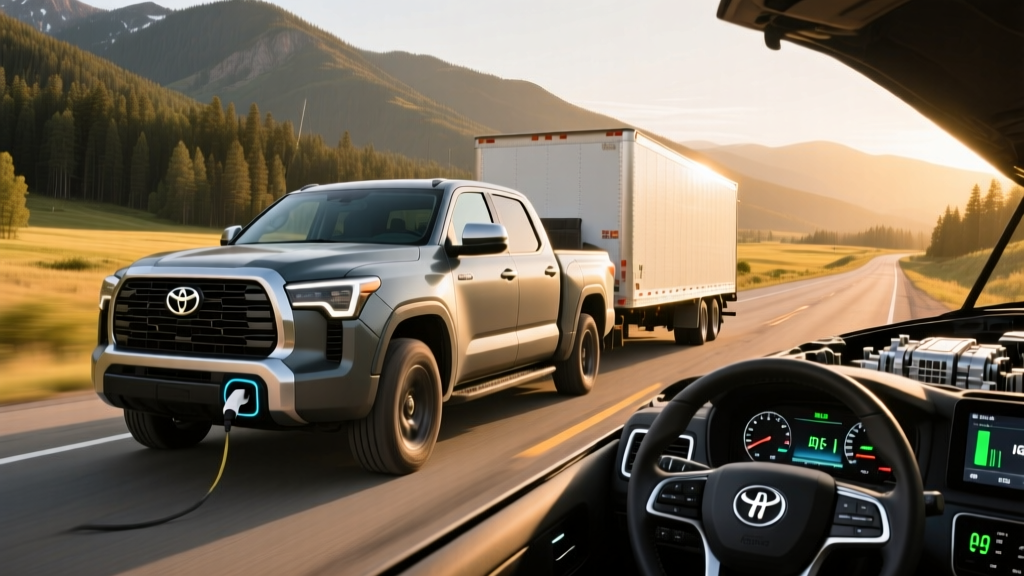
When towing, expect the hybrid advantage to narrow considerably. A 7,000-pound trailer demands continuous high power output, meaning the engine runs constantly and the small battery offers negligible assist. The i-FORCE MAX still outperforms the base V6 while towing (thanks to 583 lb-ft available from low RPM), but fuel economy drops to the 12–14 MPG range regardless of hybridization.
HEV vs. PHEV vs. EV: Which Truck Powertrain Fits You?
It's important to be precise about what the Tundra i-FORCE MAX is and isn't. This is a conventional hybrid (HEV). There is no plug, no electric-only driving mode, and no external charging. The 1.87 kWh battery is far too small to power the truck independently — it exists to assist the engine, capture regenerative braking energy, and enable engine stop-start.
| Feature | HEV (Tundra i-FORCE MAX) | PHEV (e.g., F-150 PHEV concept) | BEV (e.g., F-150 Lightning, Silverado EV) |
|---|---|---|---|
| Plug-in charging? | No | Yes | Yes |
| Electric-only range | 0 miles | 20–40 miles (typical) | 230–400+ miles |
| Battery size | ~1.9 kWh | ~15–20 kWh | ~100–200 kWh |
| Home charging needed? | No | Yes (Level 2 recommended) | Yes (Level 2 essential) |
| Federal tax credit (§30D)? | No | Up to $7,500 (if eligible) | Up to $7,500 (if eligible) |
| Towing range impact | Moderate MPG drop | EV range eliminated quickly | Range drops 40–60% |
The Tundra hybrid is the right choice if you want better fuel economy without changing your refueling behavior. You fill up at gas stations exactly as before. There's no charging infrastructure requirement, no range anxiety, and no battery large enough to meaningfully degrade over time.
If you need electric-only commuting capability, you'd need a PHEV — but as of 2026, no full-size PHEV pickup is widely available in the US market. For a fully electric truck, the Ford F-150 Lightning and Chevrolet Silverado EV are the primary competitors, though their towing range limitations remain a real concern for heavy-duty users.
Powertrain Deep Dive: i-FORCE MAX Specs
| Engine | 3.4L Twin-Turbo V6 + 48-hp electric motor |
| Combined Output | 437 hp / 583 lb-ft torque |
| Transmission | 10-speed automatic |
| Battery | 1.87 kWh NiMH (under rear seat) |
| 0–60 mph | ~5.7 seconds (4x4 CrewMax) |
| Max Towing Capacity | Up to 12,000 lbs (properly equipped) |
| Max Payload | Up to 1,940 lbs |
| EPA Fuel Economy (4x4) | 19 city / 22 hwy / 20 combined |
| Fuel Tank | 32.2 gallons (SR5+ trims) |
| Estimated Total Range | ~644 miles (4x4 combined) |
The i-FORCE MAX's 583 lb-ft of torque arrives at just 2,400 RPM, which is the real daily benefit of hybridization. The electric motor fills the torque gap before the turbos fully spool, eliminating the lag that some drivers notice in the standard i-FORCE engine. This makes the hybrid noticeably more responsive in passing maneuvers and more confident when pulling away from a stop with a loaded bed.
Pricing, Trims, and Tax Credit Eligibility
The i-FORCE MAX powertrain is available on SR5 and above trims, typically as a $3,000–$4,000 option package over the standard i-FORCE V6. Here's the approximate 2026 pricing landscape:
- SR5 i-FORCE MAX 4x2: ~$55,000 MSRP
- SR5 i-FORCE MAX 4x4: ~$58,500 MSRP
- Limited i-FORCE MAX 4x4: ~$63,000 MSRP
- Platinum i-FORCE MAX 4x4: ~$69,000 MSRP
- TRD Pro i-FORCE MAX 4x4: ~$74,000 MSRP
No. The Tundra i-FORCE MAX is a conventional hybrid (HEV), not a plug-in vehicle. Under IRS §30D rules, only plug-in electric vehicles (BEVs and PHEVs with sufficient battery capacity) qualify for the federal clean vehicle credit. Conventional hybrids like the Tundra i-FORCE MAX are not eligible for the $7,500 credit, the point-of-sale transfer, or the used-EV credit.
Some states offer modest incentives for conventional hybrids, but these are increasingly rare as incentive programs shift toward plug-in vehicles. Check your state's energy office for current programs.
The lack of a federal tax credit means the hybrid premium is purely an out-of-pocket calculation. If you drive 15,000 miles per year at $3.50/gallon, the 4x4 hybrid's 1 MPG combined improvement over the base V6 saves roughly $130 annually in fuel. That makes the payback period on the ~$3,500 hybrid option roughly 27 years on fuel savings alone — though the performance upgrade (437 hp vs. 389 hp, 583 lb-ft vs. 479 lb-ft) is the real reason most buyers choose the MAX.
Hybrid Battery Reliability, Warranty, and Replacement Cost
- Hybrid battery coverage: 10 years / 150,000 miles (whichever comes first)
- Powertrain warranty: 5 years / 60,000 miles
- Battery type: Nickel-Metal Hydride (NiMH) — proven, durable chemistry
- Capacity threshold: Toyota covers defects and significant capacity loss that impairs hybrid system function
Toyota's hybrid reliability record is among the best in the industry, anchored by decades of Prius data. The Tundra's NiMH battery pack is deliberately small (1.87 kWh) and is never deeply cycled — the hybrid control system keeps the state of charge in a narrow band (roughly 40–80%), which dramatically reduces wear. Unlike a large BEV battery that undergoes full charge-discharge cycles, the Tundra's hybrid battery experiences shallow, frequent micro-cycles that NiMH chemistry handles exceptionally well.
Based on long-term data from Toyota's hybrid SUVs (Highlander Hybrid, Sequoia), hybrid battery replacement before 200,000 miles is uncommon. When replacement is needed, a new OEM battery pack for the Tundra i-FORCE MAX runs approximately $3,000–$4,500 installed, depending on dealer labor rates. Refurbished packs may be available for $1,500–$2,500 from third-party suppliers, though these are less common for the relatively new Tundra platform.
The 10-year/150,000-mile hybrid warranty provides substantial peace of mind. For most original owners, the battery will outlast the vehicle's ownership period without issue. Toyota's hybrid system also includes a self-diagnostic system that monitors battery health continuously and alerts the driver through the instrument cluster if any anomalies are detected.
Who Should Buy the Tundra Hybrid — and Who Shouldn't
- You do a lot of city/suburban driving where stop-and-go traffic lets the hybrid system shine
- You want the performance upgrade (437 hp, 583 lb-ft) without stepping to a diesel or larger displacement engine
- You tow regularly but don't want the fuel cost penalty of a non-hybrid V8-era truck
- You have no access to home or workplace charging and can't consider a PHEV or BEV
- You plan to keep the truck 10+ years and want Toyota's proven hybrid longevity
- You have reliable Level 2 home charging and a daily commute under 200 miles
- You want to eliminate fuel costs entirely and qualify for the $7,500 federal tax credit
- You rarely tow more than 5,000 pounds (towing severely reduces EV range)
- You value instant torque, one-pedal driving, and near-silent operation
- You primarily drive highway miles where the hybrid's city-MPG advantage doesn't apply
- You want the lowest possible purchase price and the 389 hp base engine is sufficient
- The ~$3,500 hybrid premium doesn't justify the modest fuel savings for your mileage
Ownership Costs: 5-Year Projection
| Cost Category | i-FORCE MAX Hybrid | Base i-FORCE (Gas) |
|---|---|---|
| Fuel (75,000 mi at $3.50/gal) | $13,125 (20 MPG) | $13,816 (19 MPG) |
| Hybrid option premium | ~$3,500 | $0 |
| Maintenance (oil, filters, brakes) | ~$3,200 | ~$3,400 |
| Insurance (avg. estimate) | ~$9,500 | ~$9,200 |
| Federal tax credit | $0 | $0 |
| 5-Year Estimated Total | ~$29,325 | ~$26,416 |
The math is clear: the Tundra hybrid doesn't pay for itself on fuel savings alone. The ~$691 fuel savings over five years doesn't offset the $3,500 hybrid premium. Buyers should view the i-FORCE MAX as a performance and drivability upgrade that happens to be slightly more fuel-efficient — not as a cost-saving measure.
The hybrid's regenerative braking does reduce brake pad wear, which contributes to slightly lower maintenance costs over time. And the engine stop-start functionality reduces idle hours, which can extend oil life and reduce engine wear over the long term.
Frequently Asked Questions
How many MPG does the 2026 Toyota Tundra hybrid get?
The EPA rates the 2026 Tundra i-FORCE MAX at 19 city / 22 highway / 20 combined MPG for 4x4 models, and 20/24/22 for 4x2. Real-world results vary: city drivers often see 19–21 MPG, while towing drops efficiency to 12–14 MPG depending on trailer weight.
Is the Tundra hybrid a plug-in? Do I need to charge it?
No. The Tundra i-FORCE MAX is a conventional hybrid (HEV), not a plug-in hybrid (PHEV). It has a small 1.87 kWh battery that recharges through regenerative braking and the engine. You never plug it in — you refuel at gas stations like any other truck.
How far can the Tundra hybrid go on electric only?
Zero miles on electric-only. The hybrid battery is too small to propel the truck independently. The electric motor assists the gasoline engine during acceleration and low-speed driving, but the engine is always running when the truck is in motion (except during stop-start idle events).
Does the Tundra hybrid qualify for any federal tax credit?
No. Under current IRS §30D rules, only plug-in electric vehicles (BEVs and qualifying PHEVs) are eligible for the federal clean vehicle credit. Conventional hybrids do not qualify. Some states may offer minor hybrid incentives, but these vary by jurisdiction.
How long will the Tundra hybrid battery last, and what does replacement cost?
Toyota covers the hybrid battery for 10 years or 150,000 miles. Based on Toyota's long hybrid track record (Prius, Camry Hybrid, Highlander Hybrid), these NiMH packs commonly last 200,000+ miles without replacement. If replacement is needed, expect to pay approximately $3,000–$4,500 for an OEM pack installed at a dealer.
Is the Tundra hybrid reliable for towing?
Yes. The i-FORCE MAX produces 583 lb-ft of torque from low RPM, making it one of the most capable half-ton gas-hybrid powertrains for towing. Maximum towing capacity is up to 12,000 lbs when properly equipped. Fuel economy while towing drops to roughly 12–14 MPG, which is typical for the segment.
How does the Tundra hybrid compare to the F-150 PowerBoost hybrid?
The Ford F-150 PowerBoost Hybrid (3.5L V6 + electric motor, 430 hp / 570 lb-ft) rates at approximately 23–25 MPG combined depending on configuration — slightly better than the Tundra's 20–22 combined. However, the Tundra i-FORCE MAX offers more torque (583 vs. 570 lb-ft) and Toyota's longer-proven hybrid reliability record. The F-150 PowerBoost also does not qualify for a federal tax credit, as it is also a conventional HEV.