Quick Verdict: The Midsize Truck That Skips the Gas Station Less Often
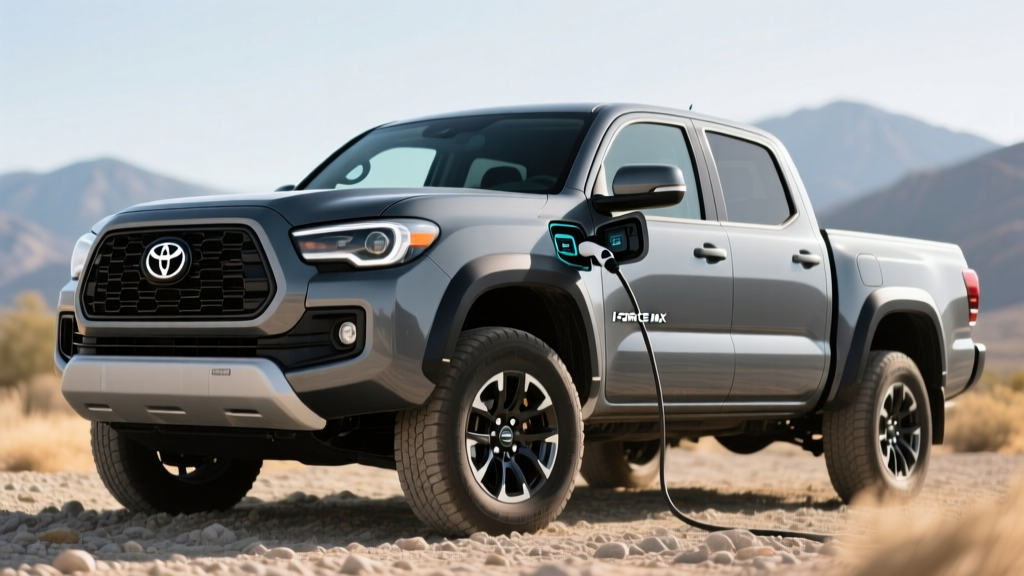
The 2026 Toyota Tacoma Hybrid pairs a turbocharged 2.4-liter four-cylinder with a 48-horsepower electric motor sandwiched inside an eight-speed automatic transmission. The result is Toyota's i-FORCE MAX powertrain: 326 combined horsepower and 465 lb-ft of torque — figures that eclipse the outgoing V6 Tacoma by a wide margin while returning an EPA-estimated 24 MPG combined. This is a conventional hybrid (HEV), not a plug-in. You never plug it in; regenerative braking and the gas engine recharge a small 1.87 kWh nickel-metal hydride battery pack behind the rear seat.
For truck buyers who tow on weekends, commute in stop-and-go traffic on weekdays, and aren't ready to commit to a fully electric pickup like the Ford F-150 Lightning or Rivian R1T, the Tacoma Hybrid occupies a pragmatic middle ground. It doesn't deliver the 80+ MPGe of a plug-in or the tailpipe-free operation of a BEV, but it eliminates range anxiety entirely while cutting fuel consumption roughly 15–20% compared to the standard turbo-four Tacoma.
HEV vs PHEV: Why the Tacoma Hybrid Doesn't Plug In
Conventional Hybrid (HEV) — Tacoma i-FORCE MAX: The gas engine and regenerative braking recharge a small battery (1.87 kWh). You never plug in. The electric motor assists during acceleration and low-speed driving, reducing fuel consumption. Electric-only driving is limited to very low speeds for short distances (under ~1 mile).
Plug-In Hybrid (PHEV) — e.g., Toyota RAV4 Prime: A larger battery (18.1 kWh) charges via a wall outlet or public charger, delivering 20–40 miles of electric-only range before the gas engine engages. Requires access to charging infrastructure to maximize benefit.
Full EV (BEV) — e.g., Ford F-150 Lightning: No gas engine. 230–320 miles of EPA range, zero tailpipe emissions, requires home or public charging. Lower per-mile fuel cost but higher upfront price and towing-related range loss.
Toyota has not announced a Tacoma PHEV variant for the 2026 model year. If you want plug-in capability in a Toyota truck-adjacent vehicle, the closest option remains the RAV4 Prime (42 miles EV range, 94 MPGe), though it sacrifices bed utility and towing capacity.
Fuel Economy: EPA Estimates vs Real-World MPG
The EPA rates the 2026 Tacoma Hybrid at 24 MPG combined (23 city / 27 highway) for 4x2 models and 23 MPG combined (22 city / 26 highway) for 4x4 configurations, according to fueleconomy.gov. These numbers apply to the SR, SR5, TRD PreRunner, and TRD Off-Road trims equipped with i-FORCE MAX.
| Configuration | City MPG | Highway MPG | Combined MPG |
|---|---|---|---|
| 4x2 (SR, SR5, PreRunner) | 23 | 27 | 24 |
| 4x4 (TRD Off-Road, Limited) | 22 | 26 | 23 |
| Non-hybrid 4x4 (i-FORCE turbo) | 20 | 24 | 21 |
Real-World MPG Expectations: Toyota hybrids historically exceed their EPA city estimates in stop-and-go traffic where regenerative braking recaptures the most energy. Owners of the Tundra Hybrid (same i-FORCE MAX architecture) report 20–22 MPG combined in mixed driving — slightly below EPA. Expect the Tacoma Hybrid to land between 22–26 MPG in real-world use depending on driving style, terrain, and payload. Highway towing will drop this to the mid-to-high teens, which is typical for any midsize truck under load.
Powertrain Deep Dive: i-FORCE MAX Specs
| Specification | Detail |
|---|---|
| Engine | 2.4L turbocharged inline-4 |
| Electric Motor | 48 hp / 184 lb-ft (integrated in transmission) |
| Combined Output | 326 hp / 465 lb-ft |
| Transmission | 8-speed automatic |
| Battery | 1.87 kWh NiMH (sealed, behind rear seat) |
| Drivetrain | RWD (4x2) or part-time 4WD (4x4) |
| Max Towing Capacity | 6,000 lbs (properly equipped) |
| Max Payload | ~1,700 lbs (varies by trim) |
| 0–60 mph (est.) | ~6.5 seconds |
The electric motor sits between the engine and the transmission housing — a P2 hybrid layout. This means the motor can drive the wheels independently at very low speeds (parking lots, crawl traffic), but its primary job is torque fill. The 465 lb-ft peak arrives at just 1,700 RPM, giving the Tacoma Hybrid a responsiveness that makes the turbo lag of the non-hybrid i-FORCE engine far less noticeable. The instant electric torque also smooths out the stop-start system, which is virtually imperceptible compared to conventional starters.
Pricing, Trims & Tax Credit Eligibility
The 2026 Tacoma Hybrid is available across multiple trims, starting with the SR5 and extending through TRD Off-Road, TRD Sport, Limited, and TRD Pro. Base MSRPs for i-FORCE MAX equipped trims:
- SR5 i-FORCE MAX (4x2): ~$41,995
- TRD Off-Road i-FORCE MAX (4x4): ~$47,295
- Limited i-FORCE MAX (4x4): ~$54,495
- TRD Pro i-FORCE MAX (4x4): ~$65,995
Destination charges add approximately $1,495.
Federal Tax Credit Status: The Tacoma Hybrid does not qualify for the §30D Clean Vehicle Credit. Under current IRS rules, the credit applies only to plug-in electric vehicles (BEVs and PHEVs) with a battery capacity of at least 7 kWh. The Tacoma's 1.87 kWh NiMH pack falls well below this threshold. Conventional hybrids without plug-in capability have not qualified for federal purchase credits since the original hybrid credits expired years ago.
State Incentives: Some states offer modest rebates or HOV lane access for conventional hybrids, but these vary widely and change frequently. Check your state's energy office or DMV for current programs.
Hybrid Battery Warranty, Lifespan & Replacement Cost
Toyota Hybrid Battery Warranty: Toyota covers the hybrid battery pack with a 10-year / 150,000-mile warranty (whichever comes first) in all 50 states, effective from the 2020 model year onward. This covers defects and capacity loss that impairs function.
Expected Lifespan: Toyota's NiMH hybrid batteries — the same chemistry used in the Prius since 2001 — routinely exceed 200,000 miles with minimal degradation. The Tacoma's pack is small (1.87 kWh) and operates within a narrow state-of-charge window (roughly 40–80%), which dramatically reduces cycle wear compared to full EV batteries that charge to 100%.
Replacement Cost: If the hybrid battery does fail outside warranty, a replacement NiMH pack for the i-FORCE MAX system is estimated at $3,000–$4,500 including labor at a Toyota dealer. Independent hybrid specialists often perform the same service for $2,000–$3,000. For context, this is roughly equivalent to a timing chain service on a conventional truck engine — a meaningful but not catastrophic expense.
The broader hybrid system — inverter, motor, control electronics — carries the same 10-year/150,000-mile warranty. Toyota's hybrid components have demonstrated exceptional field reliability across millions of vehicles over two decades.
Who Should Choose the Tacoma Hybrid vs a Full EV or Gas Truck
Choose the Tacoma Hybrid if:
- You tow regularly (up to 6,000 lbs) and can't afford the 40–50% range loss that EV pickups experience under trailer load
- Your daily commute involves heavy stop-and-go traffic where hybrid efficiency shines
- You lack reliable home charging access (apartment, street parking) making a BEV or PHEV impractical
- You want lower fuel costs without any change to your refueling habits
- You plan to keep the truck 8–15 years and value Toyota's long-term reliability record
Choose a full EV pickup (F-150 Lightning, Rivian R1T, Silverado EV) if:
- You have Level 2 home charging and your daily driving is under 250 miles
- You want maximum torque (Lightning: 563 lb-ft), instant acceleration, and a front trunk
- You qualify for the $7,500 federal tax credit, narrowing the price gap
- You rarely tow more than 5,000 lbs on long trips
Choose the standard gas Tacoma (i-FORCE turbo, non-hybrid) if:
- Upfront cost is the primary concern (the hybrid adds ~$2,000–$3,000 to MSRP depending on trim)
- You drive mostly highway miles where the hybrid's city MPG advantage is less relevant
- You prioritize maximum payload capacity (hybrid components add ~150 lbs of curb weight)
Pros and Cons at a Glance
Pros
- 465 lb-ft torque at 1,700 RPM — excellent low-end response for towing and off-road crawling
- 23–24 MPG combined beats the non-hybrid Tacoma by 2–3 MPG (15–20% improvement)
- 10-year/150,000-mile hybrid battery warranty — among the longest in the industry
- No plug-in required — zero infrastructure dependency
- 6,000-lb towing capacity matches the non-hybrid V6-equivalent models
- Proven NiMH hybrid technology with two decades of reliability data
Cons
- No federal tax credit — conventional hybrids don't qualify under §30D
- Hybrid premium adds ~$2,000–$3,000 over equivalent non-hybrid trims
- Electric-only driving limited to under 1 mile at parking-lot speeds
- Highway MPG (26–27) is only marginally better than the gas model — hybrid advantage is city-focused
- No PHEV variant available — can't access EV-only commute mode for 20+ miles
- Slightly reduced payload vs non-hybrid due to battery and motor weight
Frequently Asked Questions
How many MPG does the 2026 Tacoma Hybrid get?
The EPA rates the Tacoma Hybrid at 23 city / 27 highway / 24 combined for 4x2 models, and 22 city / 26 highway / 23 combined for 4x4 models. In real-world driving, expect 22–26 MPG combined depending on conditions. City and stop-and-go driving will push toward the higher end; sustained highway towing will drop into the teens.
Does the Tacoma Hybrid need to be plugged in?
No. The 2026 Tacoma Hybrid is a conventional hybrid (HEV). The 1.87 kWh battery recharges through regenerative braking and the gas engine. You fuel it exactly like any other gasoline truck — at a gas station, in under five minutes.
How far can the Tacoma Hybrid drive on electric power alone?
Under 1 mile at very low speeds (typically under 20 mph). The electric motor's primary role is torque assist during acceleration, not sustained electric driving. If you want meaningful EV-only range in a Toyota, the RAV4 Prime PHEV offers 42 miles — but it's a crossover, not a truck.
Is the Tacoma Hybrid reliable? What does battery replacement cost?
Toyota's hybrid systems are among the most proven in the industry, with over 20 million hybrid vehicles sold globally. The NiMH battery pack is warranted for 10 years / 150,000 miles. Out-of-warranty replacement runs $3,000–$4,500 at a dealer or $2,000–$3,000 at an independent hybrid shop. Real-world data from Prius and Camry Hybrid fleets shows these packs routinely lasting 200,000+ miles.
Does the 2026 Tacoma Hybrid qualify for any federal tax credit?
No. The federal §30D Clean Vehicle Credit requires a plug-in vehicle with at least 7 kWh of battery capacity. The Tacoma Hybrid's 1.87 kWh pack does not meet this threshold. Only BEVs and PHEVs currently qualify. Check IRS.gov for current rules, as incentive structures can change with new legislation.
Can the Tacoma Hybrid tow as much as the gas model?
Yes. The i-FORCE MAX Hybrid is rated to tow up to 6,000 lbs when properly equipped, matching the maximum towing rating of the non-hybrid turbo-four Tacoma. The hybrid's 465 lb-ft of low-RPM torque actually makes it feel more capable when pulling away from a stop with a trailer.
How does the Tacoma Hybrid compare to the Ford Maverick Hybrid?
The Ford Maverick Hybrid returns an EPA-estimated 42 MPG combined — dramatically more efficient — but it's a unibody compact truck with a 1,500-lb payload and 2,000-lb towing limit (4,000 lbs with the optional tow package on non-hybrid models). The Tacoma Hybrid trades efficiency for body-on-frame capability: 6,000-lb towing, 4x4 with a proper transfer case, and significantly more cargo volume. They serve different buyers entirely.